Crypto Market Infrastructure Is Unprecedentedly Perfect, So Why Has the Investment Environment Hit Rock Bottom?

比推2026-01-28 tarihinde yayınlandı2026-01-28 tarihinde güncellendi

Özet

The crypto market infrastructure and regulatory environment are more robust than ever, yet the investment climate is arguably at its worst. Arca CIO Jeff Dorman critiques the industry's failed attempt to position cryptocurrencies as broad macro trading tools, which has led to extreme correlation among all crypto assets, eroding differentiation. While assets like gold and silver have recently outperformed Bitcoin, the industry continues to neglect token subtypes that function like equities—such as DePIN, DeFi, and CeFi tokens—which generate actual cash flows and could appeal to traditional investors managing over $600 trillion in assets. Dorman calls for a return to fundamental analysis, emphasizing that tokens are merely a "wrapper" and that their underlying value drivers, sectors, and economic models should be the focus, rather than treating all cryptocurrencies as a single asset class. The current high correlation and lack of dispersion in returns have made the investment landscape dull compared to the healthier, more nuanced market of 2020-2021.

Author: Jeff Dorman (Arca CIO)

Compiled by: Deep Tide TechFlow

Original title: The Crypto Market Five Years Ago Was Actually Healthier Than Now


Deep Tide Introduction:

Is the crypto market becoming increasingly dull? Arca Chief Investment Officer Jeff Dorman writes that although infrastructure and regulatory environments have never been stronger, the current investment environment is the "worst in history."

He sharply criticizes industry leaders' failed attempts to forcibly transform cryptocurrencies into "macro trading tools," leading to extreme convergence in correlations among various assets. Dorman calls for a return to the essence of "tokens as securities packaging," focusing on equity-like assets such as DePIN and DeFi that have cash flow generation capabilities.

At a time when gold is surging while Bitcoin is relatively weak, this in-depth reflective article provides an important perspective for re-examining Web3 investment logic.

Full text below:

Bitcoin is facing an unfortunate situation

Most investment debates exist because people are on different time horizons, so they often "talk past each other," even though technically both sides are correct. Take the debate between gold and Bitcoin as an example: Bitcoin enthusiasts tend to say that Bitcoin is the best investment because its performance over the past 10 years has far exceeded that of gold.
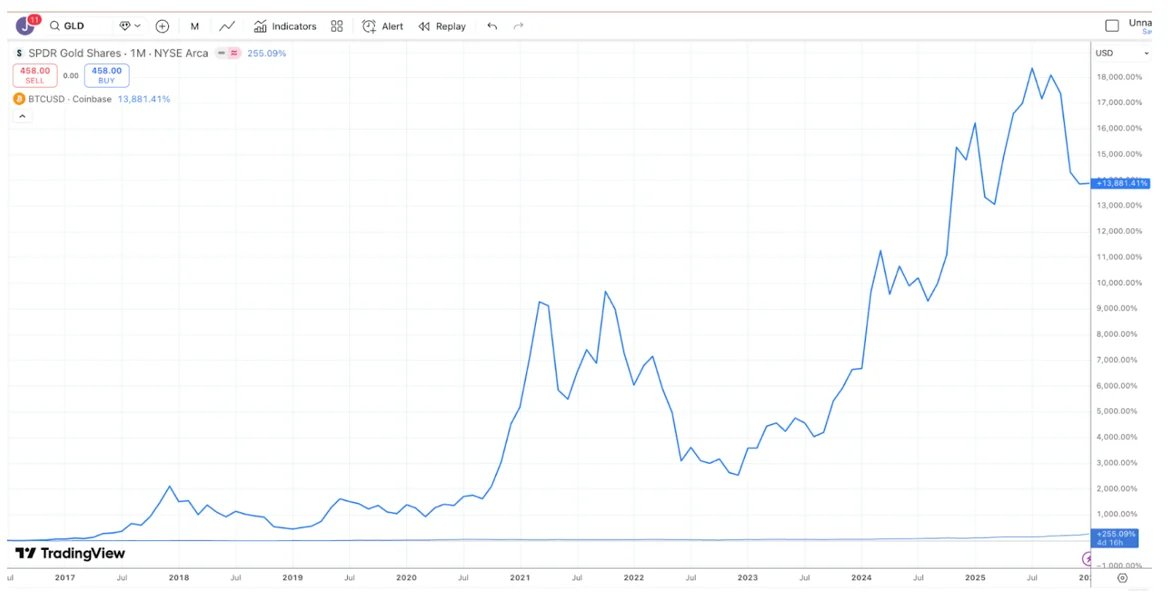
Caption: Source TradingView, comparison of Bitcoin (BTC) vs. gold (GLD) returns over the past 10 years

Gold investors, on the other hand, tend to believe that gold is the best investment and have recently been "mocking" Bitcoin's weakness, as gold has significantly outperformed Bitcoin over the past year (the same goes for silver and copper).
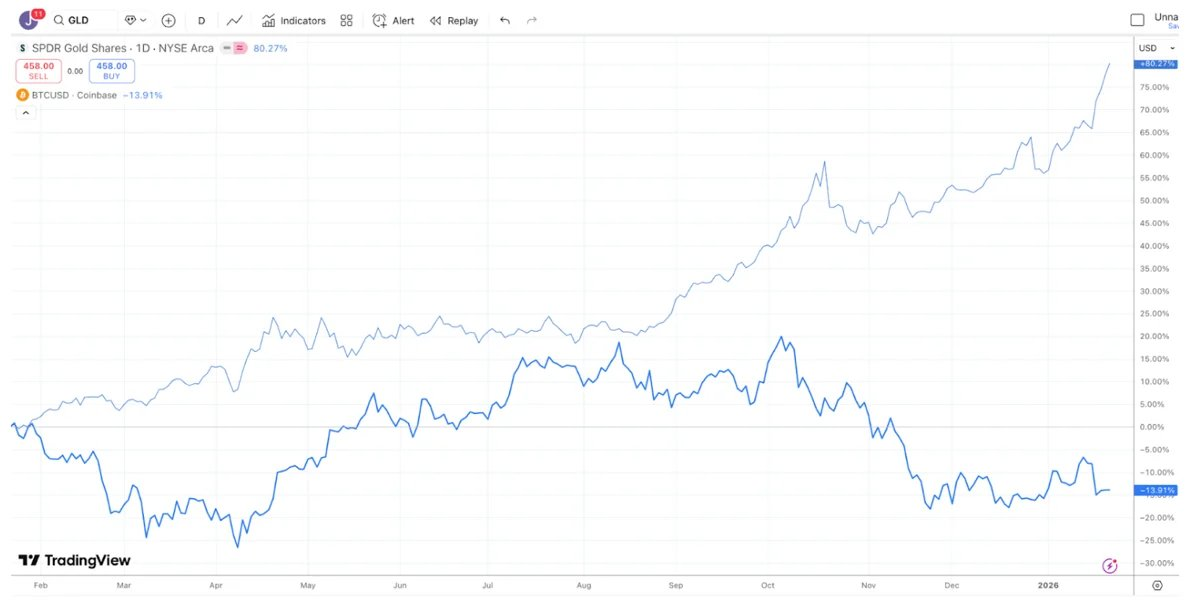
Caption: Source TradingView, comparison of Bitcoin (BTC) vs. gold (GLD) returns over the past 1 year

Meanwhile, over the past 5 years, the returns of gold and Bitcoin have been almost identical. Gold tends to do nothing for long periods, then skyrocket when central banks and trend followers buy; Bitcoin tends to have sharp rallies followed by significant crashes but ultimately moves higher.
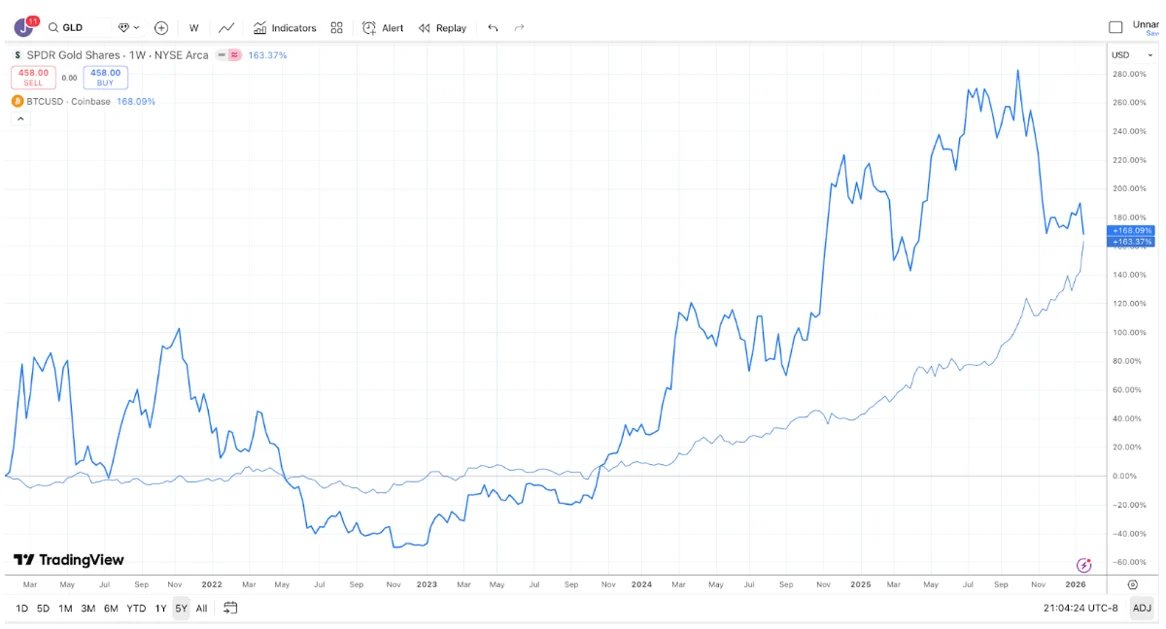
Caption: Source TradingView, comparison of Bitcoin (BTC) vs. gold (GLD) returns over the past 5 years

Therefore, depending on your investment horizon, you can almost win or lose any argument about Bitcoin vs. gold.

Even so, it's undeniable that recently gold (and silver) have shown strength relative to Bitcoin. To some extent, this is somewhat ironic (or pathetic). The largest companies in the crypto industry have spent the past 10 years trying to cater to macro investors rather than true fundamental investors, and now these macro investors are saying, "Never mind, we'll just buy gold, silver, and copper instead." We have long called for a shift in the industry's thinking. There are over $600 trillion in entrusted assets, and the buyers of these assets are a much stickier investor base. There are many digital assets that look more like bonds and stocks, issued by companies that generate revenue and conduct token buybacks, yet market leaders have, for some reason, decided to ignore this token sub-sector.

Perhaps Bitcoin's recent poor performance relative to precious metals will be enough for large brokers, exchanges, asset managers, and other crypto leaders to realize that their attempt to turn cryptocurrencies into an all-encompassing macro trading tool has failed. Instead, they might start focusing on and educating that $600 trillion pool of investors who prefer to buy cash-flow generating assets. It's not too late for the industry to start paying attention to those quasi-equity tokens that carry cash-flow generating tech businesses (like various DePIN, CeFi, DeFi, and token issuance platform companies).

Then again, if you just keep moving the "finish line," Bitcoin is still king. So, more likely than not, nothing will change.

Asset Differentiation

The "good old days" of crypto investing seem like a thing of the past. Back in 2020 and 2021, it seemed like every month brought a new narrative, sector, use case, and new type of token, with positive returns coming from all corners of the market. Although the growth engines of blockchain have never been stronger (thanks to legislative progress in Washington, stablecoin growth, DeFi, and RWA tokenization), the investment environment has never been worse.

A sign of market health is dispersion and low cross-market correlation. You want healthcare and defense stocks to move differently from tech and AI stocks; you want emerging market stocks to move independently of developed markets. Dispersion is generally seen as a good thing.

2020 and 2021 are largely remembered as "everything goes up" markets, but that wasn't entirely true. It was rare to see the entire market move in lockstep. More commonly, one sector would rise while another fell. Gaming surged while DeFi might have been falling; DeFi surged while "Dino" L1 tokens fell; Layer-1s surged while the Web3 sector fell. A diversified crypto portfolio actually smoothed returns and often lowered the overall portfolio's beta and correlation. Liquidity came and went as interest and demand shifted, but performance was diverse. This was very exciting. The massive inflow into crypto hedge funds in 2020 and 2021 made sense because the investable universe was expanding and returns were differentiated.

Fast forward to today, and the returns of all "crypto-wrapped" assets look identical. Since the flash crash on October 10th, the declines across sectors are almost indistinguishable. No matter what you hold, or how the token captures economic value, or what the project's trajectory is... the returns are largely the same. This is very frustrating.
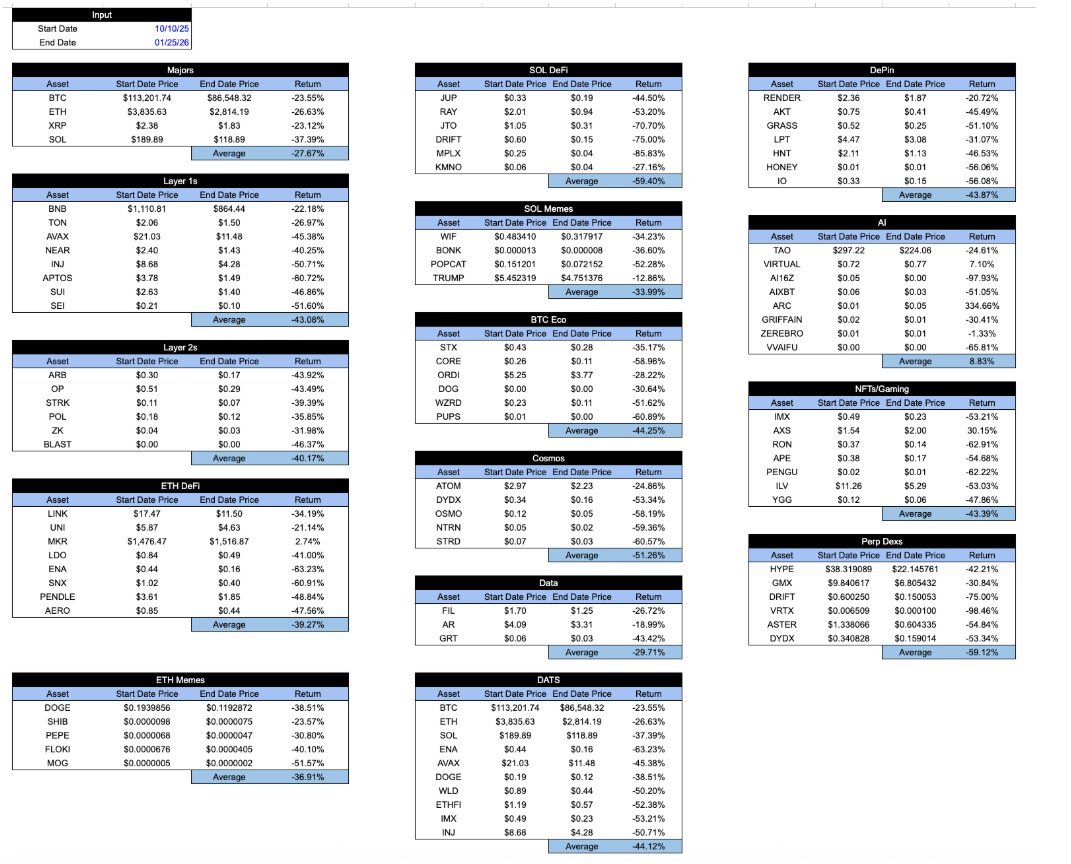
Caption: Arca internal calculations and CoinGecko API data for a sample of representative crypto assets

During market booms, this table looks slightly more encouraging. "Good" tokens tend to outperform "bad" tokens. But a healthy system should actually be the opposite: you want good tokens to perform better during bad times, not just during good times. Here is the same table from the low on April 7th to the high on September 15th.
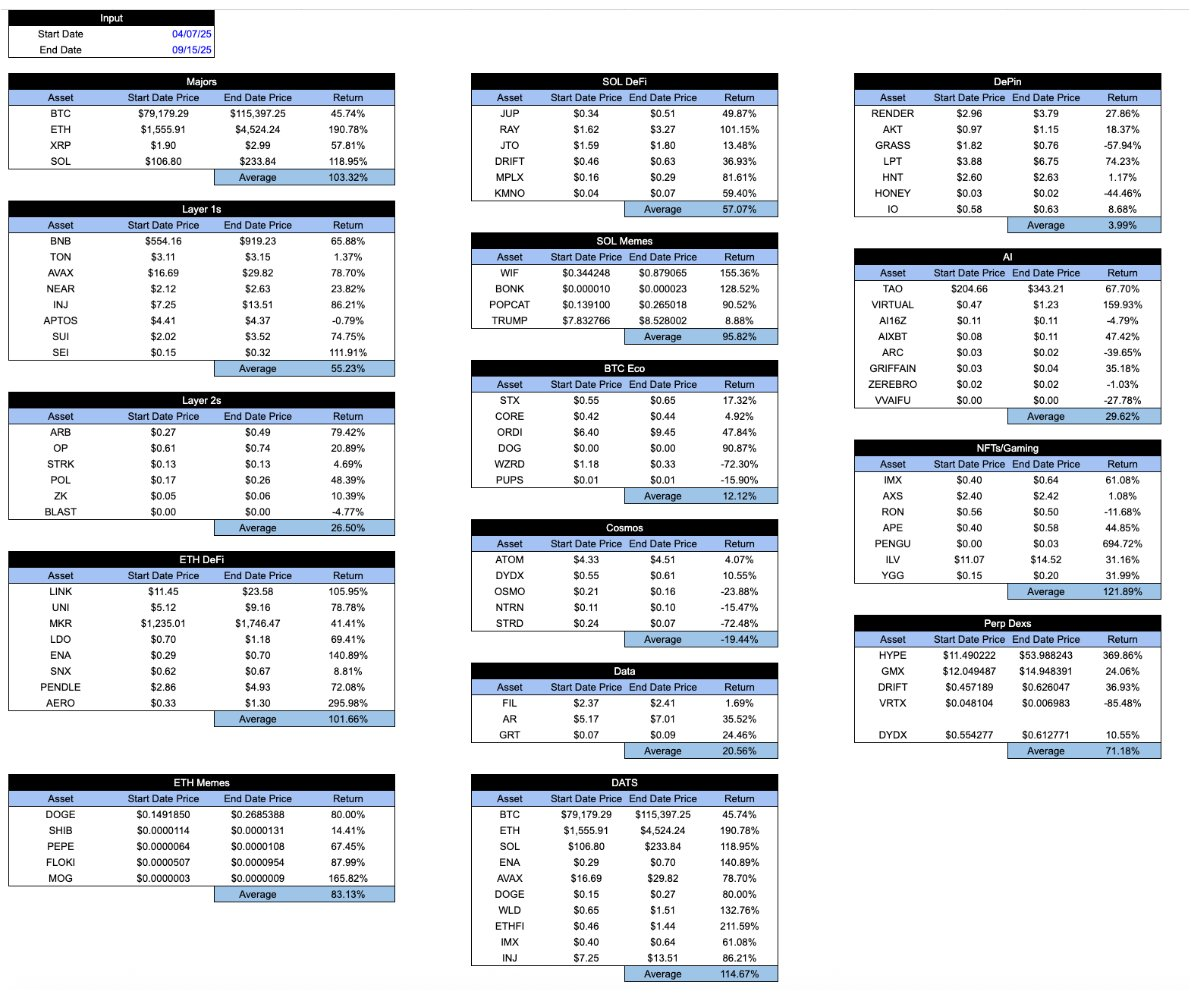
Caption: Arca internal calculations and CoinGecko API data for a sample of representative crypto assets

Interestingly, when the crypto industry was in its infancy, market participants worked very hard to differentiate between different types of crypto assets. For example, I published an article in 2018 where I categorized crypto assets into 4 types:

  1. Cryptocurrencies/money

  2. Decentralized protocols/platforms

  3. Asset-backed tokens

  4. Pass-through securities

At the time, this classification method was quite unique and attracted many investors. Importantly, crypto assets were evolving, from just Bitcoin, to smart contract protocols, asset-backed stablecoins, to equity-like pass-through securities. Researching different growth areas was a major source of alpha, and investors wanted to understand the various valuation techniques required to assess different asset types. Most crypto investors back then didn't even know when unemployment data was released or when FOMC meetings were held, and rarely looked to macro data for signals.

After the 2022 crash, these different types of assets still exist. Nothing has fundamentally changed. But there has been a huge change in how the industry markets itself. The "gatekeepers" decided that Bitcoin and stablecoins were the only things that mattered; the media decided they didn't want to write about anything except TRUMP tokens and other memecoins. Over the past few years, not only has Bitcoin outperformed most other crypto assets, but many investors have even forgotten these other asset types (and sectors) exist. The business models of the underlying companies and protocols haven't become less relevant, but the assets themselves have become more correlated due to investor flight and market makers dominating price action.

This is why Matt Levine's recent article about tokens was so surprising and well-received. In just 4 short paragraphs, Levine accurately described the differences and nuances between various tokens. It gives me some hope that this kind of analysis is still possible.

The leading crypto exchanges, asset managers, market makers, OTC desks, and pricing services still call everything besides Bitcoin an "altcoin" and seem to only write macro research, bundling all "cryptocurrencies" together as one giant asset. Take Coinbase, for example – they seem to have only a very small research team led by one primary analyst (David Duong) whose focus is primarily on macro research. I have nothing against Mr. Bitcoin (Mr. Duong) – his analysis is excellent. But who goes to Coinbase specifically for macro analysis?

Imagine if leading ETF providers and exchanges only wrote generically about ETFs, saying things like "ETFs are down today!" or "ETFs react negatively to inflation data." They would be laughed out of business. Not all ETFs are the same just because they use the same "wrapper," and those selling and promoting ETFs understand this. What's inside the ETF matters most, and investors seem to be able to intelligently differentiate between ETFs, mainly because industry leaders help their clients understand this.

Similarly, a token is just a "wrapper." As Matt Levine eloquently described, what's inside the token matters. The type of token matters, the sector matters, its properties (inflationary or amortizing) matter.

Perhaps Levine isn't the only one who understands this. But he does a better job explaining the industry than those who actually profit from it.


Twitter:https://twitter.com/BitpushNewsCN

Bitpush TG Discussion Group:https://t.me/BitPushCommunity

Bitpush TG Subscription: https://t.me/bitpush

Original link:https://www.bitpush.news/articles/7606655

Trend Kriptolar

İlgili Sorular

QWhy does the author believe the current crypto investment environment is the 'worst ever' despite strong infrastructure and regulation?

AThe author believes the investment environment is poor because all crypto assets have become highly correlated and move in lockstep, eliminating dispersion and differentiation. Market leaders have focused excessively on marketing crypto as a macro tool rather than educating investors about fundamental differences between asset types, causing a loss of alpha opportunities and making diversified portfolios ineffective.

QWhat is the main criticism the author has against crypto industry's attempt to appeal to macro investors?

AThe main criticism is that the industry's attempt to position crypto as a broad macro trading tool has failed, as macro investors are instead choosing traditional assets like gold and silver. The author argues the industry should instead focus on educating the massive $600 trillion pool of investors who prefer cash-flow generating, quasi-equity tokens that resemble stocks and bonds.

QHow does the author contrast the market behavior of 2020-2021 with the current market?

AIn 2020-2021, the market had healthy dispersion where different sectors (e.g., Gaming, DeFi, Layer-1s) moved independently, allowing for diversified portfolios to smooth returns. Today, all crypto assets are highly correlated and move uniformly, regardless of their fundamentals or value capture mechanisms, making the market monotonous and frustrating for investors.

QWhat does the author suggest is the key to improving the investment landscape for crypto assets?

AThe author suggests returning to the essence of tokens as 'securities wrappers' and focusing on fundamental analysis of what is inside the token—such as cash-flow generating businesses in DePIN, DeFi, or token issuance platforms—rather than treating all crypto as a homogeneous macro asset. Industry leaders should educate investors on these nuances.

QWhy does the author reference Matt Levine's article on tokens?

AThe author references Matt Levine's article because it accurately describes the differences and nuances between various token types in just a few paragraphs, highlighting that what matters is the content inside the token wrapper. This gives hope that nuanced analysis is still possible and needed, contrasting with the industry's current homogenized approach.

İlgili Okumalar

After Three Consecutive Quarters of Decline, Can the Crypto Market Find a Window for Stabilization in Q3?

The cryptocurrency market has just concluded its worst-performing quarter since 2022, with total capitalization dropping 12.6% to $2.1 trillion. All core metrics indicate capital is leaving the sector, not just rotating within it. Bitcoin fell 14.2% and Ethereum dropped 25.4% in Q2, breaking their previous correlation with US tech stocks. A key driver is the reversal in US spot Bitcoin ETF flows, which saw a net outflow of approximately $4.67 billion in Q2, including a record monthly outflow near $4.5 billion in June. While recent data suggests long-term holders are accumulating again, sustained ETF outflows mean continued selling pressure. Market focus is now singularly on the Federal Reserve. The upcoming July FOMC meeting is seen as the most critical event for Q3. A dovish signal could support Bitcoin reclaiming a $68,000-$84,000 range, while a hawkish stance might establish a new trading band around $50,000-$56,000. Additionally, regulatory uncertainty persists, with the progress of the crucial *CLARITY Act* stalling in the Senate, reducing its perceived 2026 passage probability to 40-45%. Despite the broad downturn, a few sectors showed growth. Prediction markets saw nominal volume surge 48.7% year-over-year to $113.8 billion, and tokenized collectibles transaction volume rose 143% quarterly to $1.4 billion. The Real-World Asset (RWA) tokenization sector also continued steady growth, now representing ~$28.1 billion in on-chain value. The market's foundation for an extreme crash appears limited, with Bitcoin price hovering near its 200-week moving average. However, the trading paradigm has shifted from narrative-driven speculation to decisions based on price action, policy developments, and interest rate expectations, making a broad sentiment-driven rally unlikely in the near term.

marsbit19 saat önce

After Three Consecutive Quarters of Decline, Can the Crypto Market Find a Window for Stabilization in Q3?

marsbit19 saat önce

BIT Trading Moment: BTC Still Suppressed by Weekly 200 EMA, Rejection May Restart Decline; Storage and Semiconductors that Surged Last Night Begin Falling in Evening Trading

**Crypto & Stock Market Wrap: Bitcoin Tests Resistance, Stocks Retreat After AI Surge** Bitcoin consolidates around $66,000, facing key resistance near $68,000—an area seen as a major psychological and technical hurdle where previous rallies have failed. Analysts note the cryptocurrency is caught between its 200-week moving average (~$63,333) and 200-week EMA (~$68,328). A clear break above $68k is needed to signal a stronger bullish trend, while a rejection could lead to a retest of $63k support. Market sentiment remains cautious, with low futures open interest pointing to a low-liquidity rebound rather than a full bull market. Bitcoin spot ETFs saw another $203 million inflow. US stock futures pointed lower after a strong Tuesday session led by a massive rebound in semiconductors and memory stocks. The rally was fueled by renewed optimism about AI-driven hardware demand, with Micron, SanDisk, and SK Hynix surging. However, those gains reversed in pre-market trading. Super Micro Computer (SMCI) soared over 20% after hours on strong guidance and a record backlog. Other standouts included Rocket Lab and nuclear energy plays Oklo and X-Energy. Rising oil prices (Brent above $91) and climbing Treasury yields (10-year near 4.64%), however, are reigniting inflation concerns and acting as a headwind for equities. In Asia, markets were mixed. South Korea's KOSPI pared early gains to close slightly higher as semiconductor stocks like SK Hynix gave back initial surges. Japan's Nikkei edged lower as the yen hit a fresh 38-year low against the dollar, raising fears of potential market intervention. Key events to watch include the Samsung Galaxy launch, AMD's AI event, and a slew of major tech earnings from Alphabet, Tesla, and IBM after the close on Wednesday, followed by the ECB meeting and Intel's earnings on Thursday.

marsbit20 saat önce

BIT Trading Moment: BTC Still Suppressed by Weekly 200 EMA, Rejection May Restart Decline; Storage and Semiconductors that Surged Last Night Begin Falling in Evening Trading

marsbit20 saat önce

Former CFTC Chairman, Circle President Tarbert: Preaching Long-Termism While Cashing Out $30 Million Himself

Former CFTC Chairman and Circle President Heath Tarbert has consistently advocated for a long-term vision in public, urging patience from investors as Circle’s stock price has fallen significantly from its peak. However, it has been revealed that since Circle’s IPO, Tarbert has continuously sold his CRCL shares through pre-arranged trading plans, cashing out approximately $30 million, without making any public market purchases. This contrast between his public messaging and personal actions has drawn criticism. Tarbert joined Circle in July 2023 as Chief Legal Officer, leveraging his regulatory experience to help guide the company through its IPO and expansion. Despite promoting stablecoins as long-term infrastructure, he established a 10b5-1 trading plan just before Circle went public, leading to substantial stock sales over the following year. In March 2026, he initiated another plan to sell more shares. His career trajectory highlights a pattern of moving between high-level regulatory roles and influential positions in the financial sector. After resigning as CFTC Chairman in early 2021, he joined Citadel Securities as Chief Legal Officer just 27 days later, during a period of intense regulatory scrutiny for the firm. He later joined Circle, aiding its efforts to navigate regulatory challenges for its public listing. While Tarbert's expertise in policy and compliance is valuable to companies like Circle, his actions—advocating long-term confidence while personally divesting—raise questions about the alignment between his public statements and his private financial decisions, leaving investors who followed his advice to bear the market risks.

marsbit20 saat önce

Former CFTC Chairman, Circle President Tarbert: Preaching Long-Termism While Cashing Out $30 Million Himself

marsbit20 saat önce

Gate Research Institute: The 'Wall Street-ization' Wave of Crypto Financial Products – Competition or Integration?

The article titled "Gate Research Institute: Are Crypto Financial Products Sparking a 'Wall Street' Wave—Competition or Convergence?" explores the evolving relationship between the crypto ecosystem and traditional finance (TradFi). The piece begins by reflecting on Bitcoin's original 2009 vision of decentralization, disintermediation, and moving away from banks. It then contrasts this with the 2024 landscape, where key crypto assets like Bitcoin are increasingly held through Wall Street products like ETFs issued by giants like BlackRock. The article questions whether this signifies that TradFi is systematically taking over the rights to issue, price, custody, and distribute crypto financial assets. The core argument is that this is not a zero-sum takeover but rather a bidirectional convergence where each side addresses the other's weaknesses. Crypto offers 24/7 global markets, programmable settlement, and open access but lacks compliant channels, institutional-grade custody, deep fiat liquidity, and mainstream distribution. TradFi possesses these but is constrained by legacy systems, limited operating hours, and slow settlement. Two primary convergence paths are highlighted: * **Path A (CEX to TradFi):** Exemplified by Gate, which has progressed from offering tokenized stocks and CFDs to providing direct, real stock trading (US, Hong Kong, South Korea) within its platform, using USDT. * **Path B (TradFi to Crypto):** Exemplified by Robinhood, which has integrated crypto trading, acquired exchanges like Bitstamp, and is moving traditional assets like stocks onto the blockchain via tokenization and its own Layer 2. Both paths are ultimately competing to become the next-generation, unified financial account—a "super account" where users can seamlessly trade cryptocurrencies, stocks, ETFs, RWA (Real World Assets), and tokenized treasury products in one interface. The growth of RWA and tokenized treasuries (e.g., BlackRock's BUIDL) is presented as the asset-layer fusion, providing stable, yield-bearing assets on-chain and acting as a bridge between the two worlds. In conclusion, the "Wall Street-ization" of crypto is framed as a mutual transformation. Decentralized ideals persist in the protocol layer, while at the application layer, a more efficient, global, and accessible unified capital market is emerging from this convergence. The future competition lies not between crypto exchanges and stockbrokers, but between platforms vying to offer the most comprehensive asset coverage, liquidity, and user experience within a single account.

marsbit20 saat önce

Gate Research Institute: The 'Wall Street-ization' Wave of Crypto Financial Products – Competition or Integration?

marsbit20 saat önce

İşlemler

Spot

Popüler Makaleler

ROCK Nasıl Satın Alınır

HTX.com’a hoş geldiniz! Rock Dao (ROCK) satın alma işlemlerini basit ve kullanışlı bir hâle getirdik. Adım adım açıkladığımız rehberimizi takip ederek kripto yolculuğunuza başlayın. 1. Adım: HTX Hesabınızı OluşturunHTX'te ücretsiz bir hesap açmak için e-posta adresinizi veya telefon numaranızı kullanın. Sorunsuzca kaydolun ve tüm özelliklerin kilidini açın. Hesabımı Aç2. Adım: Kripto Satın Al Bölümüne Gidin ve Ödeme Yönteminizi SeçinKredi/Banka Kartı: Visa veya Mastercard'ınızı kullanarak anında Rock Dao (ROCK) satın alın.Bakiye: Sorunsuz bir şekilde işlem yapmak için HTX hesap bakiyenizdeki fonları kullanın.Üçüncü Taraflar: Kullanımı kolaylaştırmak için Google Pay ve Apple Pay gibi popüler ödeme yöntemlerini ekledik.P2P: HTX'teki diğer kullanıcılarla doğrudan işlem yapın.Borsa Dışı (OTC): Yatırımcılar için kişiye özel hizmetler ve rekabetçi döviz kurları sunuyoruz.3. Adım: Rock Dao (ROCK) Varlıklarınızı SaklayınRock Dao (ROCK) satın aldıktan sonra HTX hesabınızda saklayın. Alternatif olarak, blok zinciri transferi yoluyla başka bir yere gönderebilir veya diğer kripto para birimlerini takas etmek için kullanabilirsiniz.4. Adım: Rock Dao (ROCK) Varlıklarınızla İşlem YapınHTX'in spot piyasasında Rock Dao (ROCK) ile kolayca işlemler yapın.Hesabınıza erişin, işlem çiftinizi seçin, işlemlerinizi gerçekleştirin ve gerçek zamanlı olarak izleyin. Hem yeni başlayanlar hem de deneyimli yatırımcılar için kullanıcı dostu bir deneyim sunuyoruz.

133 Toplam GörüntülenmeYayınlanma 2024.12.13Güncellenme 2026.06.02

ROCK Nasıl Satın Alınır

Tartışmalar

HTX Topluluğuna hoş geldiniz. Burada, en son platform gelişmeleri hakkında bilgi sahibi olabilir ve profesyonel piyasa görüşlerine erişebilirsiniz. Kullanıcıların ROCK (ROCK) fiyatı hakkındaki görüşleri aşağıda sunulmaktadır.

活动图片