Crypto market cap falls to 8-month low, analysts see more pain ahead

cointelegraph2025-12-19 tarihinde yayınlandı2025-12-19 tarihinde güncellendi

Özet

The total crypto market capitalization has fallen to an eight-month low of $2.93 trillion, erasing all gains made this year and declining 33% from its October all-time high. Analysts predict further short-term declines, citing macroeconomic pressures and reduced investor risk appetite. The Bank of Japan’s rate hike to 0.75% added to market uncertainty, though Bitcoin saw a brief 2.3% rise. Social sentiment reflects extreme fear, with the Crypto Fear & Greed Index at 16. Despite the bearish trend, some analysts view the pullback as a potential buying opportunity for fundamentally strong projects, noting that high fear levels historically precede market bounces.

The total crypto market capitalization has fallen to an eight-month low, wiping out all gains this year, as analysts remain bearish in the short-term.

Total market capitalization fell to $2.93 trillion in late trading on Thursday, its lowest level since April, according to CoinGecko.

The total market value of crypto has declined by around 33% since its all-time high of around $4.4 trillion in early October and is down almost 14% since the beginning of this year, prompting many analysts and observers to claim the bear market is underway.

It fell to a 2025 low of $2.5 trillion on April 9 before recovering to all-time highs six months later. The crypto market cap has been largely range-bound since March 2024, and it has now returned to the middle of that range.

Bank of Japan hikes rates

MN Fund co-founder Michaël van de Poppe predicted on Friday that more short-term pain is likely and the trend will continue downward until the Bank of Japan makes its decision on interest rates.

Japan’s central bank raised rates to 0.75% Friday morning, and while some analysts have said this will be bad news for crypto, Bitcoin (BTC) climbed by 2.3%.

Source: Michaël van de Poppe

“Wouldn’t be surprised if BTC continues to cascade and gets itself into a form of capitulation in the next 24 hours, as the trend clearly is down,” van de Poppe said. “That would mean -10/20% move on altcoins, which then should be bouncing quite quickly.”

Pullback presents buying opportunities

The recent decline in total market capitalization “reflects a broader correction driven by macroeconomic pressures and reduced risk appetite among investors,” Nick Ruck, director of LVRG Research, told Cointelegraph.

“While short-term volatility persists, this pullback presents potential accumulation opportunities in fundamentally strong projects as the sector continues to mature and attract institutional capital,” he said.

Social sentiment at rock bottom

Blockchain analytics platform Santiment reported on Friday that crypto sentiment was at fear levels again, with bearish commentary on social media following another minor pump and dump on Thursday.

“Commentary is mainly showing fear after Bitcoin bounced to $90.2K yesterday, and then quickly retraced to $84.8K,” it stated.

Related: Crypto has everything needed for a bull market, so why is the market down?

Santiment noted that historically, it is a strong sign when retail is pushing the bearish narrative harder than the bullish.

“Prices move opposite to the crowd’s expectations, so this volatility, being marked by fear, is a good signal for those who are patient enough to ride this out.”
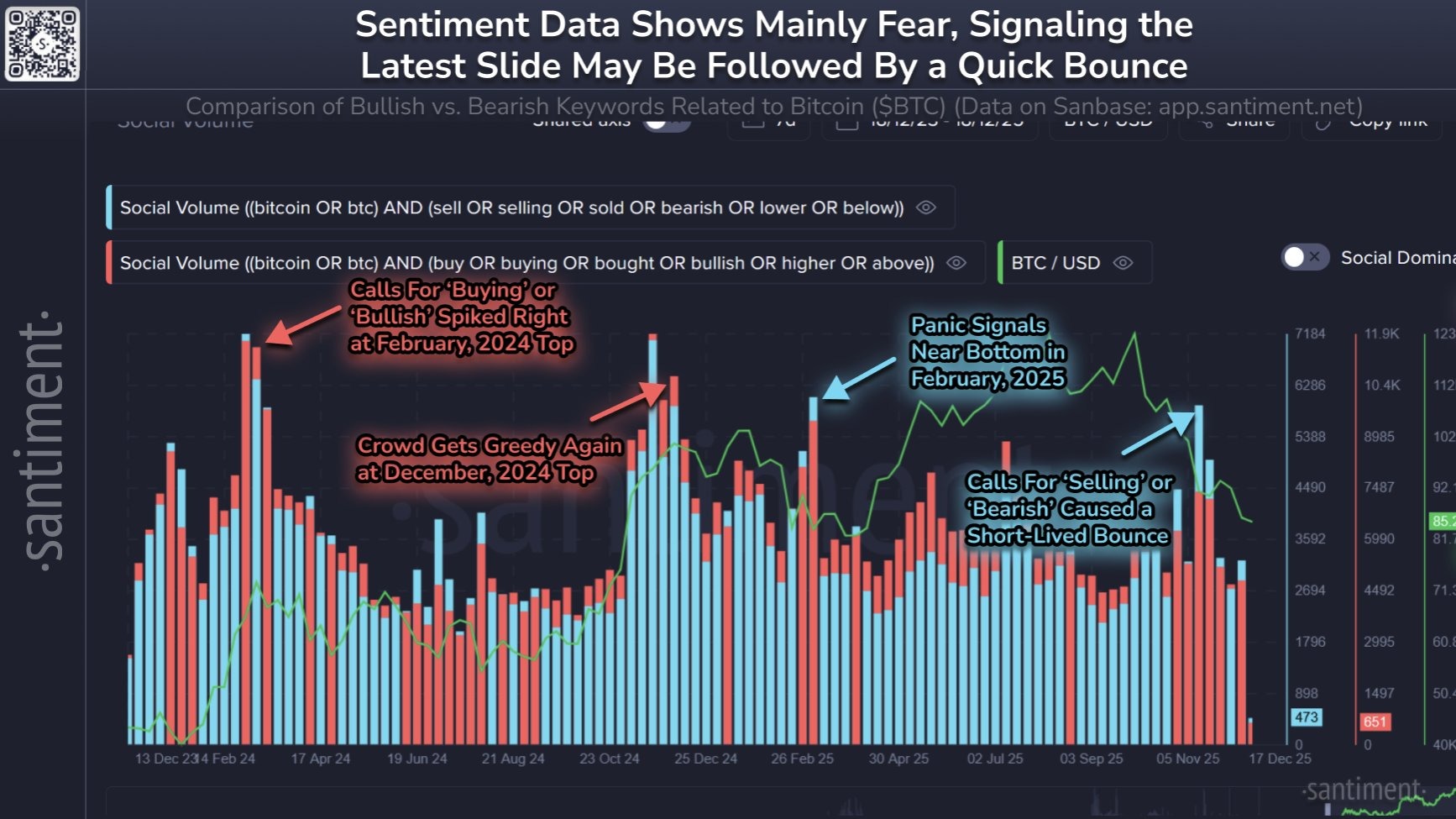
Social sentiment at bear market levels could cause a quick bounce. Source: Santiment


Meanwhile, the crypto Fear & Greed Index was buried at 16, indicating “extreme fear,” and has remained below 30 in “fear” territory since the beginning of November.

Magazine: Bitcoin’s critical level is $82.5K, Ethereum ‘not done yet’: Trade Secrets

İlgili Sorular

QWhat is the current total crypto market capitalization and how does it compare to its all-time high?

AThe total crypto market capitalization has fallen to $2.93 trillion, which is its lowest level in eight months. This represents a decline of around 33% from its all-time high of approximately $4.4 trillion in early October.

QAccording to analysts, what is the primary reason for the recent decline in the crypto market?

AAccording to Nick Ruck of LVRG Research, the decline 'reflects a broader correction driven by macroeconomic pressures and reduced risk appetite among investors.'

QWhat did the Bank of Japan do with interest rates, and how did Bitcoin initially react?

AThe Bank of Japan raised its interest rates to 0.75%. Despite some analysts predicting this would be bad news for crypto, Bitcoin's price initially climbed by 2.3%.

QWhat is the current reading of the crypto Fear & Greed Index, and what does it indicate?

AThe crypto Fear & Greed Index is at a reading of 16, which indicates 'extreme fear.' It has remained below 30, in 'fear' territory, since the beginning of November.

QWhy does analyst Michaël van de Poppe believe the current market fear could be a positive signal?

AVan de Poppe, along with data from Santiment, suggests that prices often move opposite to the crowd's expectations. Therefore, high levels of fear and bearish sentiment can be a strong contrarian indicator and a good signal for patient investors, potentially leading to a quick bounce.

İlgili Okumalar

Bitcoin Withdrawals Continue: 8 Years of Storage in a Coldcard Cold Wallet Ended in Zero

Coldcard Hardware Wallet Hacked: Losses Mount Due to Vulnerable Seed Generation A critical vulnerability in Coldcard hardware wallets has led to a continued wave of fund thefts. According to Galaxy Research, the total stolen has reached 1,367.05 BTC (approx. $88.6 million) from 4,585 addresses, a significant increase from the initial 594.5 BTC reported on July 30, 2026. Most of the stolen funds remain on the attackers' addresses. The issue is not with the current firmware, which Coinkite has updated, but with seed phrases generated on vulnerable devices between March 2021 and the release of fixed firmware versions. Due to a programmer error, devices switched from using a hardware random number generator to the software-based Yasmarang generator, which was initialized with publicly accessible data like the chip's serial number. This made the seed phrases predictable through offline brute-force attacks, meaning wallets remain at risk until funds are moved to a new wallet generated with the patched firmware. Affected devices include Mk2/Mk3 with firmware 4.0.1–4.1.9 (and up to 5.0.3), Mk4/Mk5 up to version 5.6.0, and Q models up to 1.5.0Q. The only exceptions are seeds created with a high-entropy method like at least 50 independent dice rolls or a strong unique BIP-39 passphrase. All other owners must generate a new seed on the fixed firmware and transfer their assets. A case highlighting the human impact involves a 39-year-old long-term investor who lost 2 BTC (approx. $130,000) in minutes. He had accumulated the Bitcoin over eight years through physical labor, viewing it as a financial lifeline and a retirement plan in a country suffering from hyperinflation. His story underscores that even conservative "buy and hold in cold storage" strategies can be compromised by such underlying technical flaws. From a technical perspective, this incident echoes historical failures where weak random number generators undermined cryptographic security, challenging the assumption that offline storage is automatically foolproof.

cryptonews.ru4 saat önce

Bitcoin Withdrawals Continue: 8 Years of Storage in a Coldcard Cold Wallet Ended in Zero

cryptonews.ru4 saat önce

İşlemler

Spot
活动图片





