Crypto market cap falls to 8-month low, analysts see more pain ahead

cointelegraph2025-12-19 tarihinde yayınlandı2025-12-19 tarihinde güncellendi

Özet

The total crypto market capitalization has fallen to an eight-month low of $2.93 trillion, erasing all gains made this year and declining 33% from its October all-time high. Analysts predict further short-term declines, citing macroeconomic pressures and reduced investor risk appetite. The Bank of Japan’s rate hike to 0.75% added to market uncertainty, though Bitcoin saw a brief 2.3% rise. Social sentiment reflects extreme fear, with the Crypto Fear & Greed Index at 16. Despite the bearish trend, some analysts view the pullback as a potential buying opportunity for fundamentally strong projects, noting that high fear levels historically precede market bounces.

The total crypto market capitalization has fallen to an eight-month low, wiping out all gains this year, as analysts remain bearish in the short-term.

Total market capitalization fell to $2.93 trillion in late trading on Thursday, its lowest level since April, according to CoinGecko.

The total market value of crypto has declined by around 33% since its all-time high of around $4.4 trillion in early October and is down almost 14% since the beginning of this year, prompting many analysts and observers to claim the bear market is underway.

It fell to a 2025 low of $2.5 trillion on April 9 before recovering to all-time highs six months later. The crypto market cap has been largely range-bound since March 2024, and it has now returned to the middle of that range.

Bank of Japan hikes rates

MN Fund co-founder Michaël van de Poppe predicted on Friday that more short-term pain is likely and the trend will continue downward until the Bank of Japan makes its decision on interest rates.

Japan’s central bank raised rates to 0.75% Friday morning, and while some analysts have said this will be bad news for crypto, Bitcoin (BTC) climbed by 2.3%.
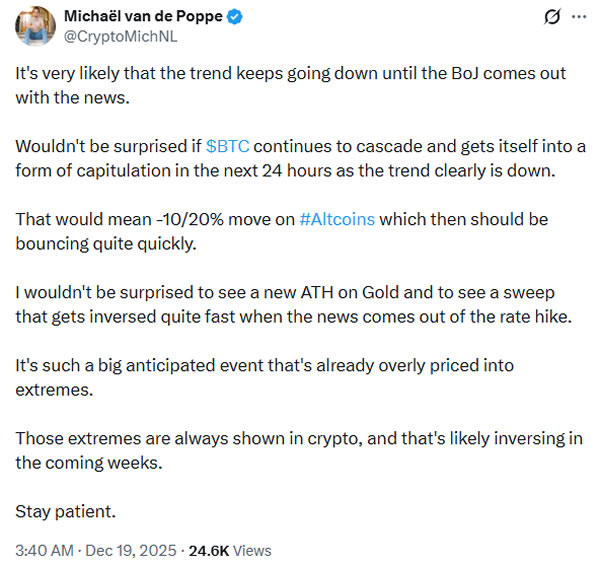
Source: Michaël van de Poppe

“Wouldn’t be surprised if BTC continues to cascade and gets itself into a form of capitulation in the next 24 hours, as the trend clearly is down,” van de Poppe said. “That would mean -10/20% move on altcoins, which then should be bouncing quite quickly.”

Pullback presents buying opportunities

The recent decline in total market capitalization “reflects a broader correction driven by macroeconomic pressures and reduced risk appetite among investors,” Nick Ruck, director of LVRG Research, told Cointelegraph.

“While short-term volatility persists, this pullback presents potential accumulation opportunities in fundamentally strong projects as the sector continues to mature and attract institutional capital,” he said.

Social sentiment at rock bottom

Blockchain analytics platform Santiment reported on Friday that crypto sentiment was at fear levels again, with bearish commentary on social media following another minor pump and dump on Thursday.

“Commentary is mainly showing fear after Bitcoin bounced to $90.2K yesterday, and then quickly retraced to $84.8K,” it stated.

Related: Crypto has everything needed for a bull market, so why is the market down?

Santiment noted that historically, it is a strong sign when retail is pushing the bearish narrative harder than the bullish.

“Prices move opposite to the crowd’s expectations, so this volatility, being marked by fear, is a good signal for those who are patient enough to ride this out.”
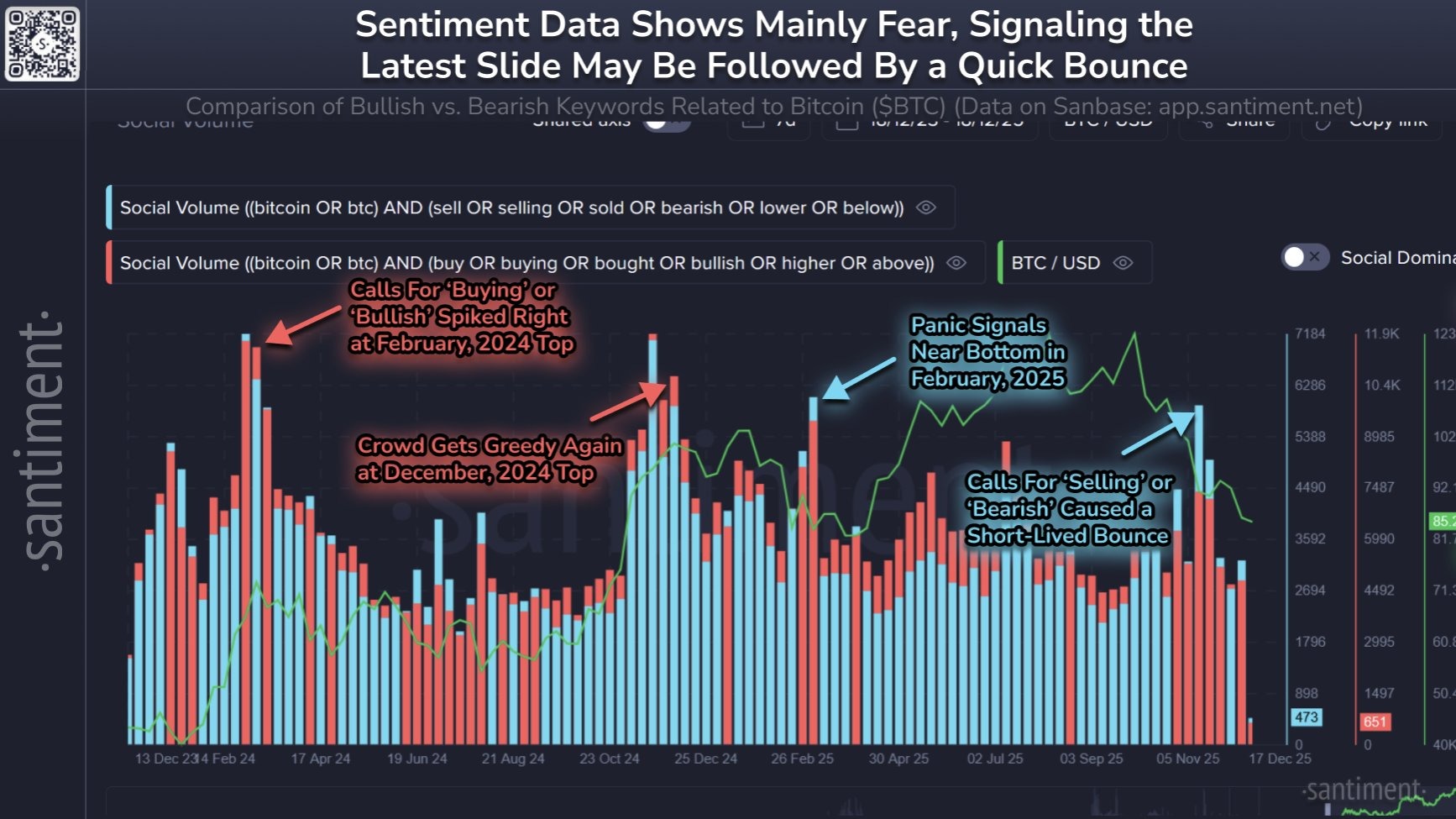
Social sentiment at bear market levels could cause a quick bounce. Source: Santiment


Meanwhile, the crypto Fear & Greed Index was buried at 16, indicating “extreme fear,” and has remained below 30 in “fear” territory since the beginning of November.

Magazine: Bitcoin’s critical level is $82.5K, Ethereum ‘not done yet’: Trade Secrets

İlgili Sorular

QWhat is the current total crypto market capitalization and how does it compare to its all-time high?

AThe total crypto market capitalization has fallen to $2.93 trillion, which is its lowest level in eight months. This represents a decline of around 33% from its all-time high of approximately $4.4 trillion in early October.

QAccording to analysts, what is the primary reason for the recent decline in the crypto market?

AAccording to Nick Ruck of LVRG Research, the decline 'reflects a broader correction driven by macroeconomic pressures and reduced risk appetite among investors.'

QWhat did the Bank of Japan do with interest rates, and how did Bitcoin initially react?

AThe Bank of Japan raised its interest rates to 0.75%. Despite some analysts predicting this would be bad news for crypto, Bitcoin's price initially climbed by 2.3%.

QWhat is the current reading of the crypto Fear & Greed Index, and what does it indicate?

AThe crypto Fear & Greed Index is at a reading of 16, which indicates 'extreme fear.' It has remained below 30, in 'fear' territory, since the beginning of November.

QWhy does analyst Michaël van de Poppe believe the current market fear could be a positive signal?

AVan de Poppe, along with data from Santiment, suggests that prices often move opposite to the crowd's expectations. Therefore, high levels of fear and bearish sentiment can be a strong contrarian indicator and a good signal for patient investors, potentially leading to a quick bounce.

İlgili Okumalar

Bitcoin Mining Farms Are Becoming AI Factories

Bitcoin mines are transforming into AI factories. This shift is driven by the convergence of three key assets from the previous crypto cycle: infrastructure, talent, and capital. Crypto mining companies like Crusoe, CoreWeave, and Bitdeer are repurposing their core competency—securing power, land, and grid connections in remote locations—to build data centers for AI clients. These firms are signing multi-billion dollar, long-term contracts with companies like Anthropic, AWS, and Microsoft, as AI's demand for reliable, high-capacity compute surpasses the profitability of Bitcoin mining. Simultaneously, crypto entrepreneurs and engineers are applying their skills to new AI ventures. Examples include OpenSea's co-founder launching OpenRouter (an AI model aggregator), and former Coinbase engineers building Fal.ai (a generative media infrastructure platform). Their experience in building scalable, global software networks translates effectively to the AI space. Furthermore, capital accumulated during the crypto boom is now fueling AI. Figures like Jed McCaleb (co-founder of Ripple) funded Voltage Park, a large-scale GPU cloud provider. Notably, some crypto investments, like FTX's early bets on Anthropic and Cursor, have generated astronomical paper returns, demonstrating how high-risk crypto capital flowed into AI before it became mainstream. The transition is not just about repurposing hardware, but about redirecting critical resources—power infrastructure, distributed systems expertise, and venture funding—to the next technological frontier: artificial intelligence.

链捕手19 dk önce

Bitcoin Mining Farms Are Becoming AI Factories

链捕手19 dk önce

Morpho Launches Fixed-Rate Product Midnight: Lenders and Borrowers Set Their Own Rates, Ending the Era of Interest Rate Models

Morpho Launches Fixed-Rate Product Midnight: Lenders and Borrowers Set Their Own Rates, Ending the Era of Algorithmic Interest Models On-chain lending has grown to $60 billion but remains minuscule compared to traditional finance's $200 trillion annual credit volume. Morpho identifies the lack of fixed rates and maturity dates as key bottlenecks. Institutions need predictability, not the passive floating rates set by algorithmic models. Midnight allows lenders and borrowers to directly quote rates, set terms, and become price makers, not takers. Fixed-rate lending is now viable due to cheaper, faster blockchains and the entry of institutions demanding control and certainty over returns, costs, and duration. Morpho Blue previously gave users control over risk; Midnight adds control over interest rates. Past attempts at on-chain fixed-rate lending failed primarily because they were built on top of floating-rate pools (creating unpredictability) or lacked sufficient active participants. Midnight avoids these pitfalls as a standalone primitive with fixed rates at its core, built upon Morpho Blue's existing large and active user base. Midnight offers distinct value: institutions gain predictable term structures and full control; fintech companies can offer tailored fixed-rate products; lenders/borrowers achieve predictability and efficiency; and curators can now differentiate by configuring both risk and interest rates. Morpho Midnight is not a replacement for Morpho Blue. The Morpho network will now feature two complementary market structures: floating-rate/open-term (Blue) for flexibility and fixed-rate/fixed-term (Midnight) for predictability. Liquidity can flow between them. The launch will be gradual, prioritizing security. Initially, it will support direct lending on Base network with one trading pair (cbBTC/USDC) and limited maturity dates. Advanced features like auto-rollovers will be introduced later.

marsbit19 dk önce

Morpho Launches Fixed-Rate Product Midnight: Lenders and Borrowers Set Their Own Rates, Ending the Era of Interest Rate Models

marsbit19 dk önce

İşlemler

Spot
活动图片