Crypto Investors Cheer As South Korea Scraps Punishing Tax Plan

bitcoinist2026-03-20 tarihinde yayınlandı2026-03-20 tarihinde güncellendi

Özet

South Korea's main opposition party, the People Power Party, has proposed a bill to abolish the planned 20% tax on cryptocurrency gains, which was scheduled to take effect in 2027. The tax had been repeatedly delayed due to political debates and concerns over fairness, as it imposed a lower threshold compared to stock gains. The proposal aims to integrate crypto income into a unified financial investment tax framework instead of maintaining a separate regime. While this offers short-term relief for investors, the country continues to advance broader crypto regulations, including user protection laws and AI-powered tracking systems, indicating that a more comprehensive and integrated tax environment may still emerge in the future.

South Korean right-wing lawmakers have proposed a bill to abolish the taxation of crypto assets scheduled to take effect on January 1, 2027.

A Long Chain Of Regulation Delays

According to Korean outlet Digital Asset, Korea’s main opposition party the People Power Party is advancing a plan that would effectively abolish the dedicated 20% “crypto tax” by merging virtual‐asset income into a unified financial investment tax framework, instead of enforcing a separate regime just for digital assets.

The proposal comes after multiple postponements. Ruling and opposition parties alternated between promising delays and demanding quick implementation, repeatedly using crypto tax timelines as an election wedge with youth voters. The original 20% tax on gains over roughly ₩2.5 million was pushed from 2022 to 2023, then to 2025, and then again toward 2027 amid political infighting and concerns over investor protection.

The core issue has lays in parity. Crypto gains were set to be taxed at 20% above a very low threshold, while stock gains only paid similar rates above ₩50 million, fueling claims that young, retail‐heavy crypto traders were being unfairly targeted. Song Eon-seok, floor leader of the party and the responsible for introducing the bill, explained:

Given that the financial investment income tax has been abolished for the development of the capital market and the protection of investors, imposing a separate income tax on digital assets raises issues regarding equity and consistency in the tax system.

Kim Han-gyu, senior deputy floor leader for policy of the Democratic Party, responded to the proposal saying that they ruling party will discuss the bill now that it’s been introduced, although “there is no serious discussion or consensus within the party”, local media reported.

South Korea In The Forefront Of Crypto Regulation

South Korea has already rolled out the Virtual Asset User Protection Act and is still fighting over a second‐phase “Virtual Asset Law” covering stablecoins and more comprehensive oversight, underscoring that taxation is only one piece of a much tougher framework.

While many jurisdictions are tightening tax enforcement on digital assets, South Korea is prioritizing regulatory safeguards and market structure first. It’s worth noting, however, that South Korea’s National Tax Service is also moving ahead with a strong AI Crypto Tracking System, as reported by Bitcoinist on March 12.

A more balanced tax design could reduce incentives for Korean traders to move volume offshore or into grey‐area platforms, potentially supporting onshore liquidity and institutional participation. The apparent end of a standalone crypto tax is a short‐term relief, but once the unified financial investment tax kicks in, sophisticated reporting and on‐chain tracing tools mean evasion risks will climb. Active traders should prepare for stricter KYC, better record‐keeping, and the possibility that today’s relief turns into tomorrow’s more robust, integrated tax regime.
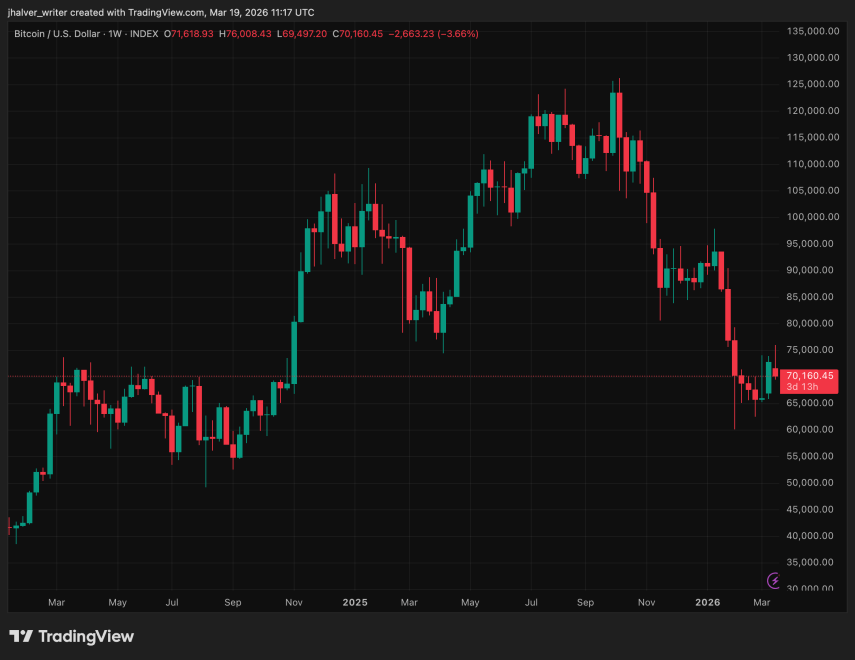
At the moment of writing, BTC’s trades for $70k on the daily chart. Source: BTCUSD on Tradingview

Cover image from Perplexity, BTCUSD chart from Tradingview

İlgili Sorular

QWhat is the main reason South Korean lawmakers are proposing to abolish the dedicated crypto tax?

AThey aim to address issues of equity and consistency in the tax system by merging virtual-asset income into a unified financial investment tax framework, rather than having a separate regime just for digital assets.

QHow many times has the implementation of South Korea's 20% crypto tax been postponed?

AThe tax has been postponed multiple times, originally from 2022 to 2023, then to 2025, and again to 2027.

QWhat was the key disparity between crypto and stock taxation that fueled claims of unfair targeting?

ACrypto gains were set to be taxed at 20% above a very low threshold (around ₩2.5 million), while stock gains only paid similar rates above a much higher threshold of ₩50 million.

QWhat broader regulatory framework is South Korea implementing alongside the tax discussion?

ASouth Korea has rolled out the Virtual Asset User Protection Act and is developing a second-phase 'Virtual Asset Law' covering stablecoins and more comprehensive oversight.

QWhat potential market impact could a more balanced tax design have according to the article?

AIt could reduce incentives for Korean traders to move volume offshore or into grey-area platforms, potentially supporting onshore liquidity and institutional participation.

İlgili Okumalar

Understanding CPO (Co-Packaged Optics) in One Article: Why Nvidia Is Willing to Spend $3.2 Billion on a Fiber?

NVIDIA and Corning announced a multi-year strategic partnership on May 6, 2026, with NVIDIA committing up to $3.2 billion to support Corning's U.S. expansion. This investment will triple Corning's manufacturing plants and significantly boost its optical fiber and communications production capacity. The core driver behind this massive investment is the fundamental shift from copper to optical interconnect technology within AI data centers. As GPU clusters scale, copper wires face critical limitations: severe signal attenuation over distance, high energy consumption for signal integrity, and excessive heat generation. Optical fiber, transmitting light instead of electrical signals, solves these issues with minimal loss, near-light speed, and lower power needs. The article outlines a three-stage evolution of data center interconnect: 1. **Traditional Copper Interconnects:** The mainstream solution of the 2010s, now being phased out due to scaling bottlenecks. 2. **Pluggable Optical Modules:** The current mainstream, where modules convert electrical signals to light externally. This process still introduces energy loss and latency. 3. **CPO (Co-Packaged Optics):** The next-generation technology where the optical engine is integrated directly with the GPU chip package. This drastically reduces the electrical signal travel distance to mere millimeters, slashing power consumption and latency while boosting data density. NVIDIA CEO Jensen Huang has identified CPO as an essential core technology for AI infrastructure. NVIDIA's investment signifies a strategic shift from being a buyer to actively controlling its supply chain for critical components. With demand for specialized optical fiber far outstripping supply—evidenced by soaring prices—securing long-term manufacturing capacity has become a competitive necessity. While Corning's expansion may pressure some suppliers, a projected global fiber supply gap of 5-15% over the next few years creates a significant opportunity window, particularly for Chinese manufacturers competitive in optical preforms, chips, and modules. Ultimately, NVIDIA's move is not about chasing a trend but an engineering imperative. The transition to light-based interconnects like CPO is driven by the physical limits of copper, marking a definitive step in the ongoing AI computing revolution.

marsbit27 dk önce

Understanding CPO (Co-Packaged Optics) in One Article: Why Nvidia Is Willing to Spend $3.2 Billion on a Fiber?

marsbit27 dk önce

KOL's Perspective: Why Is SOL Set to Rise from This Point?

**Summary: Why SOL is Positioned for Growth at This Level** The article argues that SOL is poised for an upward move from its current price point, citing several key factors. Primarily, SOL has just broken out of a 4-month consolidation phase. This breakout signals a return of risk appetite to the broader crypto market, as SOL is seen as a key indicator of overall crypto health. The token's ownership has reportedly shifted from short-term traders and tourists to long-term accumulators, leading to low volume. Any meaningful increase in trading activity could thus trigger significant upward momentum. Fundamental strengths include strong institutional adoption, integration with DeFi and RWAs (Real-World Assets), and the potential benefits from the Clarity Act. Despite its high volatility—having dropped 70% from its all-time high but still up 12x from its bear market low—SOL is highlighted as one of the few tokens from the last cycle to reach new highs. It boasts a robust ecosystem of applications, users, and protocols. Future catalysts include the expected influx of AI developers following the Miami Accelerate conference, which focused on AI on Solana. Furthermore, Solana is positioned as the premier chain for memecoin activity, a trend expected to continue and drive network usage and fees. The article concludes that recent price action reflects a healthy transfer to long-term holders, setting the stage for growth.

marsbit1 saat önce

KOL's Perspective: Why Is SOL Set to Rise from This Point?

marsbit1 saat önce

Those Pre-Bitcoin PoW Protocols Have Recently Been Reimplemented

This article details a recent surge in replicating pre-Bitcoin Proof-of-Work (PoW) protocols, specifically focusing on Hal Finney's 2004 RPOW (Reusable Proofs of Work). Within five days in May 2026, multiple independent builders in the Bitcoin/cypherpunk community launched projects inspired by this early electronic cash proposal. The initiative began with Fred Krueger's `rpow2.com`, a centralized but auditable system that replaced RPOW's original IBM 4758 hardware with Ed25519 signatures. Initially a faithful replica, it later adopted Bitcoin-like features (21M supply cap, difficulty adjustment) and a controversial 5.24% founder allocation. This sparked rapid forks, including `rpow4.com` which incorporated full Bitcoin parameters, a prediction market (`rpowmarket.com`), and a DEX (`rpow2swap.com`). Concurrently, Mike In Space created a prototype of Wei Dai's 1998 b-money proposal (`b-money.replit.app`), pushing the historical exploration even further back. The article contrasts these centralized, server-dependent experiments with Bitcoin's core innovation of decentralized, trustless consensus. It also highlights a parallel development: the `HASH` project on Ethereum, which uses smart contract hooks to enable a purely fair-launch, browser-mineable PoW token with 0% allocations to team or VCs. The collective activity is framed as a meme-driven, educational exploration of cypherpunk history rather than a serious financial movement, with all projects heavily disclaiming any investment value.

marsbit1 saat önce

Those Pre-Bitcoin PoW Protocols Have Recently Been Reimplemented

marsbit1 saat önce

İşlemler

Spot
Futures
活动图片





