Crypto Industry Watches As Poland Advances Long-Delayed Regulatory Bill

bitcoinist2026-05-16 tarihinde yayınlandı2026-05-16 tarihinde güncellendi

Özet

Poland's parliament has passed a long-delayed cryptocurrency regulatory bill, driven by urgency following a fraud scandal at a local exchange. Prime Minister Donald Tusk cited the Zondacrypto case, where users lost access to funds and which had alleged Russian ties, as proof of the need for investor protections. The approved bill grants Poland's Financial Supervision Authority (KNF) broad powers to oversee the market, impose penalties, and block accounts or transactions. However, the legislation faces potential rejection, as it retains contentious account-blocking provisions that led President Karol Nawrocki to veto two prior versions. Critics argue it lacks sufficient judicial oversight. A third veto would prolong regulatory uncertainty as Poland races to align with the EU's MiCA framework by a July deadline. The bill prevailed over three other competing proposals in a parliamentary vote.

Poland’s prime minister has tied the country’s repeated failure to pass crypto rules to a high-profile fraud case — a charge that added urgency to a parliamentary vote that had already failed twice before.

A Scandal Shapes The Debate

Prime Minister Donald Tusk pointed to Zondacrypto, a Polish crypto exchange now under a prosecutor’s fraud probe, as evidence of what happens when investor protections are not in place.

Thousands of the exchange’s users reportedly could not access their funds, and Tusk alleged the platform had ties to Russian capital and influence dating to its early years.

He argued that Poland’s inability to finalize a regulatory framework had slowed any official response to the crisis.

The exchange scandal cast a long shadow over this week’s sitting of the Sejm, Poland’s lower house of parliament, where lawmakers debated four separate crypto bills simultaneously.
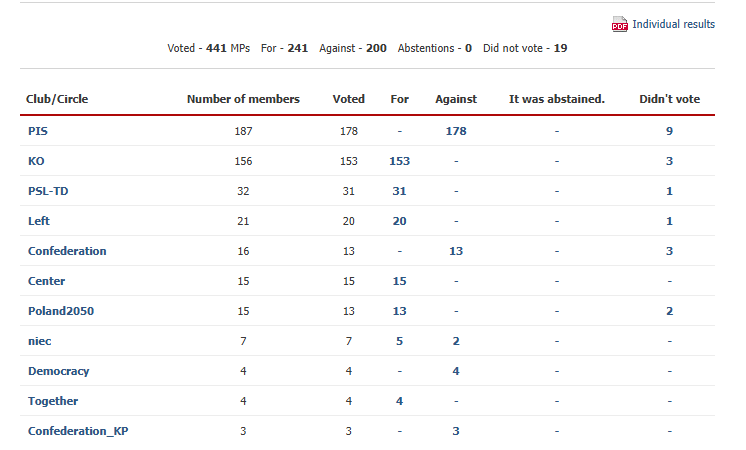
Source: SEJM

On Friday, they approved the government-backed bill — numbered 2529 and supported by the Ministry of Finance — by a vote of 241 to 200. It was the third time the government had pushed this kind of legislation through parliament after President Karol Nawrocki vetoed two earlier versions.

The approved bill hands broad authority to Poland’s Financial Supervision Authority, known as the KNF, to monitor crypto market participants, impose administrative penalties, and block accounts and transactions when deemed necessary.

Critics Point To Unchanged Provisions

Not everyone in the crypto community welcomed the outcome. Market participants and commentators noted that the account and transaction blocking provisions — the same ones that prompted Nawrocki’s previous vetoes — remained largely intact in the final text. Proposed changes such as stronger judicial oversight of enforcement actions were not included.

BTCUSD trading at $79,182 on the 24-hour chart: TradingView

With those concerns unresolved, many observers expect the president to veto the bill again. That prospect worries industry players, since a third rejection would deepen regulatory uncertainty at a particularly inconvenient time.

Poland is required to bring its rules in line with the European Union’s Markets in Crypto-Assets Regulation, known as MiCA, with implementation deadlines approaching in July.

Four Bills, One Outcome

The vote came after lawmakers reviewed competing proposals from four separate sources: the government, the president, the Confederation party, and a parliamentary group. A committee merged the texts before the final vote, and the government version ultimately prevailed.

Featured image from Hotels.com, chart from TradingView

İlgili Sorular

QWhat event did Poland's Prime Minister Donald Tusk link to the need for cryptocurrency regulation?

APrime Minister Donald Tusk linked the need for cryptocurrency regulation to the scandal surrounding the Zondacrypto exchange, which is under a fraud probe, where thousands of users reportedly could not access their funds.

QWhat is the main regulatory body granted authority under the newly passed Polish crypto bill, and what powers does it have?

AUnder the newly passed bill, Poland's Financial Supervision Authority (KNF) is granted broad authority to monitor crypto market participants, impose administrative penalties, and temporarily block accounts and transactions when deemed necessary.

QWhy do critics expect the Polish President to veto the recently passed cryptocurrency bill?

ACritics expect the President to veto the bill because it retains controversial provisions, such as the power to block accounts and transactions without the stronger judicial oversight that was proposed but not included, which were the same reasons for his previous vetoes.

QWhat is the external regulatory deadline that Poland is facing regarding cryptocurrency legislation?

APoland is facing a deadline to align its national rules with the European Union's Markets in Crypto-Assets Regulation (MiCA), with implementation deadlines approaching in July.

QHow many different cryptocurrency bills were debated in the Sejm, and which one was ultimately approved?

ALawmakers debated four separate cryptocurrency bills from different sources: the government, the president, the Confederation party, and a parliamentary group. The government-backed bill (number 2529) was the one ultimately approved after a committee merged the texts for a final vote.

İlgili Okumalar

Claude Code Introduces Dynamic Workflows: Enabling AI to Form Teams and Collaborate

Claude Code introduces dynamic workflows, enabling AI to coordinate teams of specialized agents for complex tasks. This transforms Claude from a code assistant into a programmable workbench. Workflows address key limitations of single-agent systems: agentic laziness (premature task completion), self-preferential bias (favoring own outputs), and goal drift (losing sight of original objectives). The system allows Claude to dynamically create execution frameworks using JavaScript. It can split tasks, dispatch parallel agents for isolated work (e.g., in separate worktrees), implement adversarial validation, run tournaments, and synthesize results. This multi-agent approach is valuable for tasks requiring deep research, factual verification, code migration, root cause analysis, large-scale triage, and qualitative sorting. Key patterns include: classify-and-route, fan-out-and-synthesize, adversarial verification, generate-and-filter, tournaments, and loop-until-done. While token usage is higher, workflows excel where tasks resemble programming—needing problem decomposition, isolated context, hypothesis testing, and handling many details. They extend Claude Code's utility beyond technical work to areas like business plan review, resume screening, and naming brainstorm. The feature is not a universal solution but points to a future where AI tool competitiveness depends on organizing reliable, reusable, and auditable execution flows for complex goals.

marsbit12 dk önce

Claude Code Introduces Dynamic Workflows: Enabling AI to Form Teams and Collaborate

marsbit12 dk önce

Hyperliquid, Wall Street's 24/7 Trading Convenience Store

Hyperliquid: The 24/7 Trading "Convenience Store" for Wall Street Hyperliquid, a decentralized cryptocurrency exchange, has become a go-to platform for Wall Street traders seeking to trade around the clock, especially during traditional market closures. Founded by Jeff Yan, a former quantitative trader, after the FTX collapse, the platform emphasizes user self-custody of assets. It offers a wide range of perpetual contracts—leveraged derivatives with no expiry—on assets from Bitcoin and crude oil to the S&P 500 and even pre-IPO companies like SpaceX. A notable example involves a hedge fund trader who capitalized on geopolitical news over a weekend, securing a 243% return on oil derivatives before markets reopened. The platform, run by just 11 employees, generated approximately $800 million in revenue last year, and its native token HYPE has seen significant growth. Its rise highlights the merging of traditional finance and crypto. While U.S. users are currently restricted, recent CFTC rule changes could open access. The platform is known for its transparency, having processed $10 billion in liquidations during a market crash while competitors faltered. Regulators warn of the high risks and complexity of perpetual contracts for retail investors. Key to its appeal is a strong community culture, direct engagement with founders, and a simple interface. Despite rules against VPN use, it attracts global users with its permissionless approach. Hyperliquid plans to expand into prediction markets and options, aiming to eventually host all financial activity.

marsbit13 dk önce

Hyperliquid, Wall Street's 24/7 Trading Convenience Store

marsbit13 dk önce

Who Funds the Agents?

**Summary: Who Funds AI Agents?** OpenAI recently shut down a feature allowing AI agents to shop for users, highlighting the challenge of creating a secure and regulated environment for agent-driven transactions. While payment infrastructure exists, a crucial governance layer—defining spending limits, fraud detection, tax handling, and return policies—is largely missing. The potential is enormous: AI agents already processed $73M across 176M transactions last year, with McKinsey forecasting this could grow to $3-5T in global consumer commerce by 2030. The core competition isn't just about processing payments, which can be very cheap (especially with crypto-based settlement), but about controlling the rules that govern agent spending. Key players like Stripe and Coinbase are racing to dominate this governance layer. Stripe's acquisition of wallet provider Privy allows it to set spending policies, identity checks, and human-in-the-loop approvals directly at the wallet level. Similarly, Coinbase's stack, including its x402 protocol and AgentKit, embeds governance rules. This vertical integration across settlement, wallet, and governance layers is becoming the dominant strategy. Control over the governance layer is where significant future value lies. If agents handle trillions in transactions, even a small fee for managing compliance, fraud prevention, and policy enforcement could generate billions in annual revenue. The companies that successfully integrate across the payment stack will capture value from idle agent balances, transaction fees, and governance services, positioning themselves as the foundational banks of the AI agent economy.

marsbit40 dk önce

Who Funds the Agents?

marsbit40 dk önce

İşlemler

Spot
Futures

Popüler Makaleler

BILL Nasıl Satın Alınır

HTX.com’a hoş geldiniz! Billions Network (BILL) satın alma işlemlerini basit ve kullanışlı bir hâle getirdik. Adım adım açıkladığımız rehberimizi takip ederek kripto yolculuğunuza başlayın. 1. Adım: HTX Hesabınızı OluşturunHTX'te ücretsiz bir hesap açmak için e-posta adresinizi veya telefon numaranızı kullanın. Sorunsuzca kaydolun ve tüm özelliklerin kilidini açın. Hesabımı Aç2. Adım: Kripto Satın Al Bölümüne Gidin ve Ödeme Yönteminizi SeçinKredi/Banka Kartı: Visa veya Mastercard'ınızı kullanarak anında Billions Network (BILL) satın alın.Bakiye: Sorunsuz bir şekilde işlem yapmak için HTX hesap bakiyenizdeki fonları kullanın.Üçüncü Taraflar: Kullanımı kolaylaştırmak için Google Pay ve Apple Pay gibi popüler ödeme yöntemlerini ekledik.P2P: HTX'teki diğer kullanıcılarla doğrudan işlem yapın.Borsa Dışı (OTC): Yatırımcılar için kişiye özel hizmetler ve rekabetçi döviz kurları sunuyoruz.3. Adım: Billions Network (BILL) Varlıklarınızı SaklayınBillions Network (BILL) satın aldıktan sonra HTX hesabınızda saklayın. Alternatif olarak, blok zinciri transferi yoluyla başka bir yere gönderebilir veya diğer kripto para birimlerini takas etmek için kullanabilirsiniz.4. Adım: Billions Network (BILL) Varlıklarınızla İşlem YapınHTX'in spot piyasasında Billions Network (BILL) ile kolayca işlemler yapın.Hesabınıza erişin, işlem çiftinizi seçin, işlemlerinizi gerçekleştirin ve gerçek zamanlı olarak izleyin. Hem yeni başlayanlar hem de deneyimli yatırımcılar için kullanıcı dostu bir deneyim sunuyoruz.

206 Toplam GörüntülenmeYayınlanma 2026.05.07Güncellenme 2026.06.02

BILL Nasıl Satın Alınır

Tartışmalar

HTX Topluluğuna hoş geldiniz. Burada, en son platform gelişmeleri hakkında bilgi sahibi olabilir ve profesyonel piyasa görüşlerine erişebilirsiniz. Kullanıcıların BILL (BILL) fiyatı hakkındaki görüşleri aşağıda sunulmaktadır.

活动图片