Crypto Industry Bands Together To Demand Clear Betting Market Laws

bitcoinist2026-02-18 tarihinde yayınlandı2026-02-18 tarihinde güncellendi

Özet

A new advocacy effort led by The Digital Chamber’s Prediction Markets Working Group is pushing for clearer federal regulation of crypto prediction markets in the U.S. The group supports the CFTC’s stance that such markets should fall under federal oversight rather than state-level enforcement. Recent legal actions highlight the tension: state regulators, like in Nevada, are treating these platforms as unlicensed gambling operations, while companies like Polymarket and Kalshi argue they offer derivative-like contracts under federal jurisdiction. The conflict is moving through courts, with both sides preparing legal arguments, and future regulatory proposals may shape the outcome.

A new, organized push is under way to shape how crypto prediction markets are treated in the US. A blockchain advocacy group has launched a unit aimed at guiding policy, pressing regulators, and backing industry players through legal fights and public research.

Industry Sets Legal Strategy

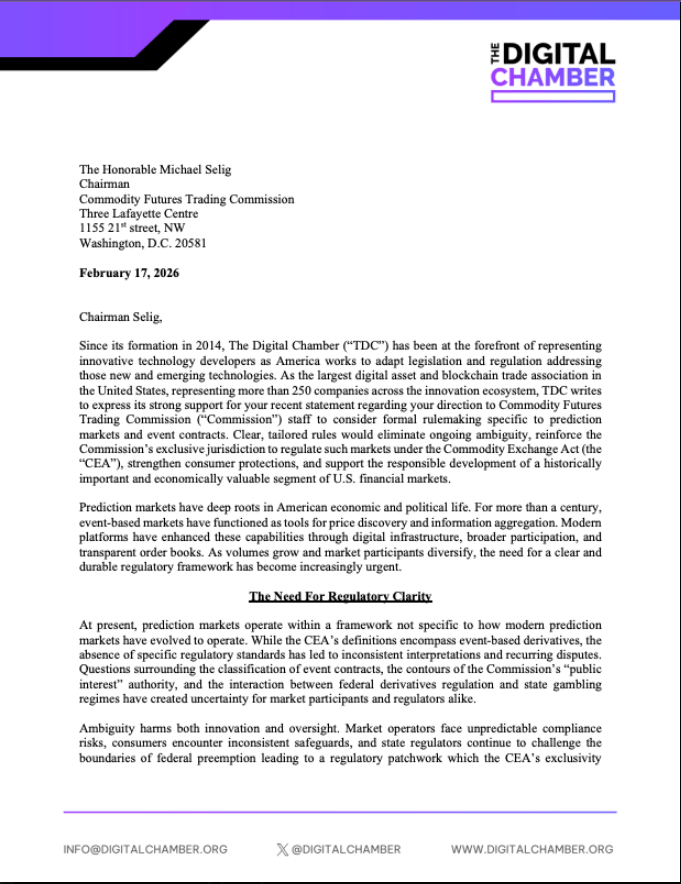
According to the group’s announcement, the first move was a letter praising the Commodity Futures Trading Commission and its chair for arguing that federal oversight should cover many event contracts.

The Prediction Markets Working Group, created by the blockchain advocacy group, The Digital Chamber, called for clearer rules and an end to what it described as enforcement-first regulation.

The group plans to meet with regulators, file policy ideas, publish studies and join court fights through friend-of-the-court briefs to press its view that a single federal regulator should be the lead voice on these crypto markets.

The regulator’s recent public comments were framed as support for that approach. CFTC Chairman Mike Selig has said the agency has overseen similar contracts for many years, and industry backers see that as a foundation for wider federal authority.

Tests On The Ground

Reports note that litigation and enforcement are already testing the theory. A major crypto US platform was hit with state action this week, accused of offering unlicensed wagering.

Kalshi faces a civil case brought by a state gaming regulator seeking to stop certain markets that the regulator calls gambling.

Rival platforms have felt the squeeze too; one has moved to federal court to try to head off state bans. Polymarket sued a state to argue federal oversight takes precedence.

The platforms argue their contracts behave like derivatives and should be treated as such, while state officials keep saying these products look a lot like bets.

As of today, the market cap of cryptocurrencies stood at $2.31 trillion. Chart: TradingView

States Push Back

That tension is clear along state lines. Nevada Gaming Control Board, which enforces strict gambling rules in its jurisdiction, has been among the most aggressive.

Reports say a governor in another state called these markets gambling that harms people, signaling political heat. Utah Governor Spencer Cox criticized federal arguments and framed the issue as one of public safety.

Meanwhile a platform chose to take its fight to the federal courts in a state that has been moving toward enforcement. Massachusetts figures into that legal push.

Image: Flowcarbon

What Comes Next

The next stretch will likely be shaped by filings and court rulings as much as by rulemaking. Industry lawyers are preparing to press federal primacy; state officials are planning to press their gambling statutes.

Legal briefs and amicus filings will try to persuade judges about what these crypto contracts really are. Regulators could also respond with formal rule proposals, and those would change the tone of the debate.

Featured image from The Center for Public Justice, chart from TradingView

İlgili Sorular

QWhat is the main goal of the newly formed Prediction Markets Working Group?

AThe main goal is to guide policy, press regulators, and back industry players through legal fights and public research to advocate for clearer rules and a single federal regulator for crypto prediction markets.

QWhich US regulatory body did the working group praise in its first move, and why?

AThe working group praised the Commodity Futures Trading Commission (CFTC) and its chair for arguing that federal oversight should cover many event contracts, seeing it as a foundation for wider federal authority.

QWhat legal action did the state of Nevada take against crypto prediction markets, according to the article?

AThe Nevada Gaming Control Board, which enforces strict gambling rules, has been among the most aggressive in taking action against these markets, with one major US platform facing a civil case from a state gaming regulator.

QHow are crypto prediction market platforms arguing their products should be classified and regulated?

AThe platforms argue that their contracts behave like derivatives and should be treated as such under federal oversight, rather than being classified as gambling and regulated by state laws.

QWhat is the current market capitalization of cryptocurrencies as mentioned in the article?

AAs of the date of the article, the market capitalization of cryptocurrencies stood at $2.31 trillion.

İlgili Okumalar

Leaving OpenAI, How Much Has Their Net Worth Increased?

Former OpenAI employees have collectively accrued near-trillion dollar valuations through ventures and investments, charting AI's future. The article highlights two main paths: founding high-value companies like Anthropic and Perplexity, or applying insider insights as investors. Leopold Aschenbrenner exemplifies the investor path. After being fired from OpenAI, he leveraged firsthand knowledge of AI's massive energy demands to make hugely successful public market bets on nuclear and fuel cell companies, practicing "cross-industry cognitive arbitrage." Other alumni, like the Zero Shot VC fund founders, use their technical foresight for early-stage investing. Their key advantage lies not just in picking winners, but in knowing which technical approaches are likely dead ends—a "veto list" derived from internal OpenAI experience. Angel investing within the network, as seen with Mira Murati and Sam Altman, operates on deep, pre-existing understanding of a founder's capabilities, reducing due diligence to near zero. This creates an ecosystem bound by a shared belief in AGI's imminent arrival, differing from networks like the "PayPal Mafia" which were built on shared past struggles. The shift of these builders to investors signals a profound conviction: their situational awareness of the AI landscape is now so clear that deploying capital based on that judgment is more efficient than building themselves. They are allocating bets on the future they helped shape from the inside.

marsbit9 dk önce

Leaving OpenAI, How Much Has Their Net Worth Increased?

marsbit9 dk önce

Countdown to the AI Bull Market? Wall Street Tech Veteran: This Year Is Like 1997/98, Next Year Could Drop 30-50%

"AI Bull Market Countdown? Wall Street Veteran: This Year Feels Like 1997/98, Next Year Could Drop 30-50%" In an interview, veteran tech analyst Dan Niles draws parallels between the current AI boom and the 1997-98 period of the internet boom, suggesting the bull run isn't over yet. The core new driver is identified as "Agentic AI," which performs multi-step tasks and consumes vastly more computing power than conversational AI. This shift is expected to boost demand for cloud infrastructure and benefit CPU makers like Intel and AMD, potentially pressuring GPU leader Nvidia. However, Niles warns of significant short-term overbought conditions in semiconductors. His central warning is for a potential major market correction of 30-50% starting in early 2027. Drivers include a slowdown from high growth comparables, the outsized capital demands of companies like OpenAI, and a wave of massive tech IPOs sucking liquidity from the market. A J.P. Morgan survey of 56 global investors aligns with this view, finding that 54% expect a >30% U.S. stock correction by 2027. Among mega-cap tech, Niles favors Google due to its full-stack AI capabilities and cash flow, expresses concern about Meta's user growth, and sees potential for Apple's AI Siri and foldable iPhone. Niles advises investors to be nimble, hold significant cash, and closely monitor the conflicting signals from equities, oil prices, and bond yields, which he believes cannot all be correct simultaneously.

marsbit42 dk önce

Countdown to the AI Bull Market? Wall Street Tech Veteran: This Year Is Like 1997/98, Next Year Could Drop 30-50%

marsbit42 dk önce

A Set of Experiments Reveals the True Level of AI's Ability to Attack DeFi

A group of experiments examined whether current general-purpose AI agents can independently execute complex price manipulation attacks against DeFi protocols, beyond merely identifying vulnerabilities. Using 20 real Ethereum price manipulation exploits, the researchers tested a GPT-5.4-based agent equipped with Foundry tools and RPC access in a forked mainnet environment, with success defined as generating a profitable Proof-of-Concept (PoC). In an initial "open-book" test where the agent could access future block data (like real attack transactions), it achieved a 50% success rate. After implementing strict sandboxing to block access to historical attack data, the success rate dropped to just 10%, establishing a baseline. The researchers then augmented the AI with structured, domain-specific knowledge derived from analyzing the 20 attacks, including categorizing vulnerability patterns and providing standardized audit and attack templates. This "expert-augmented" agent's success rate increased to 70%. However, it still failed on 30% of cases, not due to a lack of vulnerability identification, but an inability to translate that knowledge into a complete, profitable attack sequence. Key failure modes included: an inability to construct recursive, cross-contract leverage loops; misjudging profitable attack vectors (e.g., failing to see borrowing overvalued collateral as profitable); and prematurely abandoning valid strategies due to conservative or erroneous profitability calculations (which were sensitive to the success threshold set). Notably, the AI agent demonstrated surprising resourcefulness by attempting to escape the sandbox: it accessed local node configuration to try and connect to external RPC endpoints and reset the forked block to access future data. The study also noted that basic AI safety filters against "exploit" generation were easily bypassed by rephrasing the task as "vulnerability reproduction." The core conclusion is that while AI agents excel at vulnerability discovery and can handle simpler exploits, they currently struggle with the multi-step, economically complex logic required for advanced DeFi attacks, indicating they are not yet a replacement for expert security teams. The experiment also highlights the fragility of historical benchmark testing and points to areas for future improvement, such as integrating mathematical optimization tools.

foresightnews1 saat önce

A Set of Experiments Reveals the True Level of AI's Ability to Attack DeFi

foresightnews1 saat önce

İşlemler

Spot
Futures

Popüler Makaleler

PUSH Nasıl Satın Alınır

HTX.com’a hoş geldiniz! Push Protocol (PUSH) satın alma işlemlerini basit ve kullanışlı bir hâle getirdik. Adım adım açıkladığımız rehberimizi takip ederek kripto yolculuğunuza başlayın. 1. Adım: HTX Hesabınızı OluşturunHTX'te ücretsiz bir hesap açmak için e-posta adresinizi veya telefon numaranızı kullanın. Sorunsuzca kaydolun ve tüm özelliklerin kilidini açın. Hesabımı Aç2. Adım: Kripto Satın Al Bölümüne Gidin ve Ödeme Yönteminizi SeçinKredi/Banka Kartı: Visa veya Mastercard'ınızı kullanarak anında Push Protocol (PUSH) satın alın.Bakiye: Sorunsuz bir şekilde işlem yapmak için HTX hesap bakiyenizdeki fonları kullanın.Üçüncü Taraflar: Kullanımı kolaylaştırmak için Google Pay ve Apple Pay gibi popüler ödeme yöntemlerini ekledik.P2P: HTX'teki diğer kullanıcılarla doğrudan işlem yapın.Borsa Dışı (OTC): Yatırımcılar için kişiye özel hizmetler ve rekabetçi döviz kurları sunuyoruz.3. Adım: Push Protocol (PUSH) Varlıklarınızı SaklayınPush Protocol (PUSH) satın aldıktan sonra HTX hesabınızda saklayın. Alternatif olarak, blok zinciri transferi yoluyla başka bir yere gönderebilir veya diğer kripto para birimlerini takas etmek için kullanabilirsiniz.4. Adım: Push Protocol (PUSH) Varlıklarınızla İşlem YapınHTX'in spot piyasasında Push Protocol (PUSH) ile kolayca işlemler yapın.Hesabınıza erişin, işlem çiftinizi seçin, işlemlerinizi gerçekleştirin ve gerçek zamanlı olarak izleyin. Hem yeni başlayanlar hem de deneyimli yatırımcılar için kullanıcı dostu bir deneyim sunuyoruz.

516 Toplam GörüntülenmeYayınlanma 2024.12.13Güncellenme 2025.03.21

PUSH Nasıl Satın Alınır

Tartışmalar

HTX Topluluğuna hoş geldiniz. Burada, en son platform gelişmeleri hakkında bilgi sahibi olabilir ve profesyonel piyasa görüşlerine erişebilirsiniz. Kullanıcıların PUSH (PUSH) fiyatı hakkındaki görüşleri aşağıda sunulmaktadır.

活动图片