Crypto Funds See Record Exodus: $1.7 Billion Leaves Market

bitcoinist2026-01-27 tarihinde yayınlandı2026-01-27 tarihinde güncellendi

Özet

Crypto investment products experienced a record weekly outflow of $1.73 billion, the largest since November 2025. The outflows were driven by fading hopes for interest rate cuts, weak price momentum, and crypto's failure to act as a reliable inflation hedge. Major issuers like BlackRock and Fidelity saw significant withdrawals, with the U.S. market accounting for nearly $2 billion of the movement. Bitcoin and Ether funds led the outflows, losing $630 million and $1.10 billion respectively, while some altcoins like Solana saw modest inflows. Despite the sell-off, market confidence appears unsettled rather than broken, with investors shifting strategies rather than fully exiting the market.

Crypto investment vehicles dumped cash last week in a move that startled many market watchers. According to CoinShares, crypto exchange-traded products saw about $1.73 billion of outflows — the largest weekly withdrawal since mid-November 2025.

The pullback came after a recent stretch of inflows, which left some investors caught between hope and caution. Reports say fading hopes for quick interest rate cuts, weak price momentum, and a sense that crypto has not yet played the inflation hedge role many expected helped drive the exit.

Flows Reverse Sharply

Big names felt the hit. BlackRock’s iShares led issuers with roughly $950 million leaving its coffers. Fidelity lost close to $470 million, and Grayscale saw withdrawals near $270 million.

In the regional front, the US accounted for the bulk of the movement, with nearly $2 billion exiting from that market alone.
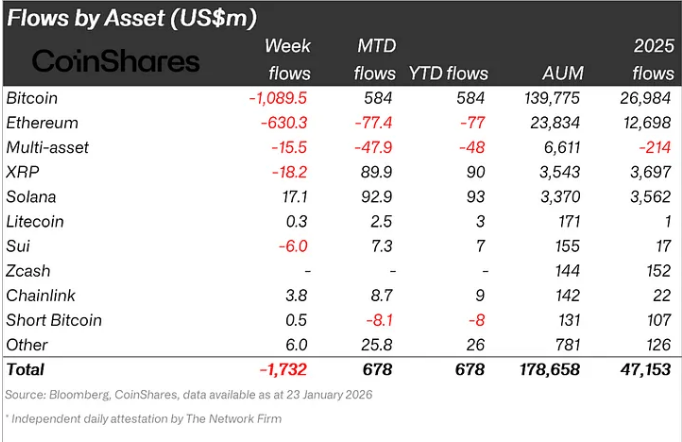
Weekly crypto ETP flows by asset in millions of USD. Source: CoinShares

Some managers did attract fresh capital — groups focused on volatility or niche strategies posted modest gains — showing that investors are shifting tactics rather than abandoning the sector entirely.

Who Pulled Money Out

Bitcoin and Ether were the largest contributors to the outflows. Combined, they comprise most of the $1.73 billion. Based on reports, Ether funds lost roughly $1.10 billion while Bitcoin-focused products shed about $630 million.

Total crypto market cap currently at $2,95 trillion. Chart: TradingView

That split shows a renewed skepticism about large-cap tokens even as traders weigh macro signals. Smaller tokens told a mixed story: Solana drew about $17 million in inflows, while XRP and SUI saw withdrawals of a little over $18 million and $6 million, respectively.

Bitcoin Price Action

Meanwhile, price moves matched the money flow. Bitcoin traded in a choppy range and slipped below $90,000 at one point as risk appetite evaporated. But it did not cave in.

Periodic buying returned, and shorts were put under stress when prices bounced back. Traders are watching macro cues; weakness in sentiment has been paired with bouts of institutional interest, creating a seesaw battle that keeps volatility up.

What This Means For Traders

Market behavior suggests that confidence is unsettled, not totally evaporated. Reports note that investors are recalibrating timeframes and tools. Some are rotating into altcoins that look cheap to them, while others beef up hedges or step back from leveraged positions.

Featured image from Unsplash, chart from TradingView

Trend Kriptolar

İlgili Sorular

QWhat was the total amount of outflows from crypto exchange-traded products last week, and why was it significant?

AThe total outflows were approximately $1.73 billion. This was significant because it marked the largest weekly withdrawal since mid-November 2025.

QWhich three major issuers saw the largest outflows, and how much did each lose?

ABlackRock’s iShares led with about $950 million in outflows, Fidelity lost close to $470 million, and Grayscale saw withdrawals of nearly $270 million.

QAccording to the article, what were the three main factors that helped drive the massive exit from crypto funds?

AThe three main factors were fading hopes for quick interest rate cuts, weak price momentum, and a sense that crypto has not yet played the inflation hedge role many expected.

QWhich two cryptocurrencies were the largest contributors to the outflows, and what were the respective amounts?

ABitcoin and Ether were the largest contributors. Ether funds lost roughly $1.10 billion, while Bitcoin-focused products shed about $630 million.

QDespite the record outflows, what does the market behavior suggest about overall investor confidence?

AThe market behavior suggests that confidence is unsettled but not totally evaporated, as investors are shifting tactics and some are rotating into altcoins or adjusting their strategies rather than abandoning the sector entirely.

İlgili Okumalar

Unlocking $100 Million in Liquidity? Pump.fun's New Policy Tests the 5-Minute Pump Technique

Pump.fun, a popular meme coin launchpad, has introduced a new standard mechanism called BOOST. It aims to address a significant capital efficiency issue: when a newly launched token graduates from its initial bonding curve to a liquidity pool (LP), roughly 20% of its liquidity becomes permanently locked as "dead liquidity," estimated to waste over $100 million annually. Instead of locking these funds permanently, BOOST repurposes them. Upon a token's migration, approximately 20% of the settlement funds (e.g., 17.6 SOL or ~$2516 USDC) are used to buy back the token on the open market over a 5-minute period via a Time-Weighted Average Price (TWAP) mechanism. All purchased tokens are immediately burned. This creates a brief, systematic buy pressure immediately after migration, potentially generating a short-term price surge ("pump") while permanently reducing the token's circulating supply. The goal is to enhance the immediate post-launch trading experience, potentially increasing trader retention and sustainable protocol revenue, which funds ongoing token buybacks. However, concerns exist that this artificial 5-minute boost could lower the barrier for launching low-quality tokens and lead to steeper price crashes once the buy pressure stops, if followed by large sell-offs. The feature automatically applies to tokens migrating after July 21, 2024, but not to previously migrated tokens or those launched via the Mayhem AI Agent lab.

marsbit9 dk önce

Unlocking $100 Million in Liquidity? Pump.fun's New Policy Tests the 5-Minute Pump Technique

marsbit9 dk önce

Podcast Notes | Conversation with GSR Asset Management Head: To Determine if This Crypto Rally is Real, Just Watch the Lending Rates on Aave

Podcast Summary: Dialogue with GSR's Head of Asset Management: To Determine if This Crypto Rally is Real, Just Check Lending Rates on Aave Andy Baehr, Managing Director of Asset Management at GSR, discusses the current crypto market, characterizing it as stuck in a state of "ambivalence" with short-lived, unsustainable rallies. He outlines a simple framework: the market moves between "ambivalence" and "conviction" (sustained upward momentum). Currently, every rally resembles a single-stage rocket booster that quickly fizzles out. Baehr identifies three key signals to watch: 1) DeFi lending rates, 2) the potential passage of the CLARITY Act, and 3) the market forming a consensus on the "Fed hawkish peak." He emphasizes that the most immediate indicator for the sustainability of the recent CPI-triggered rally is the USDC borrowing rate on Aave, currently around 3.75%—close to U.S. Treasury yields. The absence of a credit spread indicates low leverage demand and a lack of market energy. He explains that a healthy, sustained rally requires layered buying pressure. Last year's rally progressed from an ETH short squeeze to crypto-native trader influx and finally to ETF inflows. Currently, this structure is missing. Other potential structural buyers like Digital Asset Treasury (DAT) companies are absent, and ETF flows have proven transient. Baehr notes that while small-cap crypto tokens outperformed large caps in Q2—a potential sign of capitation in major assets—capital is also flowing to more exciting opportunities like AI stocks and tech IPOs, leaving crypto sidelined. Regarding DeFi, he highlights that platforms like Aave provide a clear, real-time signal of leverage demand through their supply/demand-driven interest rates. A significant, sustained rate increase would signal genuine market conviction. He also observes the quiet emergence of fixed-income-like products and vaults in DeFi. On regulation, the probability of the CLARITY Act passing before the August 7th deadline has dropped linearly from 75% to below 40% on Polymarket. Baehr suggests its passage would be treated as a bullish surprise, a potent driver for price movement. However, political hurdles, including ethical clause debates and disclosures about the First Family's crypto profits, remain significant obstacles. Ultimately, the market awaits clarity on the Fed's terminal rate under Chair Warsh. Until the "Fed Solstice"—the point where the market collectively understands the peak of hawkish policy—sustained conviction will be difficult to achieve.

marsbit40 dk önce

Podcast Notes | Conversation with GSR Asset Management Head: To Determine if This Crypto Rally is Real, Just Watch the Lending Rates on Aave

marsbit40 dk önce

İşlemler

Spot

Popüler Makaleler

MOVE Nasıl Satın Alınır

HTX.com’a hoş geldiniz! Movement (MOVE) satın alma işlemlerini basit ve kullanışlı bir hâle getirdik. Adım adım açıkladığımız rehberimizi takip ederek kripto yolculuğunuza başlayın. 1. Adım: HTX Hesabınızı OluşturunHTX'te ücretsiz bir hesap açmak için e-posta adresinizi veya telefon numaranızı kullanın. Sorunsuzca kaydolun ve tüm özelliklerin kilidini açın. Hesabımı Aç2. Adım: Kripto Satın Al Bölümüne Gidin ve Ödeme Yönteminizi SeçinKredi/Banka Kartı: Visa veya Mastercard'ınızı kullanarak anında Movement (MOVE) satın alın.Bakiye: Sorunsuz bir şekilde işlem yapmak için HTX hesap bakiyenizdeki fonları kullanın.Üçüncü Taraflar: Kullanımı kolaylaştırmak için Google Pay ve Apple Pay gibi popüler ödeme yöntemlerini ekledik.P2P: HTX'teki diğer kullanıcılarla doğrudan işlem yapın.Borsa Dışı (OTC): Yatırımcılar için kişiye özel hizmetler ve rekabetçi döviz kurları sunuyoruz.3. Adım: Movement (MOVE) Varlıklarınızı SaklayınMovement (MOVE) satın aldıktan sonra HTX hesabınızda saklayın. Alternatif olarak, blok zinciri transferi yoluyla başka bir yere gönderebilir veya diğer kripto para birimlerini takas etmek için kullanabilirsiniz.4. Adım: Movement (MOVE) Varlıklarınızla İşlem YapınHTX'in spot piyasasında Movement (MOVE) ile kolayca işlemler yapın.Hesabınıza erişin, işlem çiftinizi seçin, işlemlerinizi gerçekleştirin ve gerçek zamanlı olarak izleyin. Hem yeni başlayanlar hem de deneyimli yatırımcılar için kullanıcı dostu bir deneyim sunuyoruz.

333 Toplam GörüntülenmeYayınlanma 2024.12.13Güncellenme 2026.06.02

MOVE Nasıl Satın Alınır

Tartışmalar

HTX Topluluğuna hoş geldiniz. Burada, en son platform gelişmeleri hakkında bilgi sahibi olabilir ve profesyonel piyasa görüşlerine erişebilirsiniz. Kullanıcıların MOVE (MOVE) fiyatı hakkındaki görüşleri aşağıda sunulmaktadır.

活动图片