Crypto funds log second week of inflows after massive $5.5B selloff

cointelegraph2025-12-08 tarihinde yayınlandı2025-12-08 tarihinde güncellendi

Özet

Cryptocurrency investment products recorded their second consecutive week of inflows, attracting $716 million, following a previous week of $1 billion in gains. This marks a recovery after a significant $5.5 billion selloff over four weeks, bringing total assets under management to over $180 billion—an 8% rebound from November lows, though still below the all-time high of $264 billion. Bitcoin led inflows with $352 million, followed by XRP with $244 million. Chainlink saw a record inflow of $52.8 million, representing 54% of its AUM. Ether had minor inflows of $39 million, while short Bitcoin products saw outflows, suggesting reduced negative sentiment. Among issuers, ProShares led with $210 million in inflows, while BlackRock experienced $105 million in outflows. Geographically, the U.S., Germany, and Canada saw the highest inflows, whereas Sweden continued to record outflows.

Cryptocurrency investment products maintained upward momentum last week, logging two consecutive weeks of gains following substantial outflows.

Crypto exchange-traded products (ETPs) attracted $716 million in inflows last week, adding to the previous week’s gains of $1 billion, European crypto asset manager CoinShares reported Monday.

“Daily data highlighted minor outflows on Thursday and Friday in what we believe was a response to macroeconomic data in the US alluding to ongoing inflationary pressures,” CoinShares’ head of research, James Butterfill, said in the update.

The new inflows pushed total assets under management (AUM) above $180 billion, marking an 8% rebound from November lows following $5.5 billion of four-week outflows. However, AUM remains well below its all-time high of $264 billion, Butterfill noted.

Bitcoin leads inflows, Chainlink posts record inflow

Bitcoin (BTC) led crypto ETP gains last week, attracting $352 million in inflows, followed by XRP (XRP) funds with $244 million.

Chainlink (LINK) stood out with a record inflow of $52.8 million, which represented 54% of its AUM.
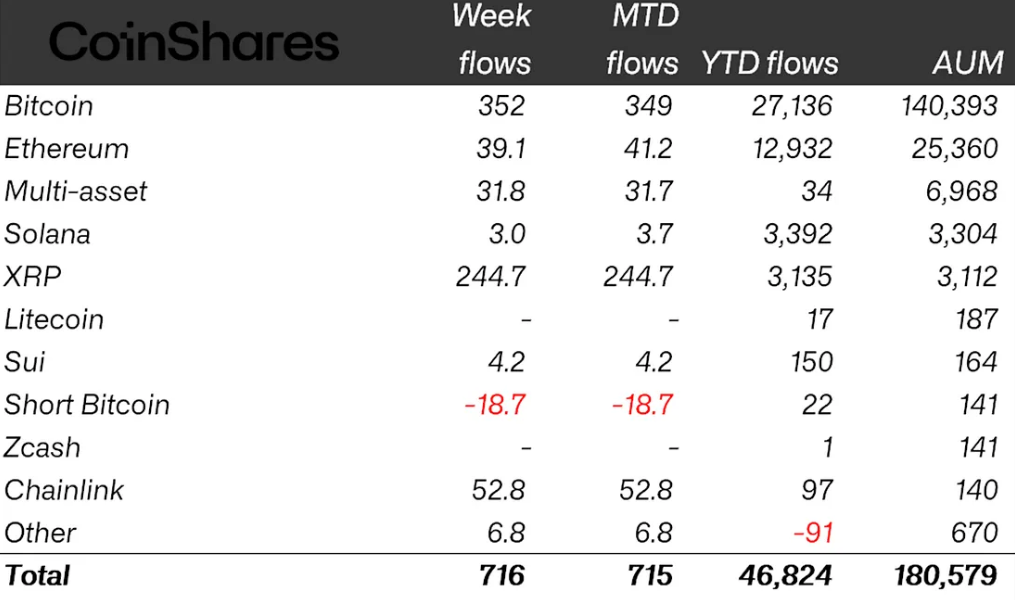
Weekly crypto ETP flows by asset as of Friday (in millions of US dollars). Source: CoinShares

On the other hand, Ether (ETH) funds saw minor inflows of $39 million, while short Bitcoin ETPs posted around $19 million in outflows, potentially indicating a lessening of negative sentiment.

ProShares tops inflows, while BlackRock’s iShares bleeds

Among issuers, ProShares led inflows with $210 million, while BlackRock — the largest issuer by AUM — experienced $105 million in outflows.

Cathie Wood’s ARK and Grayscale Investments also saw outflows, recording $78 million and $7 million, respectively, last week.
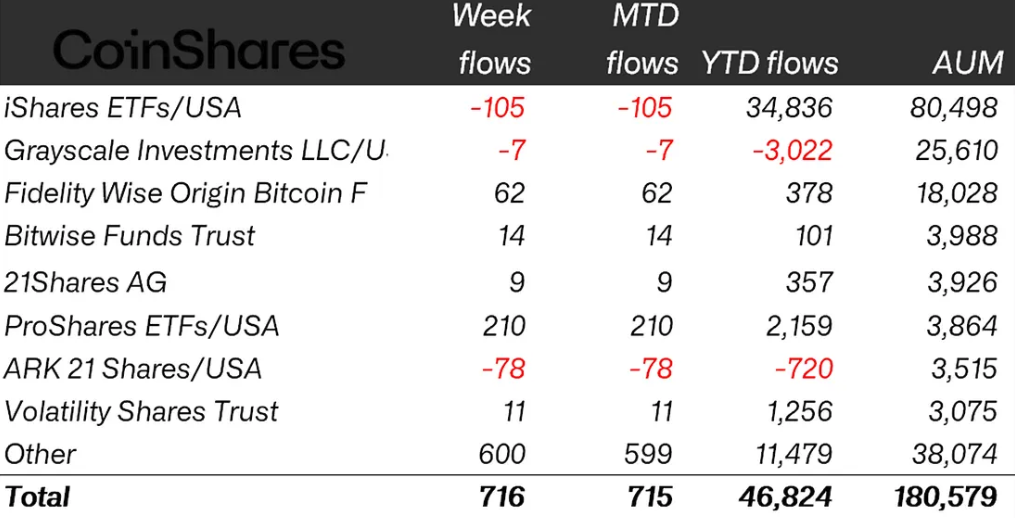
Weekly crypto ETP flows by issuer as of Friday (in millions of US dollars). Source: CoinShares

Geographically, almost all regions globally saw inflows, with the most notable being the US, Germany and Canada, with inflows of $483 million, $97 million and $80.7 million, respectively.

Related: Sweden eyes entering the Bitcoin ‘digital arms race’

On the other hand, Sweden saw $5.6 million in outflows last week, pushing its year-to-date outflows to $836 million, topping global outflows.

Magazine: Koreans ‘pump’ alts after Upbit hack, China BTC mining surge: Asia Express


İlgili Sorular

QWhat was the total amount of inflows into crypto ETPs for the week reported by CoinShares?

ACrypto ETPs attracted $716 million in inflows for the week.

QWhich cryptocurrency fund led the inflows, and how much did it attract?

ABitcoin (BTC) funds led the inflows, attracting $352 million.

QWhich asset manager experienced the largest outflows among the issuers mentioned?

ABlackRock, the largest issuer by AUM, experienced the largest outflows at $105 million.

QWhat record did Chainlink (LINK) funds set according to the report?

AChainlink (LINK) funds posted a record inflow of $52.8 million, which represented 54% of its Assets Under Management (AUM).

QWhat was the primary reason suggested for the minor outflows on Thursday and Friday?

AThe minor outflows were suggested to be a response to US macroeconomic data alluding to ongoing inflationary pressures.

İlgili Okumalar

South Korean Stock Market Sees Sharp Rebound After Forceful De-leveraging, SK Hynix Rises 30%

On July 31, South Korean stocks staged a historic rebound. The benchmark KOSPI index surged 18.27%, with chipmaker SK Hynix hitting a 30% gain limit. This followed a brutal, near-40% decline in the KOSPI over the previous month, driven largely by a deleveraging spiral involving leveraged ETFs. Analysts attributed the sharp sell-off to structural liquidity issues rather than deteriorating corporate fundamentals. The rally was triggered by a confluence of positive catalysts. Firstly, strong earnings from U.S. cloud giants Microsoft and Amazon alleviated fears of an "AI bubble burst," boosting global tech sentiment. Secondly, SK Group Chairman Chey Tae-won made a rare personal purchase of SK Hynix shares, seen as a strong vote of confidence. Thirdly, the South Korean government announced a 20 trillion won ($139 billion) AI investment fund. In response to the market turmoil, South Korean regulators are tightening controls on leveraged ETFs, admitting oversight shortcomings. Measures include raising minimum cash保证金 requirements for散户 investors and suspending new product launches. While the rebound signals eased liquidity pressure, analysts note deep structural issues remain. The market's future stability is seen as dependent on global tech capital expenditure trends and memory chip price cycles, with some viewing the surge as a technical correction rather than a definitive trend reversal.

marsbit14 dk önce

South Korean Stock Market Sees Sharp Rebound After Forceful De-leveraging, SK Hynix Rises 30%

marsbit14 dk önce

Cryptocurrency Company Wintermute Makes Pessimistic Statements Regarding Expected Altcoin Growth! Here are the Details

Crypto market maker Wintermute has made a pessimistic assessment regarding the anticipated altcoin season, suggesting that any upcoming rally may benefit only a limited number of projects. The company reports a record 72% of its spot OTC trading volume in H1 2026 came from institutional clients, whose capital is becoming more selective and concentrated. Data shows institutional traders act quickly on price spikes, while retail interest lasts longer. This selective behavior indicates the classic altcoin season, where hundreds of tokens rise simultaneously, may be changing. Wintermute believes only projects with strong use cases, high liquidity, and institutional appeal will stand out. Supporting this view, CryptoQuant data shows altcoin trading volume against Bitcoin is near its lowest since 2021, with the top 10 altcoins (excluding stablecoins) holding about 80.5% of the total altcoin market cap. Similarly, Kaiko reports that the top 10 altcoins now account for 63% of total altcoin trading volume, up from ~50% a few months ago, indicating capital concentration. Analysts suggest that in the current cautious institutional climate, projects with advanced technology, liquidity, and robust ecosystems will attract disproportionate attention. Therefore, any potential new altcoin season may be less broad than past bull markets, with gains concentrated in a narrower set of promising tokens.

cryptonews.ru14 dk önce

Cryptocurrency Company Wintermute Makes Pessimistic Statements Regarding Expected Altcoin Growth! Here are the Details

cryptonews.ru14 dk önce

UNI Activates Fee Switch: Uniswap Completes Commercial Debut, Faces First Test in September

Uniswap's Fee Switch activation on V4 has driven a surge in protocol revenue, with daily income jumping from $118,000 to $318,000. The newly launched Robinhood Chain has become the primary contributor, accounting for over 52% of total revenue, largely fueled by meme coin trading. This revenue fuels a new tokenomic "flywheel": fees accumulate in a pool, incentivizing arbitrageurs to buy and burn UNI tokens, creating deflationary pressure and boosting the token's price. However, concerns loom beneath the surface. Uniswap's revenue is now highly concentrated and dependent on the speculative, volatile activity on Robinhood Chain, which is currently subsidized by free gas fees. This subsidy is set to expire in late September, posing a significant test for sustained transaction volume and, consequently, protocol revenue. Furthermore, UNI's high valuation faces pressure if growth expectations aren't met. Debate also centers on the Fee Switch's impact. While Uniswap founder Hayden Adams clarified that the protocol fee is an "add-on" for traders and does not cut into Liquidity Providers' (LPs) existing share, questions remain about whether higher overall trading costs could indirectly reduce volume and LP earnings over time. Despite these challenges, Uniswap's Fee Switch marks a major step in protocol monetization, with its long-term success hinging on cultivating more sustainable usage beyond speculative trading.

marsbit23 dk önce

UNI Activates Fee Switch: Uniswap Completes Commercial Debut, Faces First Test in September

marsbit23 dk önce

İşlemler

Spot
活动图片