Crypto Firms Propose Key Stablecoin Concessions To Advance CLARITY Act – Report

bitcoinist2026-02-06 tarihinde yayınlandı2026-02-06 tarihinde güncellendi

Özet

Crypto firms are proposing key concessions to banks in an effort to advance the stalled CLARITY Act, a major US crypto market structure bill. The main point of contention is the treatment of stablecoin rewards. Banks argue that interest-bearing stablecoins threaten the financial system and distort credit creation. In response, crypto companies have offered compromises, such as giving community banks a larger role by having them hold a portion of stablecoin reserves or issue tokens. However, not all parties agree, and it's unclear if these proposals will resolve the dispute. The Senate Banking Committee's draft, which bans interest payments to passive token holders, has faced heavy criticism from crypto leaders who argue it would kill innovation. Recent White House-mediated talks ended without a resolution, but lawmakers remain hopeful a compromise can be reached.

Crypto firms are reportedly stepping up efforts to advance the highly anticipated market structure bill by proposing potential compromises to address some of the banking sector’s concerns on stablecoins.

Crypto Firms Offer Stablecoin Compromises

On Wednesday, Bloomberg reported that multiple crypto companies have been allegedly trying to “win over” banks to salvage the crypto market structure bill, known as the CLARITY Act.

The crypto bill has been stalled in the US Senate for weeks as crypto industry leaders and banks have been unable to reach an agreement on one of the bill’s main topics, stablecoin rewards, in the Senate Banking Committee’s portion of the legislation.

The US banking industry has repeatedly expressed concerns about stablecoin policies, claiming that interest payments will distort market dynamics and affect credit creation in the country. Bank of America CEO Brian Moynihan recently told investors that the banking sector, especially small- and medium-sized businesses, could face significant challenges if Congress does not prohibit interest-bearing stablecoins.

According to people familiar with the matter, industry participants are offering banks new concessions regarding these concerns, as part of their efforts to advance the long-awaited crypto legislation.

For instance, the firms have reportedly proposed giving community banks a larger role in the stablecoin system, allowing them to hold reserves or issue tokens through partnerships. Notably, they suggested requiring stablecoin issuers to maintain a portion of their reserves at community banks.

Not all crypto companies agree with the proposed ideas, Bloomberg sources noted, emphasizing that the two sides haven’t resolved their differences. Moreover, it remains unclear whether the concessions satisfactorily address banks’ concerns. However, it is “a sign that they’re redoubling efforts to keep the market-structure bill moving,” the report added.

The Stablecoin Rewards Dispute

As reported by Bitcoinist, banks have heavily criticized the landmark stablecoin legislation, the GENIUS Act, affirming that it has loopholes that could pose risks to the financial system.

For context, the crypto framework prohibits interest payments on the holding or use of payment-purpose stablecoins but only addresses stablecoin issuers. As a result, banking associations across the US pressed the Senate Banking Committee to add language to the CLARITY Act that also bans digital asset exchanges, brokers, dealers, and related entities.

The Senate Banking Committee published its draft last month, which received heavy backlash from crypto industry leaders for introducing key restrictions for stablecoin issuers.

Under the proposed draft, issuers would be able to offer rewards for specific actions, such as account openings and cashback. Nonetheless, they would be prohibited from providing interest payments to passive token holders. Coinbase’s CEO Brian Armstrong argued that “would kill rewards on stablecoins,” and allow banks to “ban their competition.”

This led to a delay of the Senate Banking Committee’s markup session, initially scheduled for mid-January, and an extended negotiation process between lawmakers and leaders from the two industries.

Earlier this week, the Trump administration oversaw a White House meeting with crypto and banking groups, including PayPal, Ripple, Coinbase, Multicoin, Circle, the American Bankers Association, and the Bank Policy Institute, to ease the regulatory debate.

The negotiation reportedly ended without an agreement on how to address the dispute but led to “constructive discussion on the risks and opportunities of stablecoin yield and rewards.”

Senate Banking Committee Chairman Senator Tim Scott recently affirmed that he is still hopeful the two sides can reach a balance. “We can protect consumers and community banks while still allowing innovation and competition to lower prices and expand access,” he stated. “Both sides are working toward a compromise that keeps innovation here in America.”
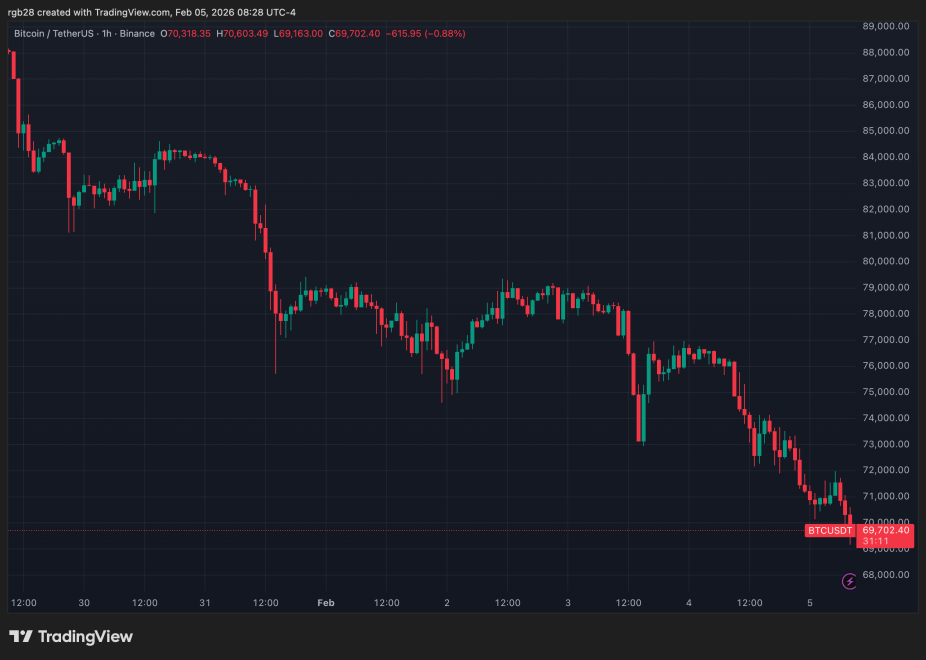
Bitcoin (BTC) trades at $69,702 on the one-week chart. Source: BTCUSDT on TradingView


İlgili Sorular

QWhat is the main purpose of the proposed concessions by crypto firms regarding the CLARITY Act?

AThe main purpose is to address the banking sector's concerns about stablecoins, particularly regarding interest payments, in order to advance the stalled crypto market structure bill and win over banks' support.

QWhat specific compromise did crypto firms propose to involve community banks in the stablecoin system?

ACrypto firms proposed giving community banks a larger role by allowing them to hold reserves or issue tokens through partnerships, and requiring stablecoin issuers to maintain a portion of their reserves at community banks.

QWhy have banks expressed concerns about stablecoin policies, according to Bank of America CEO Brian Moynihan?

ABanks are concerned that interest payments on stablecoins will distort market dynamics and affect credit creation, potentially posing significant challenges to the banking sector, especially small- and medium-sized businesses.

QWhat key restriction in the Senate Banking Committee's draft legislation has drawn criticism from crypto industry leaders like Coinbase's CEO?

AThe draft prohibits stablecoin issuers from providing interest payments to passive token holders, which critics argue would kill rewards on stablecoins and allow banks to ban their competition.

QWhat was the outcome of the recent White House meeting between crypto and banking groups regarding the stablecoin dispute?

AThe meeting ended without an agreement on how to address the dispute but led to a constructive discussion on the risks and opportunities of stablecoin yield and rewards.

İlgili Okumalar

Investors Are Now Hunting for AI Projects on Bilibili and Xiaohongshu

Investors Turn to Bilibili and Xiaohongshu to Source AI Projects The AI hardware boom is in full swing in 2025, with a surge in smart wearables like AI glasses, rings, toys, and companion robots. This frenzy has investors scrambling, not just sifting through business plans, but actively hunting for promising "under-the-radar" projects on youth and tech-enthusiast content platforms like Bilibili and Xiaohongshu. The logic is straightforward: for consumer-facing AI hardware, genuine user demand and potential pitfalls are often revealed earlier in public discussions, comments, and critiques on these communities than in formal pitches. As one industry insider notes, these products must ultimately be tested and understood by real people. This shift highlights a crucial challenge in the sector: user education. The success of AI hardware depends on moving beyond mere efficiency gains to fulfilling higher-order needs like "unleashing personal creativity." Products must convince users they are natural, unobtrusive additions to daily life. Early hype, as seen with devices like the Rabbit R1, often fades if the product fails to clearly solve real-world problems, leading to high return rates and market rejection. The market is now entering a shakeout phase. 2026 is seen as a year of commercial validation. Some projects have already stalled or been canceled due to market resistance, lack of differentiation, or financial woes. However, the long-term opportunity remains vast, with forecasts predicting a multi-trillion dollar global AI hardware market by 2030. The competition is intensifying. With giants like OpenAI and Meta preparing their own hardware, and Chinese companies launching diverse AI-powered products, the battle for user attention, product excellence, and market understanding is just beginning. The core principle endures: in the AI era, it remains a user-sovereign market.

marsbit12 dk önce

Investors Are Now Hunting for AI Projects on Bilibili and Xiaohongshu

marsbit12 dk önce

"Agents' Last Exam", Claude Fable 5 Actually Loses to GPT 5.5

Surprisingly, in the newly released "Agents' Last Exam" (ALE) benchmark from UC Berkeley, GPT-5.5 has outperformed the recently launched and highly-regarded Claude Fable 5. ALE tests AI agents on their ability to perform real-world tasks across 55 professional domains—such as 3D modeling in Siemens NX, creating game scenes in Unreal Engine, and visual effects work in Adobe After Effects—by granting them full GUI and command-line access. In the core task completion rate ranking, GPT-5.5 configurations secured the top two spots (24.0% and 23.0%), while Claude Fable 5 with Claude Code came in third (22.0%). Notably, the highest pass rate was only 24%, and the most difficult "Last-Exam" tier saw most top models, including GPT-5.5 and Fable 5, scoring zero. The benchmark also revealed significant cost and efficiency gaps: Fable 5 spent over four times more money than GPT-5.5's most expensive configuration for a slightly lower score, and was much slower. ALE differs from previous knowledge-based benchmarks by evaluating practical "ability to do" rather than static knowledge retrieval. Its tasks are derived from real expert projects, automatically scored, and designed to prevent cheating through a rotating pool of private challenges. The results suggest that high performance on traditional benchmarks does not necessarily translate to proficiency in complex, open-ended real-world work. The study also notes that agents often fail by prematurely declaring tasks complete without proper verification, and that no single model excels uniformly across all diverse domains.

marsbit18 dk önce

"Agents' Last Exam", Claude Fable 5 Actually Loses to GPT 5.5

marsbit18 dk önce

İşlemler

Spot
Futures
活动图片




