Crypto ETFs Continue to Decline with Major New Outflows

bitcoinist2026-02-02 tarihinde yayınlandı2026-02-02 tarihinde güncellendi

Özet

Crypto ETFs, particularly U.S. spot bitcoin ETFs, are experiencing significant and sustained outflows, with a notable peak of approximately $818 million in net withdrawals on January 29th. This trend reflects a broader tactical pullback by investors amid renewed market volatility and a shift towards risk reduction, coinciding with turbulence in other risk-sensitive assets. While ETFs remain a crucial gateway for institutional crypto access due to their convenience and compliance benefits, their flows have become procyclical—amplifying bullish trends and exacerbating downturns. Meanwhile, the memecoin sector continues to develop actively, with new projects like MAXI Doge emerging. In January, U.S. spot bitcoin ETFs saw an estimated $1.6 billion in net outflows, indicating a more defensive start to the year than anticipated.

After a turbulent start to the year, exchange-traded funds (ETFs) backed by cryptocurrencies continue to record significant outflows. The movement, concentrated on spot Bitcoin ETFs, fuels the idea of a tactical withdrawal by investors in the face of renewed volatility. In this context, the market is watching a key indicator: the ability of ETFs to cushion stress phases, rather than amplify them.

Repeated Outflows from Spot Bitcoin ETFs

Withdrawals have accelerated over several sessions, with a notable peak on January 29, when U.S.-listed spot Bitcoin ETFs recorded approximately $818 million in net outflows, according to data tracked by Farside Investors and cited by market aggregators.
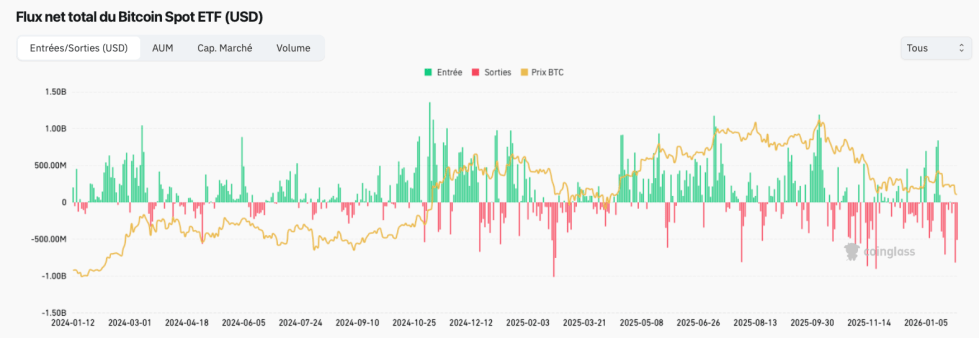
This mechanism is important because net redemptions mean that intermediaries are reducing exposure, which can lead to sales of underlying Bitcoins when shares are destroyed. In other words, the ETF becomes a rapid transition mechanism between market sentiment and the pressure that builds on-chain, especially when leverage deflates across the entire ecosystem.

The concentration of outflows on the largest vehicles is also being scrutinized. Even though major managers like BlackRock, Fidelity, or Grayscale remain structural for institutional access, short-term arbitrage is taking over during correction phases.

A Reduction in On-Chain Risk for Crypto Investors

These outflows are part of a broader climate of risk reduction, where investors are arbitrating towards more liquidity as the trajectory of U.S. monetary policy becomes uncertain again. Movements in Bitcoin and Ether have thus coincided with shocks in other assets deemed riskier, and with renewed nervousness in traditional markets.

Nevertheless, the interpretation remains open. ETFs retain a gateway role, as they simplify ownership, compliance, and portfolio integration. The question is therefore less about their utility and more about the pace, with flows becoming procyclical again, favorable in an upward trend, unfavorable when volatility dominates.

Another factor is the monthly reading. Several market summaries indicate that in January, U.S. spot Bitcoin ETFs would have accumulated approximately $1.6 billion in net outflows, a sign of a more defensive start to the year than expected given the geopolitical context.

Amid ETFs, Memecoins Show No Weakness and Accelerate Development

While ETFs are gaining ground, the world of memecoins is far from buried; on the contrary. The future is being built with new presales, notably MAXI Doge, which aims to do even better than DOGE in 2026. With a TGE approaching at high speed, this new figure in the crypto ecosystem is very promising.

Indeed, the Maxi Doge project features a token called MAXI, presented as a meme-inspired token. Its communication emphasizes a highly speculative identity and a market culture focused on performance. So, is a gain of over 300% within reach? This makes it an asset to watch closely.


This article does not constitute investment advice in any way. The information provided here should not be used as a basis for making financial decisions. Cryptocurrency investments carry risks and can lead to significant losses. You should only invest what you can afford to lose and conduct your own research before making any investment decision.


İlgili Sorular

QWhat is the main trend observed in cryptocurrency ETFs according to the article?

ACryptocurrency ETFs are experiencing significant outflows, particularly spot Bitcoin ETFs, indicating a tactical pullback by investors due to increased market volatility.

QWhat was the peak net outflow amount for US spot Bitcoin ETFs on January 29th?

AUS spot Bitcoin ETFs recorded approximately $818 million in net outflows on January 29th.

QHow does the outflows from ETFs impact the underlying Bitcoin market?

ANet redemptions mean intermediaries are reducing their exposure, which can lead to sales of the underlying Bitcoins when the shares are destroyed, making ETFs a rapid transition tool between market sentiment and on-chain selling pressure.

QWhat broader market context are these crypto ETF outflows a part of?

AThe outflows are part of a broader climate of risk reduction, where investors are moving towards more liquidity as the trajectory of US monetary policy becomes uncertain, coinciding with shake-ups in other risky assets and traditional markets.

QDespite the outflows from ETFs, what other part of the crypto ecosystem is showing strong development?

AThe memecoin sector is not weakening but accelerating its growth, with new projects like MAXI Doge emerging and aiming for high performance, presenting itself as a promising asset to watch.

İlgili Okumalar

Google and Amazon Simultaneously Invest Heavily in a Competitor: The Most Absurd Business Logic of the AI Era Is Becoming Reality

In a span of four days, Amazon announced an additional $25 billion investment, and Google pledged up to $40 billion—both direct competitors pouring over $65 billion into the same AI startup, Anthropic. Rather than a typical venture capital move, this signals the latest escalation in the cloud wars. The core of the deal is not equity but compute pre-orders: Anthropic must spend the majority of these funds on AWS and Google Cloud services and chips, effectively locking in massive future compute consumption. This reflects a shift in cloud market dynamics—enterprises now choose cloud providers based on which hosts the best AI models, not just price or stability. With OpenAI deeply tied to Microsoft, Anthropic’s Claude has become the only viable strategic asset for Google and Amazon to remain competitive. Anthropic’s annualized revenue has surged to $30 billion, and it is expanding into verticals like biotech, positioning itself as a cross-industry AI infrastructure layer. However, this funding comes with constraints: Anthropic’s independence is challenged as it balances two rival investors, its safety-first narrative faces pressure from regulatory scrutiny, and its path to IPO introduces new financial pressures. Globally, this accelerates a "tri-polar" closed-loop structure in AI infrastructure, with Microsoft-OpenAI, Google-Anthropic, and Amazon-Anthropic forming exclusive model-cloud alliances. In contrast, China’s landscape differs—investments like Alibaba and Tencent backing open-source model firm DeepSeek reflect a more decoupled approach, though closed-source models from major cloud providers still dominate. The $65 billion bet is ultimately about securing a seat at the table in an AI-defined future—where missing the model layer means losing the cloud war.

marsbit14 dk önce

Google and Amazon Simultaneously Invest Heavily in a Competitor: The Most Absurd Business Logic of the AI Era Is Becoming Reality

marsbit14 dk önce

Computing Power Constrained, Why Did DeepSeek-V4 Open Source?

DeepSeek-V4 has been released as a preview open-source model, featuring 1 million tokens of context length as a baseline capability—previously a premium feature locked behind enterprise paywalls by major overseas AI firms. The official announcement, however, openly acknowledges computational constraints, particularly limited service throughput for the high-end DeepSeek-V4-Pro version due to restricted high-end computing power. Rather than competing on pure scale, DeepSeek adopts a pragmatic approach that balances algorithmic innovation with hardware realities in China’s AI ecosystem. The V4-Pro model uses a highly sparse architecture with 1.6T total parameters but only activates 49B during inference. It performs strongly in agentic coding, knowledge-intensive tasks, and STEM reasoning, competing closely with top-tier closed models like Gemini Pro 3.1 and Claude Opus 4.6 in certain scenarios. A key strategic product is the Flash edition, with 284B total parameters but only 13B activated—making it cost-effective and accessible for mid- and low-tier hardware, including domestic AI chips from Huawei (Ascend), Cambricon, and Hygon. This design supports broader adoption across developers and SMEs while stimulating China's domestic semiconductor ecosystem. Despite facing talent outflow and intense competition in user traffic—with rivals like Doubao and Qianwen leading in monthly active users—DeepSeek has maintained technical momentum. The release also comes amid reports of a new funding round targeting a valuation exceeding $10 billion, potentially setting a new record in China’s LLM sector. Ultimately, DeepSeek-V4 represents a shift toward open yet realistic infrastructure development in the constrained compute landscape of Chinese AI, emphasizing engineering efficiency and domestic hardware compatibility over pure model scale.

marsbit51 dk önce

Computing Power Constrained, Why Did DeepSeek-V4 Open Source?

marsbit51 dk önce

İşlemler

Spot
Futures
活动图片




