Crypto Criminals In Crosshairs As Chainalysis Partners With South Korean Police

bitcoinist2026-06-11 tarihinde yayınlandı2026-06-11 tarihinde güncellendi

Özet

South Korea's national police have partnered with blockchain analytics firm Chainalysis to strengthen their investigative capabilities against crypto-related crimes. The agreement, formalized through a memorandum of understanding, provides Korean investigators with access to specialized training and certification programs. This collaboration aims to build institutional expertise for tackling a broad spectrum of virtual asset crimes, including money laundering and state-sponsored hacking. The move follows the recent creation of a dedicated multi-agency task force to eradicate crypto-based money laundering. While North Korea-linked crypto theft, which saw massive losses in 2025, is a significant concern, officials emphasize the partnership is designed to enhance overall investigative capacity for handling complex, cross-border crypto crime cases.

South Korea’s national police launched a special multi-agency task force just weeks ago to go after crypto-based money laundering. Now they have a new partner in that fight.

Building Investigative Muscle

Blockchain analytics firm Chainalysis signed a memorandum of understanding with the Korean National Police Agency on Wednesday, a deal aimed at strengthening the KNPA’s ability to investigate virtual asset crimes.

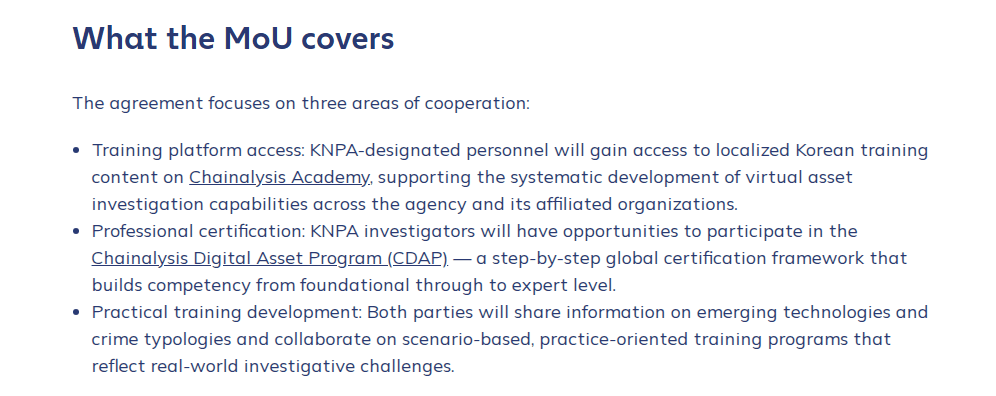
The agreement will give South Korean investigators access to personalized training content, professional certification programs, and hands-on practical instruction developed by Chainalysis.

The partnership comes at a time when North Korea-linked crypto theft has been surging. Data shows that in 2025, hackers tied to the DPRK were responsible for $2 billion in crypto losses — a 51% jump from the year before, according to research from CrowdStrike.

By April of this year, theft attributed to North Korea had already reached close to $580 million, with attacks on Kelp DAO and the Drift Protocol among the largest incidents.

South Korea’s police have been described as being at the forefront of confronting those state-level threats. But Chainalysis country director Ryan Kwon said the MoU is built around a wider purpose than targeting any single adversary.

A Wider Mandate

“While North Korean-driven attacks are understandably a national security focus, this partnership isn’t designed around a single threat,” Kwon said. “It’s fundamentally about building institutional capability.”

Chainalysis has worked alongside South Korean law enforcement before. In September last year, police in Seoul dismantled an international hacking ring that had stolen roughly $30 million.
Source: Chainalysis

The investigation started in South Korea and eventually led authorities to Thailand, with Chainalysis playing a supporting role throughout.

The newly signed agreement builds on that existing relationship. According to Chainalysis, Korean investigators need global visibility into how illicit funds move across blockchains to handle these cases effectively — and that cross-border reach is part of what the training is designed to provide.

BTCUSD trading at $62,044 on the 24-hour chart: TradingView

Casting The Net On Crypto Crime

The MoU follows the May launch of the Money Laundering Eradication Task Force, a multi-agency unit under South Korea’s Economic Crime Investigation Division created specifically to go after crypto-based financial crimes.

The back-to-back moves suggest a deliberate push by South Korean authorities to sharpen their tools against a growing range of threats — from state-sponsored hackers to scams targeting ordinary investors.

Chainalysis said the goal is not just to chase individual cases but to leave the KNPA better equipped long after any single investigation wraps up.

Featured image from Getty Images, chart from TradingView

İlgili Sorular

QWhat is the main purpose of the Memorandum of Understanding signed between Chainalysis and the Korean National Police Agency?

AThe main purpose is to strengthen the KNPA's ability to investigate virtual asset crimes by providing personalized training content, professional certification programs, and hands-on practical instruction developed by Chainalysis.

QAccording to the article, what was the estimated value of crypto losses attributed to North Korea-linked hackers in 2025?

AAccording to research from CrowdStrike, North Korea-linked hackers were responsible for an estimated $2 billion in crypto losses in 2025.

QWhat recent initiative by South Korean authorities does the Chainalysis MoU follow, and what is its focus?

AThe MoU follows the May launch of the Money Laundering Eradication Task Force, a multi-agency unit created specifically to go after crypto-based financial crimes.

QWhat does Chainalysis country director Ryan Kwon say is the fundamental goal of the partnership with the KNPA?

ARyan Kwon states that the partnership is fundamentally about building institutional capability within the KNPA, rather than being designed solely around targeting a single threat like North Korean-driven attacks.

QHow did Chainalysis previously assist South Korean law enforcement, as mentioned in the article?

AChainalysis played a supporting role in an investigation where Seoul police dismantled an international hacking ring that had stolen roughly $30 million, with the investigation starting in South Korea and leading to Thailand.

İlgili Okumalar

In Jinjiang, Fujian, a Storage Super Unicorn Lies Quiet

In Fujian's Jinjiang, a city known for sportswear, lies a quiet semiconductor giant: Fujian Jinhua Integrated Circuit Co. (JHICC). Once a promising domestic DRAM manufacturer alongside Yangtze Memory and ChangXin Memory Technologies (CXMT), its journey was derailed in 2018 when the U.S. placed it on an Entity List and filed criminal charges for alleged trade secret theft. This halted production for years. A turning point came in February 2024 when a U.S. federal court found JHICC not guilty. However, it had lost crucial time. While CXMT soared to become a top-valued A-share company in 2024, JHICC, with an estimated valuation of 80 billion RMB, was just restarting. Its current output is primarily customized DDR4 chips, not the advanced DDR5/HBM demanded for AI, but it still benefits from the broader memory chip upcycle. JHICC's story is tied to Chen Zhengkun, a veteran engineer who left Micron to lead the venture. Founded in 2016 with state-backed funding, JHICC partnered with Taiwan's UMC to develop DRAM technology. Rapid progress was cut short by the U.S. actions, which Micron initiated, partly due to its heavy reliance on the Chinese market. Post-sanctions, Chen's team worked to rebuild the production line with reduced reliance on U.S. technology. According to its records, JHICC achieved small-scale production and revenue growth under immense pressure. It now focuses on the stable "niche" DRAM market (e.g., TVs, routers) with a monthly capacity of ~40,000 wafers, aiming for 60,000 by 2026. It holds over 1,000 patents but remains on the Entity List. For Jinjiang, investing in JHICC was a bold industrial leap. The local government provided unwavering financial and logistical support during the crisis, helping the company survive. JHICC has become the anchor for a growing local semiconductor cluster. Though its scale lags behind domestic peers, JHICC's persistence symbolizes a hard-won foothold in a global market long dominated by Samsung, SK Hynix, and Micron. Having missed one boom, it seeks a place in the new AI-driven memory supercycle.

marsbit18 dk önce

In Jinjiang, Fujian, a Storage Super Unicorn Lies Quiet

marsbit18 dk önce

Must-Watch Events Next Week|CLARITY Act Could Face Senate Vote; SpaceX, Circle to Report Earnings (8.3-8.9)

**Summary: Key Events and Developments to Watch (August 3-9)** The upcoming week is marked by significant financial disclosures, key legislative deadlines, and notable product updates. **Major Financial Events:** Several companies are scheduled to release their Q2 2026 earnings. American Bitcoin (ABTC) will report on August 3, followed by SpaceX and Hut 8 Mining Corp. on August 4, and Circle on August 5. Notably, a significant portion of SpaceX shares (up to 12% of total shares) will be unlocked on August 6 following their earnings release. **Key Legislative Deadline:** The U.S. Senate faces an August 7 deadline to secure 60 votes for the CLARITY Act, a bipartisan bill aiming to establish a federal regulatory framework for cryptocurrencies. The Senate may hold a full vote on the bill during the week. **Economic Data:** The U.S. July Non-Farm Payrolls report will be released on August 7, providing crucial labor market data. **Technology & Product Updates:** * **Shutdowns:** DeFi portfolio tracker Zapper and wallet app Ctrl Wallet will cease operations on August 3. * **Upgrades:** LayerZero will deprecate its v1 relayers on August 3. XRP Ledger's new version 3.3.0, featuring five new functions, is expected next week. * **AI:** Elon Musk announced that the advanced Grok 4.6 AI model is set for release around August 7. * **Bitcoin:** The BIP-110 forced signaling for a potential Bitcoin network change is scheduled to begin around August 8. **Other Notable Events:** Chinese robotics firm Unitree Tech has set its preliminary price inquiry for its IPO for August 5. South Korean exchange Upbit will delist AQT and AERGO tokens on August 3.

marsbit2 saat önce

Must-Watch Events Next Week|CLARITY Act Could Face Senate Vote; SpaceX, Circle to Report Earnings (8.3-8.9)

marsbit2 saat önce

İşlemler

Spot
活动图片





