Crypto Crackdown Intensifies: Canada Revokes 47 Licenses

bitcoinist2026-03-20 tarihinde yayınlandı2026-03-20 tarihinde güncellendi

Özet

Canada's financial regulator FINTRAC has intensified its crackdown on the crypto sector, revoking 47 money services business licenses from crypto-related firms in 2026 alone. This follows earlier major penalties, including a $126 million fine for Cryptomus and a $14 million penalty for KuCoin. Finance Minister François-Philippe Champagne signaled continued strict enforcement, specifically highlighting risks associated with crypto ATMs and money laundering. The move represents a significant shift in Canada's regulatory approach, with FINTRAC strengthening enforcement and using its actions as a public deterrent. The broader context notes that while illicit crypto transactions are estimated at under 1%, the sector faces stricter scrutiny than traditional finance.

Canada’s financial watchdog fined crypto platform Cryptomus $126 million last October after the company allegedly failed to flag suspicious transactions on 1,068 separate occasions in a single month.

A month before that, crypto exchange KuCoin was handed a $14 million penalty for operating in Canada without registering as a foreign money services business.

Those two cases now look like early warnings of what was coming.

In the months since, the Financial Transactions and Reports Analysis Centre — better known as FINTRAC — has revoked 50 money services business registrations in 2026 alone.

Forty-seven of those belonged to crypto-related firms. The latest round, announced Monday, cut 23 registrations in one move.

Finance Minister Signals More Actions On The Way

Finance Minister François-Philippe Champagne called the pace of enforcement “significantly increased” and said the government has no plans to slow down.

“Our government will continue to monitor and pursue new measures to address risks posed by virtual currency businesses, such as cryptocurrency MSBs and crypto ATMs, which can be used to facilitate money laundering and fraud,” he said in a statement Tuesday.
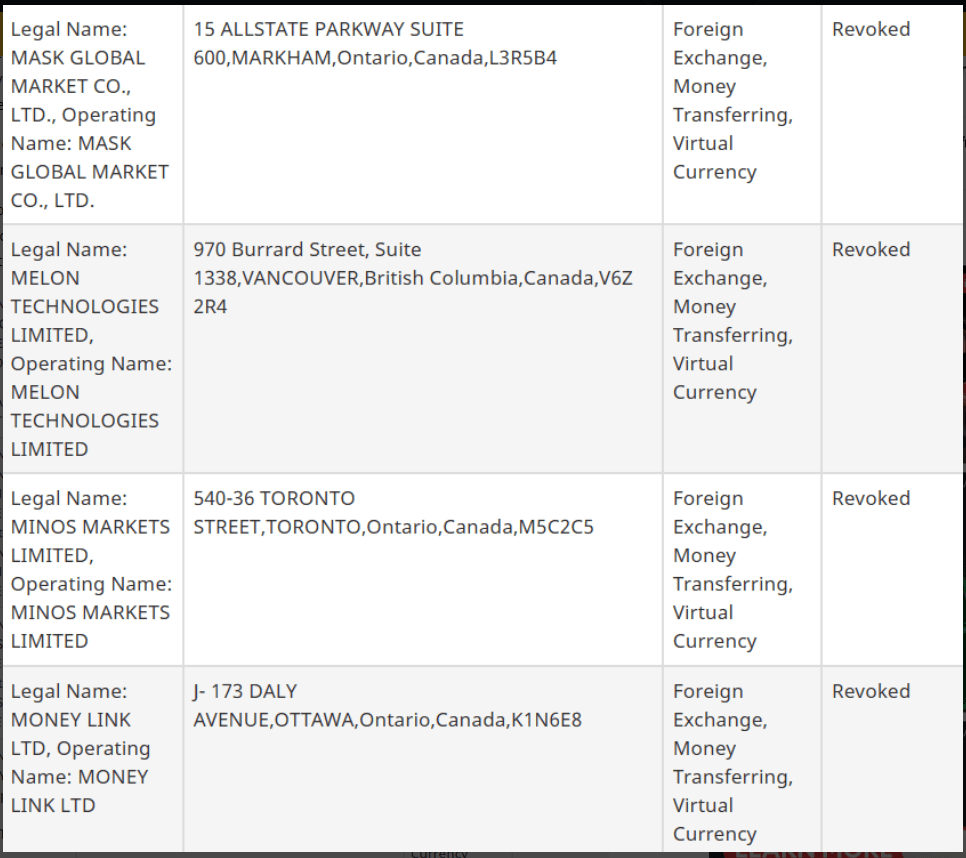
FINTRAC canceled 23 MSB registrations on Monday, according to the agency.

Any business that loses its registration has 30 days to request a review. Some may get reinstated. But the scale of the sweep — nearly 50 revocations in under three months — signals a shift in how Canada is policing the crypto sector.

FINTRAC also said it is strengthening enforcement and increasing transparency around compliance actions, a move that suggests the agency wants its actions to serve as a public deterrent, not just a regulatory cleanup.

Total crypto market cap currently at $2.38 trillion. Chart: TradingView

What The Numbers Say About Crypto And Crime

Canada’s crackdown comes at a time when the relationship between cryptocurrency and illicit finance is still hotly debated.

The Financial Action Task Force estimates that between 2% and 5% of global GDP moves through illegal channels each year — almost entirely through traditional banking systems.

Blockchain analytics firm Chainalysis puts the share of crypto transactions tied to illicit activity at under 1%.

Those figures don’t mean crypto is clean. But they do raise questions about whether the sector is being held to a stricter standard than older financial industries.

For now, Canada appears committed to its current direction. Officials have specifically called out crypto ATMs as a concern, suggesting future enforcement could extend beyond online platforms to physical kiosks scattered across the country.

Businesses that aren’t in full compliance with registration and reporting rules have reason to take that warning seriously.

Featured image from Unsplash, chart from TradingView

İlgili Sorular

QWhat was the total number of money services business registrations revoked by FINTRAC in 2026 alone, and how many of these were crypto-related firms?

AFINTRAC revoked 50 money services business registrations in 2026 alone, and 47 of those belonged to crypto-related firms.

QWhat were the two major enforcement actions taken by Canadian regulators against crypto platforms prior to the recent wave of license revocations?

ACanada's financial watchdog fined crypto platform Cryptomus $126 million for failing to flag suspicious transactions, and crypto exchange KuCoin was handed a $14 million penalty for operating without registering as a foreign money services business.

QAccording to the article, what is the estimated percentage of global GDP that moves through illegal channels each year, and what is the estimated share of crypto transactions tied to illicit activity?

AThe Financial Action Task Force estimates that between 2% and 5% of global GDP moves through illegal channels each year, while blockchain analytics firm Chainalysis puts the share of crypto transactions tied to illicit activity at under 1%.

QWhat did Finance Minister François-Philippe Champagne say about the government's future plans regarding virtual currency businesses?

AFinance Minister François-Philippe Champagne stated that the government will continue to monitor and pursue new measures to address risks posed by virtual currency businesses, such as cryptocurrency MSBs and crypto ATMs, which can be used to facilitate money laundering and fraud.

QWhat specific physical infrastructure, beyond online platforms, did Canadian officials call out as a concern for future enforcement actions?

ACanadian officials specifically called out crypto ATMs as a concern, suggesting future enforcement could extend to these physical kiosks scattered across the country.

İlgili Okumalar

Stuck Polymarket: The Real Test After Riding the Traffic Boom Has Arrived

Polymarket, a leading prediction market platform, is facing significant technical challenges as its growth outpaces its current infrastructure on Polygon. Users are experiencing laggy transactions, unresponsive orders, and delayed confirmations, severely impacting the trading experience. In response, DeFi Engineering VP Josh Stevens outlined a comprehensive engineering overhaul. The plan includes reducing on-chain data delays, fixing order cancellation issues, rebuilding the central limit order book (CLOB), improving website performance, and developing a unified SDK and API. A major revelation was the ongoing "chain migration," indicating a potential move away from Polygon. The core issue is that Polymarket has evolved from a simple prediction market into a high-frequency trading platform, making Polygon's limitations—such as block space, gas fees, and block time—a ceiling for further growth. The migration is not just a simple chain switch but a fundamental rebuild of its trading system to support more complex products like perpetual contracts (Perps). This announcement has sparked competition among chains like Solana, Sui, and Algorand, all vying to host Polymarket. For Polygon, losing this key application, which contributes significantly to its gas fee revenue, would be a major setback. The real test for Polymarket is no longer attracting users but proving it can provide a stable, reliable trading environment that retains them.

Odaily星球日报16 dk önce

Stuck Polymarket: The Real Test After Riding the Traffic Boom Has Arrived

Odaily星球日报16 dk önce

Lowering Expectations for BTC's Next Bull Market

The author, Alex Xu, explains his decision to significantly reduce his Bitcoin holdings (from full to ~30% of his portfolio) during the current bull cycle, citing a lowered long-term outlook for BTC's price appreciation in the next cycle. He outlines six key reasons for this reduced expectation: 1. **Diminished Growth Drivers:** The narrative of exponential user adoption has largely played out with institutional ETF adoption. The next major growth phase—adoption by sovereign national reserves or central banks—seems unlikely in the near future. 2. **Personal Opportunity Cost:** More attractive investment opportunities have emerged in other assets, such as undervalued companies. 3. **Industry-Wide Contraction:** The broader crypto industry is struggling, with most Web3 business models (SocialFi, GameFi, DePIN) failing. This overall萧条 (depression) reduces the fundamental demand and consensus for Bitcoin. 4. **Strain on Major Buyer:** MicroStrategy, a major corporate buyer of BTC, faces rising financing expenses for its debt, which could slow its purchasing rate and create significant marginal pressure on the market. 5. **Increased Competition from Gold:** The emergence of "tokenized gold" has closed the functional gap (portability, divisibility) between physical gold and Bitcoin, offering a strong competitor in the non-sovereign store-of-value space. 6. **Security Budget Concerns:** The block reward halving continues to exacerbate the long-standing issue of funding Bitcoin's network security, with new fee source explorations like Ordinals and L2s largely failing. The author's decision to hold a significant (though reduced) position reflects a cautious, not bearish, outlook. He remains open to increasing his exposure if the fundamental reasons for his skepticism change or if new positive catalysts emerge.

marsbit54 dk önce

Lowering Expectations for BTC's Next Bull Market

marsbit54 dk önce

Can Iran 'Control' the Strait of Hormuz?

Iran has announced a comprehensive plan to assert control over the strategic Strait of Hormuz, a critical global oil shipping chokepoint. The proposed measures include requiring all vessels to obtain Iranian permission for passage, imposing fees for security, environmental protection, and navigation management—preferably paid in Iranian rials—and absolutely banning Israeli ships. Vessels from countries deemed hostile by Iran’s top security bodies may also be barred. Analysts suggest Iran’s motives are multifaceted: increasing pressure on the U.S. and Israel by leveraging control over oil transit to influence global prices and inflation; creating a new revenue stream, potentially exceeding $7.7 billion annually, to counter Western sanctions and support postwar reconstruction; and using transit permissions as bargaining chips in future negotiations, notably with the U.S. However, the plan faces significant practical and diplomatic challenges. Enforcing comprehensive interception and fee collection in the busy waterway, patrolled by international military forces, would be difficult. The U.S. has already countering with a blockade of Iranian ports and threats to intercept any ship paying fees, potentially strangling Iran’s oil exports and fee revenue. Broad international opposition, led by European and Gulf states, and legal controversies further complicate implementation. The proposal may ultimately serve more as a negotiating tactic than a feasible policy, with its execution remaining highly uncertain.

marsbit2 saat önce

Can Iran 'Control' the Strait of Hormuz?

marsbit2 saat önce

İşlemler

Spot
Futures
活动图片