Crypto Continues to Expand in Asia as Thailand Clears Path for Digital Asset Derivatives

bitcoinist2026-02-13 tarihinde yayınlandı2026-02-13 tarihinde güncellendi

Özet

Thailand's Cabinet has approved amendments to the Derivatives Act, allowing digital assets like Bitcoin to serve as underlying instruments for regulated derivatives contracts. The Securities and Exchange Commission (SEC) will update licensing and supervision rules to enable crypto-linked futures and options on platforms such as the Thailand Futures Exchange. This move aims to enhance crypto's recognition as an investable asset class, expand investor access, and improve risk management tools. The reform aligns with Thailand's growing crypto market, valued at $3.19 billion as of August 2025, and supports plans for future crypto ETFs. The SEC will implement safeguards to address volatility and protect investors.

Thailand has taken a further step toward integrating crypto into its mainstream financial system, after the Cabinet approved changes that allow digital assets to underpin regulated derivatives contracts. The move positions the country among a growing number of Asian markets adapting crypto-linked financial products.

On Feb. 10, Thailand’s Cabinet endorsed a Finance Ministry proposal to expand the scope of assets permitted under the Derivatives Act B.E. 2546 (2003). The amendment enables digital assets, including cryptos such as Bitcoin, to serve as underlying instruments for futures and options traded on regulated platforms.

The Securities and Exchange Commission (SEC) will now amend the Derivatives Act and draft supporting regulations to govern participation, licensing, and supervision.
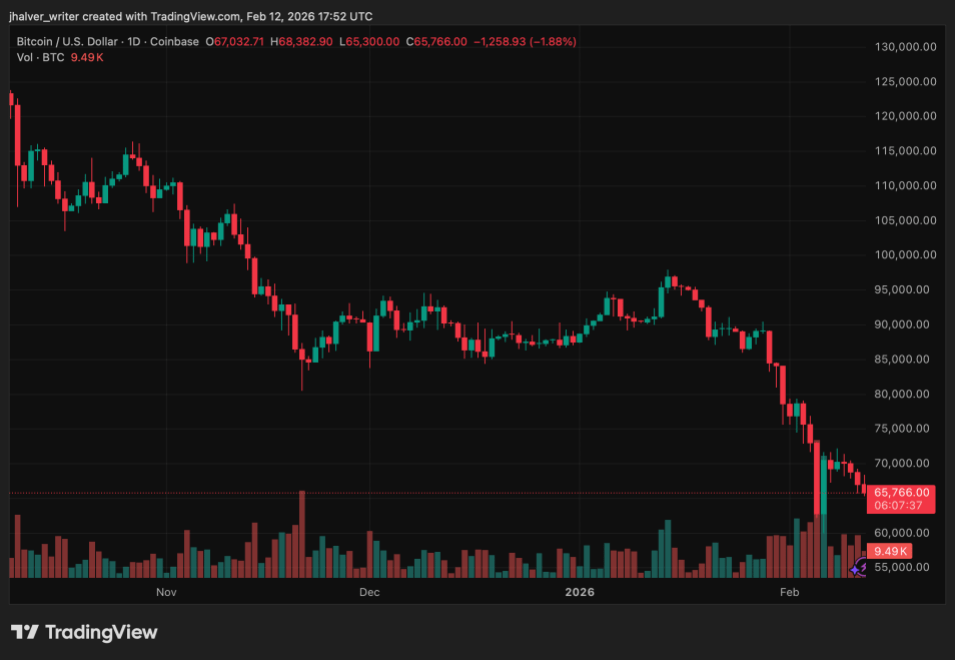
BTC's price trends to the downside on the daily chart. Source: BTCUSD on Tradingview

Thailand Integrates Crypto Into Regulated Derivatives Market

Under the revised framework, digital assets will be recognized as permissible underlying assets for derivatives products listed on exchanges such as the Thailand Futures Exchange (TFEX).

The SEC said it will revise derivatives business licenses to allow digital asset operators to offer crypto-linked contracts and will review supervisory standards for exchanges and clearinghouses.

SEC Secretary-General Pornanong Budsaratragoon said the expansion is intended to strengthen the recognition of cryptocurrencies as an investment asset class, broaden investor access, and enhance risk management tools.

The regulator will also work with TFEX to determine contract specifications that account for the volatility and risk characteristics of digital assets. Officials indicated that supervisory safeguards and investor protection measures will remain central as the market evolves.

In addition to cryptocurrencies, the amendment reclassifies carbon credits, enabling the introduction of physically delivered futures contracts alongside cash-settled products. The measure aligns with Thailand’s draft Climate Change Act and its broader carbon-neutrality objectives.

Growing Institutional Focus and Market Expansion

Thailand’s latest reform builds on a regulatory framework introduced in 2018, when the country enacted rules governing digital asset businesses. Oversight has since expanded to include stricter operational requirements and investor protection measures, while crypto payments remain prohibited by the central bank.

The SEC’s broader 2026 capital markets roadmap includes plans to introduce crypto exchange-traded funds (ETFs), subject to legal amendments. Officials have indicated that crypto ETFs could launch later this year.

Thailand’s domestic crypto market has also grown steadily. As of August 2025, the SEC valued the market at approximately $3.19 billion, with average daily trading volumes near $95 million. Active accounts rose to 230,000, reflecting increased participation from retail investors, foreign entities, and domestic institutions.

Industry participants say integrating crypto into the derivatives market could improve liquidity and provide hedging tools, but some have cautioned that capital requirements and disclosure standards must keep pace to manage systemic risk.

Cover image from ChatGPT, BTCUSD chart from Tradingview

İlgili Sorular

QWhat recent regulatory change did Thailand's Cabinet approve regarding digital assets?

AThailand's Cabinet approved changes to the Derivatives Act to allow digital assets, including cryptocurrencies like Bitcoin, to serve as underlying instruments for regulated futures and options contracts.

QWhich regulatory body is responsible for amending the Derivatives Act and drafting supporting regulations for this new framework?

AThe Securities and Exchange Commission (SEC) is responsible for amending the Derivatives Act and drafting the supporting regulations to govern participation, licensing, and supervision.

QWhat are the stated goals of integrating crypto into the derivatives market, according to SEC Secretary-General Pornanong Budsaratragoon?

AThe goals are to strengthen the recognition of cryptocurrencies as an investment asset class, broaden investor access, and enhance risk management tools.

QBesides cryptocurrencies, what other asset was reclassified by this amendment, and for what purpose?

ACarbon credits were also reclassified to enable the introduction of physically delivered futures contracts, aligning with Thailand's climate change and carbon-neutrality objectives.

QWhat is the estimated value of Thailand's domestic crypto market as of August 2025, according to the SEC?

AAs of August 2025, the SEC valued Thailand's domestic crypto market at approximately $3.19 billion.

İlgili Okumalar

Will the Next Crypto Bull Run Start with On-Chain Trading of SpaceX?

This article presents a scenario-based forecast for the crypto industry from 2026 to 2029, arguing that the next major cycle will be driven not by technological narratives but by legal access to real-world assets. The author predicts that by mid-2026, pre-IPO perpetual contracts for top private companies like SpaceX, OpenAI, and Anthropic on platforms like Hyperliquid will become the primary gateway for accessing quality assets, as most crypto-native tokens fail to capture real value. The much-hyped AI x Crypto intersection largely fails except for prediction markets, which thrive on betting on AI model supremacy. By 2027, public blockchain foundations are forced to choose between catering to retail speculation or building compliant infrastructure for institutions, with many opting for the latter. Growth in stablecoins and tokenized private credit/equity hits a "triple ceiling" due to regulatory and political uncertainty rather than market demand. The pivotal shift is forecast for 2028. A major liquidation event in pre-IPO perpetuals exposes the structural flaw of synthetic markets lacking a real underlying asset anchor. In response, regulatory changes finally allow the public solicitation of private securities resales to verified accredited investors. This creates a legitimate secondary market for real company equity, which then becomes the core asset class of the new bull market, relegating synthetic perps to a niche role. By 2029, the industry becomes "boring" but foundational. Tokens without claims on real cash flows or assets cease trading. Stablecoin growth is steady but politically capped. Crypto infrastructure fades from view as it gets absorbed into traditional finance backends. The article's central thesis is that the key bottleneck for crypto's next phase is legal and regulatory channels for real asset ownership, not technology.

marsbit3 dk önce

Will the Next Crypto Bull Run Start with On-Chain Trading of SpaceX?

marsbit3 dk önce

The Value Distribution of Stablecoins

**Summary: The Value Distribution of Stablecoins** The article argues that stablecoins are evolving from mere trading tools into broader channels for dollar access. It divides the stablecoin ecosystem into four layers to analyze how value is distributed: 1. **Issuance Layer:** Mints stablecoins, holds reserve assets, and captures the spread between reserve yield and user costs (e.g., Tether, Circle). This layer currently earns the largest profit margin. 2. **Infrastructure Layer:** Connects stablecoins to the traditional financial system, handling fiat on/off-ramps, banking integration, compliance (KYC/AML), and asset management (e.g., Bridge, BVNK). This is the "unglamorous" but critical work, building the essential bridges between crypto and real-world finance. 3. **Acquiring/Distribution Layer:** Integrates stablecoins into merchant systems, manages payment flows, and provides enterprise financial software (e.g., Stripe, Coinbase). They act as the access point for businesses. 4. **Application Layer:** The end-users and businesses that ultimately use stablecoins for payments, settlements, or as a store of value. They benefit from convenience but have little pricing power. The core thesis is that while the issuance layer currently dominates profits, the often-overlooked **infrastructure layer holds significant long-term potential**. The real challenge and barrier to mass adoption is not the on-chain transfer of stablecoins (which is simple), but the complex "last mile" integration into existing business workflows, banking systems, and regulatory frameworks across different countries. Companies in this layer are currently in a "land grab" phase, investing heavily to build networks, secure bank partnerships, and establish compliance pathways. While their position is currently pressured by the profitable issuers above and distribution platforms below, the article suggests that if stablecoins become a default financial rail for businesses, the infrastructure providers who have done the hard work of integration will ultimately gain strong pricing power and become entrenched, essential players.

marsbit6 saat önce

The Value Distribution of Stablecoins

marsbit6 saat önce

The Value Distribution of Stablecoins

The Value Distribution of Stablecoins The article argues that stablecoins are evolving from a mere trading tool into a broad "dollar channel." It analyzes the industry's value chain through four layers: 1. **Issuance Layer (e.g., Tether, Circle):** The top layer that mints stablecoins, holds reserve assets, and captures the thickest interest rate spread. 2. **Infrastructure Layer (e.g., Bridge, BVNK):** Connects stablecoins to the traditional financial system, handling critical but complex "dirty work" like fiat on/off-ramps, banking integration, compliance (KYC/AML), and cross-border settlement. 3. **Acquiring/Distribution Layer (e.g., Stripe, Coinbase):** Embeds stablecoins into merchant systems, manages payment flows, and integrates with enterprise software. 4. **Application Layer:** End-users and businesses that ultimately use stablecoins for payments, settlement, or storing value. The author posits that while the issuance layer currently captures the most profit, the most overlooked and potentially critical layer is infrastructure. The core challenge for stablecoin adoption isn't the on-chain transfer (which is simple), but bridging the gap between blockchain and the real-world financial system. This involves solving practical problems for businesses: fiat conversion, reconciliation, tax handling, and user onboarding. Infrastructure companies are currently in a difficult "land-grab" phase—building networks, securing banking relationships, and achieving compliance country-by-country. They face pressure from both the profitable issuance layer above and distribution platforms below. However, the author suggests this layer is building a crucial moat. Once stablecoins become a default business rail, the infrastructure players who have done the hard work of integration may gain significant, durable value and pricing power.

链捕手6 saat önce

The Value Distribution of Stablecoins

链捕手6 saat önce

İşlemler

Spot
Futures
活动图片