Crypto among sectors ‘debanked’ by 9 major banks: US regulator

cointelegraph2025-12-11 tarihinde yayınlandı2025-12-11 tarihinde güncellendi

Özet

According to preliminary findings from the U.S. Office of the Comptroller of the Currency (OCC), nine major U.S. banks restricted financial services to politically contentious industries—including cryptocurrency—between 2020 and 2023. The OCC stated that these banks made “inappropriate distinctions” among customers based on lawful business activities, either by implementing restrictive policies or requiring escalated reviews. Sectors affected were crypto, oil and gas, firearms, private prisons, and others. Crypto businesses faced limitations often tied to financial crime concerns. The OCC is continuing its review and may refer findings to the Justice Department. Critics argue the report overlooks regulatory pressure from agencies like the FDIC that contributed to debanking.

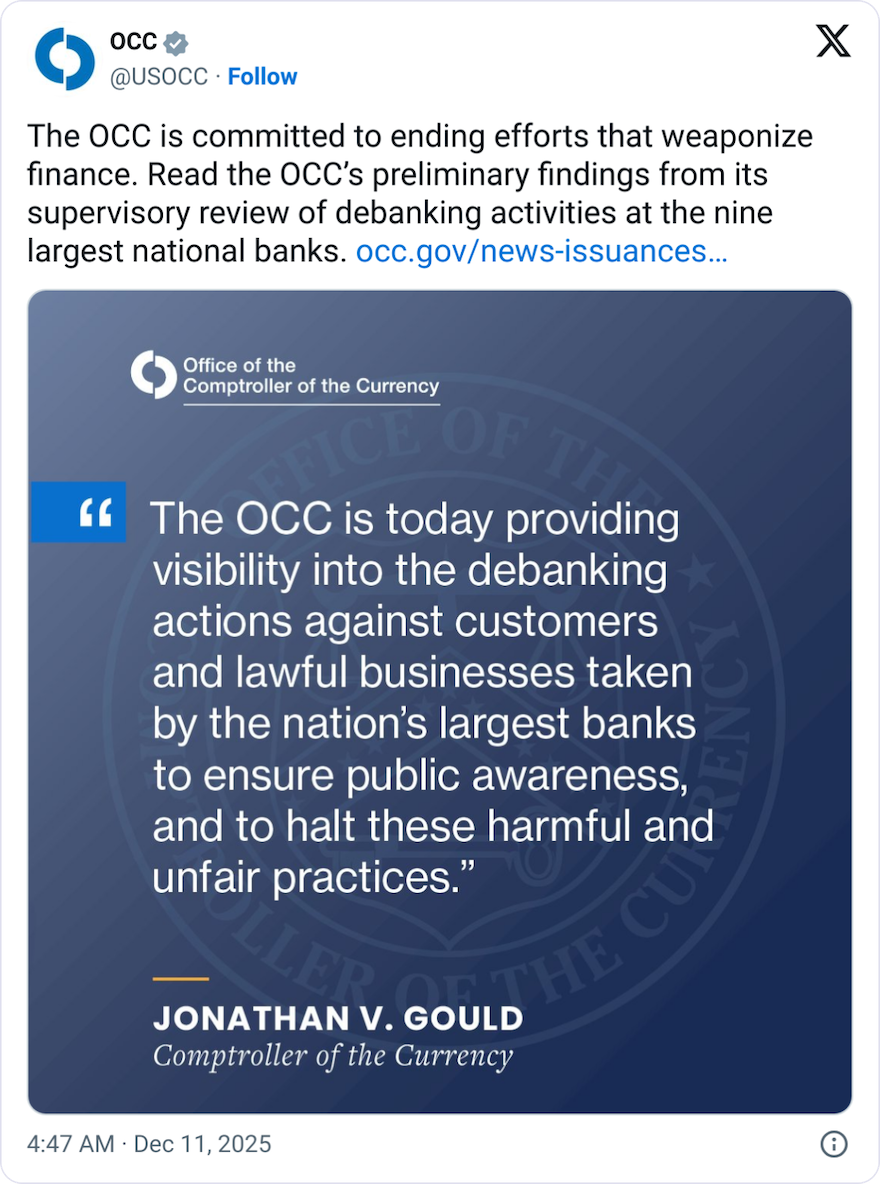
The nine largest US banks restricted financial services to politically contentious industries, including cryptocurrency, between 2020 and 2023, according to the preliminary findings of the Office of the Comptroller of the Currency (OCC).

The banking regulator said on Wednesday that its early findings show that major banks “made inappropriate distinctions among customers in the provision of financial services on the basis of their lawful business activities” across the three-year period.

The banks either implemented policies restricting access to banking or required escalated reviews and approvals before giving financial services to certain customers, the OCC said, without giving specific details.

The OCC initiated its review after President Donald Trump signed an executive order in August, directing a review of whether banks had debanked or discriminated against individuals based on their political or religious beliefs.

Crypto issuers and exchanges caught in restrictions

The OCC’s report found that in addition to crypto, the sectors that faced banking restrictions included oil and gas exploration, coal mining, firearms, private prisons, tobacco and e-cigarette manufacturers and adult entertainment.

Banks’ actions toward crypto included restrictions on “issuers, exchanges, or administrators, often attributed to financial crime considerations,” the OCC said.
Source: OCC

“It is unfortunate that the nation’s largest banks thought these harmful debanking policies were an appropriate use of their government-granted charter and market power,” said Comptroller of the Currency Jonathan Gould.

“While many of these policies were undertaken in plain sight and even announced publicly, certain banks have continued to insist that they did not engage in debanking,” he added.

The OCC examined JPMorgan Chase, Bank of America, Citibank, Wells Fargo, US Bank, Capital One, PNC Bank, TD Bank, and BMO Bank, the largest national banks it regulates.

The OCC reported that it is continuing its investigation and could refer its findings to the Justice Department.

OCC debanking report leaves “much to be desired”

Nick Anthony, a policy analyst at the libertarian think tank Cato Institute, said in an emailed statement to Cointelegraph that the OCC’s report “leaves much to be desired” and didn’t mention “the most well-known causes of debanking.”

“The report criticizes banks for severing ties with controversial clients, but it fails to mention that regulators explicitly assess banks on their reputation,” he said.

Related: ‘Grow up... We debank Democrats, we debank Republicans:’ JPMorgan CEO

“Making matters worse, the report appears to blame banks for cutting ties with cryptocurrency companies, yet makes no mention of the fact that the [Federal Deposit Insurance Corporation] explicitly told banks to stay away from these companies,” Anthony added.

Republicans on the House Finance Committee reported earlier this month that the FDIC’s so-called “pause letters” it sent to banks under the Biden administration helped to spur “the debanking of the digital asset ecosystem.”

Caitlin Long, the founder and CEO of the crypto-focused Custodia Bank, said the “worst culprits” of crypto-related debanking under the Biden administration were the FDIC and Federal Reserve, “not OCC.”

“In OCC’s defense, this report covers large banks only. Crushing crypto wasn’t a supervisory priority for large banks like it was for small [and] mid-sized banks,” she added.

Magazine: Quitting Trump’s top crypto job wasn’t easy: Bo Hines

İlgili Okumalar

The Cost of an 11.5% Annualized Return: Will MicroStrategy's STRC Face a Moment of Reckoning?

This article analyzes the potential risks associated with MicroStrategy's (MSTR) use of structured financial products like STRC to leverage its BTC exposure. While these tools have enabled impressive returns (e.g., 11.5% annualized) and fueled significant capital inflows ($13.5B outstanding), they also create substantial annual dividend obligations (~$400M). The author argues that this structure, while effective in a bull market, could become a liability if BTC price stagnates or declines. The core risk is a potential negative feedback loop: the growing dividend burden from continued STRC issuance may eventually outweigh the benefits of increased BTC holdings. To meet these obligations, MicroStrategy might need to use new issuance proceeds for dividends instead of buying more BTC, which could disappoint equity investors. If the market capitalization (mNAV) falls below the value of its BTC holdings, the company could be forced to sell BTC instead of issuing new shares, potentially triggering a panic. The author estimates a potential inflection point in 6 months, where annual dividend costs reach $3-4B. At that stage, CEO Michael Saylor might face a difficult choice: sell BTC to meet obligations or sacrifice the credibility of the preferred shares by halting dividends. The article concludes that this financial engineering, while powerful, could ultimately "backfire" on MicroStrategy if market conditions turn.

marsbit1 saat önce

The Cost of an 11.5% Annualized Return: Will MicroStrategy's STRC Face a Moment of Reckoning?

marsbit1 saat önce

İşlemler

Spot
Futures

Popüler Makaleler

US Nasıl Satın Alınır

HTX.com’a hoş geldiniz! Talus Network (US) satın alma işlemlerini basit ve kullanışlı bir hâle getirdik. Adım adım açıkladığımız rehberimizi takip ederek kripto yolculuğunuza başlayın. 1. Adım: HTX Hesabınızı OluşturunHTX'te ücretsiz bir hesap açmak için e-posta adresinizi veya telefon numaranızı kullanın. Sorunsuzca kaydolun ve tüm özelliklerin kilidini açın. Hesabımı Aç2. Adım: Kripto Satın Al Bölümüne Gidin ve Ödeme Yönteminizi SeçinKredi/Banka Kartı: Visa veya Mastercard'ınızı kullanarak anında Talus Network (US) satın alın.Bakiye: Sorunsuz bir şekilde işlem yapmak için HTX hesap bakiyenizdeki fonları kullanın.Üçüncü Taraflar: Kullanımı kolaylaştırmak için Google Pay ve Apple Pay gibi popüler ödeme yöntemlerini ekledik.P2P: HTX'teki diğer kullanıcılarla doğrudan işlem yapın.Borsa Dışı (OTC): Yatırımcılar için kişiye özel hizmetler ve rekabetçi döviz kurları sunuyoruz.3. Adım: Talus Network (US) Varlıklarınızı SaklayınTalus Network (US) satın aldıktan sonra HTX hesabınızda saklayın. Alternatif olarak, blok zinciri transferi yoluyla başka bir yere gönderebilir veya diğer kripto para birimlerini takas etmek için kullanabilirsiniz.4. Adım: Talus Network (US) Varlıklarınızla İşlem YapınHTX'in spot piyasasında Talus Network (US) ile kolayca işlemler yapın.Hesabınıza erişin, işlem çiftinizi seçin, işlemlerinizi gerçekleştirin ve gerçek zamanlı olarak izleyin. Hem yeni başlayanlar hem de deneyimli yatırımcılar için kullanıcı dostu bir deneyim sunuyoruz.

263 Toplam GörüntülenmeYayınlanma 2025.12.11Güncellenme 2025.12.11

US Nasıl Satın Alınır

Tartışmalar

HTX Topluluğuna hoş geldiniz. Burada, en son platform gelişmeleri hakkında bilgi sahibi olabilir ve profesyonel piyasa görüşlerine erişebilirsiniz. Kullanıcıların US (US) fiyatı hakkındaki görüşleri aşağıda sunulmaktadır.

活动图片