Crypto, AI Investments Surface In Fed Chair Nominee’s Financial Disclosure

bitcoinist2026-04-15 tarihinde yayınlandı2026-04-15 tarihinde güncellendi

Özet

Amidst key regulatory vacancies at the SEC and CFTC, Federal Reserve Chair nominee Kevin Warsh disclosed over $100 million in assets, including investments in crypto firms (Compound, Dapper Labs, Kinetic) and AI companies (Delphi, Conversion, among others). His largest holding is the $50+ million Juggernaut Fund. The disclosure did not value his crypto/AI holdings, raising questions about potential conflicts of interest as the Fed’s rate decisions directly impact these sectors. With Jerome Powell’s term ending May 15, Warsh’s Senate confirmation process is advancing rapidly.

Two of the most closely watched regulatory bodies in American finance are operating with skeleton crews. The Securities and Exchange Commission has three of its five commissioner seats filled — all by Republicans.

The Commodity Futures Trading Commission has just one sitting commissioner. Both vacancies come at a moment when the agencies are expected to take center stage in shaping the rules around digital assets, should a crypto market structure bill that has been stalled in the Senate since July 2025 finally pass.

A Nominee With Stakes In The Industry

Against that backdrop, Kevin Warsh — US President Donald Trump’s pick to replace Federal Reserve Chair Jerome Powell — filed a financial disclosure last week that revealed personal investments in crypto and artificial intelligence companies.

Based on reports, Warsh’s filing with the US Office of Government Ethics lists holdings in Compound, Dapper Labs, and Kinetic on the crypto side, alongside AI firms including Delphi, Conversion, Factory, and Glue, among others.

Source: US Office of Government Ethics
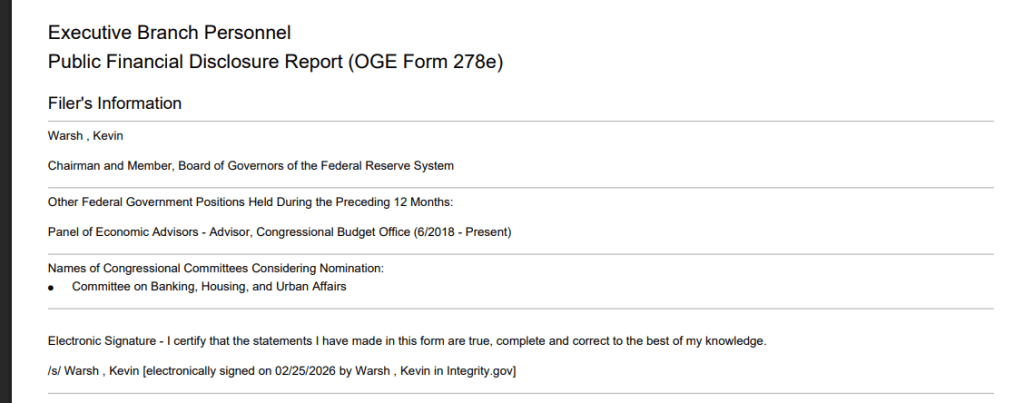
His total disclosed assets top $100 million. The largest single entry is more than $50 million in something called the Juggernaut Fund. Another major line item: more than $10 million in consulting fees from the Duquesne Family Office, the investment firm run by billionaire Stanley Druckenmiller.

None of his crypto and AI investments included a value range in the disclosure. It is unclear why. The ethics office’s rules do not require reporting assets valued under $1,000, which may explain the omission — though the gap leaves open questions about the full scope of his exposure to sectors the Fed’s interest rate decisions directly affect.

BTCUSD trading at $73,929 on the 24-hour chart: TradingView

Powell’s Clock Is Running Out

Time is short. Powell’s second four-year term ends May 15. Trump first floated Warsh’s name in January, then formally sent his nomination to the Senate in March, following months of public pressure on Powell to cut interest rates. As of Tuesday, the Senate Banking Committee had not announced a hearing date, but reports indicated a vote could come as early as next week.

Whoever takes the Fed chair position wields enormous influence over US financial policy — most visibly through decisions on federal interest rates, which ripple through every corner of the economy, including the crypto and AI sectors where Warsh holds investments.

Featured image from Real Estate News, chart from TradingView

İlgili Sorular

QWho is Kevin Warsh and what role has he been nominated for?

AKevin Warsh is US President Donald Trump's nominee to replace Jerome Powell as the Chair of the Federal Reserve.

QWhich crypto and AI companies were listed in Kevin Warsh's financial disclosure?

AHis disclosure listed holdings in crypto companies Compound, Dapper Labs, and Kinetic, and AI firms including Delphi, Conversion, Factory, and Glue.

QWhat is the significance of the SEC and CFTC operating with vacancies according to the article?

AThe vacancies are significant because these agencies are expected to be central in shaping the rules around digital assets if a stalled crypto market structure bill passes.

QWhat was the largest single asset disclosed in Kevin Warsh's filing?

AThe largest single disclosed asset was over $50 million in something called the Juggernaut Fund.

QWhen does Jerome Powell's term as Federal Reserve Chair end, creating the vacancy?

AJerome Powell's second four-year term as Federal Reserve Chair ends on May 15.

İlgili Okumalar

In Jinjiang, Fujian, a Storage Super Unicorn Lies Quiet

In Fujian's Jinjiang, a city known for sportswear, lies a quiet semiconductor giant: Fujian Jinhua Integrated Circuit Co. (JHICC). Once a promising domestic DRAM manufacturer alongside Yangtze Memory and ChangXin Memory Technologies (CXMT), its journey was derailed in 2018 when the U.S. placed it on an Entity List and filed criminal charges for alleged trade secret theft. This halted production for years. A turning point came in February 2024 when a U.S. federal court found JHICC not guilty. However, it had lost crucial time. While CXMT soared to become a top-valued A-share company in 2024, JHICC, with an estimated valuation of 80 billion RMB, was just restarting. Its current output is primarily customized DDR4 chips, not the advanced DDR5/HBM demanded for AI, but it still benefits from the broader memory chip upcycle. JHICC's story is tied to Chen Zhengkun, a veteran engineer who left Micron to lead the venture. Founded in 2016 with state-backed funding, JHICC partnered with Taiwan's UMC to develop DRAM technology. Rapid progress was cut short by the U.S. actions, which Micron initiated, partly due to its heavy reliance on the Chinese market. Post-sanctions, Chen's team worked to rebuild the production line with reduced reliance on U.S. technology. According to its records, JHICC achieved small-scale production and revenue growth under immense pressure. It now focuses on the stable "niche" DRAM market (e.g., TVs, routers) with a monthly capacity of ~40,000 wafers, aiming for 60,000 by 2026. It holds over 1,000 patents but remains on the Entity List. For Jinjiang, investing in JHICC was a bold industrial leap. The local government provided unwavering financial and logistical support during the crisis, helping the company survive. JHICC has become the anchor for a growing local semiconductor cluster. Though its scale lags behind domestic peers, JHICC's persistence symbolizes a hard-won foothold in a global market long dominated by Samsung, SK Hynix, and Micron. Having missed one boom, it seeks a place in the new AI-driven memory supercycle.

marsbit2 saat önce

In Jinjiang, Fujian, a Storage Super Unicorn Lies Quiet

marsbit2 saat önce

İşlemler

Spot
活动图片





