Cross-Chain Bridges Actively Adapt, LI.FI Leverages Intent Architecture to Become the Liquidity Hub for TradFi Institutions

Odaily星球日报2026-06-03 tarihinde yayınlandı2026-06-03 tarihinde güncellendi

Özet

Cross-Chain Bridge LI.FI Transforms with Intents Architecture to Serve as Liquidity Hub for TradFi Institutions Facing declining cross-chain transaction volumes and overall crypto market liquidity, cross-chain bridge protocol LI.FI is proactively shifting its strategy. Moving beyond its role as a "liquidity transfer protocol," LI.FI is targeting new assets, clients, and operational systems. Key to this transformation is the launch of LI.FI Intents, an intent-based execution architecture. This product positions itself as a foundational layer for stablecoin payments, Real World Assets (RWA), and compliant on-chain liquidity, catering specifically to fintech companies, neobanks, wallets, and regulated financial institutions. LI.FI Intents simplifies user experience by offering a turnkey solution. It leverages a solver network for market-maker level execution, enabling precise cross-chain swaps (e.g., between USDC and USDT) without users managing gas tokens or complex blockchain steps. It lowers barriers to entry by integrating with applications like Jumper and Rabby, allowing enterprise users to bypass direct wallet interactions for transactions like payments and asset transfers. The architecture emphasizes compliance. Its network consists of verified legal entities, and enterprises can review and approve orders within their compliance frameworks before processing. All interacting wallets undergo OFAC screening. For ecosystem coverage, LI.FI Intents supports major networks i...

Original|Odaily Planet Daily (@OdailyChina)

Author|Wenser(@wenser2010)
When TradFi becomes a must-have for the crypto industry, no project can stand apart. However, some choose to start with asset types, while others set their sights on the various companies and institutions behind the assets.

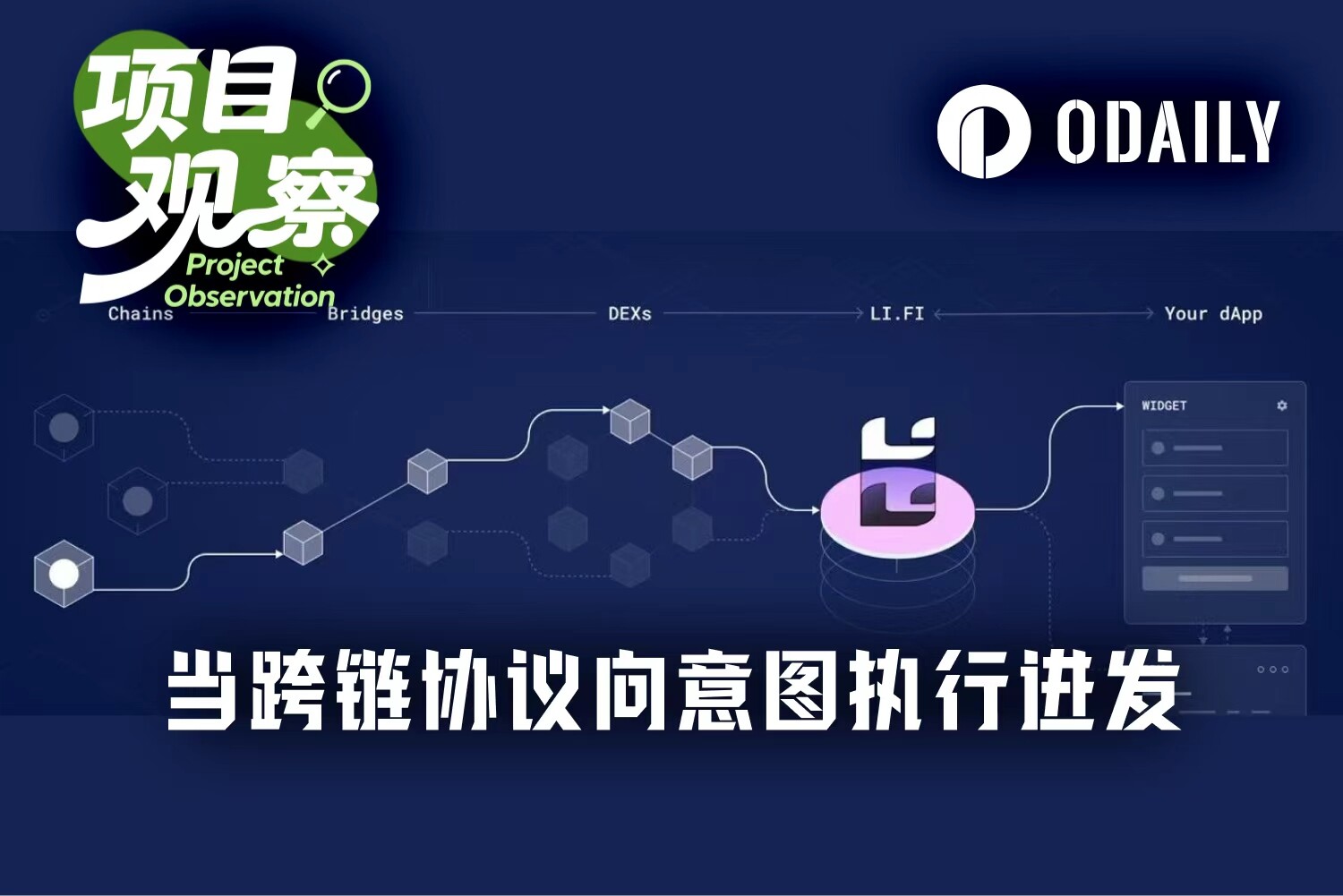
Last month, the cross-chain bridging protocol LI.FI officially and prominently announced the launch of its intent-based execution architecture, LI.FI Intents. This product will serve as the underlying execution layer providing stablecoin payments, RWA, and compliant on-chain liquidity, targeting services for fintech companies, neobanks, wallets, and regulated financial institutions.

Amidst the current trend of stablecoin payments, RWA assets, and compliant assets converging with the on-chain ecosystem, Li.Fi is no longer content with being just a "liquidity transfer protocol." Instead, it is proactively seeking breakthroughs and role upgrades in areas such as new assets, new customers, and new operating systems.

When Industry Liquidity Tightens, Cross-Chain Bridge Protocols Actively Adapt

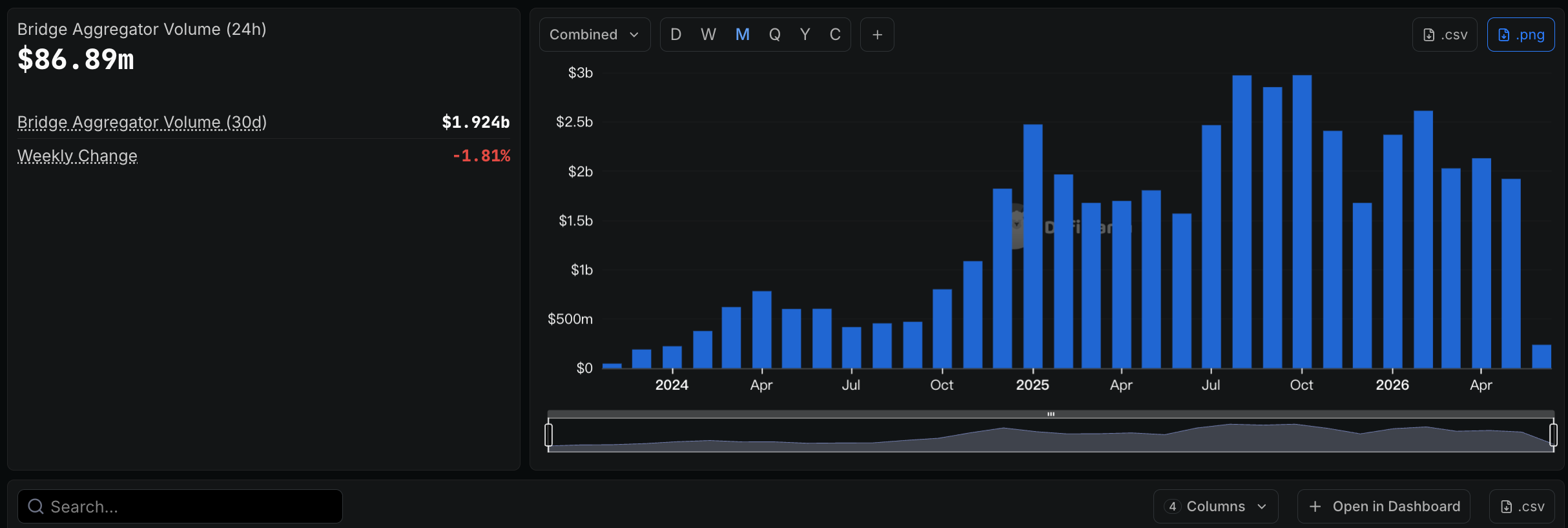
According to DefiLlama data, cross-chain bridge aggregated trading volume over the past 30 days was approximately $1.92 billion, with a weekly decline of about 1.81%. Since reaching a high of $2.974 billion in October last year, the monthly trading volume of cross-chain bridges has shown a slow downward trend. The trading volume in May dropped to around $1.9 billion, representing a decline of nearly 34% compared to the peak.
On the other hand, the overall crypto market is in a fluctuating downward trend, with BTC spot trading volume having fallen by as much as 81% from last year's highs; on-chain liquidity has further tightened as a result.

Faced with this situation, Li.Fi, as a cross-chain bridge protocol, did not wait passively like most crypto projects. Instead, it actively explored new business areas, seeking new application scenarios and service targets to ensure its long-term development.

In December last year, LI.FI announced the completion of a $29 million funding round led by Multicoin and CoinFund, bringing its total funding raised to $52 million. At that time, the project stated it planned to use this latest funding to expand its business into different trading domains, including perpetual futures, yield opportunities, prediction markets, and lending markets.

Ample funding gave Li.Fi the confidence to explore and build new products while maintaining its core business.

In April this year, LI.FI announced the launch of a new product, LI.FI Earn, providing on-chain yield functionality for enterprises with digital asset strategies. It supports accessing strategies from over 20 vault protocols through a single integration and features built-in cross-chain execution capabilities across more than 60 chains.

In May, the intent execution architecture LI.FI Intents was released, marking Li.Fi's official entry into the enterprise services sector. It empowers a range of B2B clients with the underlying operational capabilities for stablecoin payments, RWA assets, and compliant liquidity.

In the current convergence of TradFi assets and crypto assets, Li.Fi's new direction for upgrades is to lower user barriers, improve liquidity operation efficiency, and open channels for tokenized asset exchange from the operational execution layer. Compared to cross-chain protocols limited to the crypto market, providing financial services to global fintech companies, neobanks, wallets, and regulated financial institutions is undoubtedly a cash cow business with a much higher ceiling.

In terms of user experience, Li.Fi Intents provides users with a more streamlined execution solution, ready to use. It is reported that it primarily offers market-maker-level execution through a solver network, supporting precise output cross-chain swaps between stablecoins like USDC and USDT without requiring users to manage Gas tokens or handle complex underlying blockchain steps. Simultaneously, the architecture allows applications to integrate multiple tokenized asset issuers through a unified interface.

Regarding entry barriers, LI.FI Intents is already live on applications and wallets like Jumper and Rabby. Moreover, with LI.FI Intents, enterprise users do not need to interact with any wallet, which will significantly lower the cognitive barrier for enterprises in areas like transfer payments and asset movements, reducing many cumbersome operational steps.
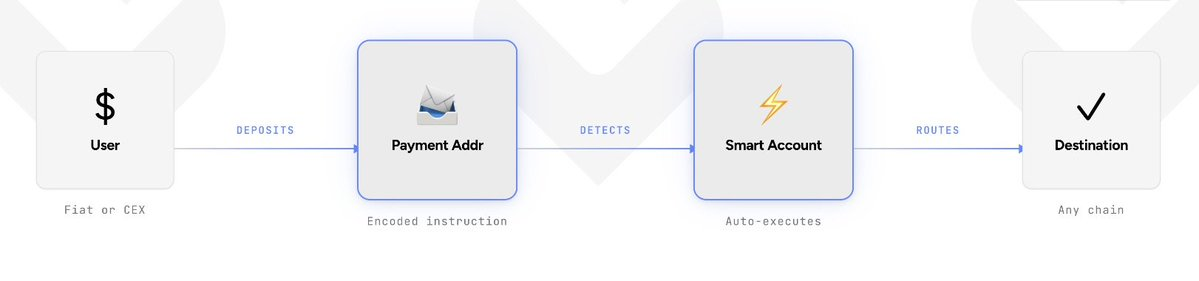
In terms of compliance, the network built by LI.FI Intents consists of verified legitimate entities. Enterprises can review and approve corresponding orders one by one before the trading processing system handles them, precisely choosing the trading processing systems they trust. This ensures orders flow within a compliant approval system. All wallets interacting with this system are subject to OFAC (U.S. Department of the Treasury's Office of Foreign Assets Control) screening, which can be considered the final layer of "compliance insurance."

Regarding ecosystem coverage, LI.FI Intents covers mainstream blockchain networks, including the EVM ecosystem, Solana network, and Tron network. It achieves a certain level of adaptation in ecosystem usability and broad coverage, avoiding potential security risks or single points of failure caused by high dependence on a single blockchain network.

Conclusion: Efficient Automated Services Behind Intent Execution

If tokenized U.S. stocks and RWA assets solve the problems of asset type updates and traditional finance entry barriers, then what Li.FI Intents targets is how to introduce stablecoin payments, RWA assets, and compliant on-chain liquidity into the ecosystems of enterprise users in a better and faster way, improving their operational efficiency and capital utilization.

More importantly, the Li.FI Intents system serves intent execution. Like destination navigation in autonomous driving, enterprise users only need to set the goal; all intermediate execution steps are outsourced and handled by the system.

In today's world of extremely rich asset types, the value of efficient operations will be further amplified, and Li.Fi has already taken the most crucial step.

İlgili Okumalar

Conversation with Co-founder of Hyperdash: Why is Hyperliquid Still Severely Undervalued?

Interview Summary with Hanson Birringer, Co-founder of Hyperdash: Why Hyperliquid Remains Undervalued In an interview on *The Rollup*, Hanson Birringer, Co-founder and Chief Revenue Officer of Hyperdash—a trading data analytics platform for Hyperliquid—shared his investment thesis on the Hyperliquid ecosystem. He described Hyperliquid as a pure play on three key crypto super-trends: perpetual contracts, real-world assets (RWAs), and stablecoins. The platform is an open-source, decentralized, and high-performance financial system uniquely positioned to bridge traditional institutional capital with decentralized finance. Birringer highlighted Hyperliquid's leadership in perpetual DEX trading and its recent innovation of RWA perpetual contracts. He emphasized the significance of USDC becoming a core quoting asset, which, by allocating 90% of its backend yield from assets like US treasuries to a protocol buyback fund, creates substantial, programmatic buy pressure for the Hype token. He addressed regulatory challenges, noting that Hyperliquid's policy team is actively engaging with US regulators like the CFTC to establish clear rules for decentralized venues. Once achieved, regulated brokers could route orders directly to Hyperliquid's backend, tapping into its low-cost liquidity layer. Regarding revenue, Birringer was optimistic, citing the immense size of traditional financial markets. Even capturing a small fraction of global trading volume in products like RWA perpetuals could lead to exponential growth for the protocol. The recently launched Grayscale Hyperliquid ETF, seeded by their SPV (Hyper Holdings Global), provides a compliant on-ramp for institutional investors drawn to the clear "cash flow + token buyback" model. Finally, he discussed Hyperdash's acquisition of Imperator, enhancing its data and node infrastructure to serve both retail traders and traditional asset managers. His bullish case rests on Hyperliquid's potential to provide unprecedented global access to dollar-based capital markets. He struggled to articulate a bear case, seeing the long-term trends of internet adoption and financial inclusion as powerful tailwinds.

marsbit52 dk önce

Conversation with Co-founder of Hyperdash: Why is Hyperliquid Still Severely Undervalued?

marsbit52 dk önce

DeepSeek V4 'Full-Blooded Edition' Leaked, Could Be Released As Early As Tomorrow

The highly anticipated full release of DeepSeek V4 is imminent, expected to launch as early as tomorrow after nearly three months of waiting. A select group has already received access to the GA (General Availability) beta, which includes two versions: DeepSeek V4 Flash and DeepSeek V4 Pro. Early testers report that V4's overall performance is close to the level of Opus 4.8, with coding capabilities rivaling GPT-5.6 Sol. Its agent abilities are significantly enhanced, and 3D/SVG generation has improved notably. While it may not surpass the recently released Kimi K3 in performance, its expected price point is significantly lower. The official release will introduce a new "peak/off-peak" pricing model for its API. For example, deepseek-v4-pro will cost $0.87 per million output tokens during standard times and $1.74 during peak hours. The flash version is even more aggressive at $0.28/$0.56 per million tokens, with cached input tokens priced extremely low at $0.0028. This makes V4 a strong contender in terms of cost-effectiveness, potentially offering Opus-level capabilities at a fraction of the cost, continuing DeepSeek's reputation as a "price disruptor" in the AI market. Initial demos showcasing V4's capabilities have begun circulating, including generated 3D simulation games, HTML games blending elements of Minecraft and No Man's Sky, and classic games like a "Cut the Rope" clone. The final GA version is set to replace the older deepseek-chat and deepseek-reasoner models, which will be retired on July 24th.

marsbit1 saat önce

DeepSeek V4 'Full-Blooded Edition' Leaked, Could Be Released As Early As Tomorrow

marsbit1 saat önce

WEEX Labs Weekly Observation: The 'Power Restructuring' of AI Infrastructure and the 'Deep Dive Movement' into the Real Economy

WEEX Labs Weekly Review: AI Infrastructure's "Power Restructuring" and the "Deep Dive" into the Real Economy Mid-July 2026 marks a pivotal shift in the global AI industry. The allocation of computing power is transferring from cloud giants to compute resource owners, while the core value of AI is solidifying around its penetration into physical industry, moving beyond the race for model parameters. The era of fragmented model development is over, replaced by a capital-intensive, integrated chain driven by hard tech. Key developments this week include Meta's planned entry into the cloud computing market with "MetaCompute." This move by social media giants with massive GPU clusters challenges traditional cloud providers like AWS, integrating compute, models, and data into one-stop services, which will squeeze smaller rental providers and shift enterprise focus towards underlying model ecosystems. Chinese foundational models like DeepSeek-V4 and Tencent's Hy-3 are pushing towards "utility" status through open-source releases and extreme cost reductions via MoE architectures. This lowers entry barriers for enterprises, allowing them to focus resources on private deployment and deep business integration. Embodied intelligence, particularly humanoid robots, is transitioning from lab demos to real-world factory applications, driven by policies promoting large-scale, practical deployment in logistics and manufacturing. The value focus is shifting from spectacle to stable industrial data and real operational efficiency. Global governance, through forums like WAIC, is evolving from theoretical ethics to practical operational frameworks for "Sovereign AI," raising geopolitical compliance barriers and making auditability and data sovereignty core design requirements from the outset. WEEX Labs Insights: The current transformation shows AI's prosperity is deeply embedding into the fabric of global manufacturing. Strategic recommendations include: 1) leveraging open-source models for private, proprietary knowledge bases; 2) maintaining cloud provider diversity to avoid vendor lock-in from integrated model ecosystems; and 3) seeking opportunities in the "embodied infrastructure" supporting robots, such as data collection, industrial simulation, and factory AI adaptation services.

marsbit1 saat önce

WEEX Labs Weekly Observation: The 'Power Restructuring' of AI Infrastructure and the 'Deep Dive Movement' into the Real Economy

marsbit1 saat önce

Is WEEX TradFi Reliable? What You Should Know Before Your First Trade of U.S. Stock Tokens

In recent years, cryptocurrency users have expanded their focus beyond Bitcoin and Ethereum to include popular traditional financial (TradFi) assets like Nvidia, Apple, and Tesla stocks. This shift raises key questions: What do these TradFi assets represent on crypto trading platforms? How do they differ from traditional stock ownership? And how can users assess the reliability of platforms offering such products? TradFi products, such as those offered by WEEX TradFi (including NVDA, MSFT, AAPL, TSLA, and QQQ tokens), are blurring the lines between crypto and traditional markets. They allow users to trade based on the price movements of traditional assets within a familiar digital asset trading environment. However, it's crucial to understand that trading a "stock token" is not equivalent to owning the actual stock. Users are participating in price speculation, not gaining shareholder rights like dividends or voting. A key feature of these products is 7x24 trading, offering flexibility beyond traditional market hours. While convenient, this also introduces unique risks, such as potential liquidity gaps and volatility when underlying markets are closed. For users evaluating TradFi products, reliability hinges on transparency and risk management. Critical factors include understanding the product mechanism, how prices track the underlying assets, and the associated risks—especially when using leverage. Popular stocks and indices are still subject to company performance, macroeconomic shifts, and sector trends. Ultimately, TradFi represents a new gateway connecting crypto users to global markets. The future points toward integrated trading environments where the distinction between "crypto investor" and "traditional investor" fades. For newcomers, a platform's reliability stems not from promises, but from a clear understanding of the product, a comprehensive view of risks, and informed judgment of the platform's capabilities.

marsbit1 saat önce

Is WEEX TradFi Reliable? What You Should Know Before Your First Trade of U.S. Stock Tokens

marsbit1 saat önce

İşlemler

Spot
活动图片