Countdown to the CLARITY Act: 25 Days Left—What Will Happen to the Crypto Market if It Fails to Pass Before the August Recess?

marsbit2026-07-03 tarihinde yayınlandı2026-07-03 tarihinde güncellendi

Özet

"The CLARITY Act, a key US crypto market structure bill, faces a tight deadline with only 25 working days left before the Senate's August 10 recess. The bill aims to clarify SEC/CFTC jurisdiction and establish a non-security path for decentralized tokens. Despite passing the House in 2025 and a Senate committee in May 2026, final negotiations have stalled over ethics and law enforcement provisions, jeopardizing the 60 Senate votes needed. If the bill fails to pass before the recess, its chances in 2026 drop significantly, with prediction markets giving only a 40% probability. Analyst Galaxy Digital has lowered its 2026 passage odds to 50%. Failure would likely lead to continued 'slow bleeding' in crypto markets, as seen in June's record $4.5 billion net outflow from US Bitcoin ETFs. XRP, which stands to gain permanent commodity status from the bill, could lose its 'regulatory premium.' Bitcoin and Ethereum, already classified as commodities via a joint agency interpretation, would face less direct impact but broader regulatory uncertainty would persist, delaying institutional capital and DeFi innovation. The path forward includes: 1) Passage before August (a major catalyst), 2) Delay to 2027 (extending market uncertainty), or 3) Failure, requiring the bill to be reintroduced in the next Congress. While delay is a setback, the bill's progress indicates the US is closer than ever to resolving crypto regulatory ambiguity."

Original | Odaily Planet Daily (@OdailyChina)

Author | Qin Xiaofeng (@QinXiaofeng 888 )

The much-anticipated Clarity for American Digital Assets Act (CLARITY Act) has unsurprisingly been delayed again. Senator Cynthia Lummis previously stated that negotiators expected to finalize the compromise text around July 4th (U.S. Independence Day) and "advance in July," but progress has clearly lagged.

Now, with the Senate's August 10th recess approaching, the window of opportunity is shrinking fast. The bill must achieve the 60-vote threshold in the Senate (requiring at least 7 Democratic defections), coordinate with the Senate Agriculture Committee's text, merge with the House bill, and receive the President's signature—all within the next 25 working days. The timeline is extremely tight.

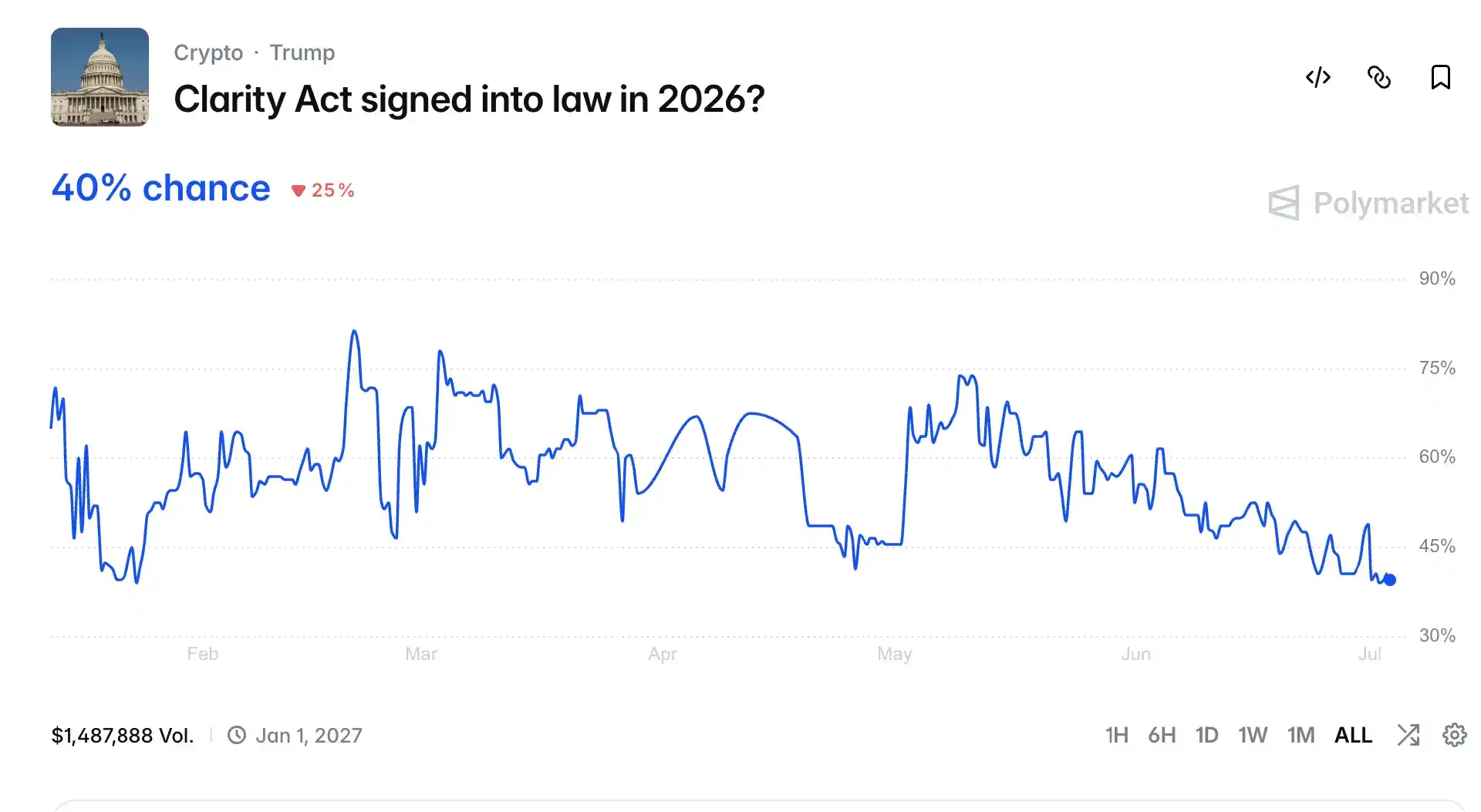
If the bill misses the pre-recess window, the probability of the CLARITY Act passing this year will drop further. Indeed, data from the prediction market Polymarket shows the bill's chance of passage this year is only 40%; Galaxy Digital has also lowered its 2026 passage probability to 50%.
I. A Recap of the Latest Developments in the CLARITY Act

The CLARITY Act is landmark crypto market structure legislation being advanced by the U.S. Congress, aiming to clarify the regulatory boundaries between the SEC and CFTC, provide a non-security pathway for decentralized tokens, and require registration and AML obligations for digital commodity intermediaries.

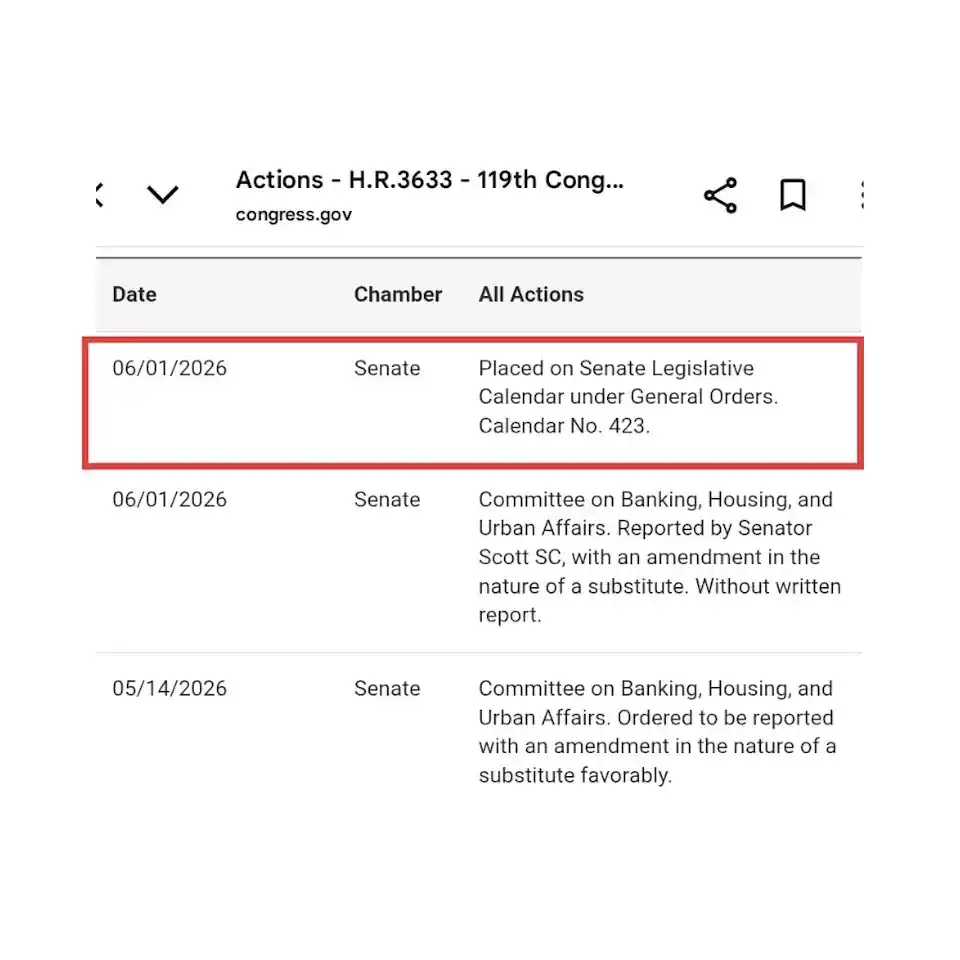
On July 17, 2025, the House of Representatives passed the HR 3633 bill proposed by French Hill with a vote of 294 in favor and 134 opposed, with over 70 Democratic votes. On May 14, 2026, the Senate Banking Committee advanced and passed the bill with a 15-9 vote (supported by 13 Republicans and 2 Democrats). On June 1, 2026, the CLARITY Act was officially placed on the Senate legislative calendar (Calendar No. 423), qualifying for full floor consideration.
However, progress on the CLARITY Act throughout June was not smooth. On June 9, negotiations over ethics clauses related to presidential crypto holdings broke down, directly leading some Democratic senators to soften their stance or impose additional conditions, slowing the bill's pace towards floor debate. On June 10, the White House met with police and prosecutor groups. Subsequently, the enforcement battle over Section 604 (the developer protection clause) in the Blockchain Regulatory Certainty Act reached an impasse; without resolution, law enforcement groups might lobby against it, and Democratic senators might also vote 'no' for perceived "insufficient consumer protection/crime-fighting."

Simply put, the former is a "political/ethics threshold," and the latter is an "enforcement/security red line." Together, they constitute the final two major obstacles before the CLARITY Act can "clear" the Senate. If unresolved, it will be difficult to gather 60 votes and finalize the text, preventing completion of the legislative process before the August 10th recess. These two negotiations directly hindered the final advancement of the CLARITY Act, becoming the key "stumbling blocks" that caused the July 4th target to be missed and overall progress to stall. Negotiations are still attempting to break the ice, but time is extremely tight.

Brian Gardner, Chief Washington Policy Strategist at Stifel Financial, stated that for the bill to pass in 2026, "it likely needs to pass the Senate by the end of July, preferably in June," warning that if the Senate misses the recess deadline, the outlook would deteriorate significantly.
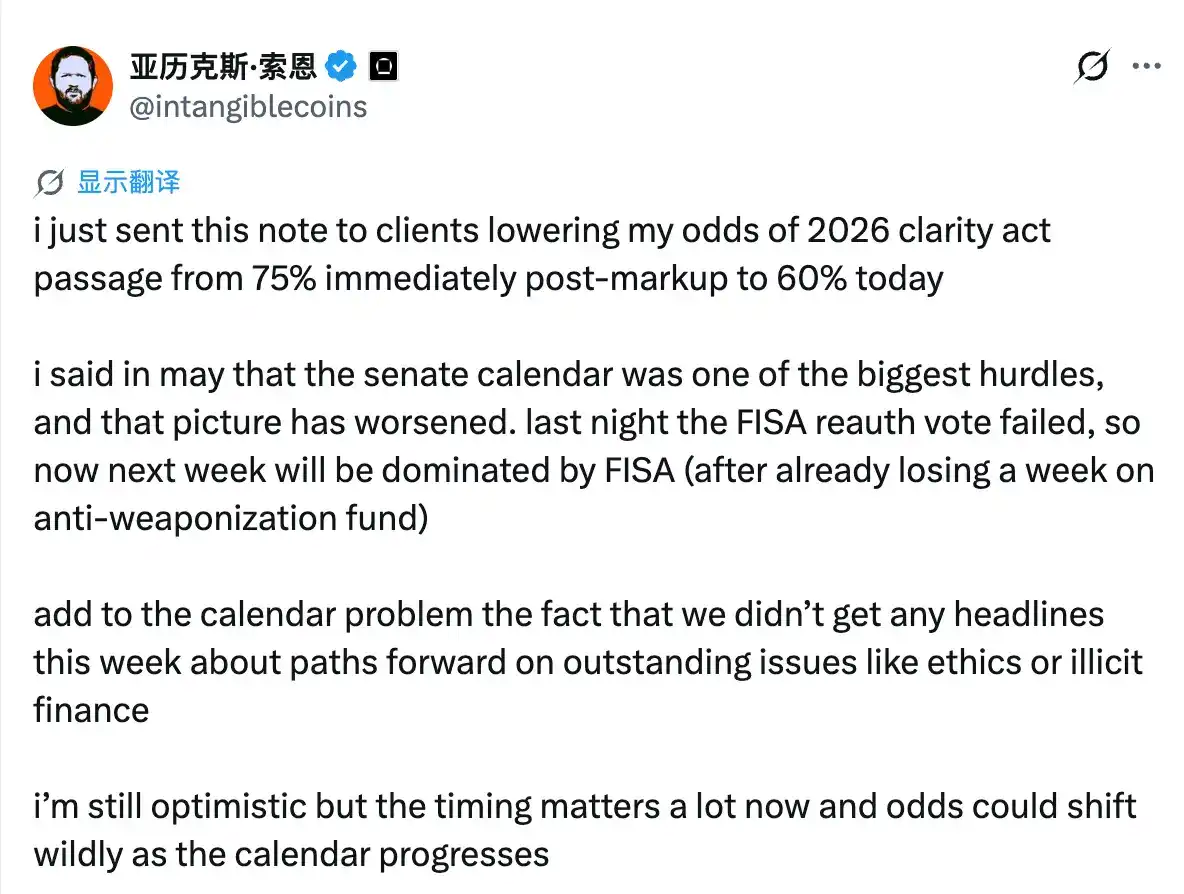
However, the market is not very hopeful about the bill passing this year. Alex Thorn, Head of Galaxy Research, lowered his 2026 passage prediction for the bill from 75% to 60% on June 5, citing the Senate's increasingly crowded agenda. Data from the prediction market Polymarket shows the bill's chance of passage this year is only 40%.

II. What Happens to Crypto if the CLARITY Act Fails to Pass on Schedule?

According to CCN's analysis, if the CLARITY Act fails to pass before the August recess, the most likely market reaction is not a crash but a "slow bleed through premium products." In fact, crypto's poor performance throughout June already indicates the market has begun repricing for legislative uncertainty. (Odaily Note: Here, "premium products" mainly refer to various spot ETFs.)

Data shows that throughout June, U.S. Bitcoin spot ETFs saw cumulative net outflows of approximately $4.5 billion, equivalent to about 77,000 BTC redeemed. This is the largest monthly net outflow since the product's launch in January 2024, exceeding the previous record from February 2025 (~$3.56 billion) and setting the worst monthly record yet.

In fact, XRP might be one of the assets most directly and significantly impacted by the bill, as it would permanently cement its commodity classification, eliminating the risk of reversible agency interpretation. If delayed long-term or fails, XRP could lose some of its "regulatory tailwind premium."

Geoffrey Kendrick, Global Head of Digital Assets Research at Standard Chartered, projects an XRP price target of $8, contingent on the Senate fully passing the relevant bill and $4-8 billion of ETF inflows. JPMorgan predicts that if the bill passes, XRP ETFs could see $4.3-$8.4 billion inflows in the first year. Data shows that since the launch of XRP spot ETFs in November 2025, cumulative net inflows are about $1.41 billion, with 84% from retail; institutional inflows still await clear regulatory signals.

For Bitcoin, which was classified as a commodity via the joint SEC-CFTC interpretation in March 2026, the CLARITY Act's main role is to codify this reversible decision into permanent federal law. Even if the bill fails or is long delayed, Bitcoin's "digital gold" narrative is relatively robust, facing less direct impact.

The impact on ETH is similar to Bitcoin, as Ethereum was also classified as a commodity via joint interpretation. Bill failure could leave DeFi protocols facing prolonged compliance ambiguity longer, dampening innovation and capital inflows. Standard Chartered's Geoffrey Kendrick projects a year-end 2026 ETH target of $7,500 (later revised to $4,000), contingent on the relevant bill's passage.

Kristin Smith, President of the Solana Foundation Policy Institute, stated that many asset allocators are actively exploring digital asset investments but are holding back capital due to unclear regulatory guidelines. The same logic applies to institutional DeFi; currently, DeFi projects are also on hold awaiting the outcome of Section 604.

III. Where Do We Go From Here?

Time is running short for the CLARITY Act to break through. The following scenarios are possible:

  • First, Passage Before the August Recess: The biggest catalyst, potentially triggering a significant price rebound, especially for XRP and related ETFs.
  • Second, Postponement to 2027: The scenario the market least wants to see, extending the "slow bleed" process and keeping institutional capital on the sidelines.
  • Third, Failure and Pushing to the Next Congress: The CLARITY Act is currently in the 119th Congress. If it fails to complete Senate floor vote, reconciliation, and final passage before the August 2026 recess, the entire process cannot conclude within this Congress. When the new Congress (120th, 2027-2028) begins, the bill must be reintroduced and go through the entire committee review, floor debate, etc., process again.

The CLARITY Act is currently at a critical "on the brink but stuck" stage—technically on the Senate calendar, but political negotiations, time windows, and bipartisan support remain the biggest obstacles.

However, as Vincent Chok, CEO of First Digital, stated: "The CLARITY Act reaching the Senate floor vote itself shows the U.S. is closer than ever to resolving regulatory ambiguity... A successful vote would accelerate this process, but failure won't necessarily stop it. In fact, delays in the U.S. framework could create urgency and extend the time window for setting global standards, with the U.S. potentially becoming the de facto global digital asset hub."


İlgili Sorular

QWhat are the two main obstacles currently preventing the CLARITY Act from being passed before the August Senate recess, according to the article?

AAccording to the article, the two main obstacles are: 1) Negotiations around ethics provisions concerning presidential crypto holdings, which collapsed on June 9th. 2) A stalemate over the law enforcement conflict involving Section 604 (the developer protection clause) of the Blockchain Regulatory Certainty Act, which if unresolved, could lead law enforcement groups and Democratic senators to oppose the bill.

QWhat is the specific deadline mentioned in the article for the CLARITY Act to pass the Senate to avoid a significantly worse outlook?

AThe article states that the Senate must pass the CLARITY Act before its recess begins on August 10th. Stifel's Brian Gardner warns that if the Senate misses this recess deadline, the prospects for the bill will 'deteriorate significantly.'

QHow did the performance of US Bitcoin spot ETFs in June reflect market sentiment towards the CLARITY Act's uncertainty?

AIn June, US Bitcoin spot ETFs saw a net outflow of approximately $4.5 billion, the largest monthly net outflow since their launch in January 2024. The article interprets this as the market 're-pricing for legislative uncertainty' and beginning a process of 'slow bleed through premium products.'

QWhy is XRP considered the asset most directly and significantly impacted by the potential failure or delay of the CLARITY Act?

AXRP is considered most impacted because the CLARITY Act would permanently codify its classification as a commodity into federal law, eliminating the risk of a reversible agency interpretation. A long delay or failure of the bill could cause XRP to lose some of its 'regulatory premium.' Analysts' price targets and ETF inflow predictions for XRP are also contingent on the bill's passage.

QWhat happens to the CLARITY Act legislative process if it fails to pass before the end of the current 119th Congress?

AIf the CLARITY Act fails to complete the Senate floor vote, reconciliation with the House bill, and final passage before the end of the 119th Congress (specifically before the August 2026 recess), the entire legislative process must restart from the beginning in the new 120th Congress (2027-2028). The bill would need to be reintroduced and go through committee reviews and floor debates all over again.

İlgili Okumalar

How Far Are We from the End of the Crypto Bear Market?

How Much Longer Until the Crypto Bear Market Ends? A persistent negative Coinbase Bitcoin Premium Index, reaching a record 46 consecutive days of negative values, underscores the ongoing crypto bear market. The downturn accelerated in late May/early June when MicroStrategy (referred to as "Strategy" in the text), a major BTC holder, sold a small amount of Bitcoin (32 BTC), shattering market confidence and triggering sharp declines in BTC, ETH, and SOL. This was compounded by sustained net outflows from US spot Bitcoin ETFs. June saw Bitcoin briefly fall below $60,000, its worst weekly performance since 2022, breaking below the critical 200-week moving average—a signal some analysts consider confirmation of a bear market. While some institutional analyses in mid-June suggested the bottom might be near (e.g., around $53,600 based on realized price, or a potential end during the 2026 World Cup summer), further price drops quickly disproved these optimistic forecasts. Key bear market indicators include: the severe de-pegging of MicroStrategy's preferred shares (STRC) from their $100 NAV, which later recovered partly due to company stabilization plans; a record number of BTC (over 10.83 million) and a significant portion of long-term ETH holders now in unrealized loss; and Bitcoin's price trading below its 200-week moving average. Predictions for the bear market's end vary. Some, like investor Yilihua, suggest July-August 2026 could present a final buying opportunity. Others, like miner Jiang Zhu'o'er, predict a bottom between $42,000-$44,000 in October-December 2026, based on the historical lag between MicroStrategy's mNAV ratio bottom and Bitcoin's price bottom. Technical indicators like the BTC 4-year average price index dipped briefly below 1, and the Coinbase Premium Index remains negative, suggesting a need for a price rebound to around $77,000 for a return to positive territory. In the absence of major external catalysts, the consensus leans toward the bear market persisting for another 2-3 months, with late September to early October 2026 being a potential turning point window.

Odaily星球日报39 dk önce

How Far Are We from the End of the Crypto Bear Market?

Odaily星球日报39 dk önce

Solana Ecosystem Shows Signs of Recovery: On-Chain Governance Upgrade, Tokenized Stocks and Meme Coins Heat Up

Solana Ecosystem Shows Signs of Revival: Governance Upgrades, Tokenized Stocks, and Memecoins Heat Up While the broader crypto market faces a downturn, Solana has shown relative strength with its price rising nearly 15% recently. This resilience is attributed to warming ecosystem activity, particularly in tokenized stocks and memecoins, coupled with a major upgrade to its on-chain governance. In the Real World Assets (RWA) sector, Solana now leads all public chains in both the number of unique holder wallets and the quantity of RWA assets. Its tokenized stock weekly trading volume has surged to a record $1.42 billion, capturing about 96% of the market share, largely driven by the Backpack exchange. Simultaneously, the Solana memecoin sector has reignited, fueled by the rapid ascent of the ANSEM token following endorsements from a prominent crypto influencer. This has boosted activity across platforms like Pump.fun and increased fee revenue for several Solana-based exchanges. A key development is the launch of Solana Governance Proposals (SGP), a new on-chain mechanism. It allows validators with at least 100,000 SOL delegated to submit proposals for community vote, enhancing decentralized decision-making. SGP will operate alongside the existing technical proposal process (SIMD), focusing on broader ecosystem governance. Despite these positive signals in specific areas, overall on-chain activity and transaction volumes still lag behind previous bull market peaks, indicating the recovery remains partial rather than ecosystem-wide.

marsbit1 saat önce

Solana Ecosystem Shows Signs of Recovery: On-Chain Governance Upgrade, Tokenized Stocks and Meme Coins Heat Up

marsbit1 saat önce

While Semiconductor Stocks Plunge, Anthropic Plans to Develop a 2nm Chip

Anthropic, the AI company behind Claude, is exploring the development of its own custom AI chip, according to a report from The Information. The company is in early discussions with Samsung Electronics to manufacture the chip using Samsung's most advanced 2-nanometer process and packaging technology. While the project is still in preliminary stages, including defining chip specifications, and could be abandoned, it marks a strategic step for Anthropic. The move comes as the company seeks greater control over its computing costs and hardware optimization, particularly for inference tasks to run its models more efficiently and cheaply. Samsung's potential involvement follows its participation as a strategic investor in Anthropic's recent $65 billion funding round. For Samsung, partnering with a major AI lab represents a significant opportunity for its foundry business to compete with market leader TSMC in advanced semiconductor manufacturing. Anthropic's CEO, Dario Amodei, has previously highlighted the immense financial challenge of securing enough computing power for anticipated growth, making cost-effective inference a critical focus. The company would join other tech giants like Google, Amazon, Microsoft, Meta, and OpenAI in pursuing custom AI silicon. However, analysts note this trend creates deeper interdependencies rather than independence, as US AI labs become more tightly woven into Asian semiconductor supply chains. Despite this move, Anthropic remains heavily reliant on a multi-cloud, multi-vendor strategy for its immediate computing needs. It has secured massive, long-term commitments for capacity from Amazon Web Services (Trainium chips), Google (TPUs), and even leased a large GPU cluster from xAI. For now, Nvidia continues to dominate the AI chip market, with its share reportedly growing to 74%.

链捕手1 saat önce

While Semiconductor Stocks Plunge, Anthropic Plans to Develop a 2nm Chip

链捕手1 saat önce

Korean Companies Following Strategy in Accumulating Cryptocurrency: From Bull Market to Delisting?

Title: Korean DAT Companies Following "Strategy" Bitcoin Hoarding Model Face Delisting Amid Bear Market Summary: Several Korean KOSDAQ-listed companies, known as Digital Asset Trusts (DATs), are at risk of being delisted due to a combination of stricter regulatory thresholds and a downturn in crypto markets. These firms, inspired by models like Strategy and Japan's Metaplanet, raised capital to buy Bitcoin, relying on a cycle of rising crypto prices to boost their stock value. However, recent reforms in Korea have raised the minimum market capitalization required to stay listed from 150 billion won to 200 billion won (approx. $1.3M), with a further increase to 300 billion won set for next January. The new rules also close loopholes like reverse stock splits used to artificially inflate share prices. The situation is exacerbated by a significant drop in Bitcoin's price from its 2025 peak and a weak KOSDAQ market. While the main KOSPI index has surged nearly 95% year-to-date, KOSDAQ has fallen about 10%, draining liquidity from smaller companies. Many DATs now hover near or below the new market cap thresholds and must also book substantial valuation losses on their Bitcoin holdings. Analysts suggest that without a sustained recovery in both crypto prices and broader market interest in KOSDAQ stocks, these companies have limited options to avoid delisting, marking a precarious moment for Korea's crypto-linked public companies.

marsbit1 saat önce

Korean Companies Following Strategy in Accumulating Cryptocurrency: From Bull Market to Delisting?

marsbit1 saat önce

İşlemler

Spot
活动图片