Could A Bitcoin Price Crash Below $10,000 Wipe Out Strategy? Saylor Shares What To Expect

bitcoinist2026-02-18 tarihinde yayınlandı2026-02-18 tarihinde güncellendi

Özet

MicroStrategy, now operating as Strategy, has become a major corporate holder of Bitcoin, though its current BTC investments are in the red. Concerns have been raised about the company's ability to survive a severe market downturn. In response, Michael Saylor shared that the company could withstand a Bitcoin price drop to as low as $8,000—an 88% decline—and still fully cover its $6.0 billion net debt. The firm holds 714,644 BTC, valued at nearly $49 billion at current prices. Even if BTC fell to $8,000, its holdings would still be worth approximately $6.0 billion, matching its debt obligations. Strategy’s that its debt consists of low-interest convertible notes with maturities between 2027 and 2032, not margin loans subject to liquidation calls. This structure allows the company to avoid forced selling during price drops. Despite recent market volatility, Strategy continues to buy Bitcoin, with a recent purchase of 1,142 BTC for $90 million in early February. Saylor reiterated the company’s plan to continue accumulating BTC regularly. While a crash to $10,000 would severely impact equity value, Strategy claims it has structured its finances to endure extreme scenarios.

MicroStrategy, now operating as Strategy, has become synonymous with corporate Bitcoin accumulation. However, the company’s returns on BTC are currently negative, and there are concerns about how it would fare in a more severe downturn and when its Bitcoin position would be finally wiped out.

Michael Saylor has now responded directly, reposting a statement from Strategy claiming the company can withstand a drop in BTC to $8,000 and still fully cover its debt.

Strategy Says It Can Survive An 88% Bitcoin Crash

Michael Saylor is still bullish on Bitcoin, and according to him, Strategy could continue meeting its obligations even if BTC’s price dropped to $8,000, with the plan being to equitize convertible debt over the next 3 to 6 years.

At the time of writing, Strategy is holding 714,644 BTC in its Bitcoin reserve. Based on the current Bitcoin price of around $69,000, those holdings are valued just under $49 billion. According to recent details shared by Strategy, the firm reports around $6.0 billion in net debt, giving it an 8.3x BTC asset coverage ratio under present conditions.
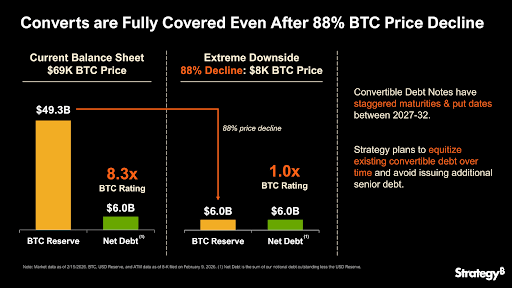
Source: Chart from Michael Saylor on X

The interesting part of the disclosure is the downside scenario. The company modeled an 88% price decline in Bitcoin, which would push BTC down to around $8,000. Under that assumption, its Bitcoin reserve would fall to roughly $6.0 billion. That figure still matches or slightly exceeds its net debt position, resulting in a 1.0x coverage ratio.

This means that even if BTC’s price were to suffer an 88% collapse from current levels, Strategy’s Bitcoin holdings would theoretically still be sufficient to cover its outstanding debt obligations on paper.

No Immediate Liquidation Risks For Strategy

Strategy’s borrowings are primarily low-interest convertible notes with staggered maturities and put dates stretching between 2027 and 2032. These are not margin loans secured by BTC that trigger automatic liquidations if BTC falls.

Since there are no margin calls associated directly with BTC price fluctuations, Strategy would not be forced to sell its BTC holdings in a sudden downturn. Instead, the company noted that it plans to equitize existing convertible debt over time. That means converting debt into company shares and avoiding issuing new senior secured debt.

Strategy is still in the business of purchasing huge amounts of Bitcoin, despite the recent price crash below $70,000. The most recent purchase was an additional 1,142 BTC for approximately $90 million in early February. Saylor even recently reiterated that Strategy plans to continue buying Bitcoin on a regular basis.

A BTC collapse to $10,000 would represent an extreme crash of 85% to 90% from recent levels. Although Strategy’s model suggests it could technically cover its net debt at $8,000 per BTC, such a scenario would dramatically shrink the value of its equity from $48.5 billion to less than $6 billion.

BTC trading at $67,856 on the 1D chart | Source: BTCUSDT on Tradingview.com

İlgili Sorular

QAccording to the article, what is the lowest Bitcoin price that Strategy (formerly MicroStrategy) claims it can withstand and still cover its debt?

AStrategy claims it can withstand a Bitcoin price drop to $8,000 and still fully cover its net debt obligations.

QWhat type of debt does Strategy hold, and why does this structure protect it from immediate liquidation in a Bitcoin price crash?

AStrategy's borrowings are primarily low-interest convertible notes with staggered maturities. They are not margin loans secured by BTC, so there are no automatic liquidation triggers or margin calls associated directly with BTC price fluctuations.

QWhat is the current BTC asset coverage ratio for Strategy, as mentioned in the article?

AUnder present conditions, with a Bitcoin price of around $69,000, Strategy has an 8.3x BTC asset coverage ratio.

QWhat is Michael Saylor's and Strategy's stated plan for their existing convertible debt?

AThe plan is to equitize the convertible debt over the next 3 to 6 years, which involves converting the debt into company shares and avoiding issuing new senior secured debt.

QDespite recent market conditions, what has Strategy continued to do regarding Bitcoin?

AStrategy has continued to purchase huge amounts of Bitcoin on a regular basis, with its most recent purchase being an additional 1,142 BTC for approximately $90 million in early February.

İlgili Okumalar

When AI Traffic Surpasses Humans, How Do You Prove You're Human?

As AI-generated web traffic now surpasses human activity, the internet's foundational business models—built on human attention, browsing, and advertising—face severe disruption. AI agents crawl websites at immense scale without generating ad revenue, while AI summaries divert traffic from original content sites. In response, over 2.5 million sites are blocking AI crawlers, and protections like Cloudflare's "honeypot" traps have emerged, though advanced AI can bypass these. The collapse of traditional CAPTCHAs, which assumed machines were weaker than humans, has led to a shift toward behavioral biometrics for human verification. Companies like IBM and BioCatch now analyze unique human patterns—cursor movements, typing rhythms, keystroke dynamics, and even cognitive delays like the Stroop effect—to distinguish real users from bots. These biometric signatures are difficult to fake or alter, offering a new layer of security but raising significant privacy concerns. Two competing visions for a reliable human verification system are emerging. One, exemplified by Sam Altman’s World (formerly Worldcoin), uses centralized iris scanning to generate unique credentials, though it faces bans and criticism over unauthorized data collection. The other employs cryptographic zero-knowledge proofs, allowing users to prove they are human without revealing identity or biometric data, as advocated by Vitalik Buterin. However, decentralized approaches risk exploitation through identity renting in economically unequal regions. The central dilemma is between a scalable but privacy-invasive centralized system that permanently controls users' biometric data, and a privacy-preserving cryptographic system vulnerable to real-world economic manipulation. The author expresses a preference for the cryptographic path, arguing that despite its flaws, it avoids the irreversible biometric surveillance inherent in centralized alternatives.

Foresight News6 dk önce

When AI Traffic Surpasses Humans, How Do You Prove You're Human?

Foresight News6 dk önce

Crypto Primary Market Investment and Financing Forward-Looking Weekly Report | Stablecoin Regulation Nears Implementation, ETF Funds Continue to Withdraw, Capital Begins Betting on Payment and Cash Flow

Crypto Market Weekly Report (Jun 1-7, 2026): Capital Shifts Focus to Payments & Cash Flow Market data indicates a significant divergence: while traditional institutional funds continue exiting via BTC and ETH ETFs (recording net outflows of $1.72B and $168M this week, respectively), stablecoin supply continues growing. This suggests capital is shifting from speculative asset allocation toward defensive positioning within on-chain liquidity, awaiting new, concrete opportunities. This trend is reflected in venture capital focus. Weekly fundraising fell 27% to $302M, with investments concentrating on infrastructure with tangible revenue potential: 1. **Stablecoin Infrastructure (28% of funding):** Projects like M0 Protocol ($35M raise) are gaining attention as regulatory clarity (e.g., the GENIUS Act) nears, shifting the focus from legitimacy to building payment and settlement networks. 2. **AI Agent Infrastructure (26%):** Investments are moving from conceptual AI Agents towards the execution and economic layers required for a functional "Agent economy." Key raises include OpenRouter ($40M) and Halliday ($20M). 3. **Real World Assets (RWA) (18%):** The search for on-chain yield and cash flow drives continued interest in RWA platforms like Ondo Finance. Security threats are evolving from smart contract exploits toward key management failures, permission control issues, and regulatory execution risks (e.g., court-ordered asset freezes). **Key Takeaways:** The investment thesis is shifting from narrative-driven bets to revenue and cash-flow-generating protocols. Future attention should be on the progression of stablecoin regulations, the commercial validation of AI Agent economies, and the performance of high-revenue protocols like derivatives platforms.

marsbit13 dk önce

Crypto Primary Market Investment and Financing Forward-Looking Weekly Report | Stablecoin Regulation Nears Implementation, ETF Funds Continue to Withdraw, Capital Begins Betting on Payment and Cash Flow

marsbit13 dk önce

Buy an NFT First to Get a Ticket? The Largest World Cup Ticket Slump in History

"Ticketing Woes for 2026 World Cup: NFT 'Right-to-Buy' and High Prices Dampen Sales" Despite anticipation for the 2026 FIFA World Cup, with 48 teams and 104 matches across North America, the tournament faces significant unsold tickets, with approximately 180,000 group-stage tickets still available for resale just before kick-off. This unexpected shortfall is attributed to FIFA's controversial new ticketing strategy, which includes an NFT-based "Right-to-Buy" (RTB) system and opaque, dynamic pricing. FIFA introduced RTBs as digital collectibles (NFTs) sold on its FIFA Collect platform. An RTB grants the holder only the right to purchase a ticket for a specific match later, not the ticket itself. This two-step process, criticized for selling "scarcity" first, saw RTBs priced from tens to hundreds of dollars, generating millions in revenue for FIFA. With many tickets remaining available on official channels, the value of these prepaid purchase rights is now being questioned. Compounding the issue are ticket prices, reported to be 2 to 4 times higher than the 2022 Qatar World Cup, and up to 7 times more for marquee matches. FIFA employed dynamic pricing, common in U.S. sports, but lacked transparency on seat availability and exact locations during sales, frustrating global fans facing high travel costs. This has drawn scrutiny from regulators in New York and New Jersey. FIFA's official resale platform also drew criticism for imposing high fees—roughly 10% on sellers and 17% on buyers, allowing FIFA to profit further from secondary market transactions. While FIFA President Gianni Infantino states over 6 million tickets have been sold, the situation highlights a potential disconnect between fan enthusiasm and willingness to pay under an aggressive commercial model.

marsbit21 dk önce

Buy an NFT First to Get a Ticket? The Largest World Cup Ticket Slump in History

marsbit21 dk önce

İşlemler

Spot
Futures
活动图片





