Contract Audit Passed, Thermometer Did Not: Polymarket's 'Physical Vulnerability' Moment

marsbit2026-04-23 tarihinde yayınlandı2026-04-23 tarihinde güncellendi

Özet

According to reports, an individual manipulated temperature sensors at Paris Charles de Gaulle Airport (LFPG) on April 6th and 15th, causing brief, anomalous spikes of over 3°C. These events were allegedly orchestrated to profit from corresponding low-probability bets on the prediction market Polymarket, turning a small investment into approximately $34,000. The French national meteorological service, Météo-France, filed a criminal lawsuit after discovering signs of physical tampering. The attack required minimal technical skill; the perpetrator reportedly used a battery-powered hairdryer to briefly heat the publicly accessible sensor. Polymarket’s market for Paris temperature settles based on the day's highest recorded temperature from a data chain that runs from the physical sensor to Météo-France, to Weather Underground, and finally to its smart contract. In response, Polymarket did not void the profits or make an official statement. It silently changed the data source for its Paris market from LFPG to Le Bourget Airport (LFPB), a location with similarly unprotected sensors. This incident highlights a critical vulnerability: while the smart contracts are audited and secure, the physical data sources feeding them remain exposed and easy to manipulate.

Original Author: Sanqing, Foresight News

According to French media Le Monde, on April 6th and 15th, the meteorological sensors at Paris Charles de Gaulle Airport experienced two anomalies. The temperature surged by more than 3°C within minutes before quickly returning to normal, as if nothing had happened. Behind each anomaly, someone had placed bets on the corresponding low-probability temperature range on Polymarket in advance. From a principal of just tens of dollars, they collectively walked away with approximately $34,000 from these two incidents. The account that placed the first bet was created just two days before the anomaly occurred.
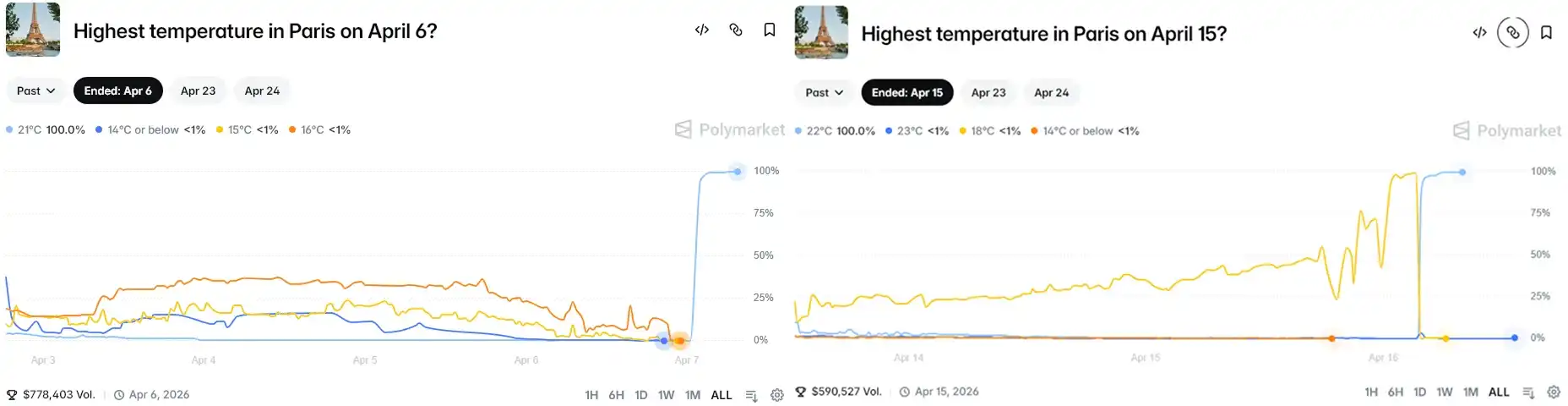
Météo-France subsequently conducted a physical inspection of the sensors and found signs of human intervention. They filed a criminal complaint with the Charles de Gaulle Airport Gendarmerie, with the charge being "interfering with an automated data processing system." According to an analysis in an AR15 forum post, based on Article 323-2 of the French Penal Code, and because Météo-France is a public institution, the related charges could carry a maximum penalty of 7 years imprisonment and a fine of 300,000 euros.

The Technical Sophistication of This Scam Is Approximately Zero

The settlement chain for Polymarket's Paris temperature market is as follows: Physical Sensor → Météo-France → Weather Underground → Polymarket Contract.

On this chain, the smart contract part is audited, data transmission is automated, and Weather Underground's data scraping is real-time. The only weak point is at the very beginning: a thermometer standing by the airport roadside, without fencing, without cameras, accessible to anyone who walks by.

All the attacker needed was a battery-powered heat gun/hairdryer.

Polymarket bases its settlement on the day's maximum temperature. This means that creating one brief temperature peak is enough to rewrite the official record for the day.

Acting in the evening or at night is more ideal, as the daytime high has usually already passed, making subsequent readings more likely to become the new record. Therefore, the suspect chose 7 PM on April 6th and 9:30 PM on April 15th.

The operational procedure was likely: buy the low-probability option in advance, walk to the sensor at night, turn on the heat gun, wait for the reading to cross the target temperature, stop, leave, and wait for on-chain settlement.

The entire operation required no technical skill whatsoever, just some understanding of the settlement mechanism and a willingness to walk to the edge of the airport.

Polymarket's Response: Quietly Swapped the Thermometer

Polymarket has not issued any official statement regarding this incident. The only thing it did was change the settlement data source for the Paris temperature market from Charles de Gaulle Airport (LFPG) to Le Bourget Airport (LFPB).
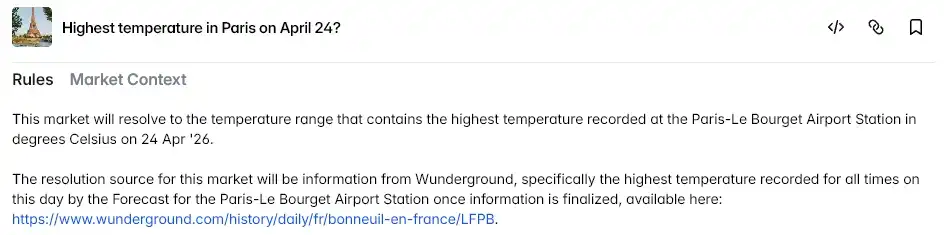
The profits from the two accounts were not revoked; the market settled normally according to the on-chain records.

The sensor at Le Bourget Airport is also placed outdoors, similarly without physical protection. They changed the address, but the problem remains entirely unchanged.

This is not Polymarket's first controversy. In October 2024, a French trader was accused of manipulating Trump election odds using 4 linked accounts, reportedly profiting $85 million; in March 2025, a whale used 5 million tokens to forcibly push through a UMA governance vote, settling a controversial market with a "Yes" outcome, involving $7 million; in January and March 2026, anomalous bets appeared in markets related to Venezuela and Iran respectively, with the latter already drawing attention from the US Congress...

Previous incidents at least required millions of dollars in capital or governance tokens; this time the cost was just a heat gun.

The Contract Was Audited, The Thermometer Was Not

This story has an absurd sense of humor. A prediction market running on the blockchain, touting decentralization and immutability, was thoroughly exploited twice by a battery-powered heat gun. Cryptography was of no help in this matter because it never verifies whether the input data is real.

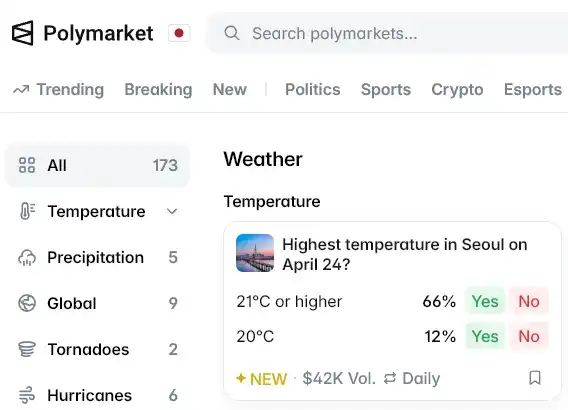
Polymarket currently has 173 active weather markets. The settlement basis for most of these markets is a single physical sensor in some location.
When a sensor is used as a meteorological tool, its credibility comes from the fact that no one has a motive to tamper with it. Polymarket gave it a new incentive structure but provided no new physical protection.

The Météo-France thermometer dutifully recorded the temperature it sensed. It just didn't know it had become a financial settlement terminal.


İlgili Sorular

QWhat was the key vulnerability exploited in the Polymarket Paris temperature market incident?

AThe physical vulnerability of the meteorological sensor at Charles de Gaulle Airport, which was unprotected and could be easily manipulated with a simple tool like a battery-powered hairdryer.

QHow did the attackers profit from manipulating the temperature sensor?

AThey placed bets on low-probability temperature ranges on Polymarket just before artificially spiking the temperature, turning a small investment of tens of dollars into approximately $34,000 in profits across two incidents.

QWhat was Polymarket's response to the temperature manipulation incidents?

APolymarket did not issue an official statement or reverse the profits. They silently changed the data source for the Paris temperature market from Charles de Gaulle Airport (LFPG) to Le Bourget Airport (LFPB), which had the same physical vulnerability.

QWhat legal consequences might the perpetrators face according to the article?

AUnder French law, specifically Article 323-2, and because Météo-France is a public institution, the charges for interfering with an automated data processing system could result in up to 7 years in prison and a €300,000 fine.

QWhat does the incident reveal about the limitations of blockchain-based prediction markets like Polymarket?

AIt highlights that while smart contracts are audited and the blockchain is secure, the system remains vulnerable if the real-world data inputs (oracles) are not physically secure and can be easily manipulated, undermining the integrity of the market.

İlgili Okumalar

As Consensus Accelerates, What Are Young Investors Betting On?

Title: As Consensus Forms Faster, What Are Young Investors Betting On? In the rapid evolution of tech investment, a new generation of young investors is navigating a landscape where AI, robotics, commercial aerospace, and quantum computing are advancing simultaneously. Traditional investment logic based on financial models is giving way to a need for deep technical understanding and the ability to act before industry consensus forms. An analysis of trends from the "WAIC FUTURE TECH" list of young investment leaders reveals key shifts in focus. The first major trend is the movement of AI from the digital screen into the physical world. Investment is shifting from large language models and chatbots towards embodied AI, robotics, AI hardware, and edge computing. While demonstrations generate excitement, the real challenge lies in achieving scalable, reliable, and cost-effective delivery in complex real-world environments like factories and logistics. Success depends not just on algorithms but on the integration of sensors, actuators, and control systems. Second, the competitive focus for large models is moving beyond raw capability toward building an "intelligence flywheel." The goal is to create self-reinforcing systems where user interaction generates data, improving the model, which in turn enhances the user experience and attracts more engagement. Companies that successfully embed AI into workflows to create these closed-loop systems can build lasting value that isn't easily erased by the next model upgrade. Third, facing a potential bottleneck in high-quality human-generated data, investors are looking at new underlying technologies. Reinforcement learning and self-play, as demonstrated by AlphaGo Zero, offer paths for AI to generate its own experience. Scientific foundation models, which aim to build general AI capabilities for fields like life sciences and materials discovery, represent a non-consensus direction that could unlock new frontiers of knowledge and data. Finally, in deep-tech areas like quantum computing, commercial aerospace, and space-based infrastructure, patient capital is essential. These fields have long, uncertain development and validation cycles involving complex engineering, supply chains, and regulations. Investment here requires a long-term view, focusing on foundational team capabilities and the eventual emergence of market demand, even if commercial returns are distant. Collectively, these trends illustrate how young investors are adapting to a new era. They are learning to make earlier, technically-informed judgments, balance hype with real-world viability, and provide the patient capital needed to build the deep-tech foundations of the future.

marsbit11 dk önce

As Consensus Accelerates, What Are Young Investors Betting On?

marsbit11 dk önce

Can Japan Buy Growth with AI? Will the Bond Market Believe It?

Japan's cabinet has introduced the 2026 Basic Policy on Economic and Fiscal Management and Reform, shifting its primary fiscal target. The new framework moves away from the traditional annual primary balance goal and instead prioritizes a stable reduction of the debt-to-GDP ratio. This change is tied to a strategy of increased "responsible proactive fiscal" spending, aiming to boost long-term growth through investments in strategic sectors like AI, semiconductors, energy, and robotics. The government estimates total public and private investment in 62 key technologies could exceed 370 trillion yen by 2040. The market reaction has been mixed and cautious. While equity markets may respond to policy signals, bond markets are focused on fiscal credibility. Concerns center on whether the weakening of the clear primary balance anchor could lead to looser fiscal discipline. If investors doubt that these strategic investments will generate sufficient productivity gains, tax revenue, and nominal growth to outpace rising interest costs, they may demand higher yields on Japanese Government Bonds (JGBs). Recent volatility in the yen and JGB yields, with the 10-year yield briefly reaching 2.9%, reflects this skepticism. The success of this new framework hinges on two factors: whether Japan can achieve a nominal growth rate consistently higher than its long-term interest rates, and whether future budgets demonstrate disciplined control over bond issuance. The government's narrative is that strategic investment is essential to break Japan's cycle of low growth, aging, and labor shortages. However, the bond market will continuously assess the credibility of this plan, pricing the risk that it may represent fiscal expansion rather than a viable growth strategy.

marsbit48 dk önce

Can Japan Buy Growth with AI? Will the Bond Market Believe It?

marsbit48 dk önce

Misjudged A-Shares: Resilience, Expectations, and Confidence

China's A-share market recently faced selling pressure, especially in tech sectors, initially triggered by a global tech sell-off that began in South Korea. However, the article argues this is a case of "mistaken injury" and highlights the market's underlying resilience. This resilience stems from three main pillars: **1) Tech Sector Fundamentals:** Unlike Korea's market dominated by a few memory chip stocks, China's tech sector is diversified across computing, communications, electronics, and semiconductors, supported by dual narratives of global AI supply chains and domestic substitution. Core areas like optical modules and fiber optics continue to show strong earnings growth. **2) "National Team" Support:** State-backed institutions and large corporations have made significant market purchases and announced buybacks, providing liquidity and signaling confidence. This is seen as a stabilizing policy signal, often associated with market bottoms. **3) Broader Market Pillars:** Other major sectors are showing endogenous recovery momentum. Consumer stocks benefit from stabilizing CPI and signs of sector recovery (e.g., liquor price hikes). Cyclical sectors like aluminum have high earnings, potential price increases due to tight supply, and low valuations. The financial sector offers stable dividends and low valuations. The conclusion is that the sell-off was driven by external contagion, not a collapse in fundamentals. With strong policy support and recovering momentum across key sectors, the A-share market possesses the toughness to regain stability.

marsbit1 saat önce

Misjudged A-Shares: Resilience, Expectations, and Confidence

marsbit1 saat önce

İşlemler

Spot
活动图片




