‘Congress must pass the Clarity Act’ – U.S. Treasury Secretary’s plea decoded

ambcrypto2026-04-09 tarihinde yayınlandı2026-04-09 tarihinde güncellendi

Özet

U.S. Treasury Secretary Scott Bessent urges Congress to pass the Digital Asset Market Clarity Act, arguing that clear federal rules are essential to prevent the relocation of crypto development to jurisdictions like Abu Dhabi and Singapore. He warns that regulatory uncertainty in the U.S. makes the risks of operating there outweigh the benefits. The call is supported by Senator Cynthia Lummis, who believes the act would serve as a "safe harbor" for innovation. However, prediction market Polymarket indicates the odds of the bill passing by 2026 have recently dropped to 57%. Despite this, key industry figures, including Coinbase's Chief Policy Officer, express confidence that legislative progress will be made.

The discussion around the CLARITY Act is intensifying day by day, and in a recent turn of events, U.S. Treasury Secretary Scott Bessent has also stepped in.

Urging Congress, Secretary Bessent has demanded the passage of the Digital Asset Market Clarity Act. Introduced in 2025, the bill is still finding common ground with both the crypto industry and the banking community, but consensus remains elusive.

Remarking on the same, Bessent said,

Congress must pass the Clarity Act. Senate floor time is scarce, and now is the time to act.

U.S. Treasury Secretary Scott Bessent’s point of argument

As reported by The Wall Street Journal, the Secretary drew comparisons with other countries, calling for clear federal rules for digital assets. This, in turn, he believes, would enable widespread developments and efficient investment, crucial for the largest economy by nominal GDP to prevail.

Comparing the U.S. with other countries, Bessent added,

A growing share of crypto development relocated to places ​with clear rules, such as Abu Dhabi and Singapore. Abroad, firms knew ​when and how to register, what standards to meet, and how to operate.

Highlighting the risks in the U.S., he summed it up best when he said,

The benefits of domiciling in the U.S. rarely outweighed the risks.

Needless to say, this isn’t the first time Bessent has stepped in to highlight the importance of clear rules in the digital assets space. Back in February, he had underlined that the bill would provide “great comfort to the market” in times of volatility.

Market conditions and others in support

Echoing similar sentiments, Senator Cynthia Lummis also noted,

We have the Administration, the momentum, and we’ve made bipartisan progress.

Lummis believes that the law is a one-pot solution for “developers, validators, and node operators.” And, once approved, the Act would work as “a safe harbor” to keep innovations anchored in the U.S.

All this comes on the heels of the crypto market fluctuating between $2 trillion and $3 trillion – thanks to increased volatility.

Polymarket odds

Meanwhile, the Polymarket odds for the passage of the CLARITY Act stood at 57% at the time of publication. However, if looked at carefully, the odds have dropped by 9% from their previous high, seen just weeks ago.
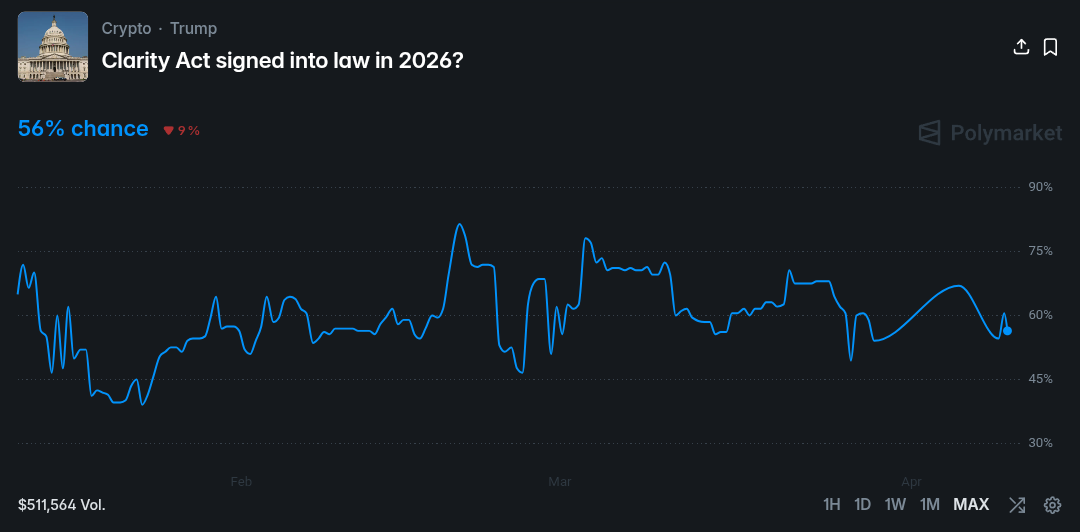
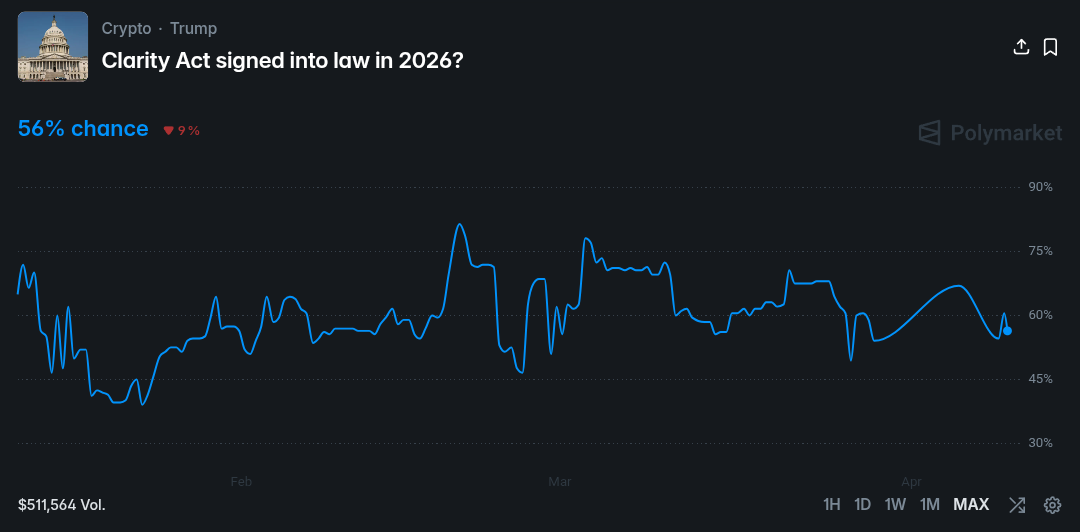
Source: Polymarket

At the same time, Coinbase’s Chief Policy Officer (CPO) also added to the ongoing demand when he noted,
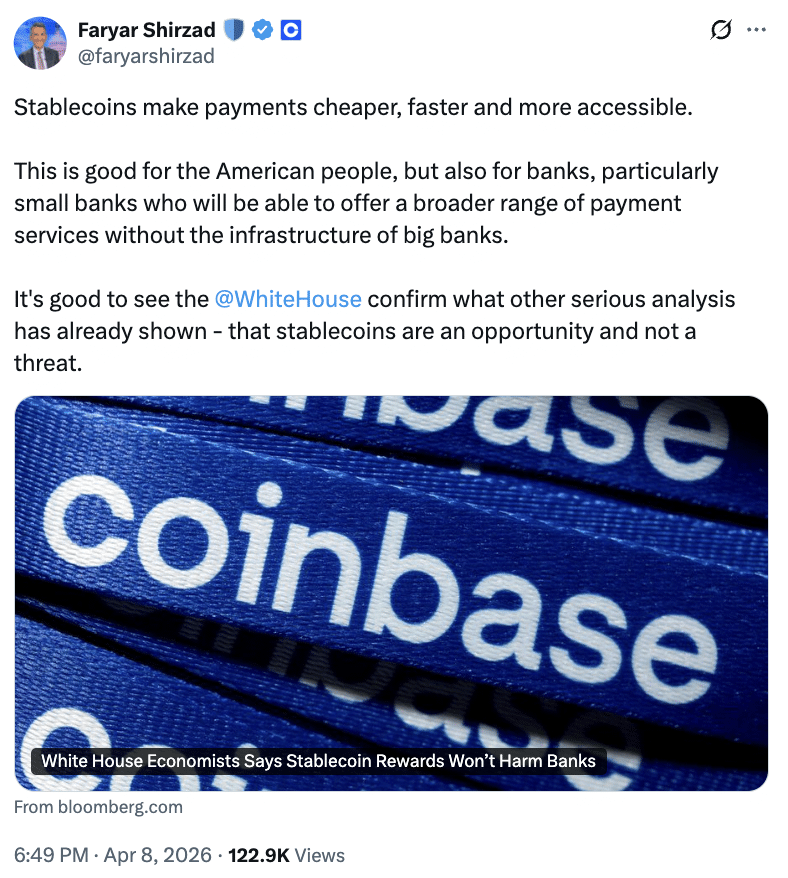
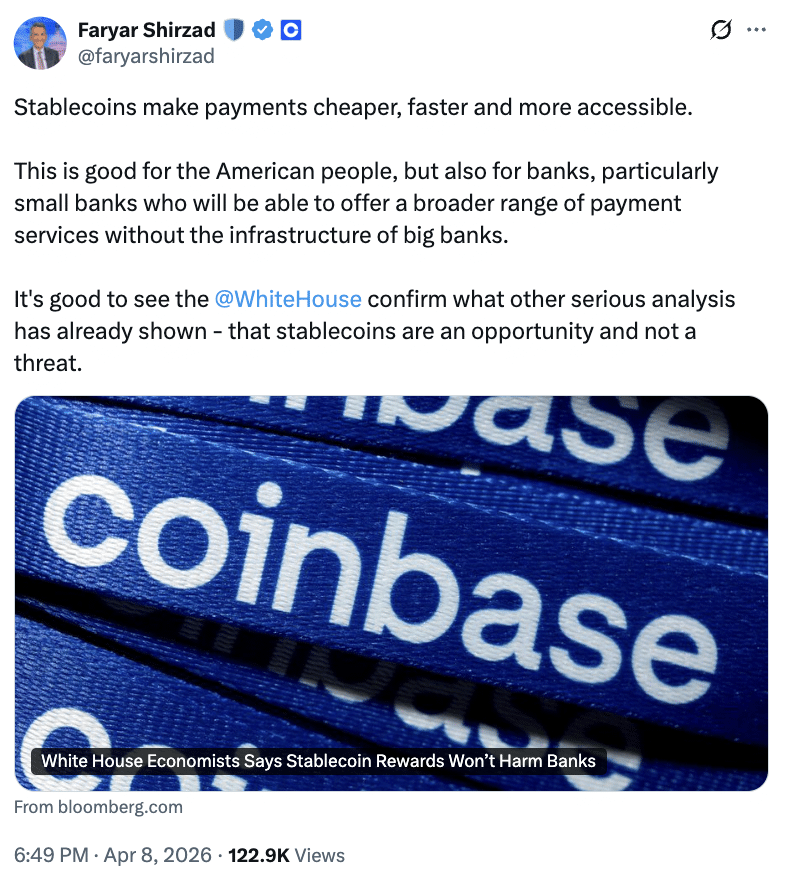
Source: X

This marks an interesting plot twist as Coinbase had recently stepped back from a recent compromise met on the CLARITY Act.

However, after the subtle threats between the White House and Coinbase, Coinbase’s CLO, Paul Grewal, turned bullish on the Act and put it best when he noted,

I’m very confident we’re going to see progress.

What’s more?

Additionally, a new report from the White House’s Council of Economic Advisers also highlighted that letting stablecoins offer yield isn’t a major threat to banks.

Thus, with so much optimism and understanding, it remains to be seen whether the CLARITY Act will be approved this year or get locked up in legislative headwinds.


Final Summary

  • The discussions around the CLARITY Act are heating up with Secretary Bessent now urging Congress to pass the Act.
  • Polymarket odds drop below 60%, adding more uncertainty to the passage of the bill by 2026.

İlgili Sorular

QWhat is the main demand made by U.S. Treasury Secretary Scott Bessent in the article?

AScott Bessent demanded that Congress pass the Digital Asset Market Clarity Act to establish clear federal rules for digital assets.

QAccording to Bessent, why are some crypto firms relocating to places like Abu Dhabi and Singapore?

ABecause these locations have clear rules, where firms know when and how to register, what standards to meet, and how to operate.

QWhat are the current Polymarket odds for the passage of the CLARITY Act, and how have they changed recently?

AThe Polymarket odds stand at 57%, which is a 9% drop from their previous high seen just weeks ago.

QWhich U.S. Senator expressed support for the CLARITY Act, and what did they call it?

ASenator Cynthia Lummis expressed support, calling the Act a 'one-pot solution' for developers, validators, and node operators, and a 'safe harbor' to keep innovations in the U.S.

QWhat was the stance of Coinbase's Chief Legal Officer, Paul Grewal, on the CLARITY Act after recent developments?

APaul Grewal turned bullish on the Act and expressed confidence, stating, 'I’m very confident we’re going to see progress.'

İlgili Okumalar

Bitcoin Withdrawals Continue: 8 Years of Storage in a Coldcard Cold Wallet Ended in Zero

Coldcard Hardware Wallet Hacked: Losses Mount Due to Vulnerable Seed Generation A critical vulnerability in Coldcard hardware wallets has led to a continued wave of fund thefts. According to Galaxy Research, the total stolen has reached 1,367.05 BTC (approx. $88.6 million) from 4,585 addresses, a significant increase from the initial 594.5 BTC reported on July 30, 2026. Most of the stolen funds remain on the attackers' addresses. The issue is not with the current firmware, which Coinkite has updated, but with seed phrases generated on vulnerable devices between March 2021 and the release of fixed firmware versions. Due to a programmer error, devices switched from using a hardware random number generator to the software-based Yasmarang generator, which was initialized with publicly accessible data like the chip's serial number. This made the seed phrases predictable through offline brute-force attacks, meaning wallets remain at risk until funds are moved to a new wallet generated with the patched firmware. Affected devices include Mk2/Mk3 with firmware 4.0.1–4.1.9 (and up to 5.0.3), Mk4/Mk5 up to version 5.6.0, and Q models up to 1.5.0Q. The only exceptions are seeds created with a high-entropy method like at least 50 independent dice rolls or a strong unique BIP-39 passphrase. All other owners must generate a new seed on the fixed firmware and transfer their assets. A case highlighting the human impact involves a 39-year-old long-term investor who lost 2 BTC (approx. $130,000) in minutes. He had accumulated the Bitcoin over eight years through physical labor, viewing it as a financial lifeline and a retirement plan in a country suffering from hyperinflation. His story underscores that even conservative "buy and hold in cold storage" strategies can be compromised by such underlying technical flaws. From a technical perspective, this incident echoes historical failures where weak random number generators undermined cryptographic security, challenging the assumption that offline storage is automatically foolproof.

cryptonews.ru1 saat önce

Bitcoin Withdrawals Continue: 8 Years of Storage in a Coldcard Cold Wallet Ended in Zero

cryptonews.ru1 saat önce

İşlemler

Spot
活动图片





