Confirmed: GPT-5.5 "Brain Drain" Exposed, OpenAI's Own Documentation Admits It

marsbit2026-05-27 tarihinde yayınlandı2026-05-27 tarihinde güncellendi

Özet

Summary: Evidence emerges that OpenAI's GPT-5.5 may be "silently" switching to a less capable model during use. Users report that after roughly two hours, the GPT-5.5 Extended Thinking model begins responding instantly with significantly degraded output quality, while the interface continues to display the premium model's label. Complaints on developer forums describe a loss of instruction-following ability and poor code quality, with even the highest "xhigh" tier affected. This is corroborated by an OpenAI help document stating that after Plus users exceed 160 messages per 3 hours, the system "silently" switches to a "mini" model without any user notification. Pro users also report "heavy thinking" modes being throttled during high server loads. Trace commands from earlier incidents have shown users requesting GPT-5.3 Codex but receiving GPT-5.2 outputs. OpenAI acknowledged performance degradation in mid-May, marking it resolved, but user reports surged again in late May. The pattern mirrors past controversies with GPT-5, 5.2, 5.3, and 5.4 releases, where each update was followed by user complaints of reduced capability. The article suggests cost-cutting on compute may be a factor, noting that while GPT-5.5 users struggle, GPT-5.6 is already being tested internally.

[Introduction] GPT-5.5 exposed for "fake thinking," secretly switched to 'mini' after two hours of use. $200 monthly fee buys you a "Schrödinger's brain." Trace command provides concrete evidence, official documentation personally acknowledges. Users are flocking to complain: OpenAI, who are you trying to fool?

ChatGPT has been caught "dumbing down" again!

Just in the last couple of days, it blew up on X first.

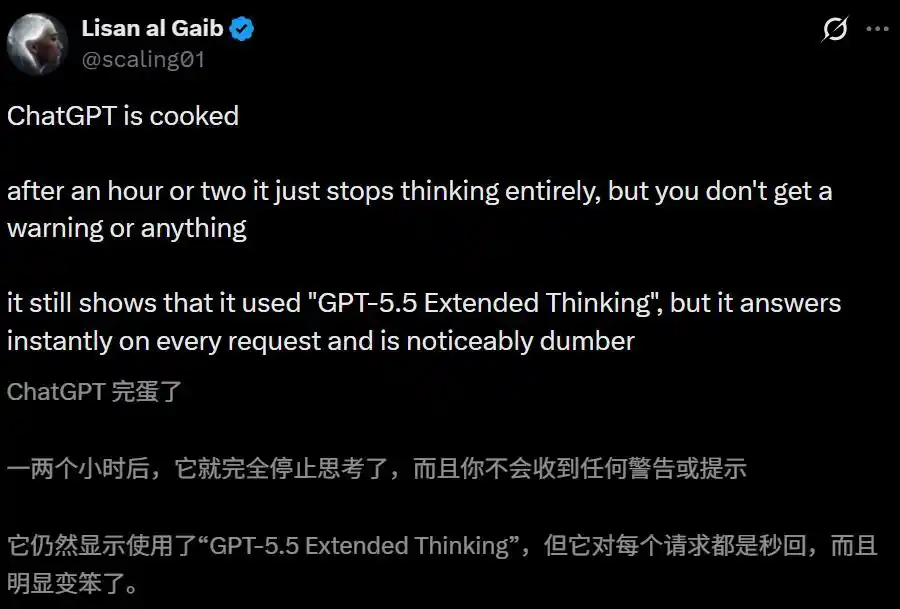
User Lisan al Gaib discovered that after using GPT-5.5 for an hour or two, it suddenly became stupid, with every request answered instantly and quality plummeting off a cliff.

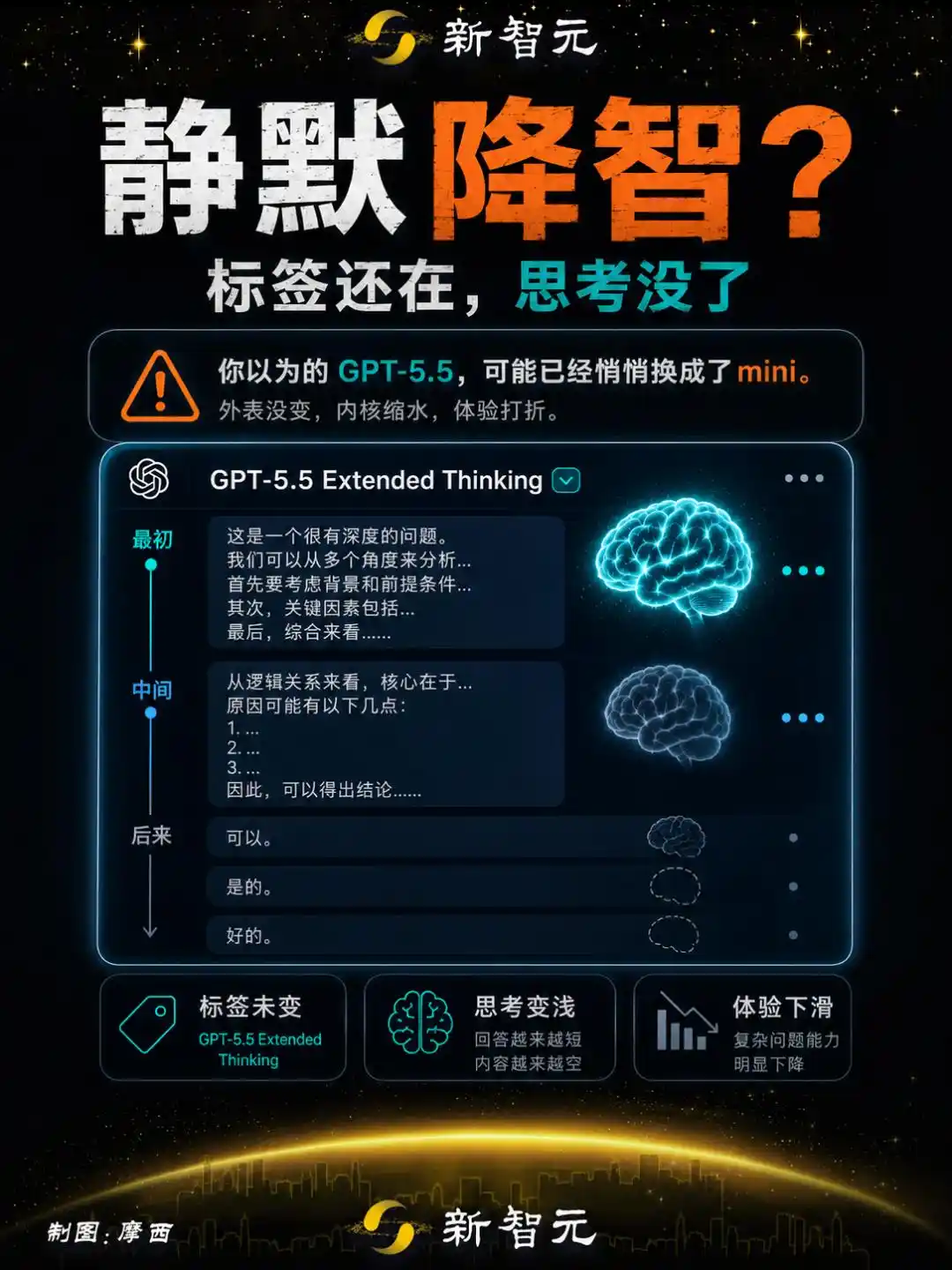
Yet the interface still displayed "GPT-5.5 Extended Thinking."

In other words, the thinking label was still there, but the thinking itself had vanished.
$200/month for a "Schrödinger's Model"

On the OpenAI developer forum, a complaint post blew up simultaneously.

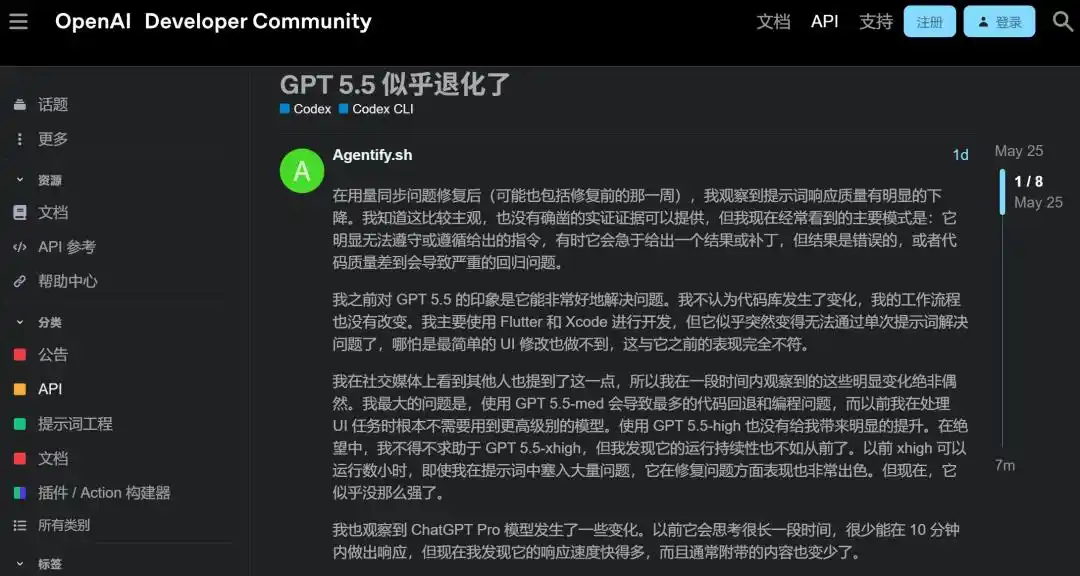
Agentify.sh stated that GPT-5.5 would suddenly lose its ability to follow instructions during use.

Watching it excitedly announce it was "fixed," only to produce code so poor it triggered a mass rollback.

UI tasks that the previous 5.5-med could handle easily now couldn't even manage the simplest changes.

Upgrading to 5.5-high didn't work. Upgrading again to xhigh, still no luck.

And xhigh, which used to run for several hours, now clearly lasted a shorter time.
As soon as the post went up, the replies exploded.

Some directly reverted to 5.4.

One used the highest tier, xhigh, but found it "clearly worse than last week, frequent errors on long tasks, not following the workflow at all."

One reported an even more bizarre situation: "Simple queries also take ages to process, and if you interrupt to correct its direction, it completely ignores you and continues with its previous incorrect plan."

That's right, everyone was describing the same phenomenon—GPT's brain had been swapped out at some unknown point.

GPT-5.5's current performance is on par with 5.3, no exaggeration. It was amazing the first few days, but now you can't find a trace of that original model.
Not an illusion, OpenAI spells it out in black and white

To verify, Lisan al Gaib conducted a comparative test.

Same account, Extended Thinking on the ChatGPT side produced garbage, but switching to xhigh on the Codex side immediately restored normal performance.

In his own words, Codex was "literally 4 billion times smarter than this thing."

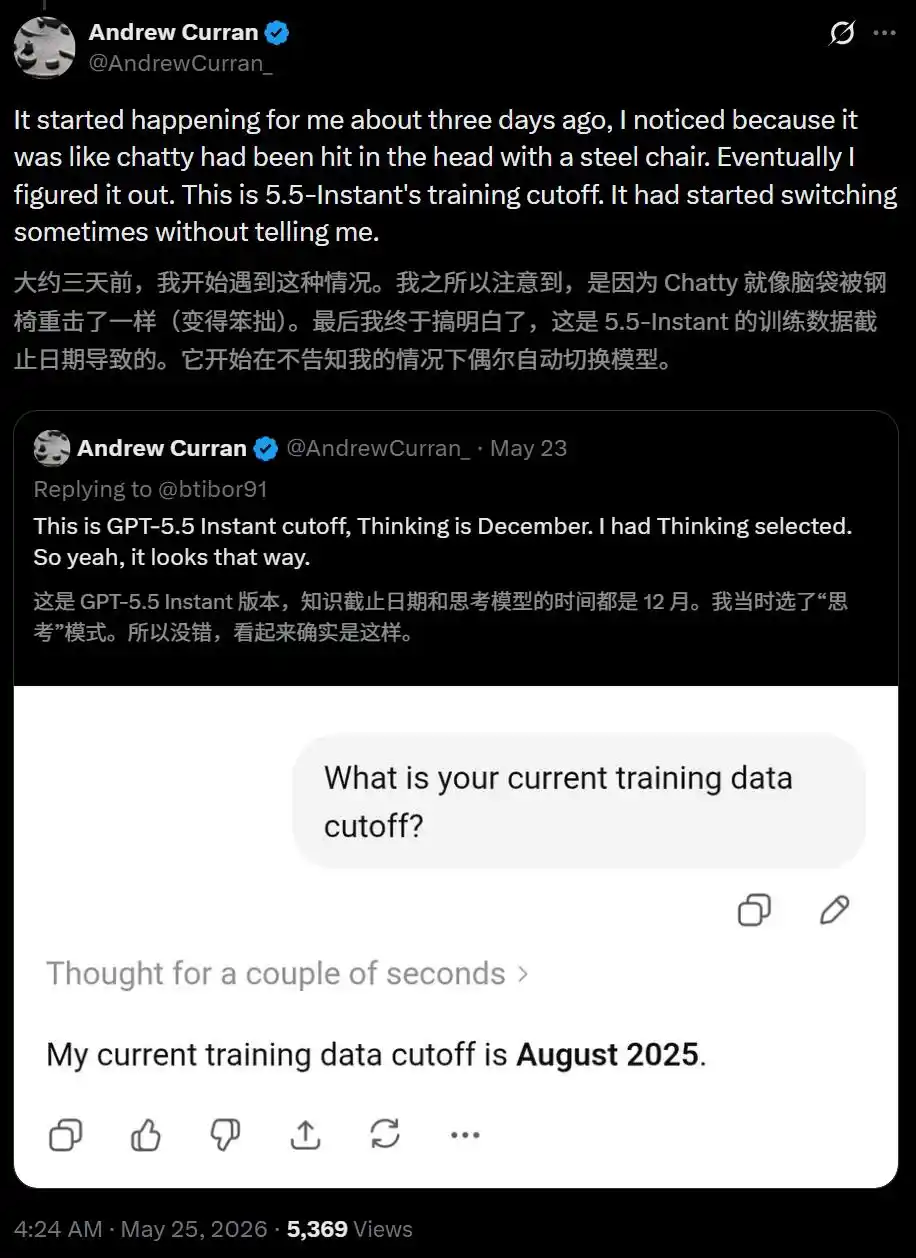
Developer Andrew Curran came up with a clever trick—directly asking the model, "What is the cutoff date for your training data?"

The model answered: August 2025.

The problem? The cutoff date for GPT-5.5 Thinking is December. August is the cutoff date for the Instant version!

In other words, he selected Thinking, but the system actually ran Instant for him.

Not a single word of the model label on the interface changed, but the model behind it had been secretly swapped......
The funny thing is, this time OpenAI itself nailed the coffin shut for users in its own help documentation.

According to the official explanation in the OpenAI Help Center, Plus users can send a maximum of 160 GPT-5.5 messages every 3 hours.

After that quota is used up, the system will silently switch to the mini model until the quota resets.
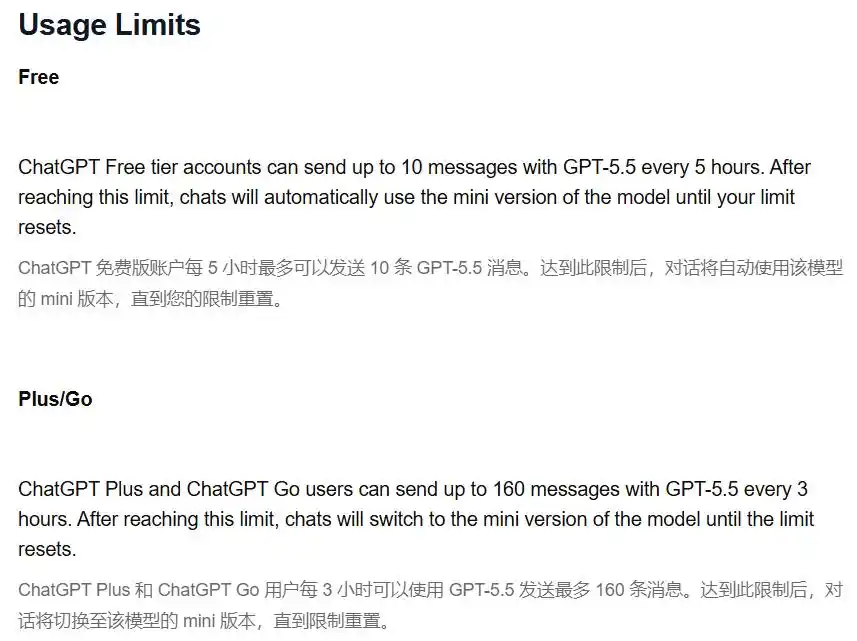
Note the word "silently."

No pop-up notification, no change in the model label, no visual feedback whatsoever.

You still think you're using the flagship model, while on the other end it has quietly been replaced with mini.

Pro users, don't celebrate too soon either.

Heavy thinking mode, the top reasoning tier exclusive to Pro users, is also subject to capacity throttling when server load is high. Again, without any warning.

In other words, a $200/month Pro subscription buys you a service that can be "switched out" at any moment.
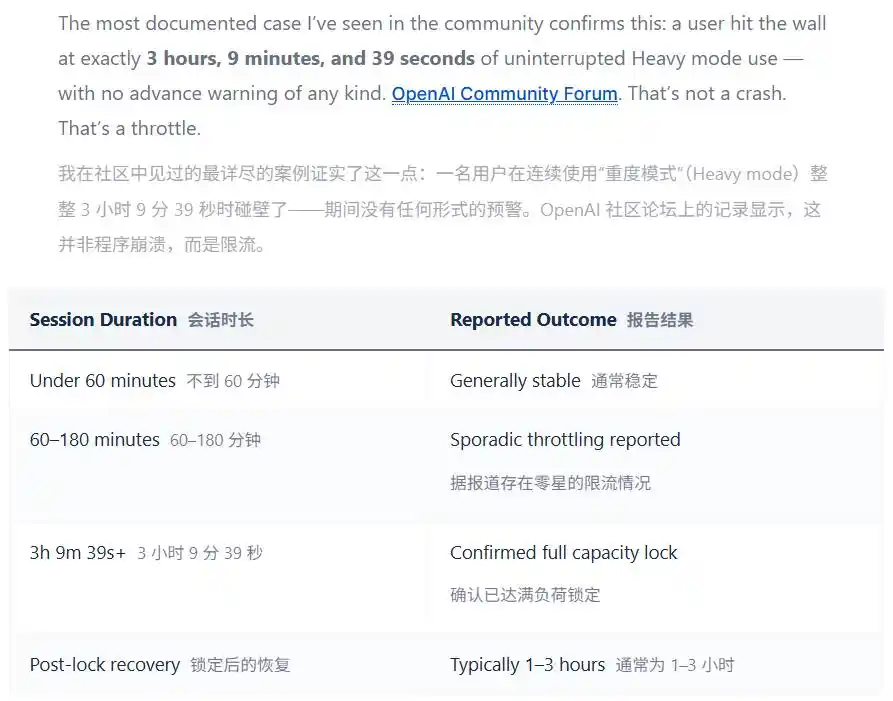
This kind of "label unchanged, brain swapped" operation was caught even earlier on the Codex side.

In February this year, an issue appeared on GitHub where a Pro user used a trace command to discover that they were requesting GPT-5.3 Codex, but the actual model returned was GPT-5.2.

Not even 5.2 Codex, but the lower-tier base 5.2.
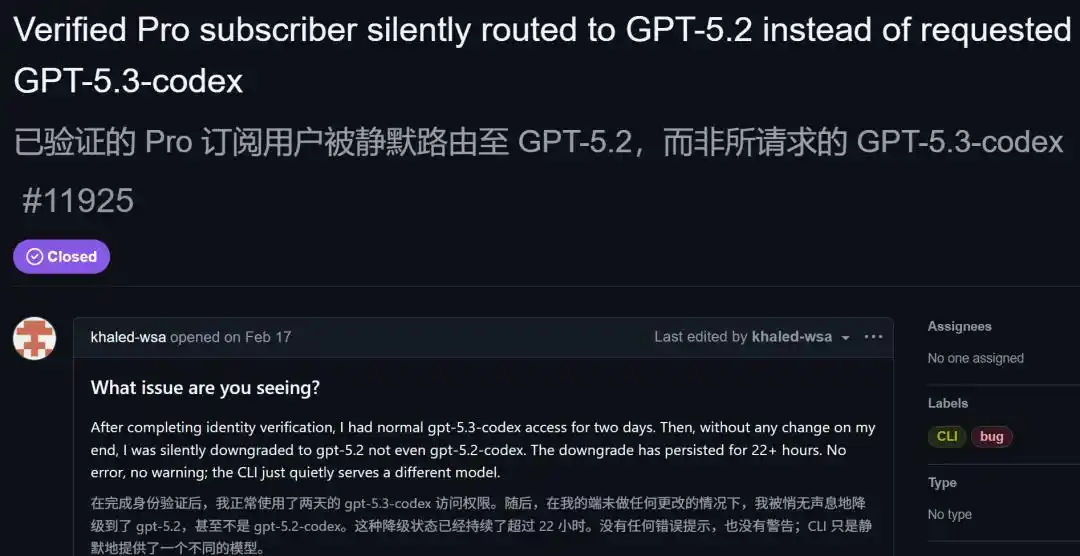
He posted the reproduction command:

  • RUST_LOG='codex_api::sse::responses=trace' codex exec --skip-git-repo-check -s read-only -m 'gpt-5.3-codex' 'hi' 2>&1 >/dev/null | rg -o --replace '$1' '"model":"([^"]+)"' | head -n1
  • Output: gpt-5.2-2025-12-11
  • Expected: gpt-5.3-codex

Multiple Pro users confirmed the same downgrade under the same issue.

And this kind of downgrade is "sticky," it doesn't revert on its own, and there's no explanation.

Even on the day GPT-5.5 was released in April, there were user reports that the speed of Fast mode was similar to Standard, but billing was still at the Fast rate.

A simple task took 7 minutes and 49 seconds, when normally it should be 5-6 minutes.

OpenAI admitted it, and then... nothing

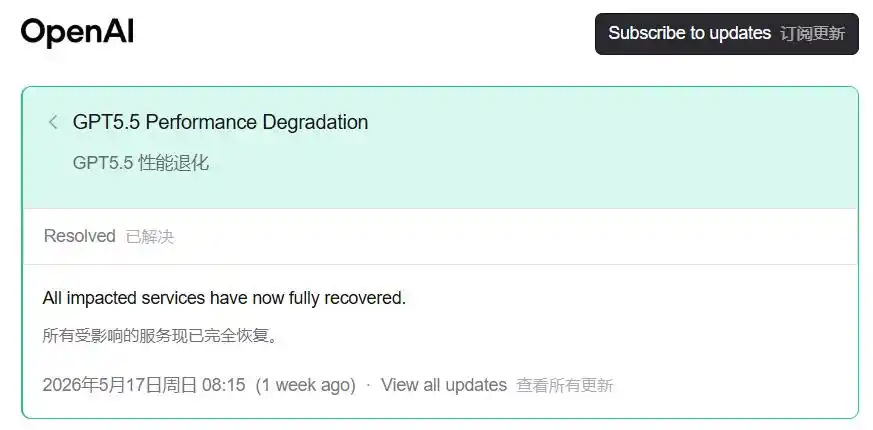
On May 15, a record appeared on OpenAI's status page.

GPT5.5 Performance Degradation, We are investigating reports of performance degradation for GPT-5.5 from some users.

On May 17, the status was updated to "Resolved."

But judging from the timeline of forum posts, complaints about "brain drain" from May 24-26 were even more intense than the wave on May 15.

Either the "resolved" problem came back, or it was never truly solved in the first place.
Every upgrade comes with a "brain drain controversy"

While all companies face complaints about their models "getting dumber," OpenAI hasn't missed a single one with every update from GPT-5 to GPT-5.5.

Every time OpenAI says it's investigating, every time it says it's resolved, and then continues with the next version.

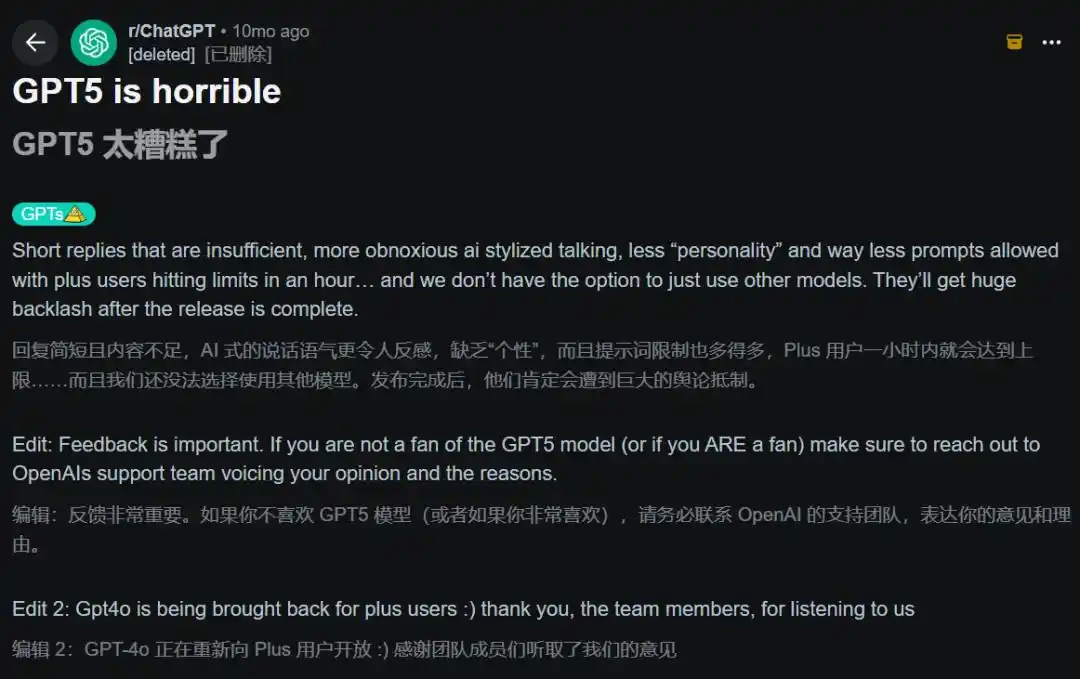
August 2025, GPT-5's debut. The hot post on Reddit was titled directly "GPT-5 is so bad." Users complained about short replies, more refusals, less personality.

OpenAI was forced to urgently restore the GPT-4o option. Altman personally admitted in a Reddit AMA, "bumpier than we expected."
December 2025, GPT-5.2. Translation quality regressed, fabricated non-existent APIs, refused to execute style instructions that 5.1 could easily handle.

February 2026, GPT-5.3-Codex. Pro users silently downgraded to 5.2, trace command confirmed.

March 2026, GPT-5.4. A post titled "GPT-5.4 has clearly regressed in Codex" appeared on the OpenAI community forum, with all replies confirming.

Early May 2026, GPT-5.5 Instant launched. Reply length shortened by 30%, emojis almost disappeared. User summary: Accuracy improved, but warmth vanished.
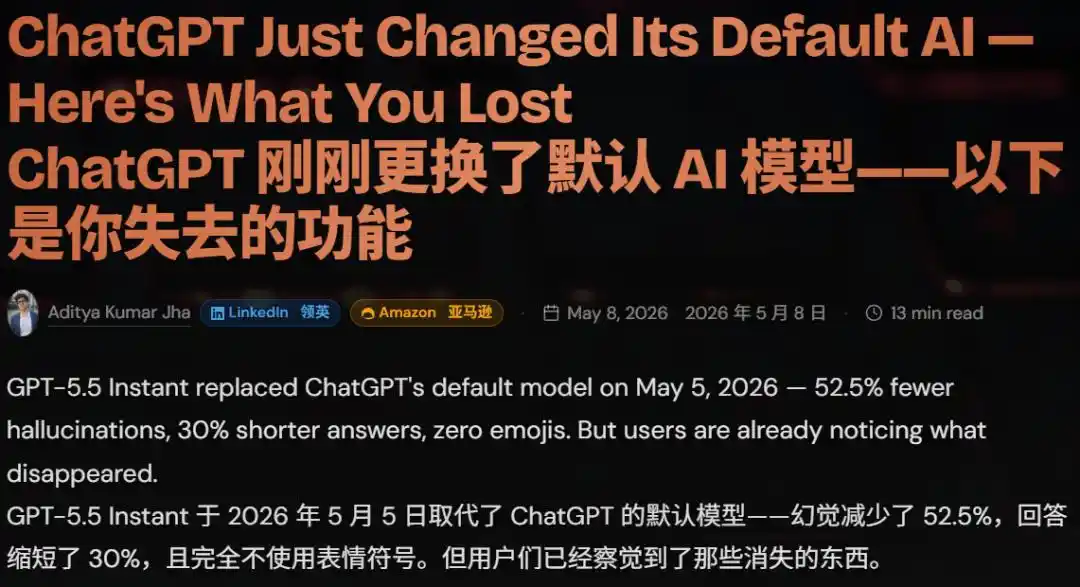
Late May 2026, now. Complaints about Thinking mode "brain drain" erupted again.

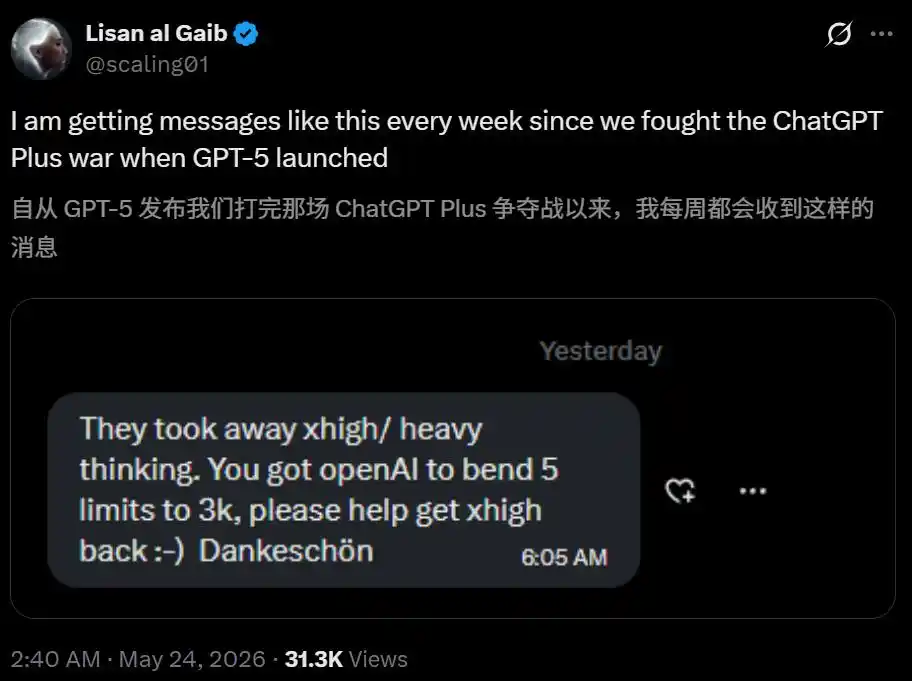
Lisan al Gaib revealed that since he led the fight for ChatGPT Plus quotas during GPT-5's release, "I receive DMs like this every week."

The latest one was someone asking him to help get their xhigh/heavy thinking back.
The day it benchmarks strongest is launch day

chatgptdisaster.com compiled 1087 verified user complaints, one frequently mentioned scenario is "routing layer failure," where the UI shows GPT-5.5 Pro, but the output is completely from another tier.

Users describe a reproducible pattern: after a long session, the model starts "completely ignoring what you say," but the top-tier label is still hanging on the model selector.
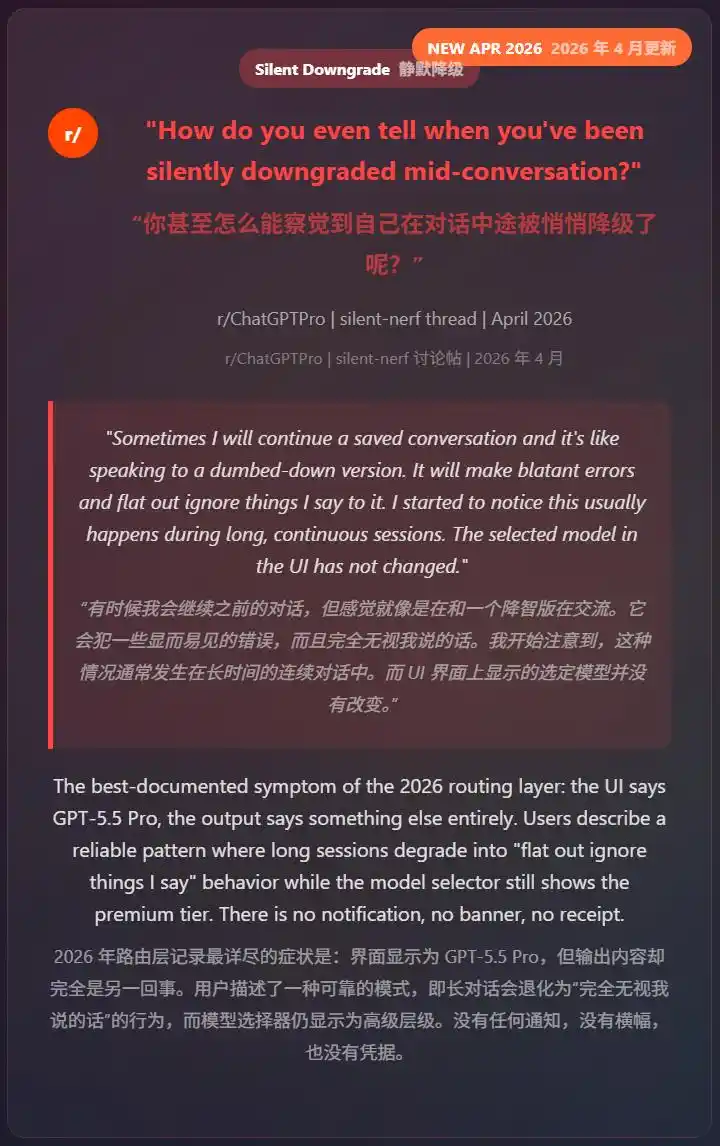
The most absurd footnote is that the mechanism for Plus users automatically switching to mini after using 160 messages/3 hours is described as a "feature" in OpenAI's official documentation.

Why is this happening? Lisan al Gaib's analysis suggests the answer is two words: cost-saving.

The crunch on compute power and profitability is affecting everyone. Cutting corners everywhere, not missing any opportunity to save a buck.

Yet, in the same week GPT-5.5 users were collectively complaining, traces of GPT-5.6 had already appeared in Codex backend logs.

Internal codename iris-alpha, 1.5 million token context, Polymarket gave an over 85% probability for a June release.

On one side, 5.5 users can't even secure a basic experience; on the other, 5.6 is already quietly running real traffic in the background.

This is the 2026 ASI race.

The speed of creating new models is getting faster and faster, but making an old model run a single session properly is getting harder and harder.

The day it benchmarks strongest is always launch day, and every day after is Schrödinger's GPT.

Reference: https://x.com/scaling01/status/2058643470357590058?s=20

This article is from the WeChat public account "AI Era," author: ASI Apocalypse; Editor: Moses

İlgili Sorular

QWhat is the main issue reported by users regarding GPT-5.5?

AUsers report that after using GPT-5.5 for a short period, its performance degrades significantly, with responses becoming instant and of much lower quality, while the interface still shows the 'GPT-5.5 Extended Thinking' label, indicating a silent model switch.

QAccording to the article, what does OpenAI's official documentation reveal about user limits?

AOpenAI's official Help Center documentation states that Plus users are limited to 160 GPT-5.5 messages every 3 hours. Once this limit is reached, the system silently switches to a mini model until the quota resets, with no visual indication to the user.

QHow did developers verify that they were receiving a different model than selected?

ADevelopers used methods like comparing outputs between ChatGPT and Codex endpoints, asking the model for its training data cutoff date (which revealed an instant model date when thinking was selected), and using trace commands that showed the actual model returned was a lower-tier version than requested.

QWhat pattern does the article describe regarding OpenAI's model updates?

AThe article describes a recurring pattern where each major model update (GPT-5, 5.2, 5.3, 5.4, 5.5) is followed by widespread user complaints about performance degradation. OpenAI typically acknowledges and investigates the issue, but complaints resurface with subsequent releases.

QWhat reason does the article suggest is behind these performance issues and silent model switches?

AThe article suggests the primary reason is cost-saving. It cites an analysis stating that 'compute and profitability constraints are affecting everyone,' leading OpenAI to silently downgrade models to manage costs, even for users paying high subscription fees.

İlgili Okumalar

Morning Post | Michael Saylor Releases Bitcoin Tracker Info; Aave Publishes Kelp rsETH Bridge Attack Post-Incident Investigation; Gravity Bridge Announces Service Suspension Following Attack

ChainCatcher Daily Summary - June 1, 2026 In regulatory news, the U.S. OCC granted preliminary conditional approval for Laser Digital to establish a federally regulated trust bank. In Vietnam, a draft law amendment proposes allowing SMEs to use digital and virtual assets as loan collateral. Hong Kong's SFC chairman reported that trading volume on the city's 12 licensed virtual asset platforms grew nearly 300% YoY in Q1 2026. Notable incidents include the Cosmos ecosystem cross-chain bridge Gravity Bridge pausing services after an attack. Aave published a post-mortem on the April 18th Kelp rsETH bridge attack, attributing it to a third-party bridge infrastructure vulnerability via an RPC poisoning attack, not the Aave protocol itself. In market developments, MicroStrategy's Michael Saylor hinted at a potential upcoming Bitcoin purchase announcement. Fed Governor Waller commented that widespread stablecoin adoption could amplify the impact of U.S. monetary policy. Meanwhile, sentiment analysis from Santiment indicates a record-high Bitcoin long/short ratio of 2.23, potentially signaling a short-term price correction, while Ethereum shows signs of FUD among commentators. In legal matters, the SEC sued the founder of Privvy Investments for an alleged $12.3 million crypto AI trading bot scam. In China, a Qingdao man was sentenced to 10 years and 9 months for stealing 107 BTC by obtaining a victim's wallet seed phrase. Top trending meme tokens on ETH, Solana, and Base networks for the past 24 hours are also listed.

链捕手42 dk önce

Morning Post | Michael Saylor Releases Bitcoin Tracker Info; Aave Publishes Kelp rsETH Bridge Attack Post-Incident Investigation; Gravity Bridge Announces Service Suspension Following Attack

链捕手42 dk önce

Alibaba 'Stocks Up', ByteDance 'Trains'

"In late May, two closely timed events in China's AI industry clearly revealed the divergent strategic approaches of two tech giants: Alibaba and ByteDance. Alibaba is aggressively integrating AI into its existing commercial ecosystem, prioritizing immediate monetization. Its Qwen App now fully integrates with Taobao, leveraging the platform's 4-billion-item database for AI-powered shopping features like virtual try-on and price comparison. Internally, Alibaba has reorganized to incentivize AI-driven business growth, notably through the 'Agentic Commerce Trust Protocol' to enable AI-agent transactions. Financially, it emphasizes ROI, with CEO Daniel Wu stating every AI chip purchased is generating revenue. Alibaba's strategy bets that foundational AI model capabilities won't be leapfrogged in the next five years, allowing its 'AI-as-a-utility' approach to succeed. In stark contrast, ByteDance's Seed division focuses on pushing the frontiers of AGI with a long-term, research-oriented mindset. Its video generation model, Seedance 2.0, topped international benchmarks. The division, led by researchers Wu Yonghui and product head Zhu Wenjia, is tasked with 'exploring the upper limits of intelligence,' even considering open-sourcing its models—a rare move among Chinese firms. ByteDance is investing heavily, with reports of its 2026 capital expenditure plan being nearly triple that of 2024, funded by its substantial private profits. This allows it to pursue projects like an 8-month research paper questioning if video models are true 'world models,' devoid of immediate commercial pressure. The core divergence is less about corporate philosophy and more about structural constraints. As a publicly traded company, Alibaba is bound to quarterly financial expectations, forcing a pragmatic, revenue-focused AI integration. As a private entity, ByteDance has the luxury to fund long-term, high-risk foundational research without answering to public markets. The article concludes that the true determinant of a Chinese company's AI path is its IPO status, suggesting that if ByteDance were public, or if Alibaba were private, their strategies might well be reversed."

marsbit2 saat önce

Alibaba 'Stocks Up', ByteDance 'Trains'

marsbit2 saat önce

Why More AI Agents Does Not Equal Higher Productivity?

Editor's Note: As AI Agents become cheaper and easier to use, a new constraint emerges: the cost isn't in launching more Agents, but in the human attention required to manage, judge, and integrate their outputs. This hidden cost is called the "orchestration tax." The article argues that a developer's cognitive bandwidth is the key bottleneck—a serial, non-parallelizable resource akin to a Global Interpreter Lock (GIL). While many Agents can run concurrently, their results ultimately require human judgment for review, conflict resolution, and final integration. Therefore, more Agents don't automatically mean higher productivity; they can simply create longer queues, lead to cognitive fatigue, and create the illusion of busyness without real output. The core solution is to design workflows around this scarce human attention. Key strategies include: scaling the number of Agents to match review capacity (not UI capacity), categorizing tasks (delegating independent ones, keeping complex judgment-heavy ones serial), batch reviewing results to minimize context-switching costs, automating verifiable checks to reserve human judgment for critical decisions, and protecting focused, uninterrupted thinking time. Ultimately, the critical skill is not launching many Agents, but architecting systems that respect the fundamental limit of human attention. Unpaid "orchestration tax" accumulates as both technical and cognitive debt, undermining system understanding and quality. True productivity comes from thoughtfully managing the single-threaded resource—your focus.

marsbit3 saat önce

Why More AI Agents Does Not Equal Higher Productivity?

marsbit3 saat önce

İşlemler

Spot
Futures
活动图片





