Compliance, Liquidity, Distribution: Where is the Real Battlefield for Stablecoin Issuance?

Odaily星球日报2026-01-26 tarihinde yayınlandı2026-01-26 tarihinde güncellendi

Özet

"Stablecoin Issuance: Where is the Real Battlefield? Compliance, Liquidity, and Distribution" The stablecoin market is evolving into application-level financial infrastructure. With clearer regulations like the GENIUS Act, major brands are shifting from integrating existing stablecoins like USDC to launching their own white-labeled dollar tokens through "issuance-as-a-service" platforms. While the core technical ability to mint a token is becoming commoditized, the real competition lies in three key areas: regulatory compliance, liquidity operations, and distribution channels. The market is stratified. For enterprises and financial institutions, the key differentiator is trust, compliance, and large-scale redemption reliability. For fintechs and consumer wallets, it's speed-to-market and integrated services like on/off-ramps. For DeFi and investment platforms, it's composability and programmable yield. . True pricing power and defensibility for issuers now come not from the token creation itself, but from bundled services, regulatory positioning, and the ability to provide liquidity. The potential for a lasting moat may lie in network effects from becoming a default interoperability standard, though it's unclear if value will be captured by individual issuers or neutral protocols. The token is merely the foundation; the business model built around it is the core.

Author | Chuk(Former Paxos Employee)

Compiled by | Odaily Planet Daily(@OdailyChina)

Translator | DingDang(@XiaMiPP)
Introduction: Everyone is Issuing Stablecoins

Stablecoins are evolving into application-level financial infrastructure. Following the introduction of the GENIUS Act and clearer regulatory frameworks, brands like Western Union, Klarna, Sony Bank, and Fiserv are shifting from "integrating USDC" to "launching their own dollars" through white-label partnership issuances.

Supporting this shift is the explosive growth of "issuance-as-a-service" platforms. A few years ago, Paxos was almost the only choice on the market; today, depending on the project type, there are over 10 viable paths, including new platforms like Bridge and MoonPay, compliance-first players like Anchorage, and industry giants like Coinbase.

The increase in choices makes stablecoin issuance seem like a capability that is being commoditized—at least at the underlying token architecture level, this is true. But "commoditization" depends on who the buyer is and the specific task to be accomplished. Once the underlying token operation is separated from liquidity operations, regulatory compliance stance, and peripheral capabilities (on/off ramps, treasury management, account systems, card services), this market no longer resembles a price war, but rather a layered competition: the truly difficult-to-replicate "outcomes" are where pricing power is most likely to concentrate.

In other words: Core issuance capabilities are converging, but in areas with high operational outcome requirements like compliance, redemption efficiency, launch time, and bundled services, suppliers are not easily replaceable.
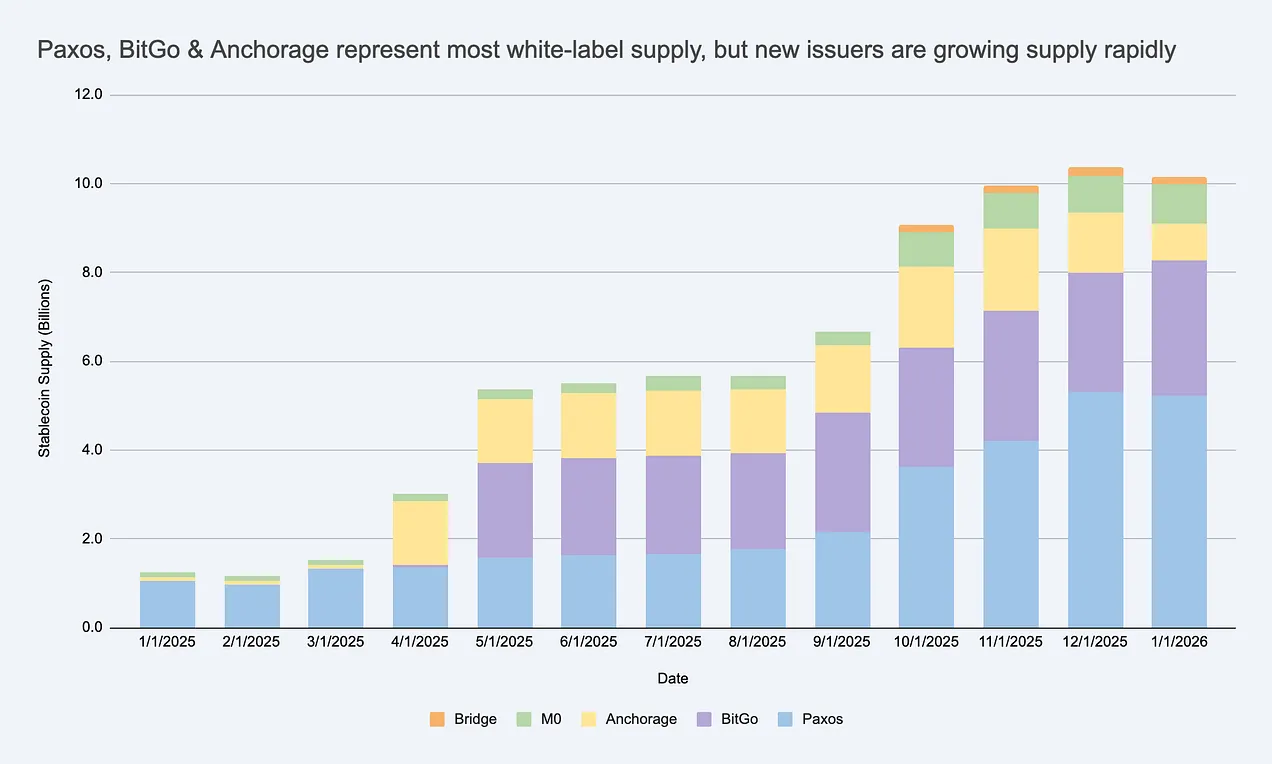
The supply of white-label stablecoins is growing rapidly, creating a vast issuer market beyond USDC/USDT. Source: Artemis

If you view issuers as completely interchangeable, you will miss where the real constraints lie and misjudge where profits might be retained.

Why Do Companies Launch Their Own Branded Stablecoins?

This is a reasonable question. Companies are primarily motivated by three aspects:

  • Economic Benefits: Retain more value from customer cash flows and balances, and expand peripheral revenue sources (treasury management, payments, lending, card services).
  • Behavioral Control: Embed customized rules and incentive mechanisms (e.g., loyalty programs), and independently decide清算 paths and interoperability to match their own product forms.
  • Accelerate Time-to-Market: Stablecoins allow teams to launch new financial experiences globally without rebuilding the entire banking system.

It is worth noting that most branded stablecoins do not need to grow to the size of USDC to be considered successful. In closed or semi-open ecosystems, the core metric may not be market capitalization, but rather ARPU (Average Revenue Per User) or improvements in unit economics—that is, how much new revenue, increased retention, or efficiency gains the stablecoin functionality brings to the business.

How Does White-Label Issuance Work? Deconstructing the Tech and Operations Stack

To judge whether issuance is "commoditized," one must first clarify the division of labor: reserve management, smart contracts and on-chain operations, and distribution channels.
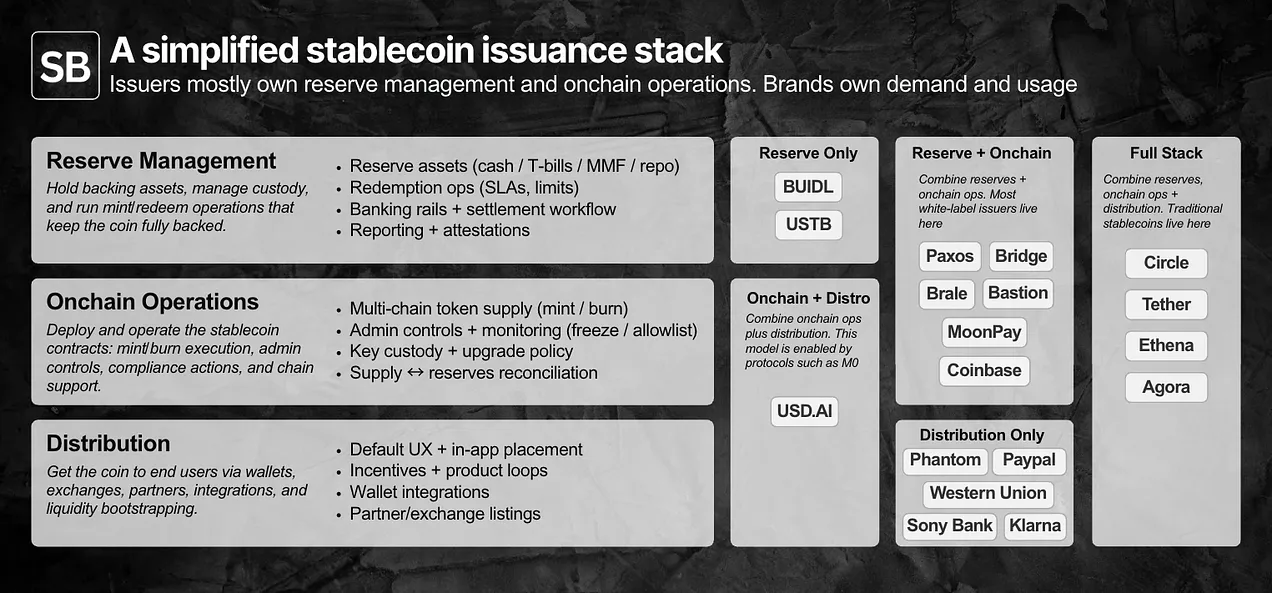
The issuer typically controls the reserve and on-chain operations; the brand controls demand and distribution. The real differences lie in the details.

The white-label issuance model allows brands to launch and distribute their own stablecoins while outsourcing the first two layers to a "issuer-of-record."

In practice, responsibilities are roughly split into two categories:

  • Primarily controlled by the brand: Distribution and use cases (distribution channels)—including where the stablecoin is used, the default user experience, wallet entry points, and which partners or platforms support it.
  • Primarily controlled by the issuer: Issuance operations. The smart contract layer (token rules, admin privileges, mint/burn execution) and the reserve layer (asset composition, custody, redemption process).

From an operational perspective, these capabilities are now mostly productized via APIs and dashboards, with launch cycles ranging from a few days to several weeks depending on complexity. Not all projects need a US-compliant issuer today, but for institutions targeting US enterprise customers, even before the full implementation of the GENIUS Act, compliance capability itself has become part of the product.

Distribution is the hardest part. Within a closed ecosystem, getting the stablecoin used is primarily a product decision; but in open markets, integration and liquidity are the bottlenecks. Here, issuers often step in with secondary liquidity support (exchange/market maker relationships, incentive design, initial liquidity injection). Although demand is still controlled by the brand, this "go-to-market support" is where issuers can significantly alter the outcome.

Different buyers weight these responsibilities differently, so the issuer market naturally splits into several clusters.

Market Stratification: Commoditization Depends on the Buyer

Commoditization refers to a service being standardized enough that changing suppliers does not change the outcome, and competition shifts to price rather than differentiation.

If changing the issuer changes the outcome you care about, then for you, issuance is not yet commoditized.

At the underlying token level, changing issuers often doesn't affect the outcome much, making them increasingly interchangeable: most institutions can hold similar Treasury bill-type reserves, deploy audited mint/burn contracts, provide basic control functions like freeze/pause, support major chains, and expose similar APIs.

But brands rarely just buy a "simple token deployment." They buy outcomes, and the outcomes needed depend heavily on the buyer type. Overall, the market roughly splits into several clusters, each with a key point where "substitutability begins to fail." Within each cluster, teams in practice often end up with only a few truly viable choices.

Enterprises and Financial Institutions are led by procurement processes and optimize for trust. Substitutability fails on compliance credibility, custody standards, governance structure, and the reliability of 7x24 redemptions at scale (potentially hundreds of millions of dollars). In practice, this is a "risk committee-style" procurement: the issuer must be defensible on paper and operate stably, predictably, even "boringly" in production.

  • Representative institutions: Paxos, Anchorage, BitGo, SoFi.

Fintech Companies and Consumer Wallets are product-oriented, focusing on delivery and distribution capabilities. Substitutability fails on time-to-launch, integration depth, and those value-added peripheral tracks (e.g., on/off ramps) that make the stablecoin usable in real business workflows. In practice, this is a "deliver within this iteration cycle" procurement strategy: the winning issuer is the one that minimizes KYC, on/off ramp, and treasury process coordination work and gets the entire functionality (not just the stablecoin itself) operational the fastest.

  • Representative institutions: Bridge, Brale (MoonPay / Coinbase might also fall here, but public information is limited).

DeFi and Investment Platforms are on-chain native applications, focusing on optimizing composability and programmability, including structures designed for different risk trade-offs and yield maximization. Substitutability has a slight impact on reserve model design, liquidity dynamics, and on-chain integration. In practice, this is a "design constraint" compromise: teams are willing to accept different reserve mechanisms if it enhances composability or yield.

  • Representative institutions: Ethena Labs, M0 Protocol.
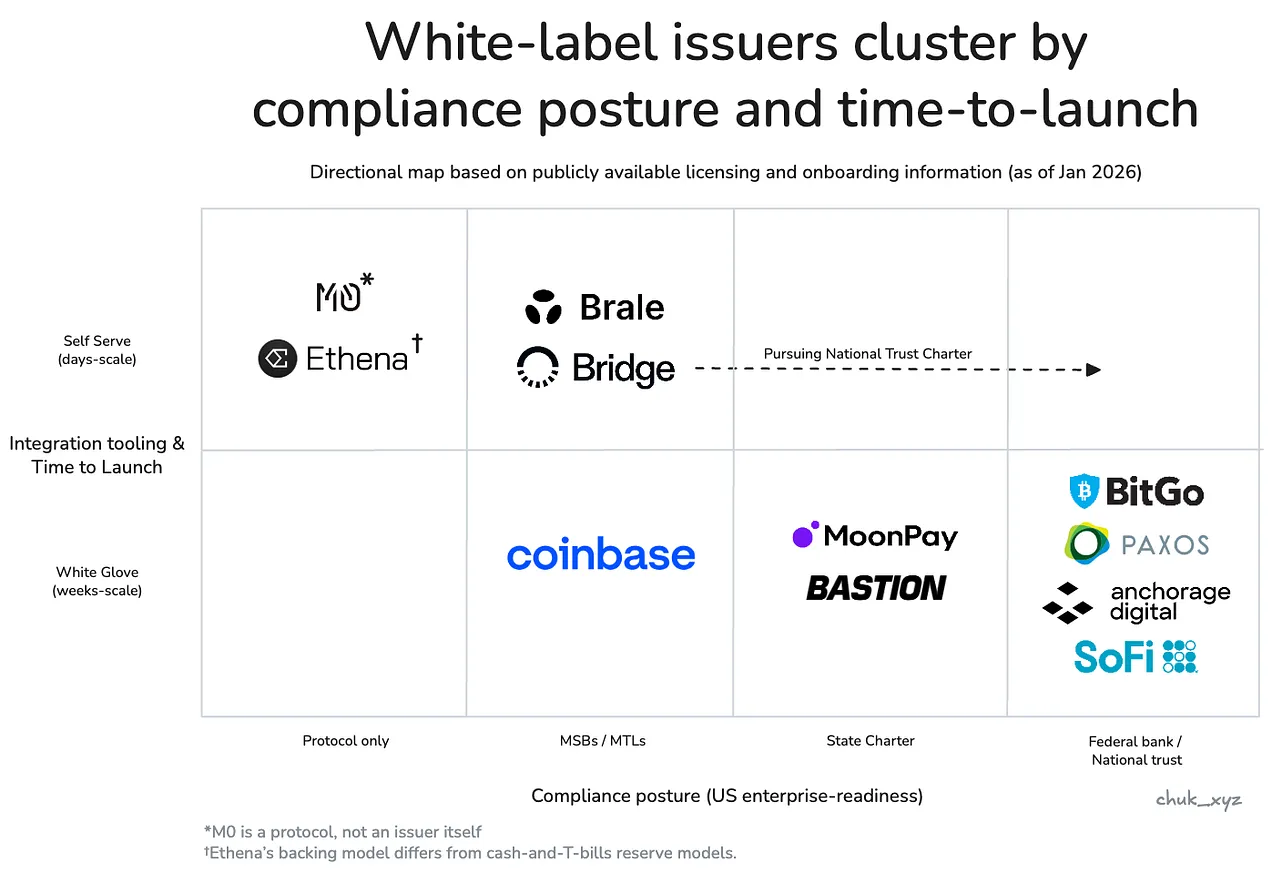
Issuers cluster according to enterprise-grade compliance posture and customer onboarding: Enterprises & Financial Institutions in the bottom right, Fintech / Wallets in the middle, DeFi in the top left.

Differentiation is moving up the stack, which is particularly evident in the Fintech / Wallet space. As issuance itself becomes more of a feature, issuers are beginning to compete by bundling配套的完善服务 to complete the overall job and aid distribution. These services include compliant on/off ramps and virtual accounts, payment orchestration, custody, and card issuance. This approach can maintain pricing power by altering time-to-market and operational outcomes.

Within this framework, the question of "is it commoditized?" becomes clear.

Stablecoin issuance is commoditized at the token level, but not at the outcome level, because buyer constraints make suppliers difficult to replace.

As the market develops, issuers serving each cluster may gradually converge on the capabilities required by that market, but we are not there yet.

Where Might Lasting Advantages Come From?

If the token layer has become table stakes, and peripheral differentiation is slowly eroding, an obvious question is: can any issuer build a lasting moat? For now, it looks more like a customer acquisition competition, with retention achieved through switching costs. Changing issuers involves reserve and custody operations, compliance processes, redemption mechanisms, and downstream system integrations, so issuers are not "replaceable with a click."

Beyond bundling services, the most likely source of a long-term moat is network effects. If branded stablecoins increasingly require seamless 1:1 convertibility and shared liquidity, value could accrue to the issuer or protocol layer that becomes the default interoperability network. What remains uncertain is whether this network will be controlled by issuers (strong value capture) or evolve into a neutral standard (broader adoption, but weaker value capture).

A trend worth watching: Will interoperability become a commoditized function, or a primary source of pricing power?

Conclusion

  • Currently, the core of token issuance is commoditized, with the differentiation happening at the edges. Token deployment and basic controls are converging, but outcomes still diverge in operations, liquidity support, and system integration.
  • For any buyer, the market is not as crowded as it seems. Actual constraints quickly narrow the candidate list, and the "credible options" are often just a handful, not a dozen.
  • Pricing power comes from bundling, regulatory environment, and liquidity constraints. The value is not in "creating the token" itself, but in the entire轨道 infrastructure surrounding the stablecoin's operation.
  • Which moats will hold long-term remains unclear. Network effects through shared liquidity and exchange standards are a plausible path, but who captures the value remains uncertain as interoperability matures.

What's next to watch: Will branded stablecoins converge to a few exchange networks, or will interoperability ultimately evolve into a neutral standard. Regardless of the outcome, the conclusion is the same: the token is just the foundation, the business model is the core.


İlgili Sorular

QWhat are the three main motivations for companies to launch their own branded stablecoins?

AThe three main motivations are: 1) Economic benefits: retaining more value from customer cash flows and balances, and expanding peripheral revenue sources (fund management, payments, lending, card business). 2) Behavioral control: embedding customized rules and incentive mechanisms (e.g., loyalty programs) and deciding their own clearing paths and interoperability to match their product form. 3) Accelerating time-to-market: stablecoins allow teams to launch new financial experiences globally without having to rebuild a complete banking system.

QAccording to the article, what is the most difficult part of the stablecoin issuance process?

ADistribution is the most difficult part. While usage within a closed ecosystem is primarily a product decision, integration and liquidity are the bottlenecks in the open market.

QHow does the article define the 'commoditization' of stablecoin issuance?

AThe article defines commoditization as a service becoming so standardized that switching suppliers does not change the outcome, and competition shifts to price rather than differentiation. It argues that issuance is commoditized at the token layer but not at the outcome layer, as different buyer constraints make suppliers difficult to replace for the desired results.

QWhat are the three main clusters of buyers in the stablecoin issuance market, as described in the article?

AThe three main clusters are: 1) Enterprises and financial institutions, which prioritize trust and a rigorous procurement process. 2) Fintech companies and consumer wallets, which are product-led and focus on delivery and distribution capabilities. 3) DeFi and investment platforms, which are chain-native and optimize for composability and programmability.

QWhere does the article suggest that a lasting competitive advantage (moat) for an issuer is most likely to come from?

AThe article suggests that the most likely source of a lasting moat is network effects. If branded stablecoins increasingly require seamless 1:1 convertibility and shared liquidity, value could accumulate with the issuer or protocol layer that becomes the default interoperability network.

İlgili Okumalar

TechFlow Intelligence Bureau: Chip Stocks Lose Trillions in a Single Day, Bitcoin Falls Below $60,000, US-Iran Conflict Escalates

**Daily Tech & Markets Roundup: AI Advances, Market Turmoil, and Geopolitical Tensions** **AI / LLMs**: Anthropic's internal report on AI self-improvement sparked serious discussions about Recursive Self-Improvement (RSI). Meanwhile, debate continues on AI coding tools after Claude was accused of introducing bugs into the rsync codebase. In positive news, DeepSeek V4 Flash impressed in local deployment tests, and GitHub Copilot now supports custom endpoints for local models. A surprising research turn suggests removing chain-of-thought prompting can sometimes improve LLM performance. **Crypto / Web3**: Bitcoin plunged below $60,000, with its RSI hitting levels last seen during the COVID-19 crash, driven by strong U.S. jobs data reviving interest rate hike fears. Discussions highlight Ethereum DeFi's continued lack of a smooth consumer payment layer. **Chips / Hardware**: Chip stocks suffered a massive sell-off, with the Philadelphia Semiconductor Index posting its worst single-day drop in six years, erasing over a trillion dollars in value. Marvell, Micron, AMD, and Intel were among the biggest losers. **Tech Companies**: A leaked Microsoft document revealing goals to make Copilot "addictive" drew criticism. LinkedIn founder Reid Hoffman left Microsoft's board to focus full-time on his AI agent startup, Manus. Google was revealed to be paying SpaceX $920 million monthly for AI training compute. **Markets & Macro**: A blowout U.S. jobs report (172k vs. 80k expected) crushed hopes for near-term rate cuts, sending Treasury yields soaring and triggering a broad market sell-off. CEOs from Kraft, McDonald's, and Whirlpool simultaneously warned U.S. consumers are exhausting their savings. **Geopolitics**: U.S.-Iran tensions escalated with missile/drone interceptions and U.S. strikes on Iranian radar sites, keeping the critical Strait of Hormuz largely closed since late February and posing ongoing oil supply risks. **The Bottom Line**: The strong jobs data acted as a single trigger for correlated sell-offs across equities, crypto, and chips. Underlying the volatility is a stark contradiction between robust employment data and warnings of consumer weakness, alongside geopolitical risks that could reignite inflation, leaving markets to price in a fraught macro outlook with no clear "soft landing" path.

marsbit2 saat önce

TechFlow Intelligence Bureau: Chip Stocks Lose Trillions in a Single Day, Bitcoin Falls Below $60,000, US-Iran Conflict Escalates

marsbit2 saat önce

It Took Me a Year to See the Bitter Truth About Agent Payments

After a year building infrastructure for the Agent economy, engaging with major players like Stripe, Visa, and Coinbase, the author shares a sobering analysis of the current state of Agent payments. The core finding is a stark lack of genuine, immediate demand across most envisioned use cases. The article breaks down four key market segments: 1. **Agent-to-Merchant (Consumer Shopping):** For most product categories (e.g., clothing, electronics), conversational AI shopping is a step backwards from visual e-commerce interfaces. While agents excel at understanding needs, they can't replace side-by-side product comparison. Real merchant interest is defensive "Agent Engine Optimization," not driven by current customer demand. Potential exists for high-frequency, low-decision purchases (like food delivery) or navigating complex store UIs, but these require massive B2C distribution channels dominated by giants like Amazon. 2. **Agent-to-API (Developer Services):** Developers already have subscriptions and billing relationships for APIs (compute, data). Prepaid balances solve micro-payment issues for low transaction volumes. A deeper structural problem is that major SaaS vendors' business models rely on enterprise contracts, resisting granular pay-per-call pricing. While protocols like MPP and x402 serve the long tail of niche services, this market is small and developers are historically low-willingness-to-pay. 3. **Agent-to-Agent:** This remains largely theoretical with minimal transaction volume. While it represents a long-term bet on a fundamentally new transaction infrastructure (sub-second, micro-penny to million-dollar, multi-party settlements), it does not constitute a present market. 4. **Agent-to-Finance:** This is the only category with existing, paying demand. Integrating AI into financial workflows (trading, portfolio management) is a natural evolution and enables new capabilities like autonomous rebalancing. However, competition favors established, regulated institutions. The "real problem" is not moving money between agents, but the broader challenge of **coordination**—orchestrating work between agents and humans, verifying outcomes, and settling results. Payment is just one component of settlement, which is itself part of coordination. Companies that solve the coordination layer will subsume payment, not the other way around. While well-funded incumbents build defensively for a long-term future, startups must find where the market is today—which, for the author's team, lies outside these four categories in an area of real, growing, and underserved activity.

marsbit3 saat önce

It Took Me a Year to See the Bitter Truth About Agent Payments

marsbit3 saat önce

It Took Me a Year to See the Hard Truth About Agent Payments

**Title: It Took Me a Year to See the Hard Truth About Agent Payments** Over the past year, I've worked on infrastructure for the Agent economy, engaging with major players like Stripe, Visa, Coinbase, and numerous startups. The findings reveal a stark reality: genuine, widespread demand for Agent-based payments does not yet exist. **Key Observations:** * **Agent-to-Merchant (Shopping):** The user experience for AI shopping often falls short, especially for visual product discovery. While AI excels at understanding needs, conversational interfaces can't yet replace browsing and comparing multiple products visually. Current merchant interest is largely defensive ("Agent Engine Optimization") for a future that hasn't arrived. High-frequency, low-friction purchases (like food delivery) are potential fits, but lack open APIs and face high AI inference costs. Simpler, more affordable, or cross-language interactions for complex UIs are a niche opportunity but require massive consumer distribution to scale. * **Agent-to-API (Developer Tools):** Developer payment needs for APIs (computing, data, models) are already met through subscriptions and prepaid credits. The core challenge is not payment friction but supplier economics: most large SaaS providers prefer enterprise contracts over micropayments for API calls. Protocols like MPP and x402 suit the long-tail of smaller services but cater to a developer market historically reluctant to pay for these tools. Major infrastructure needs at the top of the stack are already being addressed. * **Agent-to-Agent (Machine Commerce):** This is a long-term vision with almost no current transaction volume. While a future with high-speed, high-frequency, multi-party machine-to-machine transactions would require novel infrastructure, it remains theoretical. The market is not here yet. * **Agent-to-Finance:** This is the only category with clear, present demand. Financial professionals and DeFi users already pay for tools, and AI augmentation is a natural evolution. Autonomous AI agents can enable entirely new financial strategies. However, competition is fierce from established, regulated incumbents who can more easily layer AI onto their existing products. **The Core Insight:** Companies, especially giants with long time horizons, are building defensively for a potential future of mass machine commerce. For them, early investment is a low-cost hedge. For startups, the current market reality is different. The primary challenge isn't just moving money between agents (payments). The larger, unsolved problem is **orchestration** – coordinating work between agents and humans, verifying outcomes, and then settling. Payment is just a part of settlement, which is just a part of orchestration. Companies that solve the orchestration problem will subsume payments, not the other way around. After a year of building, we see the real, growing, and underserved market opportunity lies in this broader domain of orchestration.

链捕手3 saat önce

It Took Me a Year to See the Hard Truth About Agent Payments

链捕手3 saat önce

İşlemler

Spot
Futures
活动图片




