Coinbase Uses Chainlink to Deeper Integrate Tokenized Stocks into DeFi

cryptonews.ru2026-08-25 tarihinde yayınlandı2026-08-25 tarihinde güncellendi

Özet

Coinbase has selected Chainlink to provide pricing infrastructure for its tokenized stocks, enabling blockchain-based versions of stocks like Apple and NVIDIA to be used freely on decentralized lending and trading markets. This is particularly significant for non-U.S. cryptocurrency users, allowing them to utilize tokenized U.S. equities similarly to how DeFi currently uses stablecoins and tokenized Treasuries. The integration aims to move these tokens beyond mere storage—making them viable as collateral, liquidity, and building blocks within DeFi protocols. For tokenized stocks to hold value or function in DeFi, protocols require reliable price determination. Chainlink’s oracles will supply this critical data, addressing a key gap—especially in lending markets where accurate collateral valuation and liquidation mechanisms depend on trusted price feeds. The stocks, which trade on Coinbase’s Ethereum Layer-2 network Base using the B20 token standard, are structured to mirror real-world equities, with bankruptcy-remote protections. Holders can own fractional shares, trade them on platforms like Aerodrome, and use positions (e.g., in NVIDIA) as loan collateral on Aave. Legally, the initiative operates outside the U.S., with Coinbase securing regulatory approval from Abu Dhabi’s FSRA to run its global tokenization hub. Token holders receive dividends and voting rights, though access remains limited to eligible non-U.S. users, and transfers are subject to sanctions screening an...

Coinbase has chosen Chainlink to provide price infrastructure for its tokenized stocks, enabling stocks of companies like Apple and NVIDIA to flow freely across decentralized lending and trading markets.

This agreement is particularly significant for cryptocurrency users outside the US, as it allows them to use blockchain versions of US stocks in the same way the decentralized finance (DeFi) sector already does with stablecoins and tokenized treasury bonds.

Timing is crucial for the entire cryptocurrency market. The tokenized stock sector has been one of the most developed areas in blockchain finance this year, but many of these tokens have remained idle in wallets. New reliable price sources are changing the situation. They will facilitate the use of these tokens as collateral, liquidity, and building blocks for other protocols.
Why the Oracle is the Missing Element

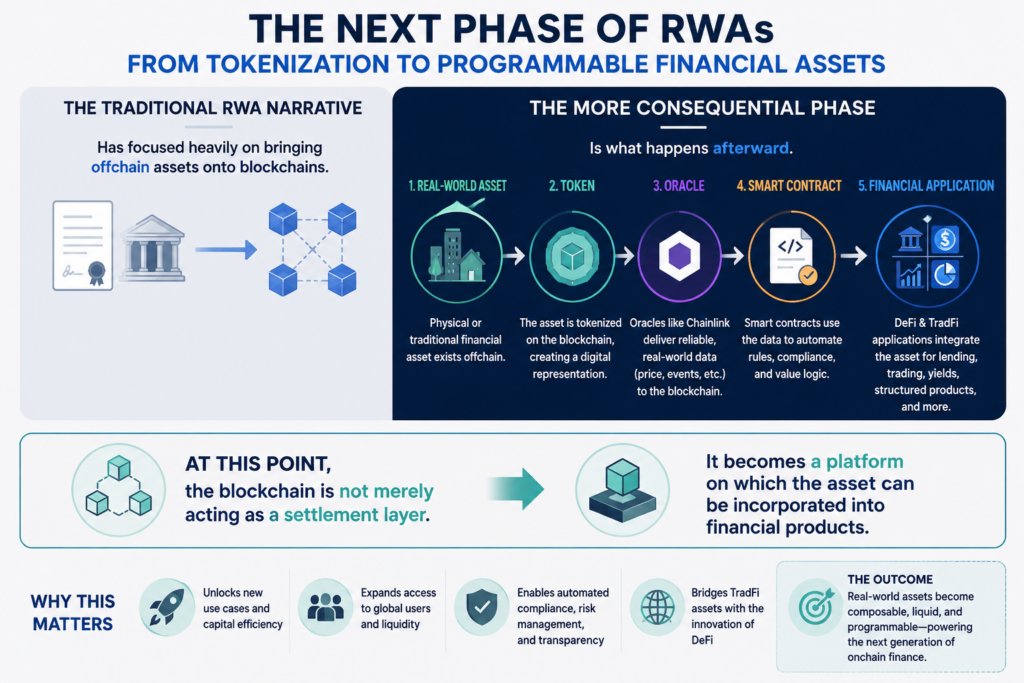
For tokenized stocks to have any value or be usable in DeFi, protocols must first determine their price. According to the Base technical documentation, the token price reflects the stock price but is adjusted via an on-chain multiplier adjustment to account for dividends and stock splits without actually changing the number of tokens in the wallet.

In lending markets, the absence of a reliable price information source leads to the market's inability to accurately value collateral or liquidate positions when their value falls below required thresholds.

Chainlink will take on this function for Coinbase. A Galaxy report noted that Chainlink was already integrated into Robinhood Chain since its launch in July, as obtaining accurate price information became critical for delivering tokenized stock-based solutions.

Apple and NVIDIA as Collateral on Base

Stocks are already trading directly on Base, Coinbase's Ethereum Layer-2 network. Base claims the stocks precisely match real stocks regulated by Alpaca, with a structure providing bankruptcy-remote protection.

Using self-custody wallets, users can own fractional shares in companies like Apple and NVIDIA, trade them via Aerodrome, and use their tokenized position (in NVIDIA's case) as loan collateral on Aave.

The stocks use Base's B20 standard, an ERC-20 extension. Once issued, they can interact with DeFi like any other on-chain asset. There are no whitelisted wallets in the secondary market, allowing tokens to move between compatible DeFi protocols.

The Regulating Authority is in Abu Dhabi

The legal framework is outside the US. On August 11, Coinbase announced receiving approval from the Abu Dhabi Global Market's regulator, FSRA, to operate its global tokenization hub.

Coinbase stated that tokens issued under this system are backed by the underlying stocks, and verified holders receive dividends and voting rights.

Access remains limited to non-US users in eligible jurisdictions. Coinbase also stated that transfers are subject to sanctions screening and that assets can be frozen at the wallet level.

Tokenized Assets Are Being Used, Not Just Issued

These figures help explain why the collateral aspect is important. By the end of June 2026, the market capitalization of tokenized stocks, RWA, reached approximately $1.7 billion, more than five times the $329 million recorded at the end of June 2025. The monthly on-chain transfer volume grew from $53 million in June 2025 to $9.22 billion in June 2026.

Metric Earlier Period Later Period Change
Tokenized Stock Market Cap $329M, end of June 2025 ~$1.7B, end of June 2026 More than 5x
Monthly On-Chain Transfer Volume of Tokenized Stocks $53M, June 2025 $9.22B, June 2026 More than 170x
Risk-Weighted Assets (RWA) Deposits on DeFi Lending Platforms and Exchanges $2.3B, Q2 2025 $7.4B, Q2 2026 More than 3x

According to data from CoinShares and Token Terminal, the volume of tokenized real-world asset deposits on DeFi lending platforms and exchanges also grew from $2.3 billion in Q2 2025 to $7.4 billion in Q2 2026, despite the overall DeFi deposit volume declining by approximately 15%.

Coinbase is not the only company addressing this demand. Nasdaq, in partnership with Payward, the parent company of Kraken, is building a gateway to connect tokenized stocks to blockchain networks, and Robinhood Chain already leads in the number of tokenized stock holders.

The real challenge for Coinbase will be whether users do more than just hold these assets. If tokens representing equity continue to become collateral and liquidity within the DeFi ecosystem, the Chainlink integration will play a role in transforming tokenized shares from a mere digital representation of stocks into a more active part of on-chain finance.
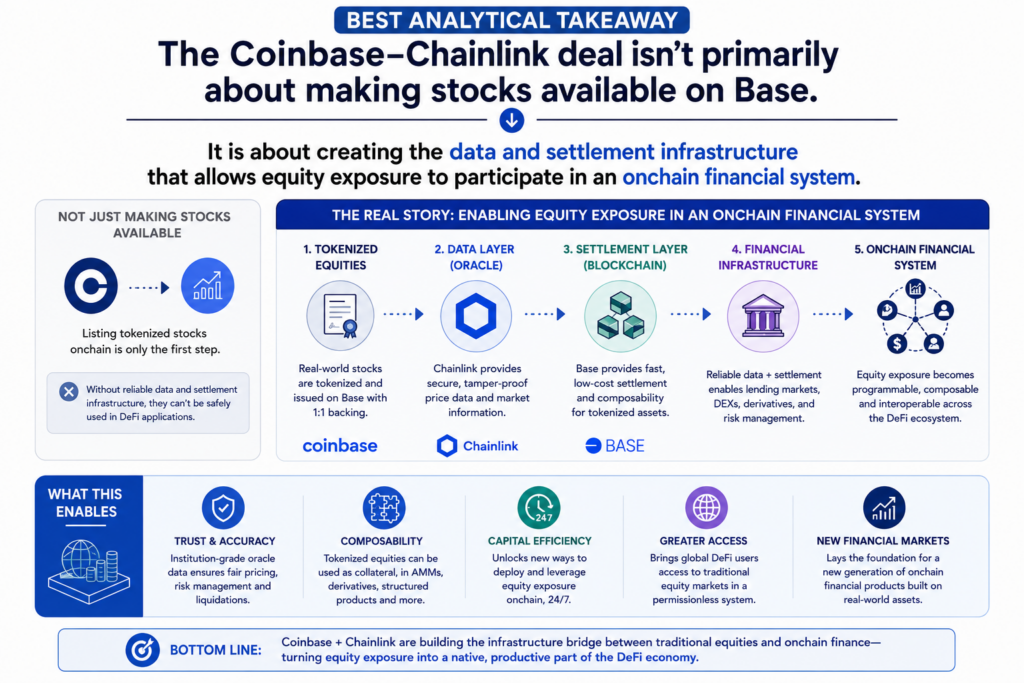
The idea is not entirely new. Sentora co-founder Jesus Rodriguez argued that tokenized stocks should not just "exist on the blockchain" but also "do something on the blockchain," including serving as productive collateral. Chainlink points to the same next stage, where reliable market data and on-chain computations enable interaction with DeFi applications.

end-content

İlgili Sorular

QWhat is the primary role of Chainlink in Coinbase's tokenized stock offering?

AChainlink provides the price oracle infrastructure for Coinbase's tokenized stocks, enabling DeFi protocols to access accurate, real-time price feeds for these stocks, which is essential for their use as collateral, liquidity, or trading assets on decentralized markets.

QWhy is the integration of Chainlink particularly significant for users outside the United States?

AIt allows users outside the U.S. to utilize blockchain-based versions of U.S. stocks (like Apple and NVIDIA) within DeFi applications (e.g., for lending or trading), similar to how DeFi already uses stablecoins and tokenized treasury bonds.

QAccording to the article, what key metric demonstrates the rapid growth of the tokenized stock market?

AThe market capitalization of tokenized stocks grew from $329 million at the end of June 2025 to approximately $1.7 billion by the end of June 2026, representing a more than fivefold increase.

QWhich regulatory body outside the U.S. granted Coinbase a license for its tokenization hub, and what does this signify?

AThe Financial Services Regulatory Authority (FSRA) of the Abu Dhabi Global Market granted Coinbase the license. This signifies that the legal and operational framework for Coinbase's global tokenized securities offering is being established outside U.S. jurisdiction, with access primarily for non-U.S. users in approved regions.

QWhat is the main challenge or next step identified for tokenized stocks to move beyond simply being digital representations?

AThe main challenge is ensuring these tokenized stocks are actively used within the blockchain ecosystem—such as serving as productive collateral and liquidity in DeFi protocols—rather than just being held statically in wallets. Chainlink's price feeds are seen as a key enabler for this next phase of utility and integration.

İlgili Okumalar

U.S. Aims at Iran's Crypto Sector Due to Oil Payments Exceeding $100 Billion

The U.S. Treasury Department has expanded sanctions on Iran to target its digital asset sector, citing over $100 million in cryptocurrency payments allegedly used to facilitate Iranian oil sales. The Treasury’s Office of Foreign Assets Control (OFAC) announced new sectoral sanctions covering digital assets, technology, gold, aviation, and shipping, alongside sanctions against nearly 60 entities, individuals, and vessels linked to nuclear, missile, cyber, and oil networks. The move allows OFAC to sanction foreign persons and firms operating in or supporting Iran’s crypto sector, which the Treasury stated is increasingly used as a "tool of choice" to circumvent sanctions, including by the Islamic Revolutionary Guard Corps (IRGC). Specific targets include Ukrainian broker Ivan Obukhov and his UAE-registered firm Foscom FZE, accused of processing over $100 million in crypto payments to facilitate oil sales for the IRGC’s Quds Force. This follows recent U.S. actions against Iran-linked crypto exchanges, including sanctions against UK-based Zedcex and Zedxion in January, four Iranian exchanges including Nobitex in June, and exchanges Shelbit and Aban Tether in August. Unlike previous targeted sanctions, the new measures establish a framework to penalize broader involvement in Iran’s crypto sector, significantly expanding OFAC’s authority under Executive Order 13902. Designated persons’ U.S.-linked property will be blocked, and foreign banks facilitating significant transactions for them may face U.S. account restrictions.

cryptonews.ru24 dk önce

U.S. Aims at Iran's Crypto Sector Due to Oil Payments Exceeding $100 Billion

cryptonews.ru24 dk önce

Conversation with Charles Zhang: Amidst the AI Frenzy, Why Pursue 'Anti-Efficiency' Content?

Dialogue with Charles Zhang: In the Era of AI's Sprint, Why Create "Anti-Efficiency" Content Standing out among China's early internet pioneers, Charles Zhang, founder and CEO of Sohu, maintains a distinct personal identity. He keeps a consistent public presence and embodies traits of high-energy individuals: sleeping only 4-5 hours daily, running 5km or marathons, and hosting frequent offline tech forums and dialogues with Nobel laureates. He has shifted focus from external business expansion to internal self-reconstruction, adhering to his own pace. "People aren't afraid of being busy; the busier you are, the better your health. Having nothing to do can lead to emotional issues and poor health." Marking the 10th anniversary of his live-streamed "Charles Zhang's English Class," he recently took it offline for a real-world classroom session. Following this, he discussed the course's decade-long journey, Sohu Video's content ecosystem, and the value of content in the AI era. **Pen and Mouth Diligence: A Class Against Instant Mastery** His English class began in August 2016 on "Qianfan Live." He spends about 40 minutes daily preparing, reviewing dozens of news headlines, reading five in detail, and selecting three for the lesson. Over ten years, he has completed over 2000 live sessions totaling more than 110,000 minutes, with over 52 million views. Initially, the stream was a way to "talk more" and combat emotional struggles. He started by repeating after TV news anchors, then moved to live-streaming with the launch of Qianfan Live. It was 40% for personal emotional regulation ("like a monk chanting sutras"), 30% to deliver authentic news, and 30% to promote the new platform. This daily "ritual" helped him overcome depression, leading to what he calls his "peak life state." From a product perspective, it was counter-intuitive—launched without prior market research or growth strategies, based on the founder's personal need that resonated with users. Yet, his content creation follows a strict routine. The decade of covering geopolitics, economics, tech, health, and society has built a vast "knowledge compound interest" system. In an age of AI summaries and algorithmic content, Zhang insists on "hard work": meticulous reading, handwritten notes, and manually created teaching materials, refusing AI-generated content. The English class is now a fixed daily rhythm; preparing for his weekly physics class requires a full day of solitary deduction on a blackboard. In his live streams, Zhang positions himself as a "content creator," not a CEO or teacher. He sees physics as extreme brain training and English as a "sensor" to understand the world. This explains why a top entrepreneur persists for a decade in seemingly "unprofessional" pursuits—it's the information input and psychological healing method he found during a low point. It's fundamentally an "anti-efficiency" commitment. He believes the meaning of reading lies in finding community and spiritual support, not just fleeting conversation points. For today's media, he states: "Reading news isn't the goal. As humans with many confusions, we need reference points, to find a group, find kindred spirits, or seek support and spiritual nourishment. Large language models can't satisfy these starting points; they only give you information." This offers solace and a value defense for media professionals impacted by AI summaries. **"Don't Think Earth Stops Turning Because AI Arrived"** A content creator expressed anxiety: after feeding their article to AI, it produced a more comprehensive, profound version, making their work feel valueless. Zhang responded with an analogy: "Carrots from the market, with a bit of soil, not glossy, taste delicious and flavorful. Tomatoes forced by chemical fertilizer have no taste at all." He sees AI giving world content a "plastic feel," but acknowledges its significant role in improving information access efficiency, especially in physics and social science research where he often queries AI for quick professional answers. The key, Zhang stresses, is that the outside world still needs to guide our perspective. LLMs provide "information," while the outside world offers "viewpoints." He cares deeply about *what* that external viewpoint is and *how* someone thinks about an issue. "Don't think the Earth stops turning because AI arrived," he analyzes. AI currently replaces rule-based work, noting significant impact on the software industry with many programmers laid off as even less experienced people can now write decent code. However, AI cannot yet replace arts, social sciences, emotions, and creative content. "Hollywood remains thriving, producing great works. Oscars will continue, Nobel Literature Prizes will still be awarded—all by real people, with works conceived by real people." While wary of AI, Zhang isn't anti-technology and is open to its applications. Sohu itself has launched AI assistants. In Sohu's AI practice, Zhang defines his role as a "large language model corpus provider." He believes LLM training is inseparable from human-original content as its data foundation, so original content retains irreplaceable value. "The era of self-media indeed offers everyone new ways to discover their strengths and achieve growth." He suggests every young person should consider self-media. Most importantly, the bottom line of content creation should be "authenticity." If using AI avatars, they must be clearly labeled; not doing so and misleading viewers wastes their time, especially when people still prefer real human content. Behind AI's sprint lie unavoidable realities. As AI quickly provides seemingly perfect answers, people grow accustomed to accepting "summarized" results, omitting processes of questioning, deduction, and trial-and-error, leading to a decline in deep thinking. Zhang's "anti-efficiency" practice with his two live-streamed classes is his answer to AI's狂奔: In an algorithm-driven era chasing ultimate efficiency, don't expect AI to fill inner voids. Read books, speak in front of a camera, sweat on a running track, and build connections with real people.

marsbit34 dk önce

Conversation with Charles Zhang: Amidst the AI Frenzy, Why Pursue 'Anti-Efficiency' Content?

marsbit34 dk önce

İşlemler

Spot
活动图片