Coinbase Secures Conditional OCC Approval For National Trust Charter – Details

bitcoinist2026-04-03 tarihinde yayınlandı2026-04-03 tarihinde güncellendi

Özet

Coinbase, the largest US crypto exchange, has received conditional approval from the Office of the Comptroller of the Currency (OCC) to establish Coinbase National Trust Company. This marks a significant step toward becoming a federally regulated crypto custodian. The company clarified that this charter does not make it a commercial bank, and it will not take retail deposits or engage in fractional reserve banking. Instead, it aims to bring federal regulatory uniformity to its custody and market infrastructure business. This approval validates Coinbase's regulatory approach and allows it to expand its reach and conduct new business. It also signals a shift in the federal regulatory framework to align with the evolving crypto landscape. However, the move faces opposition from US banks and lawmakers, including the American Bankers Association and Senator Elizabeth Warren, who have raised concerns about regulatory arbitrage and called for delays until clearer rules are established. Coinbase joins other firms like Ripple, Circle, and Fidelity that have also received similar OCC approvals.

Coinbase, the largest crypto exchange in the US, has achieved a major milestone after securing a key approval from the main banking regulator, which could unlock a broader market for the company.

Coinbase Wins Major OCC Approval

On Thursday, Coinbase announced it received conditional approval from the Office of the Comptroller of the Currency (OCC) to charter Coinbase National Trust Company, marking a crucial step to becoming a federally regulated crypto custodian.

In the official statement, Coinbase outlined the scope of the charter, explaining that the company is not becoming a commercial bank and will not take retail deposits or engage in fractional reserve banking.

“This charter is about bringing federal regulatory uniformity to the custody and market infrastructure business we have been building for years. The OCC charter was designed precisely for this purpose — to provide clear oversight over assets in safekeeping — and that is exactly how we intend to use it,” the announcement read.

The conditional OCC approval allows Coinbase to “build the next chapter of finance,” the company noted, bolstered by the regulatory confidence, and validates its approach of “engaging with regulators, earning their trust, and operating to the highest standards.”

Moreover, the approval signals that the federal regulatory framework is transforming to align with the evolving landscape that crypto has been gradually shaping.

In an interview, Greg Tusar, Co-CEO of Coinbase Institutional, affirmed that “the ability to have a federal framework for our custody business is important,” adding that “this is about us growing our reach and being able to conduct new business that we may not have been able to before.”

Crypto Trust Banks Face Opposition

Coinbase applied for the charter last October and has now joined the list of firms that have received the main banking regulator’s approval. As reported by Bitcoinist, the OCC approved conditional bank charters for Ripple, Circle, BitGo, Paxos, and Fidelity in December.

In February, stablecoin platform Bridge, owned by Stripe, and crypto exchange Crypto.com announced they had also secured the OCC’s conditional approval to establish a national trust bank. However, US banks have raised concerns that the approvals could blur the lines between banking activities and lead to regulatory arbitrage.

Nearly two months ago, the American Bankers Association (ABA) asked the banking regulator to postpone its review of applications for crypto bank charters, suggesting that the approvals should wait until key regulatory uncertainties are resolved.

In its letter, ABA called for patience as emerging regulatory frameworks take shape, proposing that the review process continue when the US Congress completes the rules that will ultimately govern many recent applicants for the OCC’s charter.

The banking lobby cited uncertainty surrounding emerging business models, the need for increased transparency in the charter application and decision-making processes, and the absence of finalized federal oversight as key reasons for the proposed delay.

US Senator Elizabeth Warren also sent a letter to Comptroller Jonathan Gould asking the banking regulator to pause its review of the Trump Family’s main crypto venture, World Liberty Financial, which applied for a national trust charter in January.
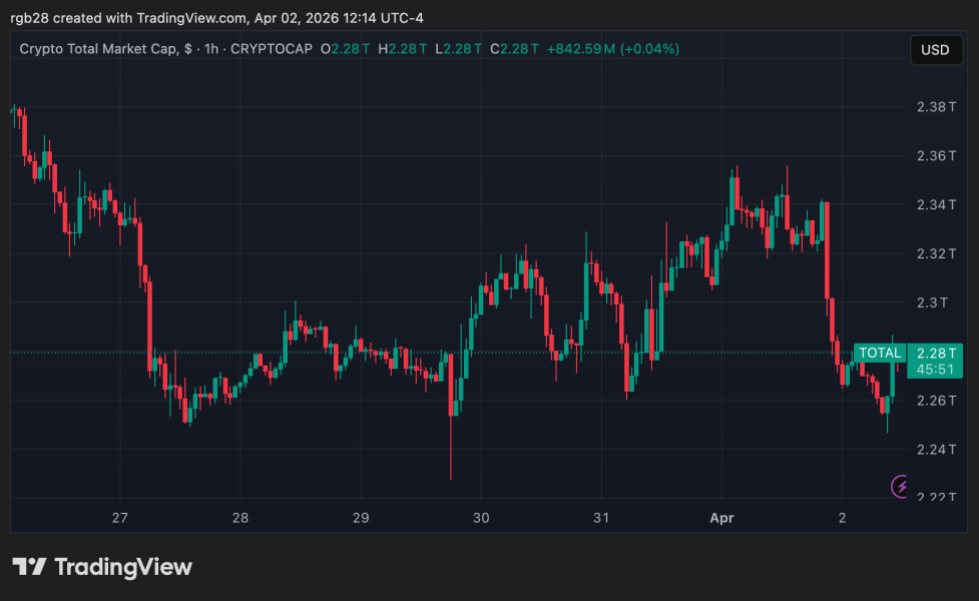
Total crypto market capitalization is at $2.28 trillion on the one-week chart. Source: TOTAL on TradingView


İlgili Sorular

QWhat is the significance of Coinbase securing conditional approval from the OCC?

AIt allows Coinbase to charter the Coinbase National Trust Company, marking a crucial step toward becoming a federally regulated crypto custodian and unlocking a broader market for the company.

QWhat does the OCC charter enable Coinbase to do, according to the company's statement?

AThe charter brings federal regulatory uniformity to Coinbase's custody and market infrastructure business, providing clear oversight over assets in safekeeping without engaging in commercial banking or taking retail deposits.

QWhich other companies have received conditional bank charters from the OCC, as mentioned in the article?

ARipple, Circle, BitGo, Paxos, Fidelity, Bridge (owned by Stripe), and Crypto.com have also secured conditional approval from the OCC for national trust bank charters.

QWhat concerns have US banks raised regarding the OCC's approval of crypto trust charters?

AUS banks are concerned that the approvals could blur the lines between banking activities and lead to regulatory arbitrage.

QWhy did the American Bankers Association (ABA) ask the OCC to postpone its review of crypto bank charter applications?

AThe ABA cited uncertainty surrounding emerging business models, the need for increased transparency in the application process, and the absence of finalized federal oversight as key reasons for the proposed delay.

İlgili Okumalar

UBS: The Crowdedness of A-Share Tech Stocks Is Far From Reaching Historical Peaks

UBS: A-share tech stocks still far from peak crowding levels A-shares' technology sector has seen a strong rebound, with trading activity hitting record highs, raising concerns about market crowding. However, UBS Securities argues that a key indicator of institutional positioning suggests the current crowding level remains well below historical peaks. While the large-cap tech sector's share of total A-share trading volume and market capitalization have reached historical highs, the overweight ratio of domestic mutual funds in this sector stood at 9.9% in Q1 2026. This is down from 11.6% in Q3 2025 and significantly lower than the historical peak of 14.1% in Q4 2015. It also pales in comparison to the historical peak overweight of 18.7% for the consumer sector. UBS notes that typical cycles from a low to a peak in fund overweighting last about three years, and the current outperformance of the tech/growth style has lasted less than two years since the policy pivot in September 2024. UBS expects A-share earnings recovery to accelerate, providing fundamental support. It forecasts 2026 A-share profit growth to rise to 11% from 3.9% in 2025. Non-financial A-share profits grew 11.8% YoY in Q1 2026, with gross and net profit margins at their highest since 2023. Persistent fund inflows, the expansion of thematic ETFs, and a recovery in private fund issuance are supporting market liquidity. In tactical allocation, UBS favors growth and cyclical styles under its "slow bull" base case, with overweight ratings on six sectors: Electronics (benefiting from semiconductor inventory recovery and AI innovation), Communications (driven by AI computing demand), Machinery (aided by domestic capex recovery), Non-ferrous Metals (due to rising copper/aluminum prices), Chemicals (supported by anti-involution policies), and Electrical Equipment (driven by policy support and AI data center power demand).

marsbit17 dk önce

UBS: The Crowdedness of A-Share Tech Stocks Is Far From Reaching Historical Peaks

marsbit17 dk önce

İşlemler

Spot
Futures
活动图片




