Coinbase Q1 Earnings Report: Nearly $4 Billion Loss, Trading Volume Halved. Can AI + RWA Turn Things Around?

链捕手2026-05-08 tarihinde yayınlandı2026-05-08 tarihinde güncellendi

Özet

Coinbase's Q1 2026 earnings report revealed a net loss of $394 million, largely driven by $482 million in unrealized losses on its crypto asset holdings. Total revenue fell 31% year-over-year to $1.41 billion. Transaction revenue declined 40% to $756 million, reflecting a market-wide slump in crypto trading volumes. Consumer trading was particularly weak, down 48%, though Coinbase's global spot market share rose to a record 8.6%. Key bright spots included institutional trading revenue, which grew 37%, and a surge in derivatives activity following the Deribit acquisition. Subscription and services revenue of $584 million was more resilient, with stablecoin revenue up 11% to $305 million. Adjusted EBITDA remained positive at $303 million. Ahead of earnings, Coinbase announced a 14% workforce reduction (~700 employees) to accelerate its transition to an "AI-native" organizational model. Strategically, the company is pursuing its "Everything Exchange" vision, expanding into derivatives and predictive markets. Its partnership with Circle on USDC remains a core revenue moat, with over 25% of the stablecoin's $80 billion supply held on its platform. The company is actively engaged in shaping stablecoin legislation like the CLARITY Act. Despite significant losses and cyclical pressures, Coinbase is positioning itself as a broader on-chain financial infrastructure provider.

On May 7th, after the US stock market closed, Coinbase released its first-quarter financial report for 2026. The data showed the company's total revenue was $1.41 billion, a year-on-year decrease of 31%.

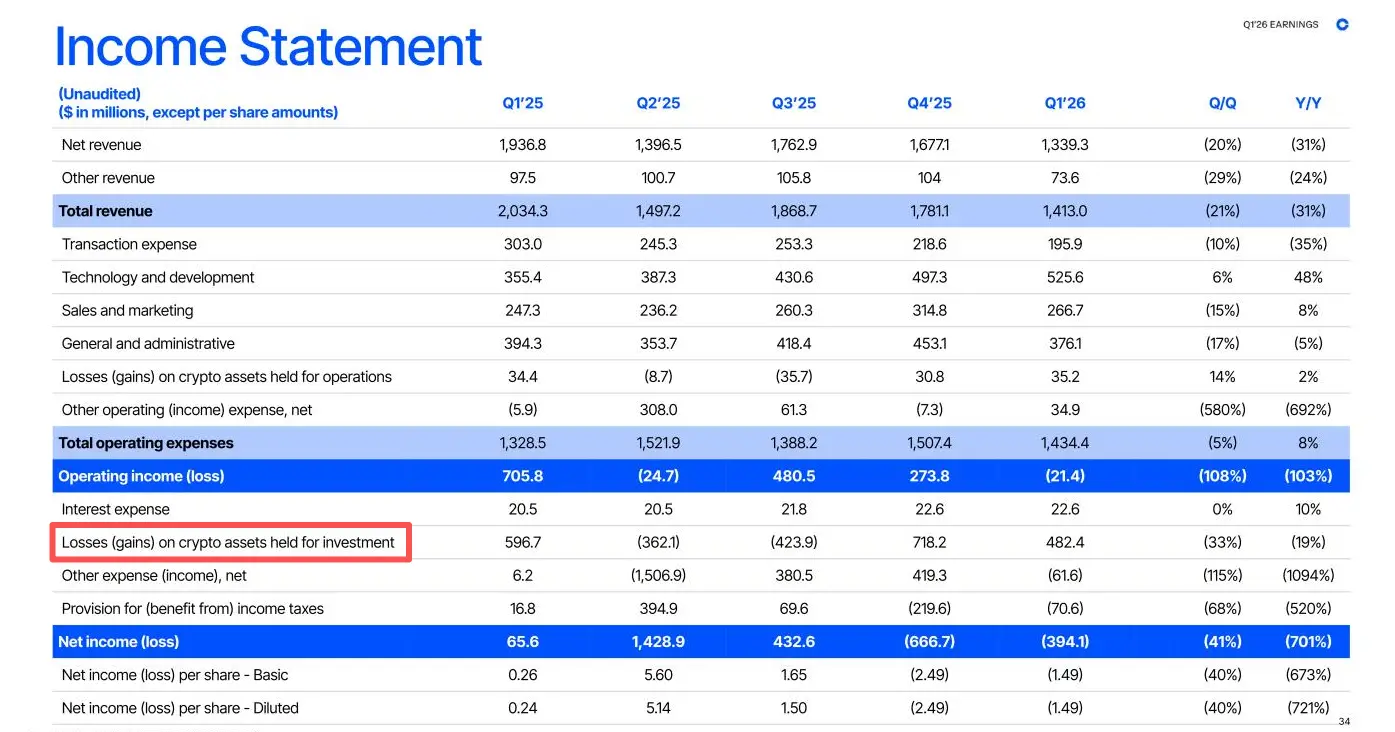
Dragged down by unrealized losses on held crypto assets, the company recorded a net loss of $394 million, with a loss per share of $1.47. In contrast, the company achieved a net profit of $66 million in the same period last year.

Following the earnings release, Coinbase's stock price fell approximately 4.7% in after-hours trading. The cumulative decline for the year-to-date has now exceeded 15%.
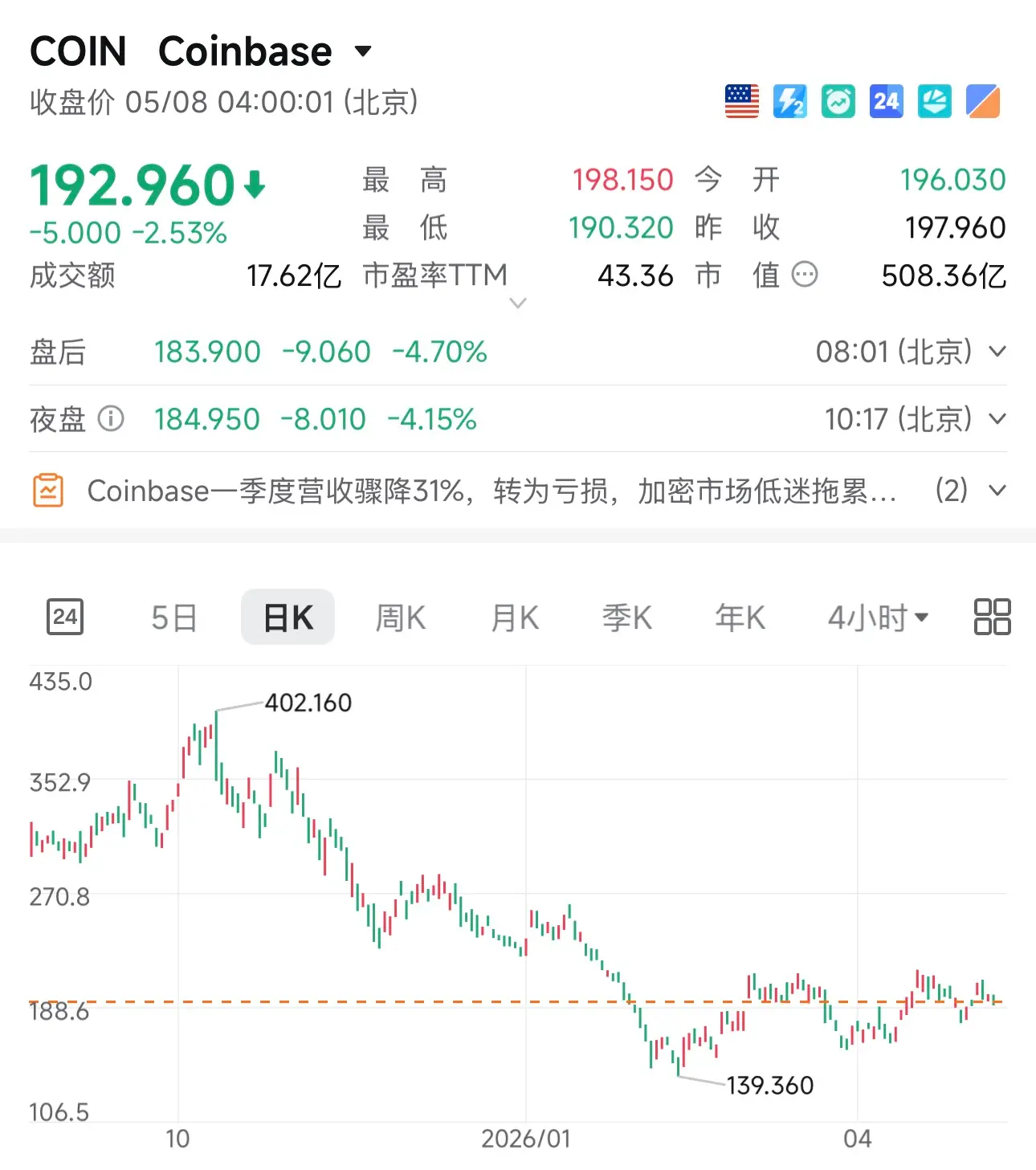
Transaction Revenue Down 40%, Institutional and Stablecoin Business as Bright Spots

Most of Coinbase's loss this quarter came from paper losses.

Behind the net loss of $394 million is an unrealized loss of $482 million from the company's investment crypto assets. This loss is accounted for with market price fluctuations and does not represent an actual cash outflow.

Excluding this portion, the company's adjusted net loss was only $45.6 million, and adjusted EBITDA remained positive at $303 million, with an operating loss of approximately $21.4 million.
The crypto market was generally weak in Q1. The price of Bitcoin fell from over $97,000 in early January to around $63,000 in early February, hovering below $70,000 by the end of the period. Market sentiment shifted rapidly, and retail trading activity contracted significantly. According to CoinGlass data, global crypto spot trading volume in Q1 was approximately $1.94 trillion, down about 44% year-on-year.

As a result, the company's total transaction revenue declined 40% to $756 million, with consumer transaction revenue at $567 million, a 48% year-on-year drop. Despite the halving of trading volume, Coinbase's global crypto spot market share rose to a record high of 8.6%, ranking fourth among global spot exchanges.

The institutional side, however, showed a completely different trend. The company's institutional transaction revenue reached $136 million, a 37% year-on-year increase. More notably, the derivatives business stood out, with derivatives trading volume growing 169% year-on-year, benefiting from the consolidation of Deribit acquired in August 2025. The collateral pledged by derivatives clients also surged from $27.4 million at the end of last year to $333 million at the end of this quarter, an increase of more than 10 times.

In terms of subscription and services revenue, the company recorded $584 million for the quarter, a 14% year-on-year decline, a significantly smaller drop than the transaction business. This segment's share of total net revenue increased to 44%. Notably, stablecoin revenue was $305 million, up 11% year-on-year, one of the few bright spots this quarter. Total assets on the platform stood at $294.4 billion at the end of the quarter.

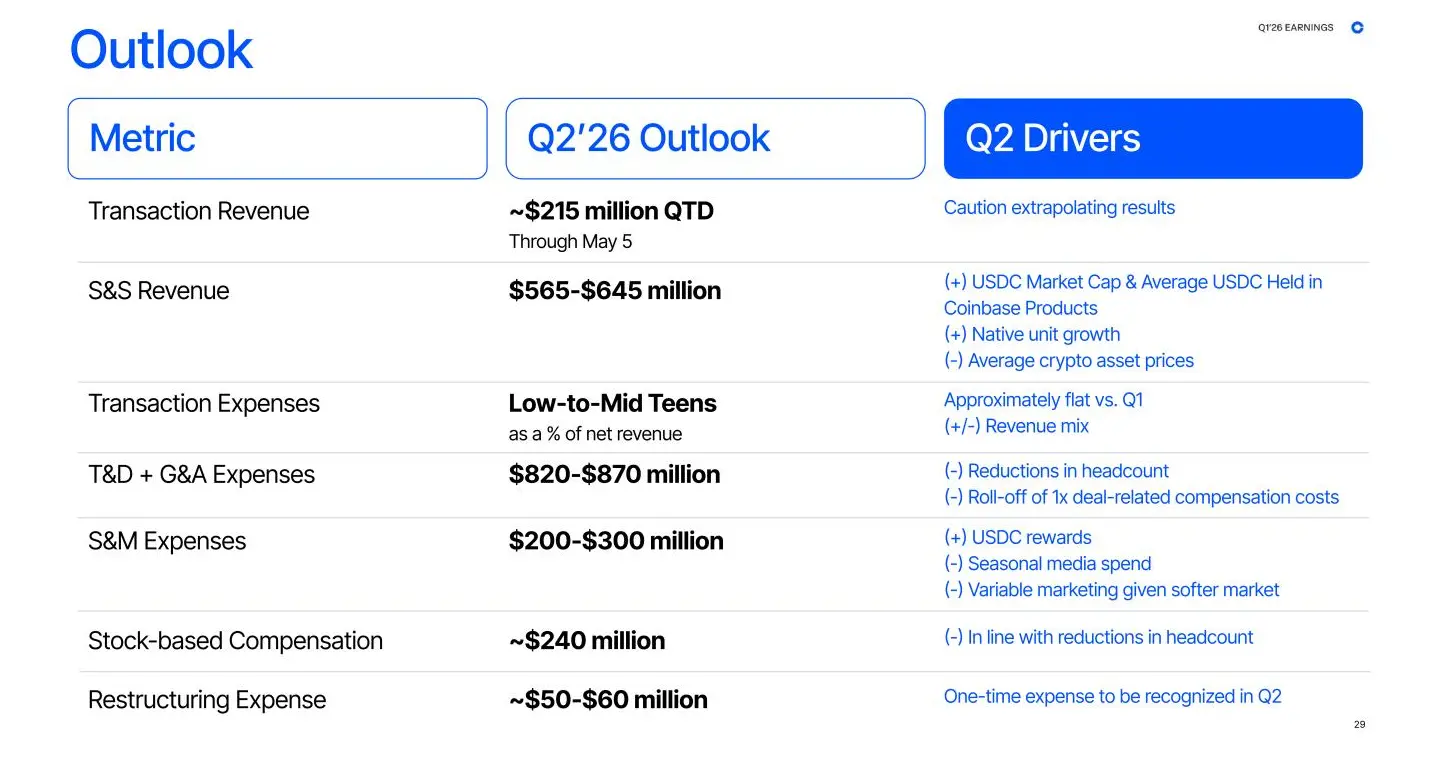
For Q2, management's outlook is generally cautious. The company disclosed that transaction revenue through May 5th was approximately $215 million, but management emphasized that current market volatility is high and this figure does not represent the trend for the entire quarter. The guidance range for subscription and services revenue is $565 million to $645 million, with the midpoint slightly above Q1's $584 million, indicating management's continued confidence in this revenue line. Restructuring expenses related to the recent layoffs, amounting to $50 to $60 million, will be recognized in Q2. Cost pressure is expected to ease significantly thereafter.
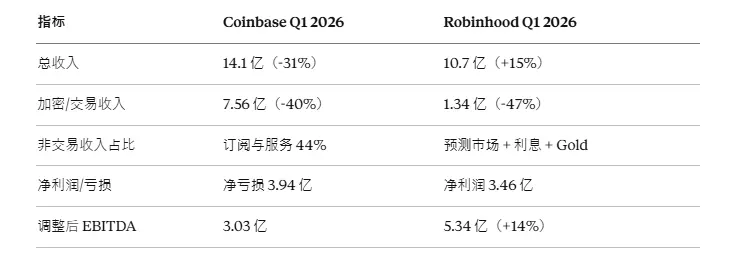
It is worth noting that Robinhood's Q1 earnings report presented a different picture. Its total revenue increased 15% year-on-year to $1.07 billion, with a net profit of $346 million and adjusted EBITDA reaching $534 million.

Examining the structure, the quality of this growth warrants scrutiny. Crypto-related revenue also declined 47% to $134 million. The company mainly filled the gap with three business segments: revenue from prediction market contracts skyrocketed 320%, becoming the largest incremental source; net interest income grew 24% to $359 million; and Gold subscription service revenue grew 32% to $50 million.

Additionally, Robinhood secured the role of sole initial trustee for the Trump account, investing approximately $100 million in related setup costs.

This quarter, Robinhood sustained growth through the policy tailwinds of prediction markets and the Trump account, while Coinbase bet on a longer-term transformation under the pressure of halved trading volumes.
Defensive Moves: Laying Off 700 Employees, What Is the Company Restructuring?

On May 5th, just two days before the earnings release, Coinbase announced cutting approximately 700 jobs, representing about 14% of its global workforce.

CEO Brian Armstrong stated that this restructuring aims to bring the company back to startup speed and accelerate the transition to an AI-native organization. The goal is to refactor Coinbase into an organization with intelligence at its core, augmented by humans at the edges.

Coinbase defines this approach as "AI-native"—not just introducing AI tools into the existing organization, but redesigning the company's operational model from the ground up. Company data shows a 78% year-on-year increase in engineer pull requests per capita. Team structures have been reorganized from traditional 10-person pods to AI-Native pods consisting of 2-3 people plus AI agents. Core service integration test coverage tripled within six months.
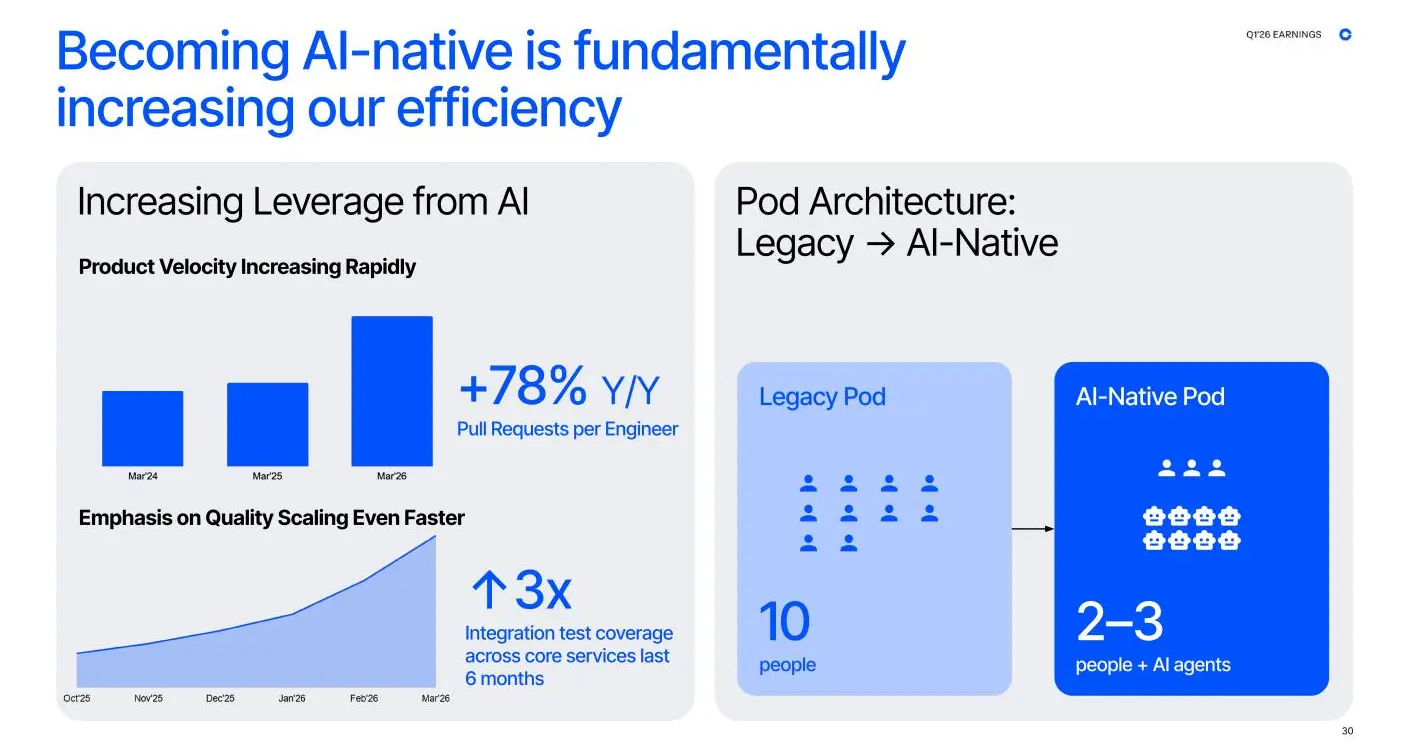
However, the financial implications need to be carefully considered. Omar, a partner at crypto venture capital firm Dragonfly, estimates that this layoff could save the company approximately $225 million in annual salary costs. But the full-year 2026 expense guidance indicates that, excluding the impact of increased USDC rewards, expenses will be roughly flat year-on-year. In other words, a significant portion of the cost savings from layoffs is offset by investments in user incentive programs.

It is also worth noting that over the past year or so, OpenAI has poached at least six senior marketing executives from Coinbase, including former CMO Kate Rouch, Sarah Russell, and others. Sarah Wolf, head of marketing for the Base chain, moved to Anthropic. Coinbase officially characterized these departures as normal personnel movement, but it is noteworthy that while the company is using AI to restructure its organization and reduce headcount, it is also supplying AI companies with marketing talent who best understand branding and growth.

When asked about potential future layoffs, CFO Alesia Haas stated, "We can't predict the future, but as a public company, we will always do what is best for the company."

Offensive Moves: Building On-Chain Financial Infrastructure

The "Everything Exchange" Blueprint

At the end of last year, Armstrong proposed the strategic goal of an "Everything Exchange"—transforming Coinbase from a primarily spot crypto platform into a comprehensive multi-asset platform encompassing derivatives, commodities, futures, and prediction market contracts, allowing users to avoid switching between different platforms.

Q1 data shows strong growth in derivatives, prediction markets, and decentralized exchanges. On the Base chain, stablecoin transactions initiated by AI agents already account for 90% of total chain transaction volume. Derivatives trading volume reached a record high, with contract business exceeding spot trading for the first time.

With initial results showing, the company has continued to double down recently, including: investing in Centrifuge to secure the tokenization infrastructure for RWA; taking a stake in Kemet to integrate institutional derivatives channels; launching the stablecoin credit fund CUSHY; obtaining the OCC national trust charter to clear the compliance hurdle for institutional custody; and partnering with AWS to integrate wallet infrastructure and the x402 protocol into Amazon Bedrock's AgentCore payment system, enabling AI agents to autonomously complete micropayments using USDC.

The Stablecoin Moat

Beyond expanding trading categories, the stablecoin business constitutes a deeper revenue moat for Coinbase.

According to Coinbase's revenue-sharing agreement with Circle, 100% of the earnings generated by USDC held on the Coinbase platform go to Coinbase, while off-platform USDC earnings are split approximately 50/50 between the two parties.

USDC's market capitalization has now reached a record high of approximately $80 billion, with over 25% held on the Coinbase platform. The balance on the platform has grown nearly 10-fold compared to three years ago. As USDC adoption continues to expand, Coinbase's share of the pie grows proportionally.

However, this revenue stream is not without risks. This quarter, the average interest rate declined by 67 basis points, negatively impacting stablecoin revenue by approximately $57.5 million. Changes in the interest rate environment may weaken the resilience of this revenue line.

CFO Alesia Haas emphasized during the earnings call, "Our USDC contract automatically renews every three years, and it renews in perpetuity. This contract cannot be terminated." CLO Paul Grewal added immediately, "We expect to continue our partnership with Circle on the same terms going forward."

These statements were clearly addressing market concerns about stablecoin regulation legislation. Regarding the CLARITY Act, Coinbase has engaged in a prolonged game of chess:

  • In January, it withdrew support due to unfavorable earnings provisions, causing the Senate to delay the vote;
  • In March, it rejected a new draft again, causing Circle's stock price to plummet 20% in a single day;
  • In early May, a compromise text emerged, prohibiting "pay for hold" but retaining space for rewards tied to real activities. Armstrong replied "Mark it up" on X, and Grewal also publicly expressed being "very confident" about the bill passing this summer.

The true value of this game is that Coinbase is not just complying with rules but participating in shaping them. The legal teams, compliance processes, and regulatory communication capabilities required to repackage yield products constitute a resource barrier that smaller exchanges cannot replicate in the short term.

In other words, once the CLARITY Act is enacted, the advantages of leading platforms will be solidified by legislation. Regulatory clarity is beneficial for the entire industry, but the deepest beneficiaries will always be the few capable of sitting at the negotiation table.

However, it is noteworthy that after the bill passes, there will be a 12-month rule-making phase, and the final boundaries are yet to be defined, leaving uncertainties.

Conclusion

With trading volume halved and a net loss of $394 million, Coinbase's earnings report once again reminds the market that the company remains strongly tied to the crypto cycle. There is no shortage of skeptical voices questioning whether the AI narrative represents a genuine transformation or merely a wrapper for declining business performance.

Brian Armstrong has repeatedly emphasized, "All finance will eventually move on-chain." As crypto increasingly resembles traditional finance, Coinbase is also striving to make itself look more like a mature financial infrastructure company. This might be the answer it is offering in the current cycle.


İlgili Sorular

QWhat were the key factors contributing to Coinbase's Q1 2026 net loss of $394 million?

ACoinbase's Q1 2026 net loss of $394 million was primarily driven by $482 million in unrealized losses on its investment portfolio of crypto assets due to market price declines. Excluding this mark-to-market impact, the adjusted net loss was $45.6 million.

QHow did Coinbase's consumer and institutional trading revenues perform in Q1 2026, and what is the 'Everything Exchange' strategy?

AIn Q1 2026, Coinbase's consumer transaction revenue fell 48% to $567 million, while institutional transaction revenue grew 37% to $136 million. The 'Everything Exchange' strategy aims to transform Coinbase from a primarily spot crypto platform into a multi-asset platform covering derivatives, commodities, futures, and prediction markets, creating a one-stop financial platform.

QWhat cost-saving measure did Coinbase announce alongside its earnings, and what is its broader organizational transformation goal?

ACoinbase announced a layoff of approximately 700 employees, about 14% of its workforce, aimed at saving an estimated $225 million in annual compensation costs. The broader goal is to accelerate its transformation into an 'AI-native' organization, fundamentally redesigning operations around AI agents to increase speed and efficiency.

QWhy is USDC stablecoin revenue significant for Coinbase, and what are the associated risks?

AUSDC revenue is a significant and growing income stream for Coinbase, reaching $305 million in Q1 (up 11% YoY). Its importance stems from a revenue-sharing agreement with Circle. However, this revenue faces risks from potential regulatory changes like the CLARITY Act, which could restrict yield products, and from sensitivity to interest rate fluctuations, which negatively impacted Q1 revenue by approximately $57.5 million.

QHow does Coinbase's Q1 2026 performance and outlook compare to its competitor Robinhood's?

ACoinbase's Q1 performance was challenged, with total revenue down 31% and a net loss, largely due to crypto market weakness. In contrast, Robinhood reported 15% revenue growth and a net profit of $346 million. However, Robinhood's crypto revenue also fell 47%; its growth was fueled by other segments like prediction markets and net interest income, while Coinbase is investing heavily in long-term infrastructure and diversification.

İlgili Okumalar

AI PC Battle: Bet on the Toll Booth, Not the Camp

**Title:** The AI PC Battle: Don't Bet on Sides, Bet on the Tollbooth **Summary:** The AI PC competition is moving beyond simple "x86 vs. Arm" narratives. The core investment thesis should focus on identifying which players can sustain margins, cash flow, and pricing power throughout the upgrade cycle, rather than backing a particular architecture. The opportunity is analyzed in three layers: 1. **The Advanced Foundry Tollbooth:** TSMC is positioned to collect "tolls" regardless of which chip designer wins, due to its dominant ~70% share in advanced semiconductor manufacturing, which is essential for high-end AI PC chips. 2. **Compute & Platform Spillover:** AMD represents an offensive in the x86 CPU+GPU space, while NVIDIA leverages its GPU and CUDA software stack dominance. Both benefit from the demand for increased local AI compute. 3. **Architecture Diffusion & Turnaround Plays:** ARM and Intel offer potential for significant upside (elasticity), but investments here require stricter discipline due to higher execution risks and competitive challenges. The industry is transitioning from concept to shipment validation. While short-term forecasts for AI PC adoption have been revised down slightly due to tariffs and procurement delays, the long-term trend towards AI becoming a standard PC feature remains intact. The key driver for upgrade cycles will be whether compelling enterprise applications (e.g., privacy-sensitive computing, low-latency inference) emerge beyond consumer-focused features like meeting summarization. Investment strategy should prioritize companies with platform-level advantages and recurring revenue streams. TSMC offers high certainty as the foundational tollbooth. AMD presents a strong offensive play within the established ecosystem. ARM and Intel are higher-risk, higher-potential-reward turnaround bets. The report cautions against chasing short-term hype and emphasizes a disciplined, long-term approach focused on buying ecosystem strength and cash-flow certainty after market enthusiasm subsides. **Key Risks:** Underwhelming AI PC applications slowing upgrade cycles; slow improvement in Windows on Arm compatibility; macro/tariff impacts on PC demand; potential advanced node supply-demand mismatches affecting TSMC; high overall AI sector valuations making stocks vulnerable to a risk-off shift in markets.

marsbit11 dk önce

AI PC Battle: Bet on the Toll Booth, Not the Camp

marsbit11 dk önce

Ten-Thousand-Word Analysis: From $10 to $290, MRVL Wins the Entire AI Era by 'Not Making GPUs'

Marvell Technology's stock price surged from under $10 in 2016 to a record $290 in June 2026, fueled not by making GPUs, but by dominating AI infrastructure connectivity. This analysis argues the market misvalues MRVL as merely a smaller Broadcom in custom AI chips, overlooking its true, unique position. Marvell's core strength lies in enabling high-speed data flow for AI clusters through three interconnected businesses. First, it holds a commanding ~70% market share in high-speed optical DSPs (essential for data center light modules), a deep-moat business with accelerating growth. Second, its custom AI chip design business serves hyperscalers like AWS, Microsoft, and Google, with a significant revenue pipeline despite lower margins. Third, stable cash flows come from Ethernet switch chips and enterprise storage controllers. Together, they form a full-stack "AI data movement" platform. CEO Matt Murphy's transformative leadership since 2016, involving strategic divestments, key acquisitions (like Inphi for optical DSPs), and securing long-term agreements with major cloud providers, repositioned the company. A pivotal $2 billion strategic investment from NVIDIA in 2026 underscored Marvell's critical role in the AI ecosystem, particularly through collaborations like NVLink Fusion. While Marvell faces risks—including client concentration (losing the Amazon Trainium3 design), lower-margin business mix, competitive threats, insider selling, and complex supply chains—its fundamentals remain strong. The optical interconnect moat is widening with the acquisition of Celestial AI (photonics fabric), and financial metrics show accelerating revenue growth and operating leverage. With a PEG ratio suggesting undervaluation relative to its growth, the thesis is that the market undervalues Marvell's monopolistic position in AI "plumbing" while overemphasizing its competitive custom chip segment. The story transcends investing, symbolizing how in any complex system—from the internet to AI—the value of "connection" ultimately surpasses that of individual "nodes."

marsbit41 dk önce

Ten-Thousand-Word Analysis: From $10 to $290, MRVL Wins the Entire AI Era by 'Not Making GPUs'

marsbit41 dk önce

AI Relay Stations Spark Heated Debate on Zhihu: Behind Cheap Tokens, What Are Users Really Worried About?

A discussion on Zhihu about "AI relay stations" shifted the niche developer topic of "cheap tokens" into broader user awareness. Users moved beyond simply questioning the legitimacy of these services to focus on practical concerns: Where do cheap tokens truly come from? Is the model being accessed the real one? Can relay stations see prompts, code, and API keys? For occasional users, are the risks worth it? The core debate centered less on price and more on trust. A primary worry is model authenticity—the risk of "model swapping," where users paying for a premium model might be routed to a cheaper one, creating an information asymmetry. Others argued that cost comparisons matter; while cheaper than official pay-as-you-go APIs, relay stations may not be the lowest-cost option versus subscriptions, domestic models, or free tiers, making user needs assessment crucial. Speculation about token sources ranged from legitimate bulk discounts to gray-area methods like account sharing or exploiting regional pricing. This opacity makes risk assessment difficult for users. Data security emerged as a critical concern, especially for enterprise use. When processing sensitive information like code, contracts, or client data, the inability to verify a relay station's data handling, retention, or access policies poses significant compliance and confidentiality risks. The evolving consensus suggests relay stations can be used cautiously for low-sensitivity, disposable tasks (e.g., summarizing public info, simple translation). However, they should not be the default for sensitive, professional, or production workflows involving proprietary data, Agents, or automated systems. Recommendations include avoiding large prepayments, not relying on a single service, using test prompts to monitor quality, anonymizing data where possible, and keeping official channels as backups. Ultimately, the discussion framed tokens not just as a billing unit but as a measure of real cost encompassing price, model integrity, data security, and service stability. The popularity of relay stations highlights user demand for affordable access, but the debate underscores a key trade-off: the savings from cheap tokens may come at the price of trust, transparency, and control over one's data and AI experience.

marsbit1 saat önce

AI Relay Stations Spark Heated Debate on Zhihu: Behind Cheap Tokens, What Are Users Really Worried About?

marsbit1 saat önce

In-Depth Research Report on TradFi: The Convergence Wave of Crypto and Traditional Finance

In 2026, the crypto industry is undergoing a profound infrastructure-level transformation—TradFi assets are migrating on-chain at an unprecedented pace. According to CoinGecko's Q1 2026 report, the total value locked (TVL) of tokenized real-world assets (RWA) has surpassed $31 billion, a nearly 4x increase from $7.8 billion at the beginning of 2025, with the sector’s aggregate market capitalization reaching $19.3 billion. Among these, the market cap of tokenized stocks surged from $2 million to $486 million, with Q1 spot trading volume reaching $15.1 billion—a single quarter already surpassing the entire second half of 2025. RWA perpetual contract Q1 trading volume reached a staggering $524.8 billion, far exceeding the $313 billion for all of 2025. Meanwhile, BlackRock's BUIDL fund has reached $2.3 billion in scale and has filed for two new tokenized funds, signaling that the world's largest asset manager's tokenization strategy is evolving from pilot to product suite expansion. HTX, as a core participant in the crypto exchange sector, officially launched TradFi perpetual futures products including NVDA, AAPL, MSFT, META, and SPY in 2026, enabling crypto users to gain 24/7 trading access to core U.S. equities. Boston Consulting Group predicts that global tokenized asset scale could reach $16 trillion by 2030, while McKinsey offers a conservative estimate of approximately $2 trillion. The on-chain migration of TradFi assets is no longer a "future narrative" but a structural transformation unfolding in real time, as crypto exchanges evolve from single crypto asset trading platforms toward "multi-asset-class trading infrastructure."

HTX Learn1 saat önce

In-Depth Research Report on TradFi: The Convergence Wave of Crypto and Traditional Finance

HTX Learn1 saat önce

İşlemler

Spot
Futures

Popüler Makaleler

4 Nasıl Satın Alınır

HTX.com’a hoş geldiniz! 4 (4) satın alma işlemlerini basit ve kullanışlı bir hâle getirdik. Adım adım açıkladığımız rehberimizi takip ederek kripto yolculuğunuza başlayın. 1. Adım: HTX Hesabınızı OluşturunHTX'te ücretsiz bir hesap açmak için e-posta adresinizi veya telefon numaranızı kullanın. Sorunsuzca kaydolun ve tüm özelliklerin kilidini açın. Hesabımı Aç2. Adım: Kripto Satın Al Bölümüne Gidin ve Ödeme Yönteminizi SeçinKredi/Banka Kartı: Visa veya Mastercard'ınızı kullanarak anında 4 (4) satın alın.Bakiye: Sorunsuz bir şekilde işlem yapmak için HTX hesap bakiyenizdeki fonları kullanın.Üçüncü Taraflar: Kullanımı kolaylaştırmak için Google Pay ve Apple Pay gibi popüler ödeme yöntemlerini ekledik.P2P: HTX'teki diğer kullanıcılarla doğrudan işlem yapın.Borsa Dışı (OTC): Yatırımcılar için kişiye özel hizmetler ve rekabetçi döviz kurları sunuyoruz.3. Adım: 4 (4) Varlıklarınızı Saklayın4 (4) satın aldıktan sonra HTX hesabınızda saklayın. Alternatif olarak, blok zinciri transferi yoluyla başka bir yere gönderebilir veya diğer kripto para birimlerini takas etmek için kullanabilirsiniz.4. Adım: 4 (4) Varlıklarınızla İşlem YapınHTX'in spot piyasasında 4 (4) ile kolayca işlemler yapın.Hesabınıza erişin, işlem çiftinizi seçin, işlemlerinizi gerçekleştirin ve gerçek zamanlı olarak izleyin. Hem yeni başlayanlar hem de deneyimli yatırımcılar için kullanıcı dostu bir deneyim sunuyoruz.

380 Toplam GörüntülenmeYayınlanma 2025.10.20Güncellenme 2026.06.02

4 Nasıl Satın Alınır

Tartışmalar

HTX Topluluğuna hoş geldiniz. Burada, en son platform gelişmeleri hakkında bilgi sahibi olabilir ve profesyonel piyasa görüşlerine erişebilirsiniz. Kullanıcıların 4 (4) fiyatı hakkındaki görüşleri aşağıda sunulmaktadır.

活动图片