Coinbase CLO turns bullish on CLARITY: ‘Confident we’re going to see progress’

ambcrypto2026-04-02 tarihinde yayınlandı2026-04-02 tarihinde güncellendi

Özet

Coinbase Chief Legal Officer Paul Grewal expressed strong optimism about the imminent passage of the Digital Asset Market CLARITY Act of 2025, predicting a breakthrough in U.S. crypto regulation within the next 48 hours. Despite resistance from traditional banks, Grewal emphasized the importance of the bill in fulfilling former President Trump’s vision of making the U.S. a global crypto capital. He differentiated crypto from fractional-reserve banking, dismissing concerns about deposit flight due to stablecoins. His shift in stance surprised Patrick Witt of the President’s Council on Digital Assets, given Coinbase’s previous hesitation. Polymarket odds of the bill becoming law by 2026 rose to 65%, reflecting growing confidence.

An interesting plot twist has emerged in the ongoing chatter around the Digital Asset Market CLARITY Act of 2025.

Coinbase Chief Legal Officer (CLO) Paul Grewal, in a recent television appearance, has shared his optimism about the passage of the crypto bill. He believes that the U.S. is on the verge of a major crypto breakthrough despite banks’ resistance.

More importantly, Grewal revealed that the deal between crypto and banks will likely pass within the next 48 hours.

I’m very confident we’re going to see progress.

However, he also pointed out that,

Other key elements of the bill are critically important to making sure that President Trump’s vision of the United States as the crypto capital world is fulfilled.

Coinbase’s CLO is confident about the CLARITY Act passage

Explaining his stance, Coinbase CLO underlined that rules might be different for banks and crypto because “the game is very different”.

While comparing traditional banks and stablecoins, Grewal highlighted how banks operate on fractional reserve lending—where they hold less and focus more on deposits and lend-outs.

However, as the ongoing debate around ‘yield generations’ surges, critics believe that stablecoin could halt people from withdrawing money from banks. But speaking in defense, Grewal rejected that notion, stating,

There has been no evidence of deposit flight whatsoever.

He also stressed how the GENIUS Act introduced the initial rule for crypto and that the CLARITY Act is the finish line for a complete regulatory framework.

Shift in stance shocks executives

This optimism from Grewal comes after Coinbase’s recent holdout. For those unaware, this stepback had pushed Patrick Witt, the executive director of the President’s Council on Digital Assets, to issue a hidden warning at Coinbase.

However, after hearing Paul Grewal’s shift in stance. Witt expressed his surprise.

Source: Patrick Witt/X

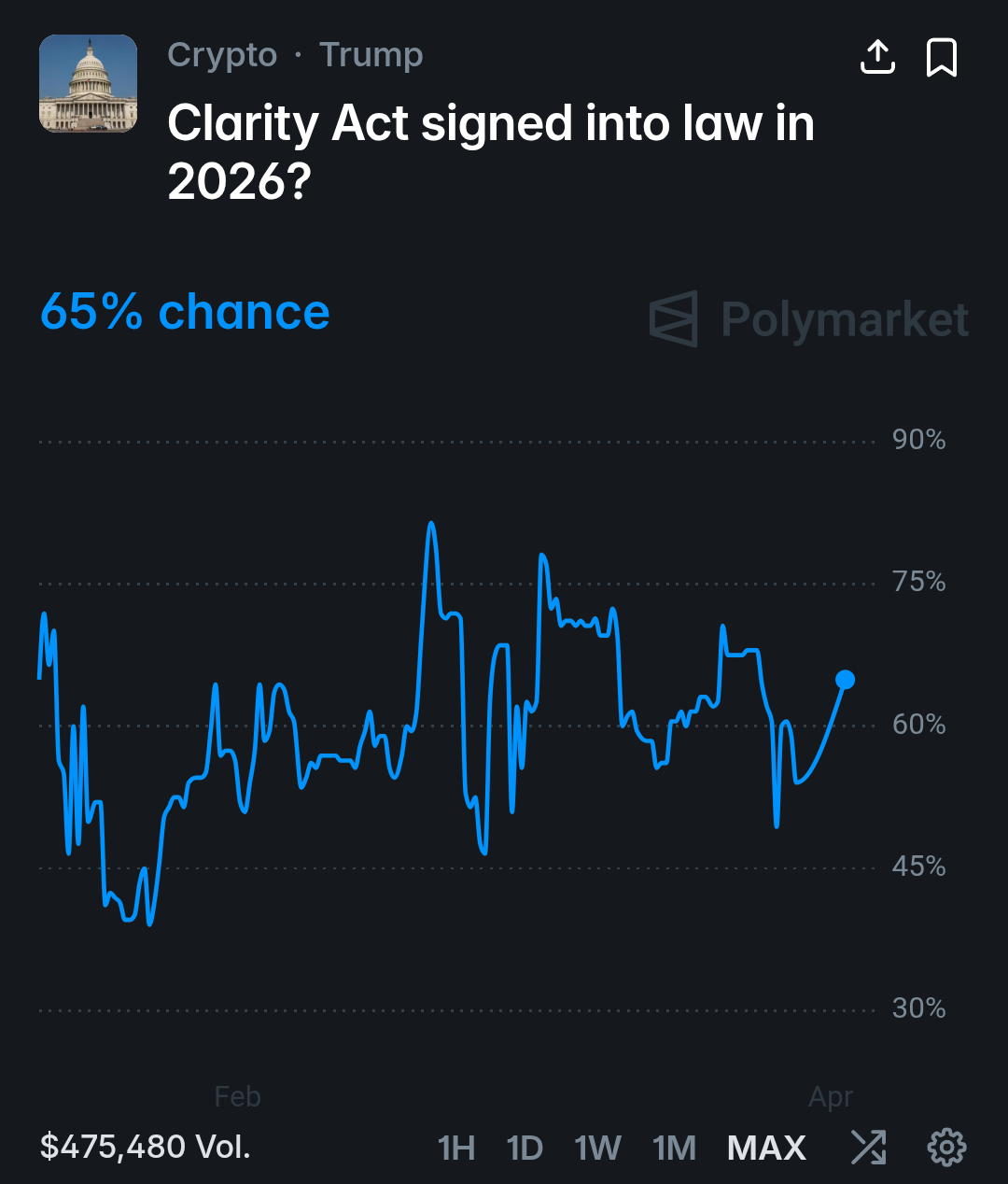
Meanwhile, the Polymarket odds of the CLARITY Act being signed into law in 2026 confirmed the positive sentiment, as it stood at 65% at the time of reporting.
Source: Polymarket

Final Summary

  • Paul Grewal’s optimism about the CLARTY Act shocks Patrick Witt, considering Coinbase’s past holdout.
  • Polymarket odds rocketed to 65%, reflecting this increased optimism.

İlgili Sorular

QWhat is Paul Grewal's position at Coinbase and what is his recent stance on the CLARITY Act?

APaul Grewal is the Chief Legal Officer (CLO) of Coinbase, and he has recently expressed optimism and confidence about the passage of the CLARITY Act.

QAccording to Grewal, when is the deal between crypto and banks likely to pass?

AGrewal revealed that the deal between crypto and banks is likely to pass within the next 48 hours.

QHow did Patrick Witt react to Paul Grewal's shift in stance on the CLARITY Act?

APatrick Witt, the executive director of the President’s Council on Digital Assets, expressed surprise at Paul Grewal's shift in stance, considering Coinbase's previous holdout.

QWhat were the Polymarket odds for the CLARITY Act being signed into law in 2026 at the time of reporting?

AThe Polymarket odds for the CLARITY Act being signed into law in 2026 stood at 65% at the time of reporting.

QWhat key difference did Grewal highlight between traditional banks and stablecoins?

AGrewal highlighted that traditional banks operate on fractional reserve lending, where they hold less and focus more on deposits and lend-outs, while implying stablecoins operate differently.

İlgili Okumalar

Apple's Desired On-Device AI Sees a Dark Horse Emerge: The First Cognitive Model is Born, 4B Matches GPT-5.4

A Chinese company, Tomorrow's Journey (Nextie), has introduced what it is calling the industry's first "cognitive model" for edge devices. Named New Journey Alpha, this 4-billion-parameter model reportedly matches the performance of trillion-parameter giants like GPT-5.4 in group intelligence tasks such as debate and collective decision-making. The development follows Andrej Karpathy's vision of stripping vast factual knowledge from large language models to retain only a smaller "cognitive core" capable of reasoning, planning, and knowing its own limits. This approach directly addresses the soaring computational costs and token expenses hindering AI's widespread deployment, as highlighted by incidents like Amazon shutting down an internal AI tool due to prohibitive costs. Trained via reinforcement learning on a corpus of academic papers from 1800-2020 to enhance generalization, the model enables three key advancements: 1) Improved decision quality in multi-agent systems, 2) Drastically reduced compute costs, allowing for cost-effective cloud or on-device (e.g., MacBook) deployment, and 3) The feasibility of "proactive" AI agents that act autonomously without user prompts, unlocking new commercial possibilities beyond today's reactive models. Built by the former Microsoft Xiaoice team—known for creating a 3.6B model that outperformed a 65B Llama model—the company is now focusing on the multi-agent systems sector, a field gaining significant investor interest. The model's economic impact is profound; by achieving high-level performance with minimal parameters, it fundamentally alters the cost structure of AI services, challenging the prevailing model of ever-larger parameter counts.

marsbit19 dk önce

Apple's Desired On-Device AI Sees a Dark Horse Emerge: The First Cognitive Model is Born, 4B Matches GPT-5.4

marsbit19 dk önce

OpenAI's 'Blueprint for the Future': Making AI Beneficial for Every Person on the Planet

A new transformative technology emerges every few generations. OpenAI draws a parallel with the advent of electricity in the 1920s, which initially brought convenience but ultimately enabled unprecedented progress in medicine, engineering, and living standards by empowering people to create new possibilities. AI is poised to recreate this phenomenon. Its true significance lies not in the technology itself, but in what people can achieve with it—from understanding a medical bill or starting a business to aiding scientific discovery. OpenAI believes AI should be universally accessible, allowing everyone to use it according to their own needs. This future, however, is not guaranteed. While transformative tech can centralize power, OpenAI's philosophy is that AI must serve humanity, augmenting human capabilities and broadly distributing its benefits. The company's first commitment is to build AI for human service, aiming to empower the many rather than concentrate power in a few. Safety, alignment with human intent, and oversight are paramount. OpenAI is optimistic about AI's potential to expand human welfare but remains clear-eyed about risks. The goal is to help people achieve more, not to replace them. Full automation is not the desired future; human judgment, values, and direction will become even more critical. OpenAI outlines three core goals: 1. Build automated AI researchers to accelerate and increasingly automate the research process itself, maintaining close human collaboration. The internal projection is that by March 2028, a significant portion of their research will be conducted by AI systems working alongside human researchers. 2. Accelerate economic development by advancing science, boosting productivity, and fostering growth, while ensuring the fruits are widely shared. 3. Provide a personal AGI for everyone on Earth, allowing individuals to benefit from this transformative technology in their own way. The company is entering its third phase, moving from foundational AGI research (Phase 1) to product deployment and learning from real-world use (Phase 2). The current challenge is making advanced AI abundant, affordable, safe, practical, and usable for all individuals and organizations. OpenAI concludes that a widely distributed power structure leads to a more resilient, adaptable, and free society. A positive AI future should not be controlled by a handful of entities but built, benefited from, and owned by many. If realized correctly, AI can become a cornerstone for enhancing global productivity, creativity, scientific advancement, and economic opportunity, fulfilling the mission to ensure AGI benefits all of humanity.

marsbit1 saat önce

OpenAI's 'Blueprint for the Future': Making AI Beneficial for Every Person on the Planet

marsbit1 saat önce

Arthur Hayes' New Article: AI Bubble Nears Bursting, Crypto Market Faces Short-Term Pressure

In a new essay, Arthur Hayes argues that the AI market bubble is approaching a rupture, which will place significant short-term pressure on crypto assets. He identifies rising oil prices, a trio of massive tech IPOs (SpaceX, Anthropic, OpenAI), and potential anti-AI political rhetoric from Trump as the three key catalysts for a correction. Hayes posits that the prolonged blockage of the Strait of Hormuz will drive energy prices higher, increasing operational costs for data centers and squeezing AI company profits. Simultaneously, the market may struggle to absorb the upcoming wave of multi-trillion dollar tech IPOs. Furthermore, with high inflation hurting his election chances, Trump could pivot to attacking the AI sector with proposals for heavy taxation and regulation to win over voters, spooking the market. Hayes notes that nearly all new dollar liquidity since 2022 has flowed into the AI sector, leaving little for Bitcoin, explaining its recent underperformance. He believes an AI stock crash would trigger a broad risk-off sentiment and credit contraction, dragging down crypto in the near term. Consequently, his fund, Maelstrom, has sold all AI-related stocks and non-core cryptocurrencies, retaining only Bitcoin and Ethereum while building positions in traditional energy stocks. He anticipates Bitcoin will bottom and resume its bull run only after the AI bubble pops and a new monetary easing cycle begins.

marsbit1 saat önce

Arthur Hayes' New Article: AI Bubble Nears Bursting, Crypto Market Faces Short-Term Pressure

marsbit1 saat önce

İşlemler

Spot
Futures
活动图片