Coinbase Announces New Board Of Experts To Combat Rising Quantum Computing Risks

bitcoinist2026-01-23 tarihinde yayınlandı2026-01-23 tarihinde güncellendi

Özet

Coinbase has formed an independent advisory board of external experts to address the emerging security threats posed by quantum computing. The board includes academics from institutions like Stanford and Harvard, as well as representatives from the Ethereum Foundation, EigenLayer, and Coinbase. According to Chief Information Security Officer Jeff Lunglhofer, quantum computers could potentially break the encryption protecting Bitcoin wallets and private keys, which currently rely on complex mathematical problems unsolvable by conventional computers in feasible time. Although this threat is not expected to materialize for at least a decade, the board will publish research and position statements to help the industry prepare. Initial defensive measures may include larger keys and added “noise” to obscure data. The first paper, focusing on quantum computing’s impact on blockchain consensus and transaction layers, is expected within months.

The crypto industry is preparing for a potential security challenge with the anticipated arrival of quantum computing. In response to this potential threat, Coinbase (COIN) has announced the formation of an advisory board composed of external experts.

Coinbase Chief Security Officer’s Warning

According to a report from Fortune, the newly established board includes academics from Stanford, Harvard, and the University of California, specializing in fields like computer science, cryptography, and fintech.

Officially titled the Coinbase Independent Advisory Board on Quantum Computing and Blockchain, the group also features experts from the Ethereum Foundation, the decentralized finance (DeFi) platform EigenLayer, and Coinbase itself.

Jeff Lunglhofer, Coinbase’s Chief Information Security Officer, elaborated on the potential impact of quantum computing on current encryption methods.

He explained that the encryption protecting wallets and private keys of Bitcoin (BTC) holders relies on complex mathematical problems that would take conventional computers thousands of years to solve.

However, with the computational power that quantum computers promise—potentially a million times greater—these problems could be solved much more swiftly, Lunglhofer asserted.

Although the security implications of quantum computing are genuine, Lunglhofer reassured that they are not expected to become an immediate concern for at least a decade. The purpose of the new advisory board is to examine the upcoming challenges posed by quantum computing in a measured manner.

This involves fostering initiatives within the blockchain industry that are reportedly already underway to enhance the resilience of Bitcoin and other networks against quantum attacks.

Blockchain Networks Expected To Implement Larger Keys

At present, Bitcoin secures its wallets through private keys, which consist of long strings of random characters. These keys are accessible to their owners but can only be estimated through extensive trial-and-error computations.

The advent of quantum computing, however, would make it feasible to deduce private keys using trial-and-error methods in a fraction of the time.

In response to this looming threat, Fortune disclosed that blockchain experts speculate that networks will implement larger keys and add “noise” to obscure their locations, making them more difficult to detect. Implementing these defensive upgrades across blockchain networks is said to take several years.

In the meantime, the newly formed Coinbase Advisory Board is gearing up to publish research papers and issue position statements aimed at helping the cryptocurrency industry brace for the impacts of quantum computing.

Their first paper, which will address quantum’s influence on the consensus and transaction layers of blockchain, is expected to be released within the next couple of months.

The daily chart shows COIN’s valuation trending downwards. Source: COIN on TradingView.com

At the time of writing, Coinbase’s stock, which trades under the ticker symbol COIN on the Nasdaq, is trading at $225.10. This represents a slight drop of 1.2% over the last 24 hours.

Featured image from OpenArt, chart from TradingView.com

İlgili Sorular

QWhat is the primary purpose of Coinbase's newly formed advisory board?

AThe primary purpose of the Coinbase Independent Advisory Board on Quantum Computing and Blockchain is to examine the upcoming challenges posed by quantum computing in a measured manner and help the cryptocurrency industry brace for its impacts.

QAccording to the Coinbase CISO, why is quantum computing a potential threat to current cryptocurrency encryption?

AQuantum computing is a threat because the encryption protecting wallets and private keys relies on complex mathematical problems that conventional computers take millennia to solve, but quantum computers, with their immense computational power, could solve them much more swiftly.

QWhat are two potential defensive upgrades that blockchain networks might implement against quantum attacks?

ABlockchain networks are expected to implement larger keys and add 'noise' to obscure transaction locations, making them more difficult to detect and crack.

QWhat is the expected timeline for the first research paper from the advisory board, and what will it address?

AThe advisory board's first research paper is expected to be released within the next couple of months and will address quantum computing's influence on the consensus and transaction layers of blockchain.

QWhat was the performance of Coinbase's stock (COIN) at the time the article was written?

AAt the time of writing, Coinbase's stock (COIN) was trading at $225.10 on the Nasdaq, representing a slight drop of 1.2% over the previous 24 hours.

İlgili Okumalar

Casper Network Publishes the Casper Manifest, a Multi-Year Roadmap to Power Regulated Real-World Assets and the Machine Economy

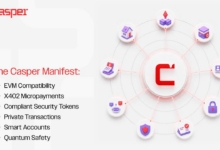
The Casper Association has published "The Casper Manifest," a multi-year technical roadmap for Casper Network. Introduced at the Digital Finance Forum in Bermuda, the roadmap outlines nine coordinated initiatives designed to position the layer-1 blockchain as the infrastructure for regulated real-world asset (RWA) tokenization and the machine-to-machine economy. Key initiatives focus on: 1. **Developer Access:** Adding full Ethereum Virtual Machine (EVM) compatibility alongside its existing WebAssembly (Wasm) execution layer. 2. **User Experience:** Implementing gasless transactions, batch operations, and smart accounts with biometric authentication. 3. **Institutional Compliance & Privacy:** Building compliant security tokens aligned with the ERC-3643 standard and a multi-phase roadmap for confidential transactions with built-in audit tools. 4. **Machine Economy:** Implementing the X402 open payment standard to enable AI agents and machines to make autonomous, programmatic micropayments. 5. **Token Infrastructure:** Creating a Native Token Registry to give all tokens protocol-level status with fixed, predictable costs. 6. **Quantum Safety:** Developing hybrid accounts with both classical and quantum-resistant keys. The first initiative, X402 micropayments, is expected within weeks. Subsequent releases through 2026 and 2027 will include EVM compatibility, compliant security tokens, the Native Token Registry, gasless transactions, and quantum-safe features. The goal is to create a blockchain that is frictionless for users, trusted by institutions, and native for machines.

TheNewsCrypto4 saat önce

Casper Network Publishes the Casper Manifest, a Multi-Year Roadmap to Power Regulated Real-World Assets and the Machine Economy

TheNewsCrypto4 saat önce

İşlemler

Spot
Futures
活动图片