Coinbase Accuses Australian Banks of Unlawful Regulatory Ban as Maxi Doge Pumps

bitcoinist2026-02-03 tarihinde yayınlandı2026-02-03 tarihinde güncellendi

Özet

Coinbase has accused major Australian banks of imposing an unlawful "shadow ban" on crypto transfers, effectively de-banking users under the guise of scam prevention. This has created barriers for retail investors moving fiat into crypto, driving interest in on-chain assets like meme coins. Maxi Doge ($MAXI) is highlighted as a leading project capitalizing on this trend, promoting a "Leverage King" culture with trading competitions and staking rewards. The token has attracted significant whale activity, with two purchases totalling $503K, and has raised $4.5M in its ongoing presale. Priced at $0.0002802, it offers dynamic APY staking and aims to avoid typical pump-and-dump cycles.

Tensions are boiling over Down Under. Coinbase has formally accused major Australian banks of imposing a shadow ban on the industry.

Executives argue that banks are systematically restricting transfers to crypto platforms, effectively ‘de-banking’ users without a clear mandate. That opacity creates a massive headache (and a crisis of confidence) for retail investors just trying to move their own money.
Banks usually cite ‘scam prevention’ as the excuse for blocking exchanges.

But industry insiders see it differently: it’s an anti-competitive moat designed to stifle digital assets. This leaves Aussie investors in limbo—unable to move fiat freely, even though they’re legally entitled to trade.

That tension highlights a strange market quirk. While banking gateways jam up, the on-chain economy is actually accelerating. Why? Traders want assets that don’t need a bank manager’s permission. When fiat rails choke, capital rotates into high-volatility sectors that live entirely on-chain. It’s the perfect storm for ‘culture coins.’

Leading the charge is Maxi Doge ($MAXI), a project mixing gym-bro aesthetics with a decentralized trading ethos.

Buy your $MAXI right here.

Maxi Doge Builds Leverage King Culture Amidst Fiat Restrictions

As TradFi tries to gatekeep the market, Maxi Doge ($MAXI) frames itself as the antidote: a 240-lb canine juggernaut built for the ‘grind.’ Most meme tokens rely on flash-in-the-pan viral moments. Maxi Doge? It’s pushing a specific ‘Leverage King’ culture. It targets retail traders who might lack whale capital but have the guts to chase outsized returns, exactly the crowd banks are alienating.

The narrative is all about ‘lifting’ portfolios. It works through Holder-Only Trading Competitions, where members compete for leaderboard rewards based on ROI. This gamifies trading, turning solitary chart-watching into a communal sport. Plus, with a ‘Maxi Fund’ treasury for liquidity, the team (relatively unknown until now) signals they’re building for longevity, not a quick exit.

For traders tired of slow-moving regulated finance, the appeal is the raw risk/reward profile. ‘Never skip leg day’ isn’t just a meme here. It’s a metaphor for holding through volatility to hit the kind of gains traditional banks simply can’t offer.

Check out the Maxi Doge presale.

Whale Wallets Accumulate $503K as Presale Hits Major Milestone

Smart money seems to be tuning out the regulatory noise. Etherscan data shows two high-net-worth whales scooped up $503K in Maxi Doge recently, with a massive single buy of $251K on October 11, 2025. That’s institutional-sized volume. It suggests big players are positioning themselves before the token hits public exchanges.

According to the official presale page, Maxi Doge has raised a staggering $4.5M so far and it’s still going.
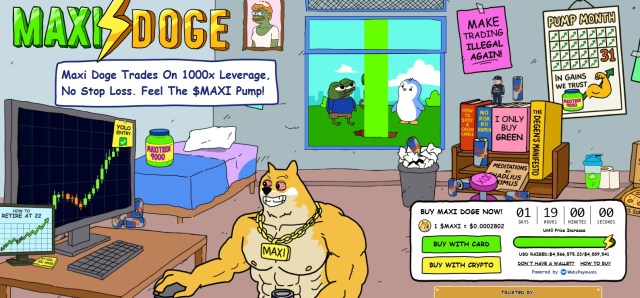
Frankly, the market is hungry for utility-driven memes. Tokens are sitting at $0.0002802, an entry point before the wider retail masses arrive. Beyond the raise, the tech includes dynamic APY staking. This lets holders earn passive yield through daily smart contract drops, incentivizing holding rather than quick flips.

Heavy whale accumulation mixed with staking mechanics breaks the typical ‘pump and dump’ mold. With the ‘Maxi Fund’ locking in liquidity and the presale entering its final laps, the market structure looks surprisingly solid at these levels.

Explore the Maxi Doge presale.

The information provided in this article does not constitute investment advice. Cryptocurrency markets are highly volatile. Always conduct your own research.


İlgili Sorular

QWhat is Coinbase accusing major Australian banks of doing?

ACoinbase is accusing major Australian banks of imposing a 'shadow ban' by systematically restricting or blocking bank transfers to cryptocurrency exchanges, effectively de-banking users without a clear regulatory mandate.

QAccording to the article, what reason do banks typically give for blocking transactions to crypto exchanges?

ABanks typically cite 'scam prevention' as the excuse for blocking transactions to cryptocurrency exchanges.

QWhat is the name of the meme token and its ticker that is leading the charge as an alternative during these banking restrictions?

AThe meme token is called Maxi Doge and its ticker is $MAXI.

QHow much money have high-net-worth 'whales' accumulated in Maxi Doge recently, according to Etherscan data mentioned in the article?

AAccording to Etherscan data, high-net-worth whales have accumulated $503,000 in Maxi Doge recently, including a single buy of $251,000.

QWhat is the total amount raised in the Maxi Doge presale as reported in the article?

AThe Maxi Doge presale has raised a total of $4.5 million so far, according to the official presale page.

İlgili Okumalar

OpenAI Post-Training Engineer Weng Jiayi Proposes a New Paradigm Hypothesis for Agentic AI

OpenAI engineer Weng Jiayi's "Heuristic Learning" experiments propose a new paradigm for Agentic AI, suggesting that intelligent agents can improve not just by training neural networks, but also by autonomously writing and refining code based on environmental feedback. In the experiment, a coding agent (powered by Codex) was tasked with developing and maintaining a programmatic strategy for the Atari game Breakout. Starting from a basic prompt, the agent iteratively wrote code, ran the game, analyzed logs and video replays to identify failures, and then modified the code. Through this engineering loop of "code-run-debug-update," it evolved a pure Python heuristic strategy that achieved a perfect score of 864 in Breakout and performed competitively with deep reinforcement learning (RL) algorithms in MuJoCo control tasks like Ant and HalfCheetah. This approach, termed Heuristic Learning (HL), contrasts with Deep RL. In HL, experience is captured in readable, modifiable code, tests, logs, and configurations—a software system—rather than being encoded solely into opaque neural network weights. This offers potential advantages in explainability, auditability for safety-critical applications, easier integration of regression tests to combat catastrophic forgetting, and more efficient sample use in early learning stages, as demonstrated in broader tests on 57 Atari games. However, the blog acknowledges clear limitations. Programmatic strategies struggle with tasks requiring long-horizon planning or complex perception (e.g., Montezuma's Revenge), areas where neural networks excel. The future vision is a hybrid architecture: specialized neural networks for fast perception (System 1), HL systems for rules, safety, and local recovery (also System 1), and LLM agents providing high-level feedback and learning from the HL system's data (System 2). The core proposition is that in the era of capable coding agents, a significant portion of an AI's learned experience could be maintained as an auditable, evolving software system.

marsbit24 dk önce

OpenAI Post-Training Engineer Weng Jiayi Proposes a New Paradigm Hypothesis for Agentic AI

marsbit24 dk önce

Your Claude Will Dream Tonight, Don't Disturb It

This article explores the recent phenomenon of AI companies increasingly using anthropomorphic language—like "thinking," "memory," "hallucination," and now "dreaming"—to describe machine learning processes. Focusing on Anthropic's newly announced "Dreaming" feature for its Claude Agent platform, the piece explains that this function is essentially an automated, offline batch processing of an agent's operational logs. It analyzes past task sessions to identify patterns, optimize future actions, and consolidate learnings into a persistent memory system, akin to a form of reinforcement learning and self-correction. The article draws parallels to similar features in other AI agent systems like Hermes Agent and OpenClaw, which also implement mechanisms for reviewing historical data, extracting reusable "skills," and strengthening long-term memory. It notes a key difference from human dreaming: these AI "dreams" still consume computational resources and user tokens. Further context is provided by discussing the technical challenges of managing AI "memory" or context, highlighting the computational expense of large context windows and innovations like Subquadratic's new model claiming drastically longer contexts. The core critique argues that this strategic use of human-centric vocabulary does more than market products; it subtly reshapes user perception. By framing algorithms with terms associated with consciousness, companies blur the line between tool and autonomous entity. This linguistic shift can influence user expectations, tolerance for errors, and even perceptions of responsibility when systems fail, potentially diverting scrutiny from the companies and engineers behind the technology. The article concludes by speculating that terms like "daydreaming" for predictive task simulation might be next, continuing this trend of embedding the idea of an "inner life" into computational processes.

marsbit26 dk önce

Your Claude Will Dream Tonight, Don't Disturb It

marsbit26 dk önce

İşlemler

Spot
Futures

Popüler Makaleler

BAN Nasıl Satın Alınır

HTX.com’a hoş geldiniz! Comedian (BAN) satın alma işlemlerini basit ve kullanışlı bir hâle getirdik. Adım adım açıkladığımız rehberimizi takip ederek kripto yolculuğunuza başlayın. 1. Adım: HTX Hesabınızı OluşturunHTX'te ücretsiz bir hesap açmak için e-posta adresinizi veya telefon numaranızı kullanın. Sorunsuzca kaydolun ve tüm özelliklerin kilidini açın. Hesabımı Aç2. Adım: Kripto Satın Al Bölümüne Gidin ve Ödeme Yönteminizi SeçinKredi/Banka Kartı: Visa veya Mastercard'ınızı kullanarak anında Comedian (BAN) satın alın.Bakiye: Sorunsuz bir şekilde işlem yapmak için HTX hesap bakiyenizdeki fonları kullanın.Üçüncü Taraflar: Kullanımı kolaylaştırmak için Google Pay ve Apple Pay gibi popüler ödeme yöntemlerini ekledik.P2P: HTX'teki diğer kullanıcılarla doğrudan işlem yapın.Borsa Dışı (OTC): Yatırımcılar için kişiye özel hizmetler ve rekabetçi döviz kurları sunuyoruz.3. Adım: Comedian (BAN) Varlıklarınızı SaklayınComedian (BAN) satın aldıktan sonra HTX hesabınızda saklayın. Alternatif olarak, blok zinciri transferi yoluyla başka bir yere gönderebilir veya diğer kripto para birimlerini takas etmek için kullanabilirsiniz.4. Adım: Comedian (BAN) Varlıklarınızla İşlem YapınHTX'in spot piyasasında Comedian (BAN) ile kolayca işlemler yapın.Hesabınıza erişin, işlem çiftinizi seçin, işlemlerinizi gerçekleştirin ve gerçek zamanlı olarak izleyin. Hem yeni başlayanlar hem de deneyimli yatırımcılar için kullanıcı dostu bir deneyim sunuyoruz.

421 Toplam GörüntülenmeYayınlanma 2024.12.11Güncellenme 2025.03.21

BAN Nasıl Satın Alınır

Tartışmalar

HTX Topluluğuna hoş geldiniz. Burada, en son platform gelişmeleri hakkında bilgi sahibi olabilir ve profesyonel piyasa görüşlerine erişebilirsiniz. Kullanıcıların BAN (BAN) fiyatı hakkındaki görüşleri aşağıda sunulmaktadır.

活动图片












