Coherent's $2 Billion Quarter: Revenue, Profit Margins, and Fixed Asset Investments

marsbit2026-08-13 tarihinde yayınlandı2026-08-13 tarihinde güncellendi

Özet

On August 12, photonics company Coherent reported its unaudited Q4 and full-year FY2026 results. Quarterly revenue reached $2.046 billion, a 33.8% year-over-year increase, marking a continuous quarterly growth curve. Revenue growth was concentrated in the "Datacenter & Communications" segment, which increased by $597 million YoY and accounted for 79% of total Q4 revenue. Meanwhile, the "Industrial" segment declined by $81 million YoY. The company emphasized that while growth is driven by data center needs, including the shift from copper to optical for AI, segment data does not provide a precise breakdown for AI-specific products. Non-GAAP operating margins improved from 18.0% to 21.8% in Q4, outpacing the rise in gross margins (from 38.1% to 40.2%). This suggests improved operating efficiency beyond just revenue growth. Significant changes occurred on the balance sheet and cash flow statement. Capital expenditures (Additions to PP&E) surged to $1.103 billion, approximately 2.5x the prior year's level, reflecting capacity expansion. Concurrently, operating cash flow dropped sharply from $634 million to $80 million, and inventory rose from $1.438 billion to $2.581 billion. These shifts indicate substantial investment to support growth. The company's Q1 FY2027 revenue guidance is $2.2 to $2.4 billion.

On August 12, American photonic device manufacturer Coherent announced its financial results for FY2026 Q4 and the full year ending June 30. According to the company's earnings release, quarterly revenue reached $2.046 billion, a year-over-year increase of 33.8%. The tables in this latest quarterly report are labeled as unaudited.

Management contextualizes demand within the transition from copper to optical connections in AI data centers, manufacturing capacity expansion, and the ramp-up of new growth platforms. However, translating this earnings report directly as 'more AI optical interconnect sales' oversimplifies the picture. The company's current reporting segments are "Datacom & Telecom" and "Industrial"; public disclosures do not break down quarterly revenue into items such as AI data centers, traditional communications, and other specific product lines.

What is truly worth unpacking are the four charts within the same disclosure. The revenue curve for FY2026 shows consecutive quarterly growth, year-over-year changes in segment revenue are highly concentrated, and non-GAAP operating profit margin grew faster than gross margin. Significant changes also occurred in the same fiscal year regarding new fixed assets, inventory, and cash flow.

What Kind of Curve is $2 Billion?
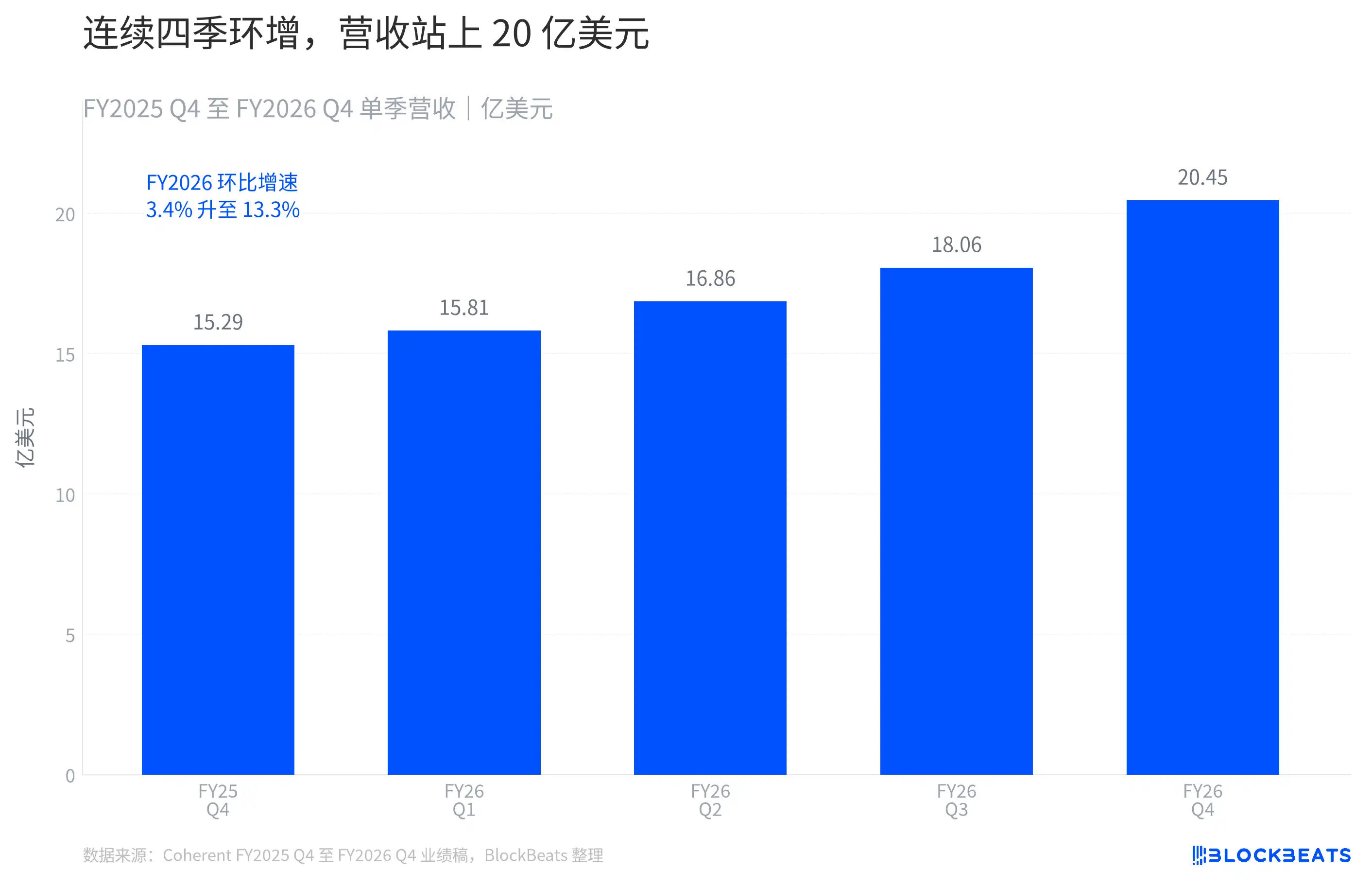
The key point of the first chart is not the single highest bar. According to Coherent's quarterly earnings releases, each quarter of this fiscal year saw revenue rise sequentially, with the final quarter reaching $2.046 billion and a sequential growth rate of 13.3%. The continuous upward trend in the chart adds another layer of meaning beyond just "reaching $2 billion"; the latest quarter is part of a sustained period of growth.

According to the company's FY2026 Q4 earnings release, the statutory year-over-year growth rate for the latest quarter was 33.8%. The company also disclosed a pro forma year-over-year growth rate excluding divested businesses. These two serve different reporting purposes and should not be conflated as a single growth rate.

The company's revenue guidance for FY2027 Q1 is $2.2 to $2.4 billion. According to the company release, this is a forward-looking statement for the next quarter and should be presented separately from realized quarterly revenue; it should not be considered an order or confirmed revenue.

Where Did the Additional Revenue Land?
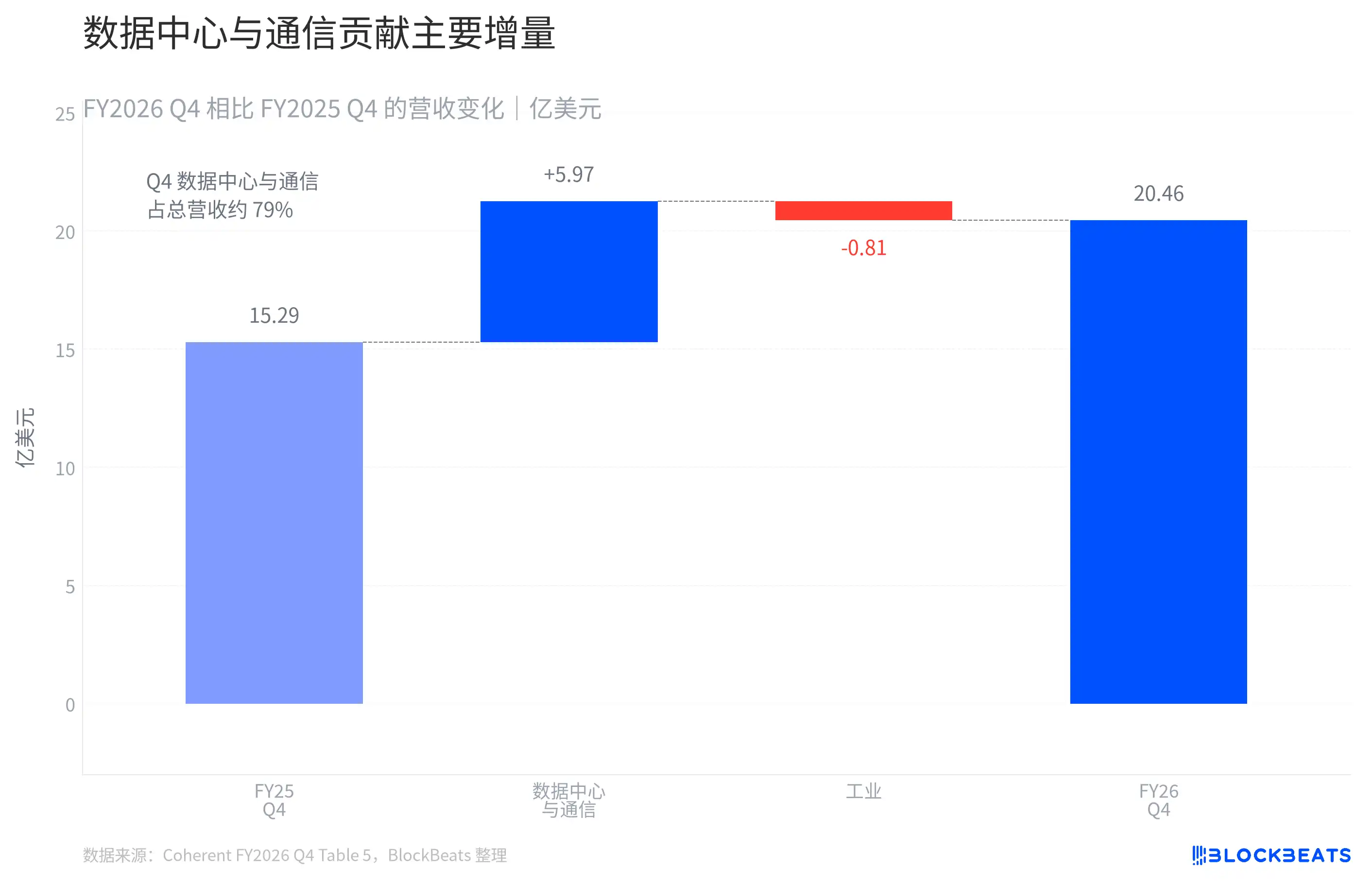
The second chart breaks down the year-over-year revenue change into two opposing forces. According to Coherent's segment revenue table for FY2026 Q4, the Datacom & Telecom segment increased by $597 million compared to the same period last year.

The Industrial segment decreased year-over-year by $81 million. The net increase for the company's total revenue was $516 million. In other words, the increase from the Datacom & Telecom segment exceeded the company's net increase, with the decline in the Industrial segment offsetting part of the growth.

According to the same segment revenue table, Q4 revenue for the Datacom & Telecom segment was $1.615 billion, accounting for approximately 79% of the company's quarterly revenue. This proportion indicates a revenue concentration in this segment, but it is not equivalent to 79% coming specifically from AI optical interconnects. The financial report does not provide product, customer, or order-level breakdowns; one cannot infer the precise contribution of a specific product type from the segment name.

The value of this chart lies precisely in it drawing two lines simultaneously. The company's disclosure can confirm which segment the growth primarily came from. What the report does not answer is the composition of products and customers within that segment. These two aspects should not be conflated.

Why is Operating Margin Growing Faster?
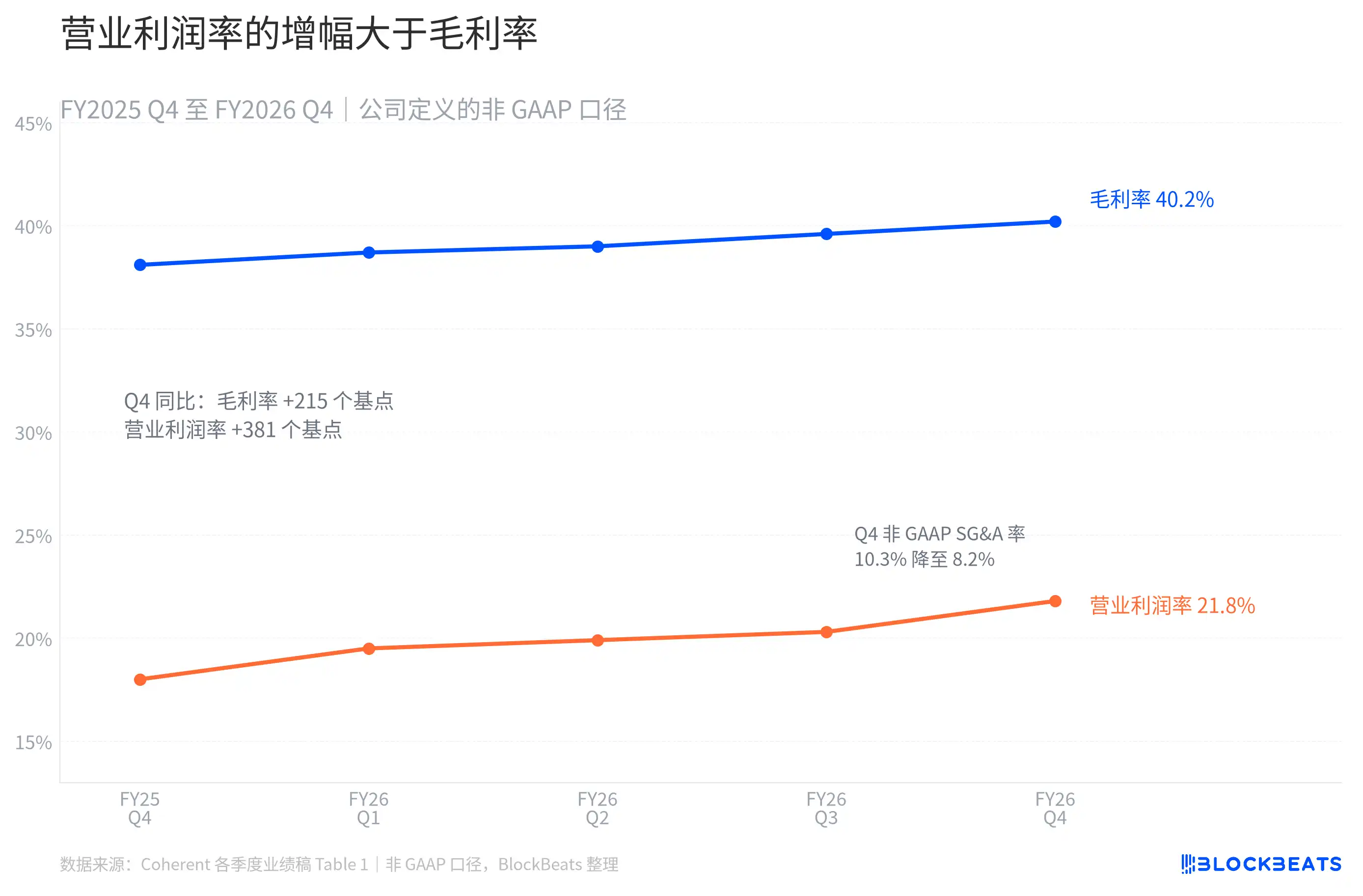
Higher revenue does not automatically mean better profitability. According to the company's earnings release, Coherent's non-GAAP gross margin rose from 38.1% in FY2025 Q4 to 40.2% in FY2026 Q4. The space left after deducting direct costs per dollar of revenue has widened.

The non-GAAP operating margin increased from 18.0% to 21.8% over the same period. According to the earnings release, the year-over-year increase in Q4 operating margin was greater than the increase in gross margin, with specific magnitudes noted in the chart.

The non-GAAP selling, general, and administrative (SG&A) expense ratio declined during this period, while the research and development (R&D) expense ratio saw a slight increase. According to the earnings release, these expense ratio changes occurred alongside the gross margin improvement during the period of margin enhancement, but they are insufficient to prove that any single cost action brought about all the improvement.

Attention must also be paid to the metrics' basis. Non-GAAP metrics exclude items such as stock-based compensation, acquisition-related intangible asset amortization, restructuring, and other items. According to the company, it is a supplementary measure used by management to observe the performance of ongoing operations and should not replace GAAP reporting.

Translating these changes into everyday language, Coherent wasn't just selling more products during the same period. The movement in revenue, gross margin, and certain expense ratios collectively reflected in the operating margin, but the public report does not attribute this change to a single business or a single cost item.

To Sustain Growth, How Much Cash is Being Deployed?
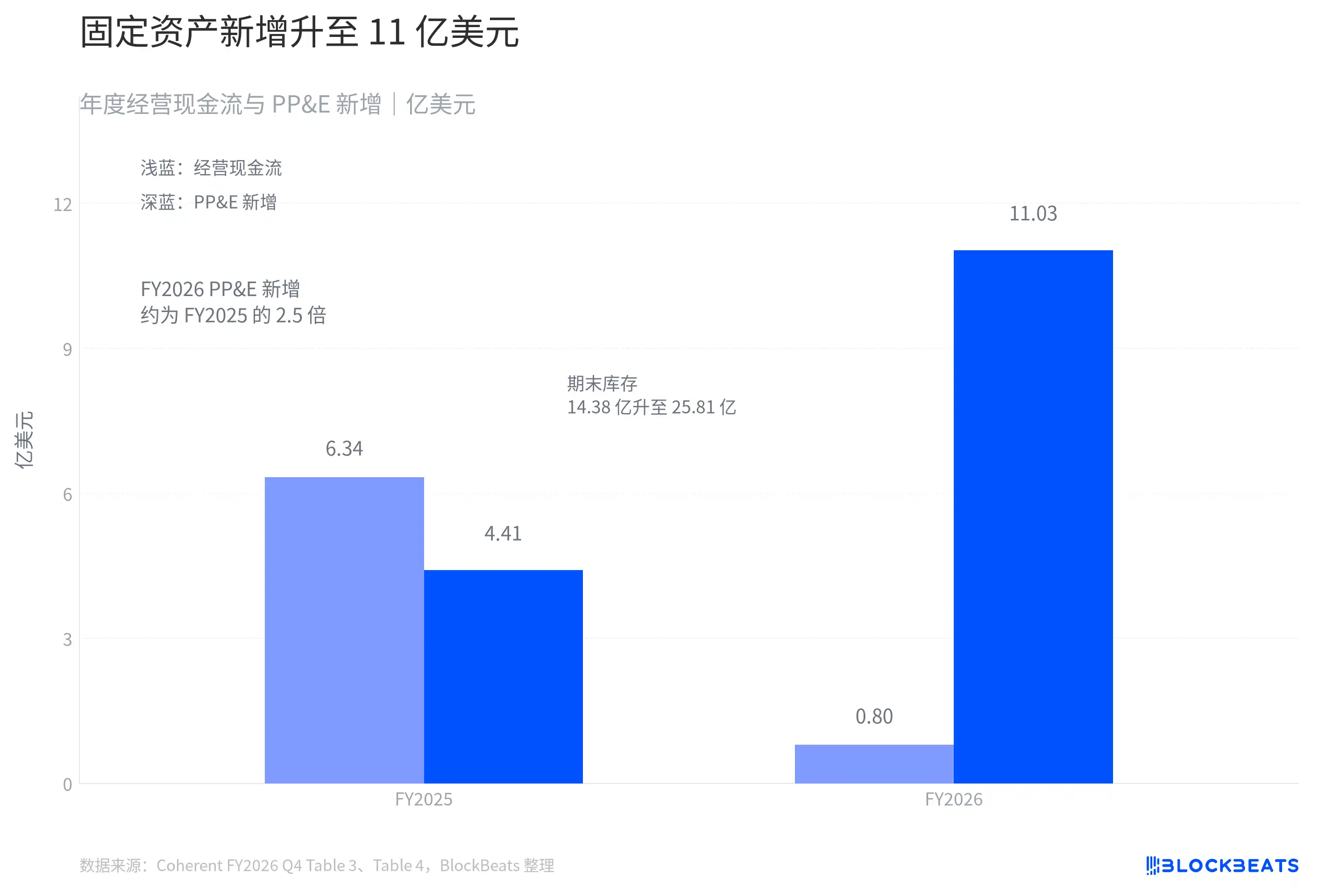
The final chart shifts focus from the income statement to the cash flow statement. According to Coherent's FY2026 cash flow statement, additions to property, plant, and equipment (PP&E) were $1.103 billion, approximately 2.5 times that of the previous fiscal year. Management states that capital allocation is prioritized for expanding manufacturing capacity, but this investment cannot be directly equated with expansion spending for a specific product line or a particular customer.

In the same fiscal year, cash flow from operations decreased from $634 million to $80 million. According to the company's balance sheet, ending inventory also rose from $1.438 billion to $2.581 billion.

These three changes occurred in the same fiscal year; public disclosures do not provide a single causal breakdown among them.

According to the cash flow statement, FY2026 net cash flow from financing activities was $1.477 billion, which includes multiple cash flow items such as stock issuance, borrowings, and debt repayments. This is a different picture of capital arrangement compared to the income statement and cannot be explained solely by the growth in single-quarter revenue.

The focal point of this earnings report is not simply replacing "Datacom & Telecom" with AI revenue. The revenue concentration, profit margins, and the changes in fixed asset additions and inventory on the cash flow statement all shifted simultaneously within the FY2026 report.


İlgili Sorular

QWhat were the key financial highlights from Coherent's FY2026 Q4 and full-year performance?

ACoherent reported unaudited Q4 revenue of $2.046 billion, a 33.8% year-over-year increase. For the full fiscal year, each quarter showed sequential revenue growth. The company provided Q1 FY2027 revenue guidance of $2.2 to $2.4 billion. Non-GAAP gross margin improved to 40.2% and operating margin to 21.8% in Q4. Capital expenditures (Additions to PP&E) were $1.103 billion, approximately 2.5 times the prior year, while operating cash flow significantly decreased, and inventory levels rose.

QHow did the revenue growth break down between Coherent's two operating segments in Q4 FY2026?

AIn Q4 FY2026, the Data Center & Communications segment increased by $597 million year-over-year, while the Industrial segment decreased by $81 million, resulting in a net revenue increase of $516 million for the entire company. The Data Center & Communications segment accounted for approximately 79% of total quarterly revenue. The report clarifies that this segment's growth is not exclusively attributable to AI optical interconnect products.

QWhat explains the improvement in Coherent's non-GAAP operating margin outpacing its gross margin growth?

AThe improvement in non-GAAP operating margin (from 18.0% to 21.8%) outpacing the gross margin increase (from 38.1% to 40.2%) is attributed to a combination of factors. These include the higher gross margin, a decline in the sales, general, and administrative (SG&A) expense ratio, and a slight increase in the R&D expense ratio. The public financial statements do not attribute this change to any single business line or cost item.

QWhat significant changes occurred in Coherent's cash flow and balance sheet items during FY2026?

AFY2026 saw significant changes in cash flow and balance sheet items: Capital expenditures (Additions to PP&E) surged to $1.103 billion (about 2.5x the prior year). Operating cash flow plummeted from $634 million to $80 million. Inventory on the balance sheet increased from $1.438 billion to $2.581 billion. The company reported net cash from financing activities of $1.477 billion. The disclosures do not establish a single causal relationship between these concurrent changes.

QWhat caution does the article advise when interpreting the 'Data Center & Communications' segment revenue?

AThe article cautions against directly equating the 'Data Center & Communications' segment revenue growth solely with AI optical interconnect sales. While this segment drove the majority of growth, the financial reports do not provide a breakdown by specific product (e.g., AI vs. traditional communications) or customer. The segment name indicates the revenue's source but does not specify the precise contribution from any single product category within it.

İlgili Okumalar

Wall Street Morning Report: CPI Lands Mildly, U.S. Stocks Stage Deep V-Shaped Reversal, AI Cloud, Storage, and Optical Communications Collectively Surge

Wall Street Morning Report: US stocks staged a deep V-shaped recovery following a mild CPI report, with AI cloud, storage, and optical communication sectors leading the rally. Major indexes were mixed: the Dow dipped slightly, while the S&P 500 and Nasdaq gained, nearing record highs. The July CPI data met expectations, with core inflation hitting its slowest pace since March 2021, further reducing expectations for a September Fed rate hike. Market focus shifted decisively towards AI infrastructure. The Philadelphia Semiconductor Index jumped 2.49%. AI cloud providers NEBIUS and CoreWeave surged 34% and 19% respectively on strong earnings and massive order backlogs. Optical communication stocks like Lumentum and Coherent also posted significant gains. The storage sector rallied broadly, with SK Hynix and Micron among the advancers. Meanwhile, major tech giants saw divergence. Nvidia rose over 3%, while Apple, Microsoft, Amazon, and Meta closed lower. In commodities, gold and silver remained strong, while oil prices retreated as markets awaited developments in the Strait of Hormuz. The US federal budget deficit widened significantly in July, raising long-term concerns. Key upcoming events include US PPI data, Sandisk's investor day, and the SEC's 13F filings deadline, which will reveal institutional holdings.

marsbit12 dk önce

Wall Street Morning Report: CPI Lands Mildly, U.S. Stocks Stage Deep V-Shaped Reversal, AI Cloud, Storage, and Optical Communications Collectively Surge

marsbit12 dk önce

A 22-Year-Old Mathematical Puzzle, Solved by a Union Hospital Intern?

In an astonishing development, a longstanding mathematical problem known as the Crouzeix conjecture, which had challenged experts in numerical linear algebra for 22 years, appears to have been solved by Shanmu Jin, a neurosurgery resident and postdoctoral researcher at Peking Union Medical College Hospital. With no formal advanced mathematical training—his background is in geology and medicine—Jin relied on self-study and, crucially, the AI model GPT-5.6. The conjecture, proposed by mathematician Michel Crouzeix in 2004, concerns a fundamental constant (speculated to be 2) bounding the relationship between matrix norms and polynomial values over numerical ranges. It is critical for applications in matrix function analysis and numerical methods. Despite dedicated efforts by leading mathematicians, the best proven constant had only been reduced to 2.414. Jin approached the problem using sophisticated prompt engineering with GPT-5.6. He adapted a known prompting strategy, isolating the AI from external resources to force original reasoning, employing multiple divergent "sub-agents" to explore different paths, and enforcing rigorous adversarial review of proposed proof steps. After about 16 hours of autonomous, unsupervised operation, the AI produced a novel and elegant proof. The key insight involved a clever "sampling strategy" that reduced the problem to a simple positivity condition—a solution described as elegant and unexpected by experts. The proof was verified by the conjecture's originator, Michel Crouzeix, and other specialists like Alex Townsend and Anne Greenbaum, who expressed astonishment at its validity. Jin has made the entire process open-source, including the prompt, drafts, and formal verification code. Remarkably, just eight days after Jin's preprint appeared, mathematicians Emiel Lorist and Felix Schwenninger published an independent, concise 5-page proof using a different approach, also developed with the aid of ChatGPT 5.6. Jin welcomed this complementary work. This event marks a potential turning point, demonstrating how AI can enable experts from non-traditional backgrounds to solve deep theoretical problems and dramatically accelerate scientific discovery, heralding what some are calling a new "golden age" for interdisciplinary research.

marsbit25 dk önce

A 22-Year-Old Mathematical Puzzle, Solved by a Union Hospital Intern?

marsbit25 dk önce

İşlemler

Spot
活动图片