Cloudflare Cuts Over 1,100 Jobs; Earnings Beat Expectations but Stock Plunges 18% After Hours

marsbit2026-05-08 tarihinde yayınlandı2026-05-08 tarihinde güncellendi

Özet

Cloudflare announced the layoff of over 1,100 employees, representing about 20% of its workforce, on the same day it reported better-than-expected Q1 2026 earnings. While revenue grew 34% to $639.8 million and full-year guidance was raised, the stock plummeted over 18% in after-hours trading, likely due to the layoffs and a slightly weaker Q2 revenue forecast. CEO Matthew Prince framed the massive restructuring as necessary preparation for the "AI agent era," not a cost-cutting measure. He cited a 600% surge in AI usage across the company in three months, with 97% of engineers using AI coding tools. Prince stated that many support roles are no longer needed as AI boosts the productivity of customer-facing and engineering staff, and that job types are changing rapidly. The company expects to incur $140-$150 million in restructuring charges. Laid-off U.S. employees will receive severance pay covering their full salary until the end of 2026, extended healthcare, and accelerated stock vesting. This move comes less than a year after Cloudflare famously announced plans to hire 1,111 interns in 2026. This announcement is part of a broader trend, as companies like Coinbase and PayPal also announced significant layoffs recently, with AI frequently cited as a driving force behind workforce transformations.

Author: Claude, Shenchao TechFlow

Shenchao TechFlow Introduction: On the same day it reported better-than-expected quarterly earnings, Cloudflare announced a reduction of approximately 20% of its workforce (over 1,100 employees). CEO Matthew Prince framed the move as a comprehensive restructuring for the "era of AI agents" rather than a cost-cutting measure. The company's AI usage surged over 600% in the past three months, with 97% of engineers already using AI coding tools. Following the news, the stock plummeted over 14% in after-hours trading. The restructuring is expected to incur $140 million to $150 million in charges.
Cybersecurity and cloud services giant Cloudflare accomplished two things on May 7th: delivering a quarterly earnings report that exceeded expectations across the board, and announcing the layoff of one-fifth of its employees.

According to Cloudflare's official blog, CEO Matthew Prince and President & COO Michelle Zatlyn sent an internal email to all employees that day, announcing a global reduction of over 1,100 positions. The email's subject line was "Building for the Future." A few hours after the layoff notice was sent, the company released its Q1 2026 earnings report.

Prince stated on the subsequent earnings call: "We discovered some roles at Cloudflare that are no longer needed for our future. Just because you're fit doesn't mean you can't be more fit."

Earnings Beat Expectations, Yet Stock Plunges

Cloudflare's Q1 revenue was $639.8 million, a 34% year-over-year increase, beating Wall Street's expectation of $620.9 million by approximately 3%. Adjusted earnings per share were $0.25, higher than the analyst consensus of $0.23. Non-GAAP operating profit was $73.1 million, with an operating margin of 11.4%. Free cash flow was $84.1 million.

The company also raised its full-year guidance: projecting 2026 full-year revenue between $2.805 billion and $2.813 billion (previously $2.785 billion to $2.795 billion), and adjusted EPS between $1.19 and $1.20 (previously $1.11 to $1.12), both exceeding market consensus expectations.

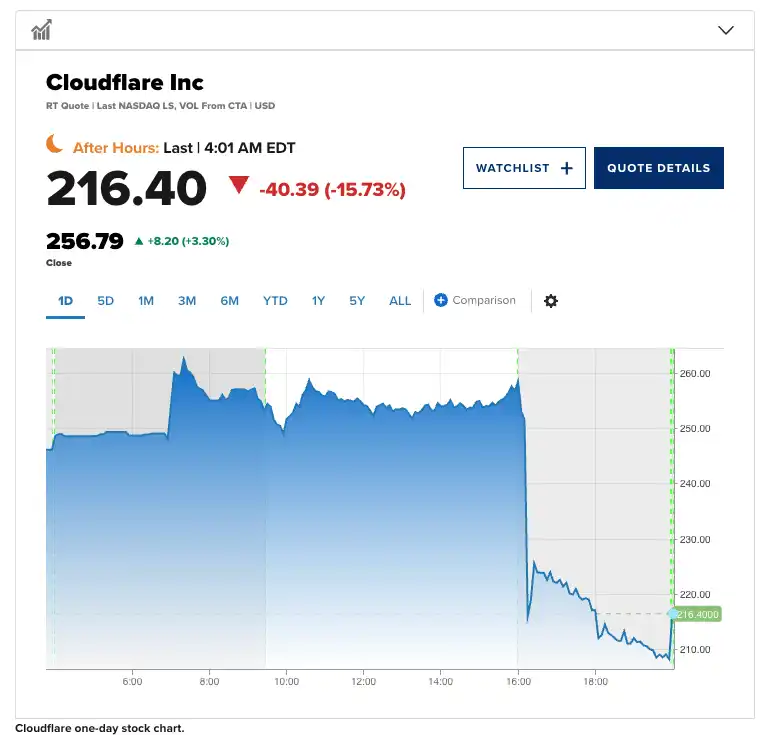
However, investors were clearly more concerned about the layoffs and the slightly below-expectations Q2 guidance. The company forecasts Q2 revenue between $664 million and $665 million, narrowly below the analyst consensus of $665.34 million. According to CNBC, Cloudflare's stock plunged over 18% in after-hours trading, hitting a low of around $212. As of the end of 2025, the company had 5,156 full-time employees.

Restructuring for the "AI Agent Era": 600% Surge in Usage, Roles Redefined

In the internal email, Prince and Zatlyn attributed the layoffs not to poor performance but to the fundamental shift AI is bringing to the company's operational methods.

The email stated that Cloudflare's AI usage grew over 600% in the past three months. Employees across all departments, from engineering to HR, finance, and marketing, run thousands of AI agent sessions daily to complete their work. According to Prism News, 97% of the company's engineers are already using AI coding tools.

Prince further explained on the earnings call: "Over the last six months, the productivity increase for people directly talking to customers and directly writing code has been phenomenal. And many of the supporting roles behind them will not be the roles driving the company's future forward."

He expects Cloudflare's total headcount in 2027 will exceed any point in 2026, "but the types of roles are changing dramatically, and you have to do something dramatic to drive that change." He emphasized this is not about cutting costs but about "getting the right people into the right roles."

According to Cloudflare's SEC filing, this restructuring is expected to generate $140 million to $150 million in charges, with $105 million to $110 million in cash expenses (including severance, notice period, and benefits) and $35 million to $40 million in non-cash stock-based compensation expenses, primarily concentrated in Q2 and Q3.

Severance Package: Pay Until Year-End, Stock Vesting Extended to August

Regarding severance terms, Cloudflare offered relatively generous conditions. Laid-off employees will receive a severance package equivalent to their full base salary through the end of 2026. US employees' medical insurance coverage will also continue through year-end. Equity vesting is extended to August 15th. For employees who have not yet met their one-year vesting cliff, the company will waive the restriction and grant prorated vesting through August.

Prince and Zatlyn stated in the email they hope this layoff only needs to be executed once. "Small, repeated layoffs or reorganizations dragged out over quarters only create ongoing emotional uncertainty for employees and slow down the speed at which we can build."

Last Year's High-Profile Announcement to Hire 1,111 Interns, This Year Layoffs of 1,100 Employees

According to Cloudflare's official blog, in September 2025 (during its birthday week activities), the company high-profile announced plans to hire up to 1,111 interns in 2026, a number derived from its signature product, the 1.1.1.1 public DNS resolver. The blog post at the time claimed this exemplified the company's culture of "long-term investment in talent."

Less than eight months later, the company laid off almost the same number of full-time employees. According to Prism News, this contrast sparked significant discussion on social media.

AI-Led Layoff Wave Spreads: Coinbase, PayPal Announce Major Job Cuts Same Week
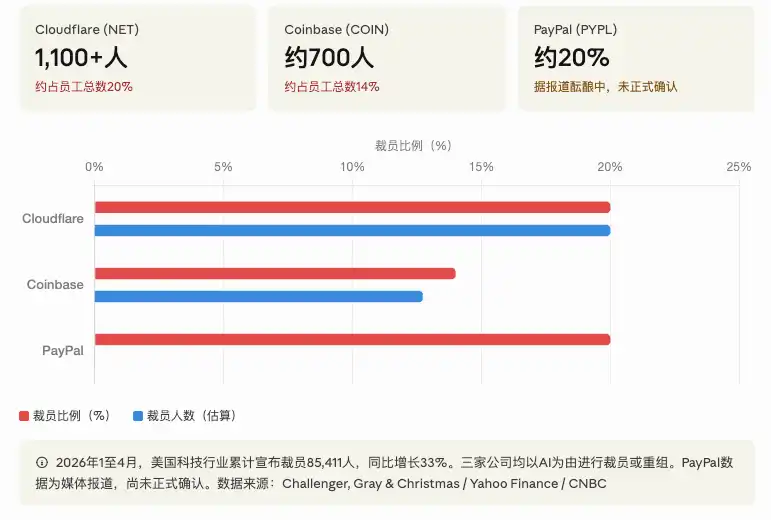
Cloudflare is not alone. According to Yahoo Finance, within the same week, Coinbase announced cutting approximately 14% of its workforce (about 700 employees), and PayPal was reportedly planning layoffs of about 20%. From January to April this year, the US tech industry announced 85,411 layoffs, a 33% increase compared to the same period last year.

Citing AI as a reason for layoffs is becoming a collective narrative for tech companies. The Register, in its reporting, directly headlined the layoffs as "jobs just aren't AI enough." Prince called AI the "single biggest tailwind Cloudflare has ever seen" on the earnings call.

For the employees who remain and those who were laid off, this "tailwind" is blowing in opposite directions.


İlgili Sorular

QWhat was the main reason given by Cloudflare's CEO for laying off over 1,100 employees?

AThe main reason was not cost-cutting but a comprehensive restructuring for the 'AI agent era.' The CEO stated that the nature of work at Cloudflare is fundamentally changing due to AI, with a 600%+ increase in AI usage, making certain supporting roles no longer aligned with the company's future direction.

QDespite beating Q1 2026 earnings expectations, why did Cloudflare's stock price drop significantly in after-hours trading?

AThe stock price dropped significantly (reportedly over 14-18%) due to investor concerns over the large-scale layoffs and the company's Q2 revenue guidance, which was slightly below analysts' expectations.

QWhat are the key financial details of Cloudflare's restructuring plan as mentioned in the article?

AThe restructuring is expected to incur total expenses of $140 million to $150 million. This includes $105 million to $110 million in cash expenditures (for severance, notice periods, and benefits) and $35 million to $40 million in non-cash stock-based compensation expenses.

QWhat notable contrast does the article highlight regarding Cloudflare's hiring and layoff actions within a short period?

AThe article highlights that in September 2025, Cloudflare announced plans to hire up to 1,111 interns for 2026. Less than eight months later, the company laid off approximately 1,100 full-time employees, a nearly identical number.

QAccording to the article, which other major tech companies announced significant layoffs around the same week as Cloudflare?

AIn the same week, Coinbase announced layoffs of about 14% of its workforce (around 700 employees), and reports indicated PayPal was planning layoffs of approximately 20% of its staff.

İlgili Okumalar

Wintermute Market Weekly: Iran War Ends, Inflation Meets Expectations, BTC Rebounds to Lower 60ks But Don’t Rush to Buy the Dip

**Wintermute Market Weekly: BTC Rebounds to $60K Lows, But Caution Advised** This week saw a broad market rebound, primarily driven by two converging factors: a US CPI inflation reading that met expectations (4.2% YoY) and former President Trump's announcement of a deal to end the Iran conflict. The latter triggered a sharp drop in oil prices, reducing geopolitical risk premiums and easing inflation fears. Consequently, risk assets like equities and cryptocurrencies rallied, with Bitcoin recovering from lows around $60,000 to close the week up 1.9%, while altcoins gained 3.1%. Despite the price bounce, the underlying liquidity picture for crypto remains weak. Key funding channels—stablecoin flows, ETF inflows, and Digital Asset Treasury (DAT) activity—show no signs of structural improvement. ETF outflows recently hit a record streak, and DAT assets have declined significantly. The rally from $60K to $83K earlier is now viewed as a bear-market rally that has failed. The current environment is characterized by low directional conviction and choppy, range-bound trading, likely persisting into summer. The report advises caution against aggressively buying the dip. While the $60K area offers attractive long-term risk/reward, a sustained bull run requires a visible turnaround in capital inflows, which hasn't materialized. The upcoming FOMC meeting and Powell's commentary, alongside the formal Iran deal signing, are noted as near-term catalysts. The core takeaway is to watch fund flows rather than price action and avoid being whipsawed by volatility before clear signs of institutional or retail capital returning emerge.

marsbit13 dk önce

Wintermute Market Weekly: Iran War Ends, Inflation Meets Expectations, BTC Rebounds to Lower 60ks But Don’t Rush to Buy the Dip

marsbit13 dk önce

Cursor, Why Boarded Musk's Starship?

SpaceX announced its acquisition of AI programming startup Cursor's parent company, Anysphere, for $60 billion in an all-stock deal, just days after its record-breaking IPO. The move sent SpaceX's stock soaring, briefly making it the most valuable U.S. company. Cursor, founded in 2022 by MIT graduate Michael Truell and his classmates, is a popular AI coding assistant that allows developers to switch between models from OpenAI, Anthropic, and others. It saw explosive revenue growth, reaching a $4 billion annualized run rate in early 2026. However, its market share was eroded by the launch of competitor Claude Code from its key AI supplier, Anthropic. This dependence prompted Cursor to develop its own AI model, Composer, in early 2026. To scale Composer, Cursor needed immense computing power. In April 2026, it struck a deal with SpaceX, granting the latter an option to acquire it post-IPO. SpaceX exercised this option, offering Cursor access to its Colossus supercomputer, powered by hundreds of thousands of top-tier Nvidia AI chips. For SpaceX, the acquisition is a strategic move to bolster its AI capabilities, particularly for its xAI division, and advance its broader ambition of building orbital, solar-powered data centers. While the deal surprised some employees and investors given Truell's earlier stance on independence, it represents a high-stakes partnership. SpaceX CEO Elon Musk has projected the company could reach $1 trillion in revenue by 2030. For Truell, joining forces with SpaceX is a monumental gamble on an unprecedented scale in the race for AI dominance.

链捕手15 dk önce

Cursor, Why Boarded Musk's Starship?

链捕手15 dk önce

The More It Rises, the More Dangerous? The Systemic Risks Behind SpaceX's Soaring Valuation

Summary: The article raises concerns about the systemic risks posed by SpaceX's skyrocketing valuation, arguing that modern market mechanics, rather than fundamentals, are driving its price discovery. Following SpaceX's market capitalization surpassing $3 trillion in after-hours trading, the author contends that the market is no longer functioning properly. The core issue is not SpaceX's business prospects but the unhealthy market structure surrounding it. With limited float and the imminent launch of options trading, the stage is set for a potential "gamma squeeze"—a feedback loop where market makers hedging call options are forced to buy shares, pushing the price higher and attracting more speculative momentum traders. This mechanism, seen previously with Tesla and meme stocks, can decouple valuation from financial reality. The danger escalates as extreme valuations force passive funds, ETFs, pensions, and major indices to hold the stock. If SpaceX grows large enough—hypothetically reaching $5 or even $10 trillion—its performance would increasingly dictate broader market indices, embedding systemic risk. The author warns that when price appreciation itself becomes the primary bullish thesis, the market transforms from a capital allocation mechanism into a self-reinforcing speculative machine, endangering the retirement savings of ordinary investors tied to passive strategies. The piece questions whether such a system can still perform its fundamental role of price discovery.

marsbit20 dk önce

The More It Rises, the More Dangerous? The Systemic Risks Behind SpaceX's Soaring Valuation

marsbit20 dk önce

How Much of the Subscription Fee You Pay to Claude Can Optical Module Companies Get?

How much of your $20 Claude Pro subscription actually goes to AI model companies like Anthropic? A viral breakdown image highlights the fundamental valuation challenge for AI applications versus traditional SaaS. Unlike SaaS with high software margins, AI subscriptions face variable "inference costs": every user query consumes GPU time, power, and cloud resources. This creates a tension between fixed subscription fees and usage-driven expenses. While the specific dollar splits are illustrative, the core question is whether AI revenue can achieve SaaS-like margins as usage scales. Currently, infrastructure providers (cloud platforms, GPU makers like Nvidia, HBM suppliers, power/data centers) capture more certain revenue from growing AI usage. Their financials reflect pricing power and faster earnings validation. The bullish case hinges on efficiency improvements: model optimization, caching, smaller models, and custom chips could lower per-token costs over time. The key debate is whether cost declines can outpace increases in user workload complexity and volume. Ultimately, for AI companies to command high SaaS-like valuations, they must demonstrate not just user growth but also improving gross margins after accounting for inference costs. Investors will scrutinize not just subscriber numbers, but usage patterns, enterprise pricing tiers, and real efficiency gains.

marsbit30 dk önce

How Much of the Subscription Fee You Pay to Claude Can Optical Module Companies Get?

marsbit30 dk önce

İşlemler

Spot
Futures
活动图片