Cloudflare Cuts Over 1,100 Jobs; Earnings Beat Expectations but Stock Plunges 18% After Hours

marsbit2026-05-08 tarihinde yayınlandı2026-05-08 tarihinde güncellendi

Özet

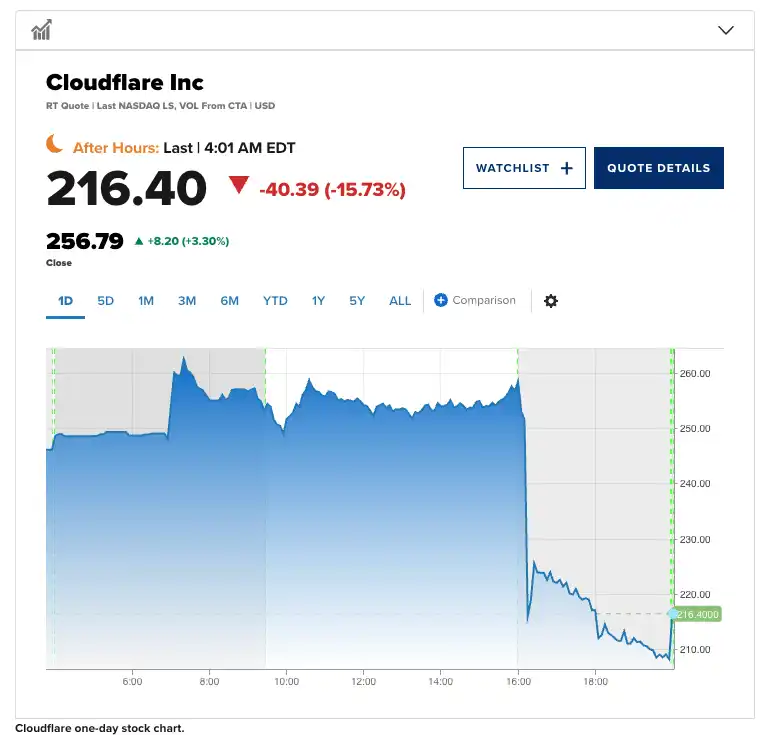
Cloudflare announced the layoff of over 1,100 employees, representing about 20% of its workforce, on the same day it reported better-than-expected Q1 2026 earnings. While revenue grew 34% to $639.8 million and full-year guidance was raised, the stock plummeted over 18% in after-hours trading, likely due to the layoffs and a slightly weaker Q2 revenue forecast. CEO Matthew Prince framed the massive restructuring as necessary preparation for the "AI agent era," not a cost-cutting measure. He cited a 600% surge in AI usage across the company in three months, with 97% of engineers using AI coding tools. Prince stated that many support roles are no longer needed as AI boosts the productivity of customer-facing and engineering staff, and that job types are changing rapidly. The company expects to incur $140-$150 million in restructuring charges. Laid-off U.S. employees will receive severance pay covering their full salary until the end of 2026, extended healthcare, and accelerated stock vesting. This move comes less than a year after Cloudflare famously announced plans to hire 1,111 interns in 2026. This announcement is part of a broader trend, as companies like Coinbase and PayPal also announced significant layoffs recently, with AI frequently cited as a driving force behind workforce transformations.

Author: Claude, Shenchao TechFlow

Shenchao TechFlow Introduction: On the same day it reported better-than-expected quarterly earnings, Cloudflare announced a reduction of approximately 20% of its workforce (over 1,100 employees). CEO Matthew Prince framed the move as a comprehensive restructuring for the "era of AI agents" rather than a cost-cutting measure. The company's AI usage surged over 600% in the past three months, with 97% of engineers already using AI coding tools. Following the news, the stock plummeted over 14% in after-hours trading. The restructuring is expected to incur $140 million to $150 million in charges.
Cybersecurity and cloud services giant Cloudflare accomplished two things on May 7th: delivering a quarterly earnings report that exceeded expectations across the board, and announcing the layoff of one-fifth of its employees.

According to Cloudflare's official blog, CEO Matthew Prince and President & COO Michelle Zatlyn sent an internal email to all employees that day, announcing a global reduction of over 1,100 positions. The email's subject line was "Building for the Future." A few hours after the layoff notice was sent, the company released its Q1 2026 earnings report.

Prince stated on the subsequent earnings call: "We discovered some roles at Cloudflare that are no longer needed for our future. Just because you're fit doesn't mean you can't be more fit."

Earnings Beat Expectations, Yet Stock Plunges

Cloudflare's Q1 revenue was $639.8 million, a 34% year-over-year increase, beating Wall Street's expectation of $620.9 million by approximately 3%. Adjusted earnings per share were $0.25, higher than the analyst consensus of $0.23. Non-GAAP operating profit was $73.1 million, with an operating margin of 11.4%. Free cash flow was $84.1 million.

The company also raised its full-year guidance: projecting 2026 full-year revenue between $2.805 billion and $2.813 billion (previously $2.785 billion to $2.795 billion), and adjusted EPS between $1.19 and $1.20 (previously $1.11 to $1.12), both exceeding market consensus expectations.

However, investors were clearly more concerned about the layoffs and the slightly below-expectations Q2 guidance. The company forecasts Q2 revenue between $664 million and $665 million, narrowly below the analyst consensus of $665.34 million. According to CNBC, Cloudflare's stock plunged over 18% in after-hours trading, hitting a low of around $212. As of the end of 2025, the company had 5,156 full-time employees.

Restructuring for the "AI Agent Era": 600% Surge in Usage, Roles Redefined

In the internal email, Prince and Zatlyn attributed the layoffs not to poor performance but to the fundamental shift AI is bringing to the company's operational methods.

The email stated that Cloudflare's AI usage grew over 600% in the past three months. Employees across all departments, from engineering to HR, finance, and marketing, run thousands of AI agent sessions daily to complete their work. According to Prism News, 97% of the company's engineers are already using AI coding tools.

Prince further explained on the earnings call: "Over the last six months, the productivity increase for people directly talking to customers and directly writing code has been phenomenal. And many of the supporting roles behind them will not be the roles driving the company's future forward."

He expects Cloudflare's total headcount in 2027 will exceed any point in 2026, "but the types of roles are changing dramatically, and you have to do something dramatic to drive that change." He emphasized this is not about cutting costs but about "getting the right people into the right roles."

According to Cloudflare's SEC filing, this restructuring is expected to generate $140 million to $150 million in charges, with $105 million to $110 million in cash expenses (including severance, notice period, and benefits) and $35 million to $40 million in non-cash stock-based compensation expenses, primarily concentrated in Q2 and Q3.

Severance Package: Pay Until Year-End, Stock Vesting Extended to August

Regarding severance terms, Cloudflare offered relatively generous conditions. Laid-off employees will receive a severance package equivalent to their full base salary through the end of 2026. US employees' medical insurance coverage will also continue through year-end. Equity vesting is extended to August 15th. For employees who have not yet met their one-year vesting cliff, the company will waive the restriction and grant prorated vesting through August.

Prince and Zatlyn stated in the email they hope this layoff only needs to be executed once. "Small, repeated layoffs or reorganizations dragged out over quarters only create ongoing emotional uncertainty for employees and slow down the speed at which we can build."

Last Year's High-Profile Announcement to Hire 1,111 Interns, This Year Layoffs of 1,100 Employees

According to Cloudflare's official blog, in September 2025 (during its birthday week activities), the company high-profile announced plans to hire up to 1,111 interns in 2026, a number derived from its signature product, the 1.1.1.1 public DNS resolver. The blog post at the time claimed this exemplified the company's culture of "long-term investment in talent."

Less than eight months later, the company laid off almost the same number of full-time employees. According to Prism News, this contrast sparked significant discussion on social media.

AI-Led Layoff Wave Spreads: Coinbase, PayPal Announce Major Job Cuts Same Week
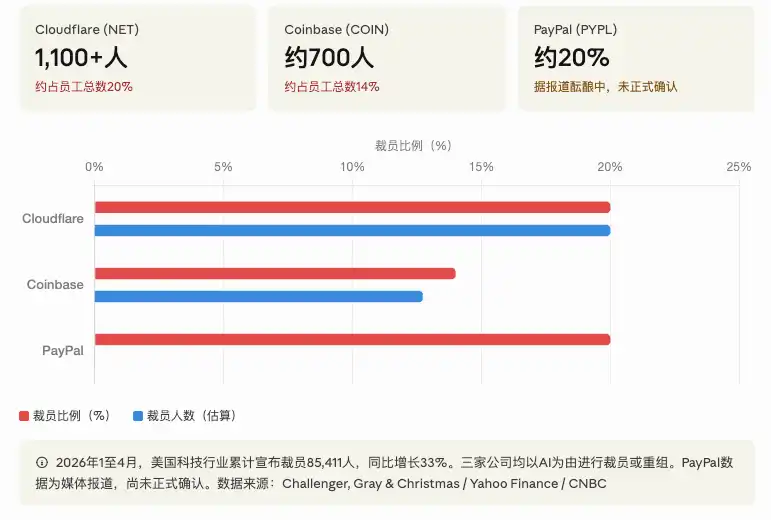
Cloudflare is not alone. According to Yahoo Finance, within the same week, Coinbase announced cutting approximately 14% of its workforce (about 700 employees), and PayPal was reportedly planning layoffs of about 20%. From January to April this year, the US tech industry announced 85,411 layoffs, a 33% increase compared to the same period last year.

Citing AI as a reason for layoffs is becoming a collective narrative for tech companies. The Register, in its reporting, directly headlined the layoffs as "jobs just aren't AI enough." Prince called AI the "single biggest tailwind Cloudflare has ever seen" on the earnings call.

For the employees who remain and those who were laid off, this "tailwind" is blowing in opposite directions.


İlgili Sorular

QWhat was the main reason given by Cloudflare's CEO for laying off over 1,100 employees?

AThe main reason was not cost-cutting but a comprehensive restructuring for the 'AI agent era.' The CEO stated that the nature of work at Cloudflare is fundamentally changing due to AI, with a 600%+ increase in AI usage, making certain supporting roles no longer aligned with the company's future direction.

QDespite beating Q1 2026 earnings expectations, why did Cloudflare's stock price drop significantly in after-hours trading?

AThe stock price dropped significantly (reportedly over 14-18%) due to investor concerns over the large-scale layoffs and the company's Q2 revenue guidance, which was slightly below analysts' expectations.

QWhat are the key financial details of Cloudflare's restructuring plan as mentioned in the article?

AThe restructuring is expected to incur total expenses of $140 million to $150 million. This includes $105 million to $110 million in cash expenditures (for severance, notice periods, and benefits) and $35 million to $40 million in non-cash stock-based compensation expenses.

QWhat notable contrast does the article highlight regarding Cloudflare's hiring and layoff actions within a short period?

AThe article highlights that in September 2025, Cloudflare announced plans to hire up to 1,111 interns for 2026. Less than eight months later, the company laid off approximately 1,100 full-time employees, a nearly identical number.

QAccording to the article, which other major tech companies announced significant layoffs around the same week as Cloudflare?

AIn the same week, Coinbase announced layoffs of about 14% of its workforce (around 700 employees), and reports indicated PayPal was planning layoffs of approximately 20% of its staff.

İlgili Okumalar

Gensyn AI: Don't Let AI Repeat the Mistakes of the Internet

In recent months, the rapid growth of the AI industry has attracted significant talent from the crypto sector. A persistent question among researchers intersecting both fields is whether blockchain can become a foundational part of AI infrastructure. While many previous AI and Crypto projects focused on application layers (like AI Agents, on-chain reasoning, data markets, and compute rentals), few achieved viable commercial models. Gensyn differentiates itself by targeting the most critical and expensive layer of AI: model training. Gensyn aims to organize globally distributed GPU resources into an open AI training network. Developers can submit training tasks, nodes provide computational power, and the network verifies results while distributing incentives. The core issue addressed is not decentralization for its own sake, but the increasing centralization of compute power among tech giants. In the era of large models, access to GPUs (like the H100) has become a decisive bottleneck, dictating the pace of AI development. Major AI companies are heavily dependent on large cloud providers for compute resources. Gensyn's approach is significant for several reasons: 1) It operates at the core infrastructure layer (model training), the most resource-intensive and technically demanding part of the AI value chain. 2) It proposes a more open, collaborative model for compute, potentially increasing resource utilization by dynamically pooling idle GPUs, similar to early cloud computing logic. 3) Its technical moat lies in solving complex challenges like verifying training results, ensuring node honesty, and maintaining reliability in a distributed environment—making it more of a deep-tech infrastructure company. 4) It targets a validated, high-growth market with genuine demand, rather than pursuing blockchain integration without purpose. Ultimately, the boundaries between Crypto and AI are blurring. AI requires global resource coordination, incentive mechanisms, and collaborative systems—areas where crypto-native solutions excel. Gensyn represents a step toward making advanced training capabilities more accessible and collaborative, moving beyond a niche controlled by a few giants. If successful, it could evolve into a fundamental piece of AI infrastructure, where the most enduring value in the AI era is often created.

marsbit5 saat önce

Gensyn AI: Don't Let AI Repeat the Mistakes of the Internet

marsbit5 saat önce

Why is China's AI Developing So Fast? The Answer Lies Inside the Labs

A US researcher's visit to China's top AI labs reveals distinct cultural and organizational factors driving China's rapid AI development. While talent, data, and compute are similar to the West, Chinese labs excel through a pragmatic, execution-focused culture: less emphasis on individual stardom and conceptual debate, and more on teamwork, engineering optimization, and mastering the full tech stack. A key advantage is the integration of young students and researchers who approach model-building with fresh perspectives and low ego, prioritizing collective progress over personal credit. This contrasts with the US culture of self-promotion and "star scientist" narratives. Chinese labs also exhibit a strong "build, don't buy" mentality, preferring to develop core capabilities—like data pipelines and environments—in-house rather than relying on external services. The ecosystem feels more collaborative than tribal, with mutual respect among labs. While government support exists, its scale is unclear, and technical decisions appear driven by labs, not state mandates. Chinese companies across sectors, from platforms to consumer tech, are building their own foundational models to control their tech destiny, reflecting a broader cultural drive for technological sovereignty. Demand for AI is emerging, with spending patterns potentially mirroring cloud infrastructure more than traditional SaaS. Despite challenges like a less mature data industry and GPU shortages, Chinese labs are propelled by vast talent, rapid iteration, and deep integration with the open-source community. The competition is evolving beyond a pure model race into a contest of organizational execution, developer ecosystems, and industrial pragmatism.

marsbit6 saat önce

Why is China's AI Developing So Fast? The Answer Lies Inside the Labs

marsbit6 saat önce

3 Years, 5 Times: The Rebirth of a Century-Old Glass Factory

Corning, a 175-year-old glass company, is experiencing a dramatic revival as a key player in AI infrastructure, driven by surging demand for high-performance optical fiber in data centers. AI data centers require vastly more fiber than traditional ones—5 to 10 times as much per rack—to handle high-speed data transmission between GPUs. This structural demand shift, coupled with supply constraints from the lengthy expansion cycle for fiber preforms, has created a significant supply-demand gap. Nvidia has invested in Corning, along with Lumentum and Coherent, in a $4.5 billion total commitment to secure the optical supply chain for AI. Corning's competitive edge lies in its expertise in producing ultra-low-loss, high-density, and bend-resistant specialty fiber, which is critical for 800G+ and future 1.6T data rates. Its deep involvement in co-packaged optics (CPO) with partners like Nvidia further solidifies its position. While not the largest fiber manufacturer globally, Corning's revenue from enterprise/data center clients now exceeds 40% of its optical communications sales, and it has secured multi-year supply agreements with major hyperscalers including Meta and Nvidia. Financially, Corning's optical communications revenue has surged, doubling from $1.3 billion in 2023 to over $3 billion in 2025. Its stock price has risen nearly 6-fold since late 2023. Key future catalysts include the rollout of Nvidia's CPO products and the scale of undisclosed customer agreements. However, risks include high current valuations and potential disruption from next-generation technologies like hollow-core fiber. The company's long-term bet on light over electricity, maintained even through the telecom bubble crash, is now being validated by the AI boom.

marsbit7 saat önce

3 Years, 5 Times: The Rebirth of a Century-Old Glass Factory

marsbit7 saat önce

İşlemler

Spot
Futures
活动图片