Claude Code Source Code Leaked, Over 500,000 Lines of Code Obtained by Developers

marsbit2026-04-01 tarihinde yayınlandı2026-04-01 tarihinde güncellendi

Özet

Anthropic faces a major security incident as the complete source code for its AI tool Claude Code, exceeding 500,000 lines of TypeScript, was leaked. The breach originated when a developer shared a compressed file on Twitter, which quickly gained over 5.3 million views. The exposure was due to Anthropic accidentally including .map files when publishing to npm, revealing core code. The leaked code unveils several advanced features, including a project codenamed BUDDY, which offers a personalized cyber pet system with traits like debugging power and even a "sarcasm value." Another feature, KAIROS, aims to create an "always-on" AI assistant capable of maintaining memory across sessions and initiating tasks. The code also includes a "Nightly Dreaming" mechanism, allowing Claude to organize information and consolidate core content while the user sleeps. Despite the breach, the incident has inadvertently showcased Anthropic's innovative capabilities, turning a PR crisis into an unexpected demonstration of their cutting-edge AI developments.

Recently, artificial intelligence company Anthropic encountered an unprecedented crisis when the complete source code of its latest tool, Claude Code, was accidentally leaked within the developer community. The incident began when a developer, Chaofan Shou, posted a compressed package containing over 500,000 lines of TypeScript code on Twitter, sparking widespread attention and discussion among developers globally. This leak quickly exploded online, with page views surpassing 5.3 million within hours, becoming a hot topic in the tech circle.
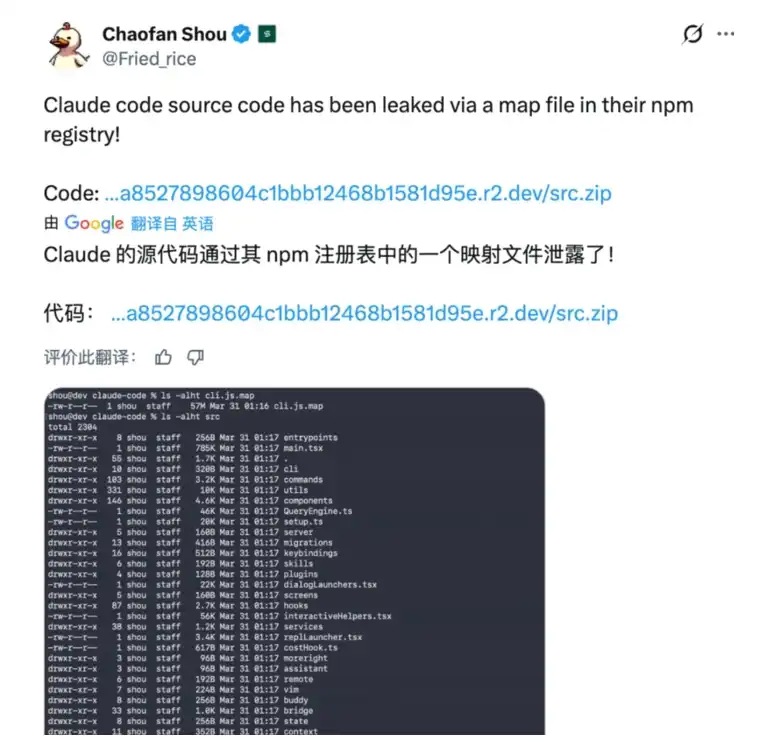
So, what was the cause of this leak? According to reports, when Anthropic published the code to npm, it actually forgot to remove the .map files, leading to the exposure of the core code. This mistake not only embarrassed the company but also raised external doubts about its security management. However, this accidental leak has given the outside world an early glimpse into some of Anthropic's cutting-edge functionalities in the AI field.

From the source code, it can be seen that Claude Code includes several astonishing features, with the project codenamed BUDDY being particularly notable. It can not only accompany developers in writing code but also has a unique personalized pet system, allowing users to incubate their own cyber pets based on personal information. This pet not only has a cute appearance but also has dynamic stats like debugging power and patience, and even a "sarcasm value," undoubtedly adding a lot of fun to the work atmosphere.

Even more forward-looking is the feature codenamed KAIROS, which aims to achieve an "always-on" AI assistant. Unlike traditional conversation methods, KAIROS can maintain memory across multiple sessions and proactively initiate tasks. Additionally, the source code includes a Nightly Dreaming mechanism, where Claude organizes information and consolidates core content while the user sleeps. This innovative concept not only makes the AI smarter but also brings new possibilities for future work methods.

Although Anthropic is currently busy dealing with this leak, the unexpected exposure might also provide a platform to showcase their cutting-edge technology. This accidental PR crisis has instead highlighted the company's innovative capabilities. The future of the AI field will become even more exciting because of such attempts.


İlgili Sorular

QWhat was the cause of the Claude Code source code leak at Anthropic?

AAnthropic forgot to remove .map files when publishing the code to npm, which exposed the core source code.

QHow many lines of TypeScript code were leaked in the Claude Code incident?

AOver five hundred thousand lines of TypeScript code were leaked.

QWhat is the name of the project that features a personalized cyber pet system for developers?

AThe project is called BUDDY, which includes a personalized cyber pet system with traits like debugging power and patience.

QWhat is the KAIROS feature designed to do according to the leaked source code?

AKAIROS is designed to be an 'always-on' AI assistant that maintains memory across multiple sessions and can proactively initiate tasks.

QWhat mechanism does Claude have for processing information during user inactivity?

AClaude has a 'Nightly Dreaming' mechanism where it organizes information and consolidates core content while the user is sleeping.

İlgili Okumalar

With Two Consecutive Quarters of Losses, Coinbase Must Rely on Paths Beyond Trading

Coinbase posted its second consecutive quarterly net loss of $359 million on $1.22 billion in revenue for Q2, highlighting its vulnerability to crypto market cycles where weaker prices and lower volatility reduce user trading. However, the report also reveals a strategic shift in its business model. Despite a 25% quarter-over-quarter decline in global spot trading volume, Coinbase increased its market share to a company-record 10.3%. This suggests its position as a compliant U.S. on-ramp is strengthening even in a cooler market. A key development is the diversification of revenue streams. Transaction revenue fell to $599 million, nearly equaling subscription and services revenue of $555 million. Stablecoin services, generating $292 million, are becoming a crucial revenue "floor." This income, derived from interest on the $20 billion average USDC balance held on its platform, is less tied to daily trading activity. Furthermore, while spot trading volume dropped significantly, derivatives volume held steady at $1.03 trillion. Coinbase is pushing to integrate spot, stablecoin, and derivatives liquidity to create a more interconnected and sticky ecosystem for users. The GAAP net loss includes non-cash expenses like stock-based compensation and crypto asset valuation changes. Its adjusted EBITDA remained positive at $208 million for the 14th straight quarter, indicating core operations can cover ongoing costs. The company is also reducing expenses to manage the downturn. The central question moving forward is whether Coinbase's growing market share, stablecoin revenues, and expanding product integration can sufficiently offset the inherent cyclicality of its core trading business during future market contractions.

marsbit5 dk önce

With Two Consecutive Quarters of Losses, Coinbase Must Rely on Paths Beyond Trading

marsbit5 dk önce

In the Age of Artificial Intelligence, We Need 'Magicians,' Not 'Managers'

In the AI era, leadership must shift from management to magic. As knowledge rapidly expires, value shifts from what leaders know to what they can facilitate. Traditional "inside-out" management, driven by internal experience, is giving way to "outside-in" thinking focused on external opportunities, customer needs, and disruptive change. The core challenge is fostering new ideas that may invalidate existing knowledge. While technologies like steam, electricity, and AI provide the "skeleton" for innovation, it is human vision—connecting technology to customer dreams—that creates magic. Historical figures like Richard Arkwright and Eldridge R. Johnson succeeded not by inventing core technologies, but by reimagining work and business models from the outside in. Leaders must transition from controllers to "architects of flourishing." Their role is to design environments where empowerment, creativity, and adaptive learning thrive. This involves granting autonomy, fostering partnerships, and building resilient systems that scale innovation. Critical leadership qualities now include judgment, creativity, and the ability to learn continuously rather than relying on static expertise. Therefore, cultivating future leaders requires a focus on timeless fundamentals, humanities for broader perspective, and social acuity, rather than over-specialization in quickly outdated technical skills. The future rewards those who respond to the unseen and create conditions for better answers to emerge. Leadership in the AI age is less about having all the answers and more about enabling others to discover them—creating organizations where people explore, imagine, and thrive.

marsbit41 dk önce

In the Age of Artificial Intelligence, We Need 'Magicians,' Not 'Managers'

marsbit41 dk önce

İşlemler

Spot
活动图片