Claude Code Source Code Leaked, Over 500,000 Lines of Code Obtained by Developers

marsbit2026-04-01 tarihinde yayınlandı2026-04-01 tarihinde güncellendi

Özet

Anthropic faces a major security incident as the complete source code for its AI tool Claude Code, exceeding 500,000 lines of TypeScript, was leaked. The breach originated when a developer shared a compressed file on Twitter, which quickly gained over 5.3 million views. The exposure was due to Anthropic accidentally including .map files when publishing to npm, revealing core code. The leaked code unveils several advanced features, including a project codenamed BUDDY, which offers a personalized cyber pet system with traits like debugging power and even a "sarcasm value." Another feature, KAIROS, aims to create an "always-on" AI assistant capable of maintaining memory across sessions and initiating tasks. The code also includes a "Nightly Dreaming" mechanism, allowing Claude to organize information and consolidate core content while the user sleeps. Despite the breach, the incident has inadvertently showcased Anthropic's innovative capabilities, turning a PR crisis into an unexpected demonstration of their cutting-edge AI developments.

Recently, artificial intelligence company Anthropic encountered an unprecedented crisis when the complete source code of its latest tool, Claude Code, was accidentally leaked within the developer community. The incident began when a developer, Chaofan Shou, posted a compressed package containing over 500,000 lines of TypeScript code on Twitter, sparking widespread attention and discussion among developers globally. This leak quickly exploded online, with page views surpassing 5.3 million within hours, becoming a hot topic in the tech circle.
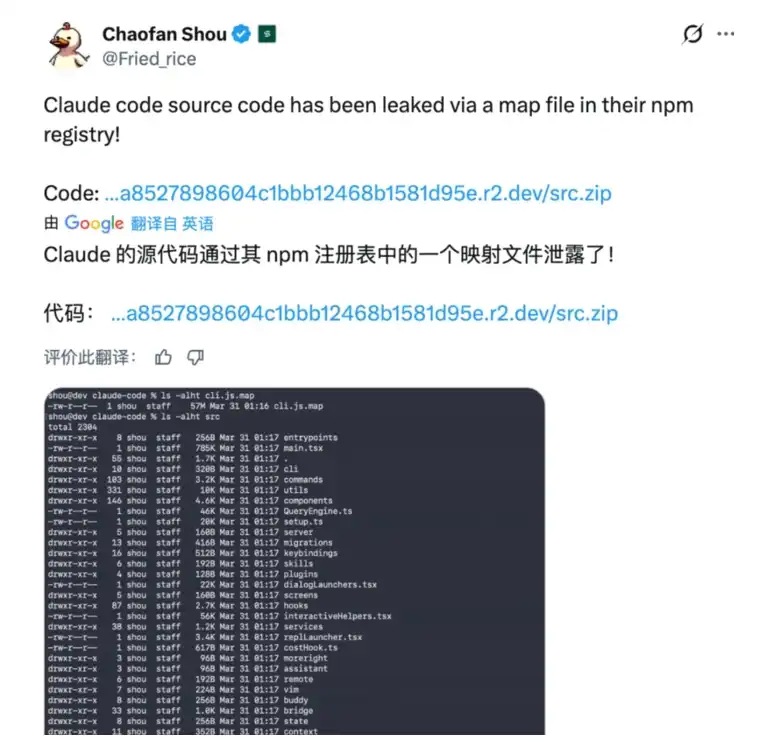
So, what was the cause of this leak? According to reports, when Anthropic published the code to npm, it actually forgot to remove the .map files, leading to the exposure of the core code. This mistake not only embarrassed the company but also raised external doubts about its security management. However, this accidental leak has given the outside world an early glimpse into some of Anthropic's cutting-edge functionalities in the AI field.

From the source code, it can be seen that Claude Code includes several astonishing features, with the project codenamed BUDDY being particularly notable. It can not only accompany developers in writing code but also has a unique personalized pet system, allowing users to incubate their own cyber pets based on personal information. This pet not only has a cute appearance but also has dynamic stats like debugging power and patience, and even a "sarcasm value," undoubtedly adding a lot of fun to the work atmosphere.

Even more forward-looking is the feature codenamed KAIROS, which aims to achieve an "always-on" AI assistant. Unlike traditional conversation methods, KAIROS can maintain memory across multiple sessions and proactively initiate tasks. Additionally, the source code includes a Nightly Dreaming mechanism, where Claude organizes information and consolidates core content while the user sleeps. This innovative concept not only makes the AI smarter but also brings new possibilities for future work methods.

Although Anthropic is currently busy dealing with this leak, the unexpected exposure might also provide a platform to showcase their cutting-edge technology. This accidental PR crisis has instead highlighted the company's innovative capabilities. The future of the AI field will become even more exciting because of such attempts.

İlgili Sorular

QWhat was the cause of the Claude Code source code leak at Anthropic?

AAnthropic forgot to remove .map files when publishing the code to npm, which exposed the core source code.

QHow many lines of TypeScript code were leaked in the Claude Code incident?

AOver five hundred thousand lines of TypeScript code were leaked.

QWhat is the name of the project that features a personalized cyber pet system for developers?

AThe project is called BUDDY, which includes a personalized cyber pet system with traits like debugging power and patience.

QWhat is the KAIROS feature designed to do according to the leaked source code?

AKAIROS is designed to be an 'always-on' AI assistant that maintains memory across multiple sessions and can proactively initiate tasks.

QWhat mechanism does Claude have for processing information during user inactivity?

AClaude has a 'Nightly Dreaming' mechanism where it organizes information and consolidates core content while the user is sleeping.

İlgili Okumalar

Where Is the AI Infrastructure Industry Chain Stuck?

The AI infrastructure (AI Infra) industry chain is facing unprecedented systemic bottlenecks, despite the rapid emergence of applications like DeepSeek and Seedance 2.0. The surge in global computing demand has exposed critical constraints across multiple layers of the supply chain—from core manufacturing equipment and data center cabling to specialty materials and cleanroom facilities. Key challenges include four major "walls": - **Memory Wall**: High-bandwidth memory (HBM) and DRAM face structural shortages as AI inference demand outpaces training, with new capacity not expected until 2027. - **Bandwidth Wall**: Data transfer speeds lag behind computing power, causing multi-level bottlenecks in-chip, between chips, and across data centers. - **Compute Wall**: Advanced chip manufacturing, reliant on EUV lithography and monopolized by ASML, remains the fundamental constraint, with supply chain fragility affecting production. - **Power Wall**: While energy demand from data centers is rising, power supply is a solvable near-term challenge through diversified energy infrastructure. Expansion is further hindered by shortages in testing equipment, IC substrates (critical for GPUs and seeing price hikes over 30%), specialty materials like low-CTE glass fiber, and high-end cleanroom facilities. Connection technologies are evolving, with copper cables resurging for short-range links due to cost and latency advantages, while optical solutions dominate long-range scenarios. Innovations like hollow-core fiber and advanced PCB technologies (e.g., glass substrates, mSAP) are emerging to meet bandwidth needs. In summary, AI Infra bottlenecks are multidimensional, spanning compute, memory, bandwidth, power, and supply chain logistics. Advanced chip manufacturing remains the core constraint, while substrate, material, and equipment shortages present immediate challenges. The industry is moving toward hybrid copper-optical solutions and accelerated domestic supply chain development.

marsbit13 dk önce

Where Is the AI Infrastructure Industry Chain Stuck?

marsbit13 dk önce

Autonomy or Compatibility: The Choice Facing China's AI Ecosystem Behind the Delay of DeepSeek V4

DeepSeek V4's repeated delay in early 2026 has sparked global discussions on "de-CUDA-ization" in AI. The highly anticipated trillion-parameter open-source model is undergoing deep adaptation to Huawei’s Ascend chips using the CANN framework, representing China’s first systematic attempt to run a core AI model outside the CUDA ecosystem. This shift, however, comes with significant engineering challenges. While the model uses a MoE architecture to reduce computational load, it places extreme demands on memory bandwidth, chip interconnects, and system scheduling—areas where NVIDIA’s mature CUDA ecosystem currently excels. Migrating to Ascend introduces complexities in hardware topology, communication latency, and software optimization due to CANN’s relative immaturity compared to CUDA. The move highlights a broader strategic dilemma: short-term compatibility with CUDA offers practical benefits and faster adoption, as seen in CANN’s efforts to emulate CUDA interfaces. Yet, long-term over-reliance on compatibility risks inheriting CUDA’s limitations and stifling native innovation. If global AI shifts away from transformer-based architectures, strict compatibility could lead to technological obsolescence. Despite these challenges, DeepSeek V4’s eventual release could demonstrate the viability of a full domestic AI stack and accelerate CANN’s ecosystem growth. However, true technological independence will require building an original software-hardware paradigm beyond compatibility—a critical task for China’s AI ambitions in the next 3-5 years.

marsbit31 dk önce

Autonomy or Compatibility: The Choice Facing China's AI Ecosystem Behind the Delay of DeepSeek V4

marsbit31 dk önce

How Blockchain Fills the Identity, Payment, and Trust Gaps for AI Agents?

AI Agents are rapidly evolving into autonomous economic participants, but they face critical gaps in identity, payment, and trust infrastructure. They currently lack standardized ways to prove who they are, what they are authorized to do, and how they should be compensated across different environments. Blockchain technology is emerging as a solution to these challenges by providing a neutral coordination layer. Public ledgers offer auditable credentials, wallets enable portable identities, and stablecoins serve as a programmable settlement layer. A key bottleneck is the absence of a universal identity standard for non-human entities—akin to "Know Your Agent" (KYA)—which would allow Agents to operate with verifiable, cryptographically signed credentials. Without this, Agents remain fragmented and face barriers to interoperability. Additionally, as AI systems take on governance roles, there is a risk that centralized control over models could undermine decentralized governance in practice. Cryptographic guarantees on training data, prompts, and behavior logs are essential to ensure Agents act in users' interests. Stablecoins and crypto-native payment rails are becoming the default for Agent-to-Agent commerce, enabling seamless, low-cost transactions for AI-native services. These systems support permissionless, programmable payments without traditional merchant onboarding. Finally, as AI scales, human oversight becomes impractical. Trust must be built into system architecture through verifiable provenance, on-chain attestations, and decentralized identity systems. The future of Agent economies depends on cryptographically enforced accountability, allowing users to delegate tasks with clearly defined constraints and transparent operation logs.

marsbit1 saat önce

How Blockchain Fills the Identity, Payment, and Trust Gaps for AI Agents?

marsbit1 saat önce

İşlemler

Spot
Futures
活动图片