Claude always makes mistakes in writing code? These 12 rules reduce the error rate to 3%

marsbit2026-05-14 tarihinde yayınlandı2026-05-14 tarihinde güncellendi

Özet

Claude's Coding Errors Drop to 3% with 12 Key Rules In early 2026, Andrej Karpathy's critique of Claude's coding failures led to the creation of a CLAUDE.md file with 4 foundational rules: "Think before coding," "Prefer simplicity," "Make surgical edits," and "Execute goal-first." These effectively reduced common errors from 40% to 3% in applicable tasks. However, as Claude Code evolved into multi-step agent workflows by May 2026, new failure modes emerged. Eight additional rules were developed to address these gaps: 5. Don't make non-linguistic decisions (e.g., API retry logic). 6. Set hard token budgets to prevent runaway iterations. 7. Expose conflicts; don't average contradictory code patterns. 8. Read existing code before writing to avoid duplication. 9. Ensure tests validate real logic, not just pass. 10. Use checkpoints for long-running, multi-step tasks. 11. Follow existing conventions over introducing new patterns. 12. Fail explicitly; avoid silent failures that appear successful. Testing across 30 codebases showed the 12-rule version maintained a 76% adherence rate while reducing the overall error rate to 3%, covering new agent-specific issues. The key is to treat CLAUDE.md as a behavioral contract targeting observed failures, keeping it under 200 lines for effectiveness. Users should adapt the rules to their specific workflows.

Editor's Note: In January 2026, Andrej Karpathy's complaints about Claude writing code led to the emergence of a seemingly small but extremely crucial file in the AI programming workflow: CLAUDE.md. Forrest Chang later organized these issues into 4 behavioral rules, attempting to constrain Claude's common mistakes when coding: silent assumptions, over-engineering, unintended damage to unrelated code, and lack of clear success criteria.

But a few months later, the use cases for Claude Code are no longer just "make the model write a piece of code." With multi-step Agents, hook chain triggering, skill loading conflicts, and multi-repository collaboration becoming the norm, new failure modes have begun to emerge: the model losing control during long tasks, tests passing without verifying real logic, migrations completing but silently skipping errors, and different coding styles being incorrectly mixed.

The author of this article tested 30 codebases over 6 weeks and added 8 new rules on top of Karpathy's original 4 rules, aiming to cover the new problems arising as AI programming moves from single-shot completions to Agent-driven collaboration.

The following is the original text:

In late January 2026, Andrej Karpathy posted a tweet thread complaining about Claude's approach to writing code. He pointed out three typical problems: making incorrect assumptions without explanation, over-complicating things, and causing unintended damage to code that shouldn't have been touched.

Forrest Chang saw this tweet thread, distilled the complaints into 4 behavioral rules, wrote them into a separate CLAUDE.md file, and published it on GitHub. The project gained 5,828 stars on its first day, was bookmarked 60,000 times within two weeks, and now has 120,000 stars, becoming the fastest-growing single-file code repository of 2026.
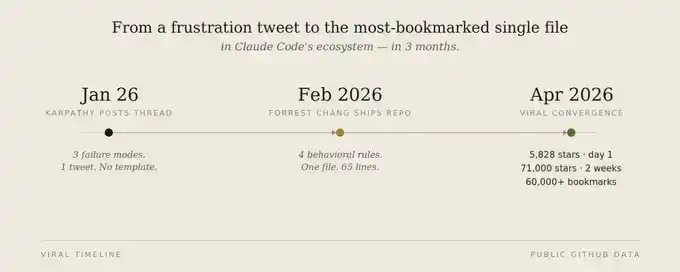
Subsequently, I tested it with 30 codebases over 6 weeks.

These 4 rules are indeed effective. Errors that previously appeared with roughly a 40% probability dropped to below 3% for tasks where these rules were applicable. The problem is, this template was initially created to address errors Claude made when writing code in January.

By May 2026, the problems facing the Claude Code ecosystem had changed: Agents conflicting with each other, hook chain triggering, skill loading conflicts, and multi-step workflow disruptions across sessions.

So, I added 8 more rules. Below is the complete 12-rule version of CLAUDE.md: why each one is worth adding, and where the original Karpathy template will quietly fail in 4 specific areas.

If you want to skip the explanation and start using it directly, the complete file is at the end of the article.

Why This Matters

The CLAUDE.md file for Claude Code is the most underestimated file in the entire AI programming tech stack. Most developers typically make three kinds of mistakes:

First, treating it as a preference trash can, stuffing all their habits into it until it bloats to over 4000 tokens, with rule compliance dropping to 30%.

Second, not using it at all, re-prompting every time. This leads to 5x token waste and a lack of consistency between sessions.

Third, copying a template once and never updating it. It might work for two weeks, but as the codebase changes, it will fail without you even realizing it.

The Anthropic official documentation is clear: CLAUDE.md is essentially just advisory. Claude will follow it about 80% of the time. Once it exceeds 200 lines, compliance drops noticeably because important rules get drowned in noise.

Karpathy's template solves this: one file, 65 lines, 4 rules. This is the minimum baseline.

But the ceiling can be higher. Adding the following 8 rules means it covers not just the code-writing problems Karpathy complained about in January 2026, but also the Agent orchestration problems that emerged by May 2026—problems that didn't exist when the original template was written.

The Original 4 Rules

If you haven't seen Forrest Chang's repository, here's the basic version:

Rule 1: Think before you code.
Don't make silent assumptions. State your assumptions, expose trade-offs. Ask before guessing. Propose counterarguments when simpler alternatives exist.

Rule 2: Simple first.
Use the minimal code that solves the problem. Don't add imagined features. Don't design abstraction layers for one-off code. If a senior engineer would find it overcomplicated, simplify it.

Rule 3: Surgical changes.
Only modify what must be changed. Don't "optimize" adjacent code, comments, or formatting as a side effect. Don't refactor what isn't broken. Maintain consistency with the existing style.

Rule 4: Execute toward the goal.
Define success criteria first, then iterate in cycles until verification is complete. Don't tell Claude each step; tell it what the successful outcome should look like and let it iterate.

These 4 rules solve roughly 40% of the failure modes I've seen in unsupervised Claude Code sessions. The remaining 60% of problems lie in the gaps outlined below.
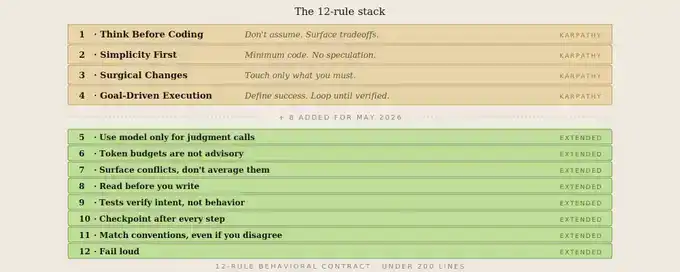
My 8 New Rules, and Why

Each rule comes from a real moment when Karpathy's original 4 rules were no longer sufficient. Below, I'll describe the scenario first, then give the corresponding rule.

Rule 5: Don't let the model do non-language work

Karpathy's rules didn't cover this. So the model started deciding issues that should have been handled by deterministic code: whether to retry an API call, how to route a message, when to escalate. The result was inconsistent decisions every week. You got an unstable, $0.003-per-token if-else statement.

The moment was this: There was code calling Claude to "decide whether to retry on a 503 error." It worked fine initially for two weeks, then suddenly became unstable because the model started treating the request body as part of the decision context. The retry strategy became random because the prompt itself was random.

Rule 6: Set a hard token budget, no exceptions

A CLAUDE.md without budget constraints is a blank check. Every loop can spiral out of control into a 50,000-token context dump. The model won't stop itself.

The moment was this: A debugging session lasted 90 minutes. The model kept iterating over the same 8KB error message, gradually forgetting which fixes it had already tried. In the end, it started proposing solutions I had rejected 40 messages earlier. With a token budget, this process should have been terminated at the 12-minute mark.

Rule 7: Expose conflicts, don't average them out

When two parts of a codebase contradict each other, Claude tries to please both sides, resulting in incoherent code.

The moment was this: A codebase had two error-handling patterns: one using async/await with explicit try/catch, another using a global error boundary. Claude wrote new code that used both. Errors got handled twice. It took me 30 minutes to figure out why errors were being swallowed two times over.

Rule 8: Read first, then write

Karpathy's "Surgical changes" tells Claude not to modify adjacent code. But it doesn't tell Claude to understand adjacent code first. Without this, Claude writes new code that conflicts with existing code 30 lines away.

The moment was this: Claude added a function right next to an existing function that did exactly the same thing, because it didn't read the original function first. Both functions performed the same task. But due to import order, the new function overrode the old one, which had been the de facto standard for 6 months.

Rule 9: Testing is not optional, but tests are not the goal

Karpathy's "Execute toward the goal" implies testing can be a success criterion. But in practice, Claude treats "tests pass" as the sole goal, writing code that passes shallow tests but breaks other things.

The moment was this: Claude wrote 12 tests for an authentication function; all passed. But the authentication logic broke in production. The tests were just verifying the function "returned something," not that it returned the correct thing. The function passed because it returned a constant.

Rule 10: Long-running operations need checkpoints

Karpathy's template assumes interaction is one-off. But real Claude Code work is often multi-step: refactoring across 20 files, building a feature in one session, debugging across multiple commits. Without checkpoints, one wrong step can lose all previous progress.

The moment was this: A 6-step refactoring task failed on step 4. By the time I noticed, Claude had already completed steps 5 and 6 on top of the erroneous state. Unraveling the fix took longer than redoing the entire task. With checkpoints, step 4 would have revealed the problem.

Rule 11: Conventions over novelty

In a codebase with established patterns, Claude loves to introduce its own style. Even if its way is "better," introducing a second pattern is worse than any single pattern.

The moment was this: Claude introduced hooks into a React codebase based on class components. It ran. But it also broke the codebase's existing testing patterns, which relied on componentDidMount. It took half a day to delete and rewrite it.

Rule 12: Fail loudly, not silently

Claude's most expensive failures are often the ones that look like successes. A function "runs" but returns wrong data; a migration "completes" but skips 30 records; a test "passes" but only because the assertion itself is wrong.

The moment was this: Claude said a database migration "completed successfully." In reality, it silently skipped 14% of records triggering constraint conflicts. The skipping was logged but not explicitly surfaced. Eleven days later, when report data started showing anomalies, we discovered the problem.

Data Results

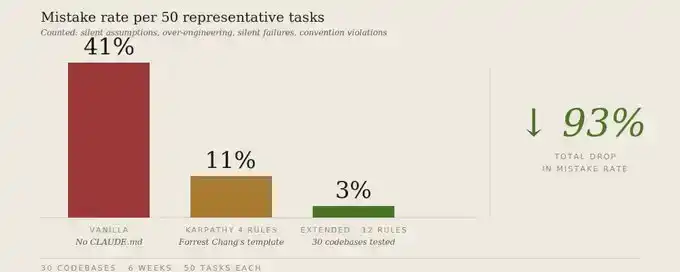
Over 6 weeks, I tracked the same set of 50 representative tasks across 30 codebases, testing three configurations.
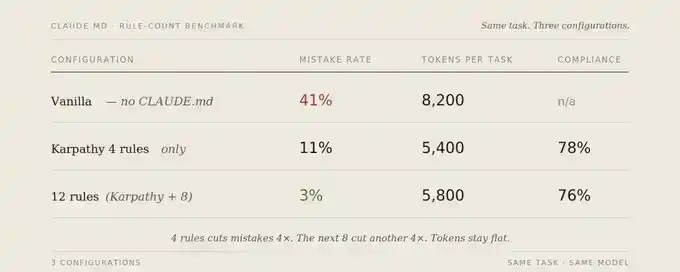
Error rate refers to: tasks needing correction or rewriting to match original intent. Counted errors include: silent erroneous assumptions, over-engineering, unintended damage, silent failures, convention violations, conflict averaging, missed checkpoints.

Compliance rate refers to: when a rule applies, how likely Claude is to explicitly apply it.

The truly interesting result isn't just the error rate dropping from 41% to 3%. More importantly, expanding from 4 to 12 rules barely increased compliance burden—compliance only dropped from 78% to 76%, but the error rate fell another 8 percentage points. The new rules cover failure modes the original 4 didn't handle; they aren't competing for the same attention budget.
Where the Karpathy Template Quietly Fails

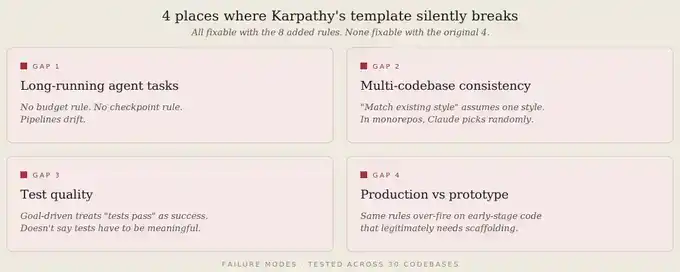
Even without new rules, the original 4-rule template is insufficient in at least 4 areas.

First, long-running Agent tasks.
Karpathy's rules mainly target the moment Claude is writing code. But what happens when Claude runs a multi-step pipeline? The original template has no budget rule, no checkpoint rule, no "fail loudly" rule. So the pipeline slowly drifts.

Second, multi-repository consistency.
"Match existing style" assumes only one style. But in a monorepo with 12 services, Claude must choose which style to match. The original rules don't tell it how. So it either picks randomly or averages several styles together.

Third, test quality.
"Execute toward the goal" treats "tests pass" as success, without stating tests must be meaningful. Result: Claude writes tests that verify almost nothing, but that make it overconfident.

Fourth, production vs. prototyping differences.
The same 4 rules that prevent production code from being over-engineered can also slow down prototyping. Because prototyping sometimes needs 100 lines of exploratory scaffolding to find direction first. Karpathy's "Simple first" triggers too easily for early-stage code.

These 8 new rules aren't meant to replace Karpathy's original 4, but to patch their gaps: the original template corresponds to the auto-completion-like coding scenario of January 2026; by May 2026, Claude Code has entered an Agent-driven, multi-step, multi-repository collaborative environment, and the problems faced are different.
What Didn't Work

Before finalizing these 12 rules, I tried other approaches.

Adding rules I saw on Reddit / X.
Most were either rephrasing Karpathy's original 4 rules or domain-specific rules that couldn't generalize, like "Always use Tailwind classes." I eventually removed them all.

More than 12 rules.
I tested up to 18. After 14, compliance dropped from 76% to 52%. The 200-line limit is real. Beyond that, Claude starts pattern-matching to "there are rules here" instead of reading each rule.

Rules dependent on specific tools.
For example, "Always use eslint." If eslint isn't installed in the project, the rule fails, silently. I later rephrased them to be tool-agnostic, e.g., changing "use eslint" to "follow styles already enforced in the codebase."

Putting examples in CLAUDE.md instead of rules.
Examples consume more context than rules. Three examples use roughly the same context as 10 rules, and Claude easily overfits to examples. Rules are abstract, examples are concrete. So, use rules.

"Be careful," "Think deeply," "Stay focused."
These are noise. Compliance for such instructions dropped to about 30% because they aren't verifiable. I replaced them with more specific imperative rules like "State assumptions explicitly."

Telling Claude to act like a "senior engineer."
This didn't work. Claude already thinks it's like a senior engineer. The real issue isn't whether it thinks so, but whether it executes like one. Imperative rules narrow this gap; identity prompts don't.

The Complete 12-Rule CLAUDE.md

Below is the complete version ready for copy-paste.

Temporarily unable to display this content outside of Lark Docs.

Save it as CLAUDE.md in your repository root. Below these 12 rules, add project-specific rules like tech stack, test commands, error patterns, etc. Keep the total under 200 lines; beyond that, rule compliance drops noticeably.

How to Install

Just two steps:

1. Append Karpathy's 4 basic rules to your existing CLAUDE.md
curl https://raw.githubusercontent.com/forrestchang/andrej-karpathy-skills/main/CLAUDE.md >> CLAUDE.md


2. Paste Rules 5–12 from this article below them

Save the file in the repository root. The >> is crucial—it appends to any existing CLAUDE.md instead of overwriting your project-specific rules.

Mental Model

CLAUDE.md isn't a wishlist; it's a behavioral contract to block specific failure patterns you've observed.

Each rule should answer one question: What error does it prevent?

Karpathy's 4 rules prevent the failure modes he saw in January 2026: silent assumptions, over-engineering, unintended damage, weak success criteria. They are the foundation; don't skip them.

My 8 new rules prevent the new failure modes emerging after May 2026: Agent loops without budget constraints, multi-step tasks without checkpoints, tests that seem to test but miss critical logic, and problems where silent failures are packaged as silent successes. They are incremental patches.

Of course, results vary. If you don't run multi-step pipelines, Rule 10 is less important. If your codebase has only one unified style enforced by linters, Rule 11 is redundant. After reading these 12, keep the rules that truly correspond to errors you've actually made; delete the rest.

A 6-rule CLAUDE.md tailored to your real failure patterns is better than a 12-rule version where 6 rules are never applicable.

Conclusion

Karpathy's tweet in January 2026 was essentially a complaint. Forrest Chang turned it into 4 rules. Ultimately, 120,000 developers starred the result. And most of them are still using only those 4 rules today.

The models have advanced, and the ecosystem has changed. Multi-step Agents, hook chains, skill loading, multi-repo collaboration—these didn't exist when Karpathy wrote that tweet. The original 4 rules don't solve these problems. They aren't wrong; they're incomplete.

Add 8 more rules. 6 weeks of testing across 30 codebases. Error rate drops from 41% to 3%.

Bookmark this article tonight and paste these 12 rules into your CLAUDE.md. If it saves you a week of Claude-related detours, feel free to share it.

İlgili Sorular

QWhat was the original 4-rule CLAUDE.md template created to solve, and how effective was it?

AThe original 4-rule CLAUDE.md template was created to solve the typical errors Andrej Karpathy complained about in January 2026 regarding Claude's coding behavior: silent assumptions, over-engineering, unintended collateral damage to unrelated code, and lack of clear success criteria. In tests, it reduced the error rate from around 40% to below 3% for tasks where these rules applied.

QWhat are two of the new problems that emerged in the Claude Code ecosystem by May 2026 that the original 4 rules didn't cover?

ABy May 2026, new failure modes included agents conflicting with each other, chain reactions from hooks, skill loading conflicts, and interruptions in multi-step, cross-session workflows. The original rules were insufficient for these issues related to agent orchestration and long-running tasks.

QAccording to the article, what are two common mistakes developers make when using a CLAUDE.md file?

ATwo common mistakes are: 1) Treating it as a preference dump, stuffing all personal habits into it until it bloats to over 4000 tokens, causing rule compliance to drop to 30%. 2) Not using it at all and re-prompting every time, which wastes 5x more tokens and lacks consistency across sessions.

QWhat does Rule 6 ('Set a hard token budget, no exceptions') aim to prevent, and what was the 'moment' that revealed its necessity?

ARule 6 aims to prevent uncontrolled, runaway iterative processes where a debugging session could spiral into a 50,000-token context dump without the model stopping itself. The revealing moment was a 90-minute debugging session where the model kept iterating over the same 8KB error message, forgetting previous fixes and eventually proposing solutions that had been rejected 40 messages earlier.

QWhy does the author advise against having more than 12-14 rules in a CLAUDE.md file, and what was the observed effect of exceeding this limit?

AThe author advises against having more than 12-14 rules because Anthropic's documentation states that compliance noticeably drops once the file exceeds 200 lines, as important rules get drowned out by noise. In tests, when the rule count exceeded 14, compliance rates dropped from 76% to 52%, as Claude started pattern-matching for 'rules are here' instead of reading each rule carefully.

İlgili Okumalar

How to Define "Real U.S. Stocks": Differences Between On-Chain Tokens, Price Contracts, and Direct Broker Connections

**Title:** Defining "Real US Stocks": Differences Among On-Chain Tokens, Price Contracts, and Broker-Direct Access **Summary:** In 2026, using stablecoins to purchase US stocks is mainstream, but products marketed as "buying US stocks with USDT" offer fundamentally different assets. This article analyzes three primary models. **1. Tokenized Stocks:** These are on-chain tokens representing economic exposure to underlying stocks, held by an issuer or custodian. They offer benefits like 24/7 trading and DeFi composability (e.g., use as loan collateral). However, users lack direct legal shareholder status; dividends may not be paid in cash, and voting rights are typically non-binding advisory expressions. Examples include platforms like Ondo Finance. **2. Stock Futures / Equity Perpetuals:** These are derivative contracts tracking a stock's price, allowing leveraged long/short positions 24/7, similar to crypto perpetuals. They offer high efficiency and flexibility but involve funding fees, which can be a significant long-term cost, especially during strong trends. Crucially, they confer no ownership rights (dividends, voting) to the holder. **3. Broker-Direct Model:** This model provides access to real securities via licensed broker-dealers. Stocks/ETFs are bought and held within the US clearing and custodial system (e.g., DTCC), making it the only path to genuine stock ownership. Users receive cash dividends and formal proxy voting rights (where applicable). It supports thousands of stocks and ETFs, far exceeding the coverage of the other two models. Key advantages include no funding fees, a clean cost structure for long-term holds, and the potential to transfer holdings to other brokers. Some platforms facilitate stablecoin (USDT/USDC) deposits, reducing reliance on traditional banking. A critical distinction exists *within* the broker-direct model: the underlying brokerage architecture (e.g., Fully Disclosed IB, Omnibus IB, Self-Clearing) determines how client assets are held, protected, and how safeguards like SIPC insurance are conveyed. Users should verify the specific clearing structure and regulatory compliance of any platform. In conclusion, "buying US stocks with USDT" can mean holding an on-chain economic proxy (Tokenized Stocks), trading a price derivative (Stock Futures), or owning the actual security (Broker-Direct). For users seeking full ownership rights and long-term investment, the broker-direct model is the definitive choice, though its implementation details require careful scrutiny.

marsbit36 dk önce

How to Define "Real U.S. Stocks": Differences Between On-Chain Tokens, Price Contracts, and Direct Broker Connections

marsbit36 dk önce

NVIDIA Launches DSX Platform, Expanding into AI Factory Infrastructure

NVIDIA has unveiled the DSX platform at its GTC Taipei event, marking a strategic expansion from GPU sales into comprehensive AI factory infrastructure solutions. The platform addresses challenges like power supply, cooling, and resource orchestration as AI models scale, shifting the industry focus from single-chip performance to overall infrastructure efficiency. DSX integrates NVIDIA's chips, systems, software, and partner technologies to cover the entire AI factory lifecycle—from design and simulation to deployment and operations. It aims to accelerate deployment, improve reliability and operational efficiency, and reduce the cost per generated token in AI inference. The software suite includes DSX MaxLPS, which uses 45°C liquid cooling and rack-level optimization to allow up to 40% more GPUs per megawatt, and DSX OS, an open-source platform for AI factory operations. The platform also encompasses reference designs, digital twin simulation (DSX Sim), dynamic workload adjustment based on grid conditions (DSX Flex), and data exchange between systems. Early adopters include cloud providers like CoreWeave and Lambda. Major hardware partners, including Dell, HPE, Lenovo, and Supermicro, are developing DSX-ready systems. Pilot projects for DSX Flex are underway with energy providers. Strategically, DSX represents NVIDIA's ongoing transition from an AI chip supplier to a full-stack AI infrastructure platform provider, aiming to set industry standards and solidify its market leadership.

marsbit42 dk önce

NVIDIA Launches DSX Platform, Expanding into AI Factory Infrastructure

marsbit42 dk önce

After Burning Tens of Billions of Dollars in Tokens, Silicon Valley Giants Start Limiting Employee Token Usage

After burning tens of billions of dollars on AI tokens, major Silicon Valley firms are now restricting employee usage. Companies like Microsoft, Uber, and Salesforce, which heavily promoted AI for "efficiency," are facing a cost crisis. The practice of "tokenmaxxing"—pushing employees to maximize AI tool usage—led to wasteful spending on trivial tasks like checking the weather or writing birthday messages, with studies showing significant hidden costs for bug fixes and code rewrites. The core issue is a misalignment between individual productivity gains and actual business value. While employees use AI to automate tasks they dislike, such as writing reports, this often doesn't translate to increased company revenue or improved core business outcomes. For instance, AI-generated code speeds up development but also sees an 800% increase in "code churn" (code being discarded or rewritten). As a result, only 14% of CFOs report seeing a clear, measurable return on AI investments. Firms are now shifting strategies. Microsoft has revoked most internal licenses for Claude Code, while others are implementing monitoring and cost controls. New tools from companies like Harness and CloudZero aim to track AI spending and tie costs to business results. Some AI vendors, like HubSpot, are moving from token-based pricing to charging based on outcomes, such as "resolved conversations" or "leads generated." This represents a necessary correction in the AI adoption cycle. The challenge now is for companies to move beyond using AI merely to speed up old tasks and instead rethink their workflows and business models fundamentally. The future of enterprise AI depends on proving its value, not just its usage.

marsbit1 saat önce

After Burning Tens of Billions of Dollars in Tokens, Silicon Valley Giants Start Limiting Employee Token Usage

marsbit1 saat önce

İşlemler

Spot
Futures

Popüler Makaleler

$S$ Nedir

SPERO'yu Anlamak: Kapsamlı Bir Genel Bakış SPERO'ya Giriş İnovasyonun manzarası gelişmeye devam ederken, web3 teknolojilerinin ve kripto para projelerinin ortaya çıkışı dijital geleceği şekillendirmede önemli bir rol oynamaktadır. Bu dinamik alanda dikkat çeken projelerden biri SPERO, $$s$$ olarak adlandırılmaktadır. Bu makale, SPERO hakkında ayrıntılı bilgi toplamak ve sunmak amacıyla, meraklılar ve yatırımcıların web3 ve kripto alanlarındaki temellerini, hedeflerini ve yeniliklerini anlamalarına yardımcı olmayı amaçlamaktadır. SPERO,$$s$$ Nedir? SPERO,$$s$$, kripto alanında merkeziyetsizlik ve blok zinciri teknolojisi ilkelerini kullanarak etkileşimi, faydayı ve finansal kapsayıcılığı teşvik eden bir ekosistem yaratmayı amaçlayan benzersiz bir projedir. Proje, kullanıcıların yenilikçi finansal çözümler ve hizmetler sunarak eşler arası etkileşimleri yeni yollarla kolaylaştırmayı hedeflemektedir. SPERO,$$s$$'nin temel amacı, bireyleri güçlendirmek ve kripto para alanındaki kullanıcı deneyimini artıran araçlar ve platformlar sağlamaktır. Bu, daha esnek işlem yöntemlerini mümkün kılmayı, topluluk odaklı girişimleri teşvik etmeyi ve merkeziyetsiz uygulamalar (dApp'ler) aracılığıyla finansal fırsatlar yaratmayı içermektedir. SPERO,$$s$$'nin temel vizyonu kapsayıcılık etrafında dönmekte olup, geleneksel finansal sistemlerdeki boşlukları kapatmayı ve blok zinciri teknolojisinin faydalarından yararlanmayı hedeflemektedir. SPERO,$$s$$'nin Yaratıcısı Kimdir? SPERO,$$s$$'nin yaratıcısının kimliği bir miktar belirsizdir, çünkü kurucusu(ları) hakkında ayrıntılı arka plan bilgisi sağlayan sınırlı kamuya açık kaynaklar bulunmaktadır. Bu şeffaflık eksikliği, projenin merkeziyetsizlik taahhüdünden kaynaklanabilir—birçok web3 projesinin paylaştığı bir etik anlayışı, bireysel tanınmanın yerine kolektif katkıları önceliklendirmektedir. Topluluk ve onun kolektif hedefleri etrafında tartışmaları merkezileştirerek, SPERO,$$s$$, belirli bireyleri öne çıkarmadan güçlendirme özünü taşımaktadır. Bu nedenle, SPERO'nun etik anlayışını ve misyonunu anlamak, tek bir yaratıcının kimliğini belirlemekten daha önemlidir. SPERO,$$s$$'nin Yatırımcıları Kimlerdir? SPERO,$$s$$, kripto sektöründe yeniliği teşvik etmeye adanmış girişim sermayedarlarından melek yatırımcılara kadar çeşitli yatırımcılar tarafından desteklenmektedir. Bu yatırımcıların odak noktası genellikle SPERO'nun misyonuyla uyumlu olup, toplumsal teknolojik ilerlemeyi, finansal kapsayıcılığı ve merkeziyetsiz yönetimi vaat eden projeleri önceliklendirmektedir. Bu yatırımcı temelleri, yalnızca yenilikçi ürünler sunan projelere değil, aynı zamanda blok zinciri topluluğuna ve ekosistemlerine olumlu katkılarda bulunan projelere de ilgi duymaktadır. Bu yatırımcıların desteği, SPERO,$$s$$'yi hızla gelişen kripto projeleri alanında dikkate değer bir rakip haline getirmektedir. SPERO,$$s$$ Nasıl Çalışır? SPERO,$$s$$, onu geleneksel kripto para projelerinden ayıran çok yönlü bir çerçeve kullanmaktadır. İşte benzersizliğini ve yeniliğini vurgulayan bazı temel özellikler: Merkeziyetsiz Yönetim: SPERO,$$s$$, kullanıcıların projenin geleceğiyle ilgili karar alma süreçlerine aktif olarak katılmalarını sağlayan merkeziyetsiz yönetim modellerini entegre etmektedir. Bu yaklaşım, topluluk üyeleri arasında sahiplik ve hesap verebilirlik duygusunu teşvik etmektedir. Token Kullanımı: SPERO,$$s$$, ekosistem içinde çeşitli işlevler sunmak üzere tasarlanmış kendi kripto para token'ını kullanmaktadır. Bu token'lar, işlemleri, ödülleri ve platformda sunulan hizmetlerin kolaylaştırılmasını sağlayarak genel etkileşimi ve faydayı artırmaktadır. Katmanlı Mimari: SPERO,$$s$$'nin teknik mimarisi, modülerlik ve ölçeklenebilirliği destekleyerek projenin evrimi sırasında ek özelliklerin ve uygulamaların sorunsuz bir şekilde entegrasyonuna olanak tanımaktadır. Bu uyum sağlama yeteneği, sürekli değişen kripto manzarasında geçerliliği sürdürmek için hayati öneme sahiptir. Topluluk Katılımı: Proje, işbirliği ve geri bildirim teşvik eden mekanizmalar kullanarak topluluk odaklı girişimlere vurgu yapmaktadır. Güçlü bir topluluk oluşturarak, SPERO,$$s$$, kullanıcı ihtiyaçlarını daha iyi karşılayabilir ve piyasa trendlerine uyum sağlayabilir. Kapsayıcılığa Odaklanma: Düşük işlem ücretleri ve kullanıcı dostu arayüzler sunarak, SPERO,$$s$$, daha önce kripto alanında yer almamış bireyler de dahil olmak üzere çeşitli bir kullanıcı tabanını çekmeyi hedeflemektedir. Bu kapsayıcılık taahhüdü, erişilebilirlik yoluyla güçlendirme misyonuyla uyumludur. SPERO,$$s$$ Zaman Çizelgesi Bir projenin tarihini anlamak, gelişim yolculuğu ve kilometre taşları hakkında kritik bilgiler sağlar. Aşağıda, SPERO,$$s$$'nin evriminde önemli olayları haritalayan önerilen bir zaman çizelgesi bulunmaktadır: Kavram Geliştirme ve Fikir Aşaması: SPERO,$$s$$'nin temelini oluşturan ilk fikirler, blok zinciri endüstrisindeki merkeziyetsizlik ve topluluk odaklılık ilkeleriyle yakından uyumlu olarak geliştirildi. Proje Beyaz Kağıdının Yayınlanması: Kavramsal aşamayı takiben, SPERO,$$s$$'nin vizyonunu, hedeflerini ve teknolojik altyapısını ayrıntılı bir şekilde açıklayan kapsamlı bir beyaz kağıt yayımlandı ve topluluk ilgisini ve geri bildirimini toplamak amacıyla sunuldu. Topluluk Oluşturma ve Erken Katılımlar: Projenin hedefleri etrafında tartışmalar yürüterek destek toplamak ve erken benimseyenler ile potansiyel yatırımcılar için bir topluluk oluşturmak amacıyla aktif iletişim çabaları gerçekleştirildi. Token Üretim Etkinliği: SPERO,$$s$$, yerel token'larını erken destekçilere dağıtmak ve ekosistem içinde başlangıç likiditesini sağlamak amacıyla bir token üretim etkinliği (TGE) gerçekleştirdi. İlk dApp'in Yayınlanması: SPERO,$$s$$ ile ilişkili ilk merkeziyetsiz uygulama (dApp) faaliyete geçti ve kullanıcıların platformun temel işlevleriyle etkileşimde bulunmalarını sağladı. Sürekli Gelişim ve Ortaklıklar: Projenin tekliflerine sürekli güncellemeler ve iyileştirmeler yapılmakta olup, blok zinciri alanındaki diğer oyuncularla stratejik ortaklıklar, SPERO,$$s$$'yi rekabetçi ve gelişen bir oyuncu haline getirmiştir. Sonuç SPERO,$$s$$, web3 ve kripto paranın finansal sistemleri devrim niteliğinde dönüştürme ve bireyleri güçlendirme potansiyelinin bir kanıtıdır. Merkeziyetsiz yönetime, topluluk katılımına ve yenilikçi tasarlanmış işlevselliğe olan bağlılığıyla, daha kapsayıcı bir finansal manzaraya doğru bir yol açmaktadır. Hızla gelişen kripto alanındaki herhangi bir yatırımda olduğu gibi, potansiyel yatırımcılar ve kullanıcılar, SPERO,$$s$$ içindeki devam eden gelişmelerle ilgili olarak kapsamlı bir araştırma yapmaları ve düşünceli bir şekilde katılmaları teşvik edilmektedir. Proje, kripto endüstrisinin yenilikçi ruhunu sergileyerek, sayısız olasılığını keşfetmeye davet etmektedir. SPERO,$$s$$'nin yolculuğu hala devam ederken, temel ilkeleri, teknoloji, finans ve birbirimizle etkileşim biçimimizi etkileyebilir.

89 Toplam GörüntülenmeYayınlanma 2024.12.17Güncellenme 2024.12.17

$S$ Nedir

AGENT S Nedir

Agent S: Web3'te Otonom Etkileşimin Geleceği Giriş Web3 ve kripto para dünyasında sürekli gelişen manzarada, yenilikler bireylerin dijital platformlarla etkileşim biçimlerini sürekli olarak yeniden tanımlıyor. Bu tür öncü projelerden biri olan Agent S, açık ajans çerçevesi aracılığıyla insan-bilgisayar etkileşimini devrim niteliğinde değiştirmeyi vaat ediyor. Otonom etkileşimlerin yolunu açarak, Agent S karmaşık görevleri basitleştirmeyi ve yapay zeka (AI) alanında dönüştürücü uygulamalar sunmayı hedefliyor. Bu detaylı inceleme, projenin karmaşıklıklarına, benzersiz özelliklerine ve kripto para alanındaki etkilerine dalacaktır. Agent S Nedir? Agent S, bilgisayar görevlerinin otomasyonunda üç temel zorluğu ele almak üzere özel olarak tasarlanmış çığır açıcı bir açık ajans çerçevesidir: Alan Spesifik Bilgi Edinimi: Çerçeve, çeşitli dış bilgi kaynaklarından ve iç deneyimlerden akıllıca öğrenir. Bu çift yönlü yaklaşım, alan spesifik bilgi açısından zengin bir veri havuzu oluşturmasını sağlar ve görev yürütmedeki performansını artırır. Uzun Görev Ufukları Üzerinde Planlama: Agent S, karmaşık görevlerin verimli bir şekilde parçalanmasını ve yürütülmesini kolaylaştıran deneyim artırımlı hiyerarşik planlama kullanır. Bu özellik, çoklu alt görevleri etkili ve verimli bir şekilde yönetme yeteneğini önemli ölçüde artırır. Dinamik, Homojen Olmayan Arayüzlerle Başlama: Proje, ajanlar ve kullanıcılar arasındaki etkileşimi geliştiren yenilikçi bir çözüm olan Ajan-Bilgisayar Arayüzü'ni (ACI) tanıtmaktadır. Çok Modlu Büyük Dil Modellerini (MLLM'ler) kullanarak, Agent S çeşitli grafik kullanıcı arayüzlerini sorunsuz bir şekilde gezinebilir ve manipüle edebilir. Bu öncü özellikler aracılığıyla, Agent S, makinelerle insan etkileşimini otomatikleştirmede karşılaşılan karmaşıklıkları ele alan sağlam bir çerçeve sunarak, AI ve ötesinde birçok uygulama için zemin hazırlıyor. Agent S'nin Yaratıcısı Kimdir? Agent S'nin kavramı temelde yenilikçi olsa da, yaratıcısı hakkında spesifik bilgiler belirsizliğini koruyor. Yaratıcı şu anda bilinmiyor, bu da projenin yeni aşamasını veya kurucu üyeleri gizli tutma stratejik tercihini vurguluyor. Anonimlikten bağımsız olarak, odak çerçevenin yetenekleri ve potansiyeli üzerinde kalıyor. Agent S'nin Yatırımcıları Kimlerdir? Agent S, kriptografik ekosistemde oldukça yeni olduğundan, yatırımcıları ve finansal destekçileri hakkında ayrıntılı bilgiler açıkça belgelenmemiştir. Projeyi destekleyen yatırım temelleri veya organizasyonları hakkında kamuya açık bilgilerdeki eksiklik, finansman yapısı ve gelişim yol haritası hakkında sorular doğuruyor. Destekleyicilerin anlaşılması, projenin sürdürülebilirliğini ve potansiyel pazar etkisini değerlendirmek için kritik öneme sahiptir. Agent S Nasıl Çalışır? Agent S'nin temelinde, çeşitli ortamlarda etkili bir şekilde çalışmasını sağlayan son teknoloji bir sistem yatmaktadır. İşleyiş modeli birkaç ana özellik etrafında inşa edilmiştir: İnsan Benzeri Bilgisayar Etkileşimi: Çerçeve, bilgisayarlarla etkileşimleri daha sezgisel hale getirmeyi amaçlayan gelişmiş AI planlaması sunar. Görev yürütmedeki insan davranışını taklit ederek, kullanıcı deneyimlerini yükseltmeyi vaat eder. Anlatı Belleği: Yüksek düzeyde deneyimlerden yararlanmak için kullanılan Agent S, görev geçmişlerini takip etmek amacıyla anlatı belleğini kullanarak karar verme süreçlerini geliştirir. Episodik Bellek: Bu özellik, kullanıcılara adım adım rehberlik sağlayarak, çerçevenin görevler gelişirken bağlamsal destek sunmasına olanak tanır. OpenACI Desteği: Yerel olarak çalışabilme yeteneği ile Agent S, kullanıcıların etkileşimleri ve iş akışları üzerinde kontrol sağlamasına olanak tanır ve Web3'ün merkeziyetsiz felsefesiyle uyumlu hale gelir. Dış API'lerle Kolay Entegrasyon: Çeşitli AI platformlarıyla uyumluluğu ve çok yönlülüğü, Agent S'nin mevcut teknolojik ekosistemlere sorunsuz bir şekilde entegre olmasını sağlar ve geliştiriciler ile organizasyonlar için cazip bir seçenek haline getirir. Bu işlevsellikler, Agent S'nin kripto alanındaki benzersiz konumuna katkıda bulunarak, karmaşık, çok aşamalı görevleri minimum insan müdahalesi ile otomatikleştirir. Proje geliştikçe, Web3'teki potansiyel uygulamaları dijital etkileşimlerin nasıl gelişeceğini yeniden tanımlayabilir. Agent S'nin Zaman Çizelgesi Agent S'nin gelişimi ve kilometre taşları, önemli olaylarını vurgulayan bir zaman çizelgesinde özetlenebilir: 27 Eylül 2024: Agent S'nin kavramı, “Bilgisayarları İnsan Gibi Kullanan Açık Bir Ajans Çerçevesi” başlıklı kapsamlı bir araştırma makalesi ile tanıtıldı ve projenin temelini sergiledi. 10 Ekim 2024: Araştırma makalesi arXiv'de kamuya açık olarak yayınlandı ve çerçevenin derinlemesine bir incelemesini ve OSWorld benchmark'ına dayalı performans değerlendirmesini sundu. 12 Ekim 2024: Agent S'nin yetenekleri ve özellikleri hakkında görsel bir içgörü sağlayan bir video sunumu yayımlandı ve potansiyel kullanıcılar ve yatırımcılarla daha fazla etkileşim sağlandı. Bu zaman çizelgesindeki işaretler, sadece Agent S'nin ilerlemesini değil, aynı zamanda şeffaflık ve topluluk katılımına olan bağlılığını da göstermektedir. Agent S Hakkında Ana Noktalar Agent S çerçevesi gelişmeye devam ederken, birkaç ana özellik öne çıkmakta ve yenilikçi doğasını ve potansiyelini vurgulamaktadır: Yenilikçi Çerçeve: İnsan etkileşimine benzer bir bilgisayar kullanımı sağlamak üzere tasarlanan Agent S, görev otomasyonuna yeni bir yaklaşım getiriyor. Otonom Etkileşim: GUI aracılığıyla bilgisayarlarla otonom olarak etkileşim kurabilme yeteneği, daha akıllı ve verimli hesaplama çözümlerine doğru bir sıçrama anlamına geliyor. Karmaşık Görev Otomasyonu: Sağlam metodolojisi ile karmaşık, çok aşamalı görevleri otomatikleştirerek süreçleri daha hızlı ve daha az hata payı ile gerçekleştirebilir. Sürekli İyileştirme: Öğrenme mekanizmaları, Agent S'nin geçmiş deneyimlerden öğrenmesini sağlar ve sürekli olarak performansını ve etkinliğini artırır. Çok Yönlülük: OSWorld ve WindowsAgentArena gibi farklı işletim ortamlarında uyumlu olması, geniş bir uygulama yelpazesine hizmet edebilmesini sağlar. Agent S, Web3 ve kripto alanında kendini konumlandırırken, etkileşim yeteneklerini artırma ve süreçleri otomatikleştirme potansiyeli, AI teknolojilerinde önemli bir ilerlemeyi temsil etmektedir. Yenilikçi çerçevesi aracılığıyla, Agent S dijital etkileşimlerin geleceğini örneklemekte ve çeşitli sektörlerde kullanıcılar için daha sorunsuz ve verimli bir deneyim vaat etmektedir. Sonuç Agent S, AI ve Web3'ün birleşiminde cesur bir sıçramayı temsil ediyor ve teknoloji ile etkileşim biçimimizi yeniden tanımlama kapasitesine sahip. Henüz erken aşamalarında olmasına rağmen, uygulama olanakları geniş ve çekici. Kritik zorlukları ele alan kapsamlı çerçevesi ile Agent S, otonom etkileşimleri dijital deneyimin ön plana çıkmasına taşımayı hedefliyor. Kripto para ve merkeziyetsizlik alanlarına daha derinlemesine girdikçe, Agent S gibi projelerin teknoloji ve insan-bilgisayar işbirliğinin geleceğini şekillendirmede önemli bir rol oynayacağı kesin.

520 Toplam GörüntülenmeYayınlanma 2025.01.14Güncellenme 2025.01.14

AGENT S Nedir

S Nasıl Satın Alınır

HTX.com’a hoş geldiniz! Sonic (S) satın alma işlemlerini basit ve kullanışlı bir hâle getirdik. Adım adım açıkladığımız rehberimizi takip ederek kripto yolculuğunuza başlayın. 1. Adım: HTX Hesabınızı OluşturunHTX'te ücretsiz bir hesap açmak için e-posta adresinizi veya telefon numaranızı kullanın. Sorunsuzca kaydolun ve tüm özelliklerin kilidini açın. Hesabımı Aç2. Adım: Kripto Satın Al Bölümüne Gidin ve Ödeme Yönteminizi SeçinKredi/Banka Kartı: Visa veya Mastercard'ınızı kullanarak anında Sonic (S) satın alın.Bakiye: Sorunsuz bir şekilde işlem yapmak için HTX hesap bakiyenizdeki fonları kullanın.Üçüncü Taraflar: Kullanımı kolaylaştırmak için Google Pay ve Apple Pay gibi popüler ödeme yöntemlerini ekledik.P2P: HTX'teki diğer kullanıcılarla doğrudan işlem yapın.Borsa Dışı (OTC): Yatırımcılar için kişiye özel hizmetler ve rekabetçi döviz kurları sunuyoruz.3. Adım: Sonic (S) Varlıklarınızı SaklayınSonic (S) satın aldıktan sonra HTX hesabınızda saklayın. Alternatif olarak, blok zinciri transferi yoluyla başka bir yere gönderebilir veya diğer kripto para birimlerini takas etmek için kullanabilirsiniz.4. Adım: Sonic (S) Varlıklarınızla İşlem YapınHTX'in spot piyasasında Sonic (S) ile kolayca işlemler yapın.Hesabınıza erişin, işlem çiftinizi seçin, işlemlerinizi gerçekleştirin ve gerçek zamanlı olarak izleyin. Hem yeni başlayanlar hem de deneyimli yatırımcılar için kullanıcı dostu bir deneyim sunuyoruz.

1.5k Toplam GörüntülenmeYayınlanma 2025.01.15Güncellenme 2025.03.21

S Nasıl Satın Alınır

Tartışmalar

HTX Topluluğuna hoş geldiniz. Burada, en son platform gelişmeleri hakkında bilgi sahibi olabilir ve profesyonel piyasa görüşlerine erişebilirsiniz. Kullanıcıların S (S) fiyatı hakkındaki görüşleri aşağıda sunulmaktadır.

活动图片