CLARITY Bill Still Unsettled, Caught Up in U.S. Bipartisan Political Game

Odaily星球日报2026-05-15 tarihinde yayınlandı2026-05-15 tarihinde güncellendi

Özet

The U.S. Senate Banking Committee voted 15-9 to advance the CLARITY Act for a full Senate vote, overcoming a key industry compromise on stablecoin rewards. However, the legislation faces significant political hurdles as it moves forward. The vote fell largely along party lines, with all 13 Republican committee members voting in favor and only two Democrats—Ruben Gallego and Angela Alsobrooks—joining them. Both Democrats indicated their support was conditional to keep debate alive and could be withdrawn later. The path to final passage in the full Senate remains difficult. The bill requires 60 votes to pass. With a current 53-47 Republican majority, this means at least 7 Democratic votes are needed, assuming no Republican defections. The narrow, partisan committee vote suggests securing that level of bipartisan support will be challenging. During the committee process, Democrats pushed for numerous amendments, including a key ethics provision to restrict top government officials' financial ties to the crypto industry. Republicans used their majority to block these amendments, leaving core Democratic concerns unaddressed. These issues, particularly around anti-money laundering and ethics, are expected to resurface as major points of contention during the full Senate debate. Republicans are pushing for a swift Senate vote, ideally before the July 4 recess and the upcoming election season, fearing that a shift in congressional power after the next election could jeopardize th...

Original | Odaily Planet Daily (@OdailyChina)

Author | Golem (@web3_golem)
On May 14th, after several hours, the U.S. Senate Banking Committee finally passed the review of the CLARITY Act, advancing the bill to the full Senate vote stage.

This committee approval is significant for the CLARITY Act because it had been stalled in the review stage for over 4 months since January due to disagreements between the banking industry and the crypto industry over stablecoin yield regulations. In the latest version of the bill, this core disagreement has been resolved: stablecoins are still not allowed to pay rewards similar to bank deposit interest, but they are permitted to pay rewards based on real activities or transactions, leaving room for stablecoin businesses to survive.

However, clearing this major obstacle does not guarantee smooth sailing for the future implementation of the CLARITY Act. This is because the CLARITY Act involves not only the conflicting interests of two major industries (banking and crypto) but has also been drawn into the political tug-of-war between the two U.S. parties (Republicans and Democrats). The outcome of this game is determining whether the CLARITY Act can secure enough votes in the full Senate vote.

CLARITY Act Forces Its Way Through

The U.S. Senate Banking Committee ultimately succeeded in passing the review of the CLARITY Act with a vote of 15 to 9. Judging from the voting outcome and support rate, the CLARITY Act can be considered as having forced its way through.

The current U.S. Senate Banking Committee has 24 members, including 13 Republicans and 11 Democrats. Republicans hold a majority of seats on the committee. Therefore, theoretically, even if all Democrats on the committee opposed it, Republicans could still force the CLARITY Act through review with a vote of 13 to 11 based on their seat advantage. But this would be the worst-case scenario, as it would essentially mean no consensus was reached between the two parties on the CLARITY Act. Even if advanced to the full Senate vote stage, it would be almost impossible for the bill to secure enough votes to pass.

Therefore, compared to the result of the CLARITY Act review being passed, the number of Democratic votes it received in the Senate Banking Committee is more important. This is a strong signal that can indirectly reflect the support rate for the CLARITY Act between the two parties and the difficulty of its subsequent passage in the full Senate vote.

However, the final voting result of 15:9 in the committee on May 14th is not much more optimistic than the worst-case scenario of 13:11. The voting blocs were very clear: all 13 Republican committee members voted in favor, only 2 Democratic committee members defected to support it, and the remaining 9 Democratic committee members all opposed. The supporting Democratic members were Ruben Gallego from Arizona and Angela Alsobrooks from Maryland.

Before the CLARITY Act review began, the market anticipated that the votes of 5 Democratic committee members with a swing stance would be crucial. How many of their affirmative votes Republicans could secure would affect the smoothness of the subsequent progress. They were:

  • Mark Warner: From Virginia, a member of the Securities Subcommittee and the Digital Assets Subcommittee. He voted in favor of the GENIUS Act and the SAB 121 bill.
  • Angela Alsobrooks: From Maryland, she co-led the stablecoin yield compromise solution with Thom Tillis and has been the most active representative in negotiations on the bill text within the Democratic Party.
  • Ruben Gallego: From Arizona, the ranking Democratic member of the Digital Assets Subcommittee. He voted to support the GENIUS Act.
  • Catherine Cortez Masto: From Nevada, a member of the Financial Institutions and Consumer Protection Subcommittee. She had reservations about the law enforcement-related provisions in the Blockchain Regulatory Certainty Act (BRCA) and had been urging revisions to address these concerns.
  • Raphael Warnock: From Georgia, a member of the Senate Economic Policy Subcommittee. He has strongly advocated for strengthening anti-money laundering and combating illicit finance measures and voted in favor of the GENIUS Act.

In the end, only 2 of these 5 Democratic committee members cast affirmative votes, and these two votes of support were "hostage votes." Alsobrooks explicitly stated after the vote that her support was to allow the conversation to continue on the Senate floor, and if the issues were ultimately not resolved, she and Gallego could change their minds at any time during the full Senate vote.

Currently, the U.S. Senate has a total of 100 Senators, with Republicans holding 53 seats, Democrats 45 seats, and Independents holding 2 seats. Considering that the two independents (Bernie Sanders and Angus King) consistently vote with the Democrats, the actual party lineup ratio in the Senate is 53:47, with Republicans as the majority party.

Although Republicans used their seat advantage to force the bill through in committee, in the upcoming full Senate vote, the CLARITY Act needs 60 votes to pass. Assuming no Republicans defect, Republicans would still need the support of at least 7 Democratic Senators.

For Republicans to gain support from at least 7 Democratic Senators appears challenging based on the current committee vote results, as they failed to secure the full support of any Democratic committee member. Galaxy stated before the Banking Committee review that if the CLARITY Act passed with only a party-line vote or close to it, the difficulty of securing 60 votes in the Senate would significantly increase, thereby dimming its prospects for passage in 2026.

Political Tug-of-War Between U.S. Parties Over the CLARITY Act

During the Banking Committee review of the CLARITY Act, the two parties engaged in intense debate over numerous amendments. Over 100 amendments were submitted to the committee by Senators in total, with Democratic Senator and Banking Committee member Elizabeth Warren alone submitting over 40. However, several amendments proposed by Democrats were rejected by Republicans using their seat advantage. The failure to satisfy multiple demands also contributed to the final outcome where the CLARITY Act forced its way through with a 15:9 vote.

Among them, the ethics amendment became the core battleground for Democrats. Democratic members had long sought to include this provision in the bill. During the review session, Democratic committee member Chris Van Hollen proposed it again, aiming to prohibit senior government officials, including the President and Vice President, from having business interests in the crypto industry and to strengthen transparency requirements. In his remarks, he specifically mentioned the association between Trump, his family, and World Liberty Financial.

However, Republican committee member Bernie Moreno opposed the amendment, stating he believed "this is not within the scope of the Banking Committee review." Ultimately, the amendment failed to pass with a party-line vote of 11 in favor and 13 against. The Democrats' persistent push for the ethics amendment is not merely for integrity; essentially, they view the crypto industry as a new capital alliance for the Republican Party and believe the current CLARITY Act would pave the way for the Trump camp's future new financial coalition.

Although crypto lobbying groups (such as the Fairshake Super PAC and its affiliated organizations) have shifted their funding strategies in recent years, no longer solely funding one party but specifically supporting and courting pro-crypto lawmakers, the majority of their political contributions still go to Republicans. Democrats are well aware that if the CLARITY Act passes without ethical restrictions, Republican leaders could legally amass enormous wealth by holding and promoting crypto assets.

Increasing the compliance difficulty for officials holding crypto is essentially also reducing the penetration rate of cryptocurrency as a "compliant safe-haven asset" among the elite. Besides traditional banks, unions and other foundational middle-class groups in the U.S. are also staunch Democratic voters. Therefore, insisting on pushing the ethics amendment is also a way for Democrats to use the moral high ground of "anti-corruption" for political mobilization, aiming to win over traditional middle-class voters who are uneasy about crypto volatility.

Of course, Democrats also know that completely opposing the crypto industry would certainly lose some of the younger voter base. Therefore, apart from progressive Democrats like Elizabeth Warren who vehemently oppose and obstruct crypto, there are also moderate, swing young Democratic lawmakers who are open to crypto.

In addition to the ethics amendment, Democrats had different demands regarding anti-money laundering regulations and the Blockchain Regulatory Certainty Act (BRCA), among other areas. However, these amendments were similarly rejected by Republicans using their seat advantage. Therefore, the committee's approval of the CLARITY Act this time did not resolve the issues between the two parties; it was the result of Republicans forcefully advancing the bill's progress. All the problems will accumulate and be addressed during the full Senate vote.

This means that the anti-money laundering and ethics amendments rejected in committee today will certainly become the ultimate weapons for Democrats to demand political concessions during the full Senate vote. Without substantive compromises or quid pro quo exchanges, this crucial bill for the crypto industry is highly likely to face fierce obstruction.

Future Prospects of the CLARITY Act

The motivation for Republicans to rush the review of the CLARITY Act is also evident. Republican Cynthia Lummis had stated multiple times previously that if the CLARITY Act is not passed this year, it might be delayed until 2030 or later.

This is because the power balance may shift in the 120th Congress (convening in January 2027). New committees and new political motivations will affect the legislative process of the CLARITY Act. If Democrats gain a majority in the new Senate and House, and Democrats like Elizabeth Warren or Sherrod Brown, who hold "hostile attitudes" towards crypto, chair the Senate Banking Committee, the probability of the CLARITY Act passing becomes even lower.

Therefore, Republicans must pass the CLARITY Act in the Senate before the environment becomes more complicated. Considering the Senate's August recess and the subsequent midterm election season, this requires Republicans to schedule the full vote before July, with the White House's ideal target being for the President to sign the bill into law before July 4th (the 250th anniversary of U.S. independence).

However, considering the final voting result in the Senate Banking Committee on May 14th and the Democrats' tough stance, for the CLARITY Act to pass smoothly in the Senate may require Republicans to demonstrate extraordinary "political skill" and coordination ability.

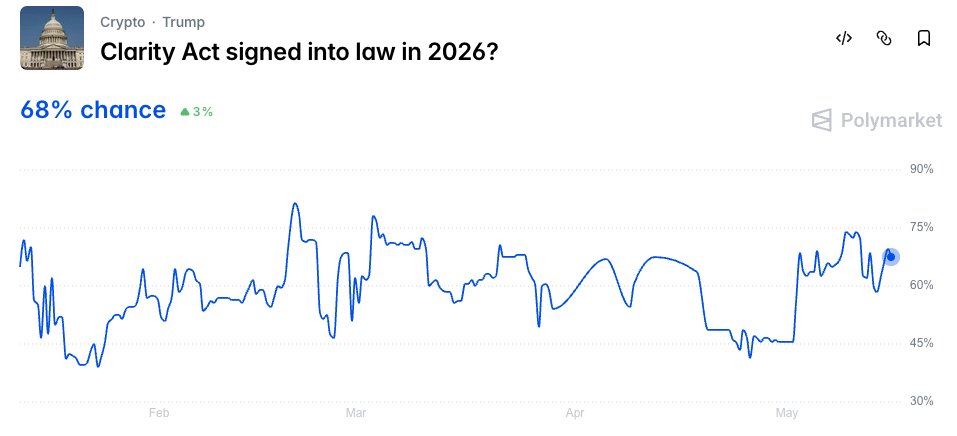
As of May 15th, the probability of the CLARITY Act being signed into law within 2026 on Polymarket is 68%, while the real probability might be much lower......
İlgili Sorular

QWhat is the CLARITY Act and why was its passage through the Senate Banking Committee considered a 'forced advance'?

AThe CLARITY Act is a piece of U.S. legislation related to the crypto industry. Its passage through the Senate Banking Committee with a 15-9 vote was considered a 'forced advance' because it passed largely along party lines (with all 13 Republican members voting in favor and only 2 out of 11 Democrats supporting it). This indicates a lack of bipartisan consensus, making its future passage in the full Senate more difficult.

QAccording to the article, why is the number of Democratic votes in the committee vote for the CLARITY Act significant?

AThe number of Democratic votes in the committee is a strong signal of the bill's bipartisan support. A low level of Democratic support in the committee suggests it will be harder to secure the necessary votes from Democratic senators (at least 7) needed for the bill to reach the 60-vote threshold for passage in the full Senate, especially with no Republican defections.

QWhat are the main political points of contention between Democrats and Republicans regarding the CLARITY Act, as mentioned in the article?

AThe main points of contention include: 1) A 'ethics amendment' proposed by Democrats to prohibit senior government officials from having crypto business interests, which Republicans rejected. Democrats view this as preventing a new financial alliance for Republicans. 2) Differences over anti-money laundering (AML) provisions and the Blockchain Regulatory Certainty Act (BRCA). Republicans used their majority to reject these Democratic proposals in committee.

QWhat is the political calculation behind the Republican Party's urgency to advance the CLARITY Act?

ARepublicans are urgently advancing the CLARITY Act because they fear the political landscape will become less favorable after the 2026 midterm elections. If Democrats gain control of Congress, committee leadership could shift to figures like Elizabeth Warren who are hostile to crypto, drastically lowering the bill's chance of passage. Their goal is to pass it before the political environment changes.

QBased on the committee vote, what is the article's assessment of the CLARITY Act's prospects for becoming law in 2026?

AThe article suggests the prospects are challenging. The forced, largely partisan committee vote (15-9) indicates significant Democratic opposition that was not resolved. Key Democratic demands (like the ethics and AML amendments) were rejected and will likely be used as bargaining chips in the full Senate vote. Without major concessions from Republicans, the bill faces a high chance of being blocked. While a prediction market gave a 68% chance, the article implies the real probability is much lower.

İlgili Okumalar

AI Trading Cools, South Korean Stocks Plunge 1.8%, Spot Gold Rises 1%, Bitcoin Dives

A sell-off in AI-related stocks, triggered by Broadcom's disappointing earnings forecast, sent shockwaves through global markets. South Korea's KOSPI led Asia's decline, plunging 1.8% as the risks from concentrated chip stock gains and surging leveraged investments came to the fore. The tech-heavy Nasdaq 100 futures fell 0.5% following Broadcom's 14% after-hours plunge, which signaled a slower-than-expected transition to AI clients. This pullback extended Wall Street's weakness, halting the S&P 500's nine-day rally amid hawkish Fed signals and renewed Middle East tensions. South Korean authorities convened an emergency meeting, pledging "immediate measures" against market volatility and warning of record-high stock margin debt. The adjustment rippled across assets: Bitcoin fell to around $64,000, its lowest since February, while safe-haven gold rose 1% on bargain hunting. Oil prices dipped on Middle East ceasefire news. Market analysts noted the sell-off was driven by profit-taking after massive gains, particularly in chip stocks like Samsung and SK Hynix, which now dominate the KOSPI. Wall Street banks are divided on Korea's outlook, with Goldman Sachs raising its target while Citigroup and others warn of overvaluation and a potential bubble. Bridgewater's Ray Dalio noted that great technological shifts often create bubbles. Meanwhile, Fed officials' hints at potential future rate hikes added to the cautious mood ahead of key U.S. jobs data.

华尔街日报14 dk önce

AI Trading Cools, South Korean Stocks Plunge 1.8%, Spot Gold Rises 1%, Bitcoin Dives

华尔街日报14 dk önce

Seeking Alpha's Hot Article: Why Might the U.S. Stock Market Crash in June?

In a recent Seeking Alpha article, financial professor and analyst Damir Tokic argues that the US stock market may be poised for a significant crash in June 2026. The core thesis centers on a "mega-bubble" in equities, particularly within the technology sector, which has driven the S&P 500 to near-record valuations, with a Shiller P/E ratio exceeding 40—a level comparable to the 2000 dot-com bubble. Tokic identifies two primary catalysts for a potential collapse. First, he points to unsustainable market exuberance fueled by what he terms the "Trump Stimulus"—massive AI capital expenditure by tech giants, which he believes is politically driven and cannot last. Second, and more urgently, he highlights the escalating Iran war as a critical threat. The ongoing closure of the Strait of Hormuz has created a severe global energy supply crunch. Strategic petroleum reserves are projected to hit critically low operational levels by June, potentially causing oil prices to spike above $200 per barrel and triggering a severe, supply-driven inflationary shock. This scenario, Tokic warns, would force the Federal Reserve's hand. Despite currently maintaining a dovish bias, the Fed would likely be compelled to officially pivot to a hawkish stance at its June FOMC meeting to combat soaring inflation and bond yields. He contends that such a shift—or even a failure to act, which would destroy Fed credibility—could be the trigger that punctures the market bubble. The resulting downturn, he concludes, could rival the bear markets of 2000 and 2008, advising investors to prepare for a major correction.

marsbit36 dk önce

Seeking Alpha's Hot Article: Why Might the U.S. Stock Market Crash in June?

marsbit36 dk önce

AI PC Battle: Bet on the Toll Booth, Not the Camp

**Title:** The AI PC Battle: Don't Bet on Sides, Bet on the Tollbooth **Summary:** The AI PC competition is moving beyond simple "x86 vs. Arm" narratives. The core investment thesis should focus on identifying which players can sustain margins, cash flow, and pricing power throughout the upgrade cycle, rather than backing a particular architecture. The opportunity is analyzed in three layers: 1. **The Advanced Foundry Tollbooth:** TSMC is positioned to collect "tolls" regardless of which chip designer wins, due to its dominant ~70% share in advanced semiconductor manufacturing, which is essential for high-end AI PC chips. 2. **Compute & Platform Spillover:** AMD represents an offensive in the x86 CPU+GPU space, while NVIDIA leverages its GPU and CUDA software stack dominance. Both benefit from the demand for increased local AI compute. 3. **Architecture Diffusion & Turnaround Plays:** ARM and Intel offer potential for significant upside (elasticity), but investments here require stricter discipline due to higher execution risks and competitive challenges. The industry is transitioning from concept to shipment validation. While short-term forecasts for AI PC adoption have been revised down slightly due to tariffs and procurement delays, the long-term trend towards AI becoming a standard PC feature remains intact. The key driver for upgrade cycles will be whether compelling enterprise applications (e.g., privacy-sensitive computing, low-latency inference) emerge beyond consumer-focused features like meeting summarization. Investment strategy should prioritize companies with platform-level advantages and recurring revenue streams. TSMC offers high certainty as the foundational tollbooth. AMD presents a strong offensive play within the established ecosystem. ARM and Intel are higher-risk, higher-potential-reward turnaround bets. The report cautions against chasing short-term hype and emphasizes a disciplined, long-term approach focused on buying ecosystem strength and cash-flow certainty after market enthusiasm subsides. **Key Risks:** Underwhelming AI PC applications slowing upgrade cycles; slow improvement in Windows on Arm compatibility; macro/tariff impacts on PC demand; potential advanced node supply-demand mismatches affecting TSMC; high overall AI sector valuations making stocks vulnerable to a risk-off shift in markets.

marsbit51 dk önce

AI PC Battle: Bet on the Toll Booth, Not the Camp

marsbit51 dk önce

Ten-Thousand-Word Analysis: From $10 to $290, MRVL Wins the Entire AI Era by 'Not Making GPUs'

Marvell Technology's stock price surged from under $10 in 2016 to a record $290 in June 2026, fueled not by making GPUs, but by dominating AI infrastructure connectivity. This analysis argues the market misvalues MRVL as merely a smaller Broadcom in custom AI chips, overlooking its true, unique position. Marvell's core strength lies in enabling high-speed data flow for AI clusters through three interconnected businesses. First, it holds a commanding ~70% market share in high-speed optical DSPs (essential for data center light modules), a deep-moat business with accelerating growth. Second, its custom AI chip design business serves hyperscalers like AWS, Microsoft, and Google, with a significant revenue pipeline despite lower margins. Third, stable cash flows come from Ethernet switch chips and enterprise storage controllers. Together, they form a full-stack "AI data movement" platform. CEO Matt Murphy's transformative leadership since 2016, involving strategic divestments, key acquisitions (like Inphi for optical DSPs), and securing long-term agreements with major cloud providers, repositioned the company. A pivotal $2 billion strategic investment from NVIDIA in 2026 underscored Marvell's critical role in the AI ecosystem, particularly through collaborations like NVLink Fusion. While Marvell faces risks—including client concentration (losing the Amazon Trainium3 design), lower-margin business mix, competitive threats, insider selling, and complex supply chains—its fundamentals remain strong. The optical interconnect moat is widening with the acquisition of Celestial AI (photonics fabric), and financial metrics show accelerating revenue growth and operating leverage. With a PEG ratio suggesting undervaluation relative to its growth, the thesis is that the market undervalues Marvell's monopolistic position in AI "plumbing" while overemphasizing its competitive custom chip segment. The story transcends investing, symbolizing how in any complex system—from the internet to AI—the value of "connection" ultimately surpasses that of individual "nodes."

marsbit1 saat önce

Ten-Thousand-Word Analysis: From $10 to $290, MRVL Wins the Entire AI Era by 'Not Making GPUs'

marsbit1 saat önce

İşlemler

Spot
Futures

Popüler Makaleler

BILL Nasıl Satın Alınır

HTX.com’a hoş geldiniz! Billions Network (BILL) satın alma işlemlerini basit ve kullanışlı bir hâle getirdik. Adım adım açıkladığımız rehberimizi takip ederek kripto yolculuğunuza başlayın. 1. Adım: HTX Hesabınızı OluşturunHTX'te ücretsiz bir hesap açmak için e-posta adresinizi veya telefon numaranızı kullanın. Sorunsuzca kaydolun ve tüm özelliklerin kilidini açın. Hesabımı Aç2. Adım: Kripto Satın Al Bölümüne Gidin ve Ödeme Yönteminizi SeçinKredi/Banka Kartı: Visa veya Mastercard'ınızı kullanarak anında Billions Network (BILL) satın alın.Bakiye: Sorunsuz bir şekilde işlem yapmak için HTX hesap bakiyenizdeki fonları kullanın.Üçüncü Taraflar: Kullanımı kolaylaştırmak için Google Pay ve Apple Pay gibi popüler ödeme yöntemlerini ekledik.P2P: HTX'teki diğer kullanıcılarla doğrudan işlem yapın.Borsa Dışı (OTC): Yatırımcılar için kişiye özel hizmetler ve rekabetçi döviz kurları sunuyoruz.3. Adım: Billions Network (BILL) Varlıklarınızı SaklayınBillions Network (BILL) satın aldıktan sonra HTX hesabınızda saklayın. Alternatif olarak, blok zinciri transferi yoluyla başka bir yere gönderebilir veya diğer kripto para birimlerini takas etmek için kullanabilirsiniz.4. Adım: Billions Network (BILL) Varlıklarınızla İşlem YapınHTX'in spot piyasasında Billions Network (BILL) ile kolayca işlemler yapın.Hesabınıza erişin, işlem çiftinizi seçin, işlemlerinizi gerçekleştirin ve gerçek zamanlı olarak izleyin. Hem yeni başlayanlar hem de deneyimli yatırımcılar için kullanıcı dostu bir deneyim sunuyoruz.

234 Toplam GörüntülenmeYayınlanma 2026.05.07Güncellenme 2026.06.02

BILL Nasıl Satın Alınır

Tartışmalar

HTX Topluluğuna hoş geldiniz. Burada, en son platform gelişmeleri hakkında bilgi sahibi olabilir ve profesyonel piyasa görüşlerine erişebilirsiniz. Kullanıcıların BILL (BILL) fiyatı hakkındaki görüşleri aşağıda sunulmaktadır.

活动图片













