CLARITY Act Could Unlock Wider Tech Growth In America, Says a16z

bitcoinist2026-05-17 tarihinde yayınlandı2026-05-17 tarihinde güncellendi

Özet

The CLARITY Act, a crypto market structure bill, faces its main hurdle in securing bipartisan Senate support, according to Grayscale. While it advanced from committee with mostly Republican votes, achieving the needed 60 votes will require significant Democratic support. Analysts cite the bipartisan passage of the GENIUS Act as a hopeful precedent. Venture firm a16z argues the bill's impact extends beyond crypto, claiming a clear U.S. legal framework would drive wider domestic innovation and bolster the dollar's global standing. Internationally, the legislation is seen as a regulatory signal for other countries. The outcome now depends on Senate vote counts.

Bipartisan support remains the main obstacle standing between the CLARITY Act and becoming law. That was the assessment from asset management firm Grayscale on Friday, even as the company said it believes the bill has a strong chance of passing.

Republicans hold 53 Senate seats, meaning at least seven Democrats would need to cross the aisle for the legislation to clear the full chamber.

CLARITY Act Advances

The CLARITY Act advanced out of the US Senate Banking Committee last Thursday after a vote that split mostly along party lines. All 13 Republican members voted in favor, joined by two Democrats.

Nine Democrats voted against it. The bill, which aims to give the crypto industry clearer rules around market structure, has been a subject of intense debate since its introduction in July 2025.

Grayscale pointed to the GENIUS Act as a possible guide for what comes next. That stablecoin legislation passed the Senate with 66 votes, including 18 Democrats.

Based on that track record, Grayscale said it believes similar bipartisan backing for the CLARITY Act is achievable, though it acknowledged that several hurdles remain before it can be signed into law.

Broader Economic Stakes

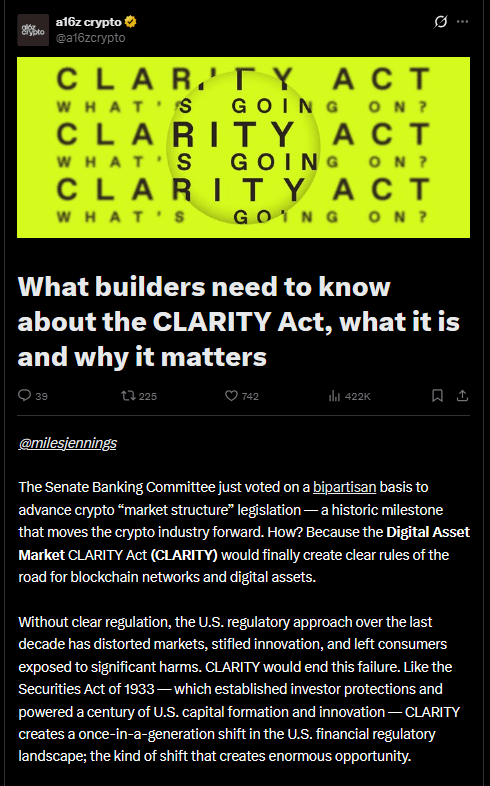
Venture capital firm a16z crypto argued Friday that the implications of the bill go well beyond the crypto sector. According to the firm, giving builders in the US a clear legal framework would drive wider domestic innovation.

BTCUSD now trading at $78,417. Chart: TradingView

It cited the GENIUS Act’s passage as a precedent, saying that legislation produced strong growth and adoption that it described as beneficial not just for the US economy but for the long-term position of the US dollar globally.

The US dollar index, which measures the dollar’s strength against a basket of major currencies, stood at 99.26 at the time of publication, up 1.25% over the prior 30 days, according to TradingView data.

Image: IQ.wiki

Global Signal

Sharplink Gaming CEO Joseph Chalom added another dimension to the conversation, saying the bill is being watched far beyond US borders.

While many see the legislation as a domestic matter, Chalom said other countries are treating it as a signal for how they might approach their own crypto regulations.

A16z framed the broader stakes plainly: when US legal frameworks balance innovation with consumer protection, the country tends to lead and the rest of the world follows.

Whether the Senate delivers that framework is now a question of vote counting.

Featured image from MadebyBaurley, chart from TradingView

İlgili Sorular

QWhat is the main obstacle for the CLARITY Act to become law according to Grayscale?

ABipartisan support remains the main obstacle for the CLARITY Act to become law.

QHow did the US Senate Banking Committee vote on the CLARITY Act, and what was the party-line split?

AThe CLARITY Act advanced out of the US Senate Banking Committee with all 13 Republican members voting in favor, joined by two Democrats, while nine Democrats voted against it.

QWhat precedent does a16z crypto cite to argue for the potential benefits of the CLARITY Act?

Aa16z crypto cites the passage of the GENIUS Act as a precedent, saying it produced strong growth and adoption beneficial for the US economy and the long-term global position of the US dollar.

QAccording to Sharplink Gaming CEO Joseph Chalom, how are other countries viewing the CLARITY Act?

AJoseph Chalom said that other countries are treating the CLARITY Act as a signal for how they might approach their own crypto regulations, watching it far beyond US borders.

QWhat does a16z crypto argue is the broader implication of passing the CLARITY Act for US innovation?

Aa16z crypto argues that giving builders in the US a clear legal framework through the CLARITY Act would drive wider domestic innovation.

İlgili Okumalar

70% of the Public Opposes AI, Americans Hope the U.S. Loses the AI War

70% of Americans believe AI development is moving too fast, with growing public resistance evolving from online criticism to real-world protests and violence. This widespread anti-AI sentiment stems from fears of job losses, rising utility costs, environmental damage, threats to democracy, and financial instability. Key incidents illustrate the backlash: Google's former CEO Eric Schmidt was loudly booed at a graduation for promoting AI; AI company ads are vandalized; protests and even violent attacks target AI firms and data centers. Polls show deep public pessimism and strong local opposition to data center construction, often surpassing resistance to nuclear power plants. The core grievances are economic and practical: AI is seen as automating jobs, concentrating wealth, and increasing household electricity and water bills due to massive data center resource demands. Environmentalists also oppose AI's high energy use and carbon emissions. This opposition has turned AI into a major political issue in the US. While the Trump administration prioritizes AI innovation for global competition, bipartisan pushback is growing. Democrats and factions within the MAGA movement are forming temporary alliances to support stricter regulations and local bans on new data centers, pressuring the administration to choose between its tech industry backers and its voter base. The situation highlights a profound national divide over AI's future.

marsbit29 dk önce

70% of the Public Opposes AI, Americans Hope the U.S. Loses the AI War

marsbit29 dk önce

Agents Take Over Traffic Distribution Power: What Are Tencent, ByteDance, and Alibaba Competing For?

In the race to dominate the AI era's entry point, China's tech giants—Tencent, ByteDance, and Alibaba—are aggressively deploying AI Agents to control the future of traffic distribution. Alibaba is pursuing a dual-track "closed loop + openness" strategy. Its Qianwen app is evolving into a super-Agent integrated across its ecosystem (Taobao, Alipay, etc.) to handle complex tasks like travel planning. Concurrently, it is opening its platform to external brands (Luckin Coffee, KFC) and has launched a B2B Agent platform, "Wukong," targeting enterprise automation. Its other flagship, Quark, aims to be an "AI super search box" for information and tasks. ByteDance is executing an omnipresent "sprawl strategy." Its Doubao app boasts over 300 million monthly active users and is evolving into a default AI entry point for daily life, with plans for paid versions and e-commerce integration. Its core weapon is the Kouzi platform, a visual "AI assembly factory" for developers to build custom Agents. ByteDance is also pushing hardware integration, collaborating on AI phones and developing smart glasses to embed Doubao everywhere. Tencent is playing its long-held "ultimate card" by quietly embedding an AI Agent directly into WeChat. This Agent, accessible via a swipe, can understand user commands and automatically execute tasks by calling upon WeChat's millions of mini-programs (e.g., finding and ordering coffee). This leverages WeChat's unparalleled 1.4-billion-user ecosystem to position the app as an AI-powered "service operating system," a move that could dramatically reshape the competitive landscape. The core battleground is shifting from competing for "user screen time" to competing to be the "default execution layer" for user intent. The business model is evolving from an "attention economy" to an "intent economy," where the Agent that can most efficiently fulfill a user's need gains control over service access and token flow. This represents a fundamental change in how users connect with digital services, making the fight for the Agent入口 (entry point) a pivotal moment for redefining industry leadership in the AI age.

marsbit2 saat önce

Agents Take Over Traffic Distribution Power: What Are Tencent, ByteDance, and Alibaba Competing For?

marsbit2 saat önce

İşlemler

Spot
Futures
活动图片