Citigroup raises short-term gold target to $4,800, J.P. Morgan bets on major volatility!

2026-08-25 tarihinde yayınlandı2026-08-25 tarihinde güncellendi

Özet

Gold prices approached $4,700 on Tuesday before experiencing a short-term pullback, yet institutional outlooks on future trends remain strong. Citi has raised its short-term target price to $4,800 and maintains a bullish view towards $5,000. Meanwhile, JPMorgan cautions that gold may still experience significant and rapid volatility.

On Monday, Citigroup raised its gold price target for the next 0 to 3 months to $4,800 per ounce, while maintaining its target of $5,000 per ounce for the next 6 to 12 months unchanged. The bank believes gold prices still have room to move higher.

At the start of the week, spot gold extended last week's gains, briefly approaching the $4,700 per ounce level during Tuesday's Asian session before subsequently pulling back to around $4,640, showing signs of a short-term accelerated correction. Gold and silver have performed strongly this month; according to Bull Theory analysis, the two precious metals collectively added nearly $5 trillion in market capitalization this month. However, both remain below the all-time highs set earlier this year.
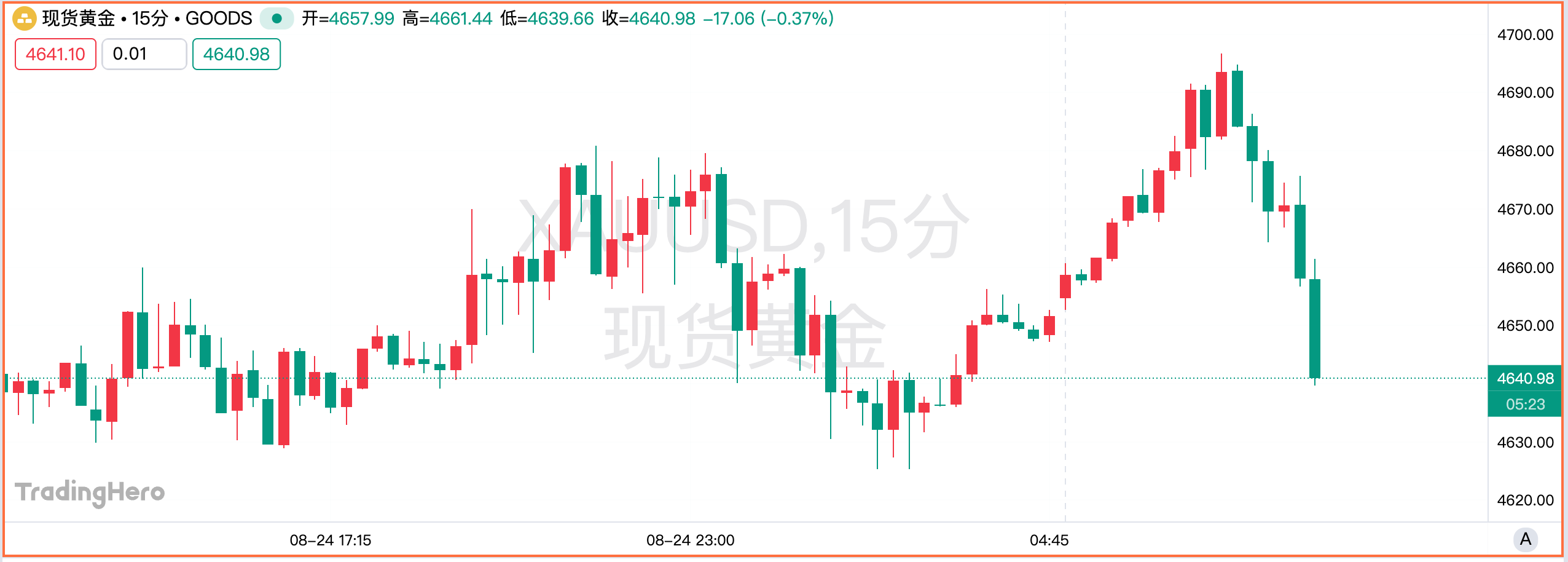
Citigroup believes gold's rally is still supported by multiple factors, including geopolitical risks in the Middle East, expectations for lower real interest rates, and the Federal Reserve's monetary policy pivot. The bank stated that as tensions in the Strait of Hormuz are expected to gradually ease, real interest rates continue to decline, and the Fed's hawkish stance weakens, gold still has a foundation for gains in the coming months.

The recent breakout in gold prices has also been driven by changes in market liquidity. Following the U.S. Treasury's expansion of its long-term bond repurchase program, expectations for easing upward pressure on long-term rates have strengthened, prompting investors to further increase their allocation to precious metals and fueling gold buying. Simultaneously, persistent tensions in the Middle East have reinforced gold's safe-haven appeal, and the rebound in energy prices has further boosted safe-haven demand amid shifting market risk sentiment.

J.P. Morgan also maintains a positive view on the gold market, but the bank believes short-term price action will still depend on macroeconomic data and signals from Federal Reserve policy. Given the significant uncertainty in the Middle East situation, coupled with recent tariff-related news pushing market risk premiums higher, it is normal for investors to pause and adjust their positions.

The market is currently focused on two key events: the U.S. PCE inflation data to be released on Wednesday and remarks from Fed officials at the Jackson Hole conference on Friday. J.P. Morgan noted that the PCE data is particularly important, with its research team expecting the data may reflect elevated inflation levels, while the market has not fully ruled out the possibility of the Fed adjusting interest rate policy in September.

J.P. Morgan pointed out that if inflation data exceeds expectations, the market may reassess the path for rate cuts, potentially pushing gold lower to test its 200-day moving average. However, if inflation falls short of expectations and the market has not fully priced in policy signals from Jackson Hole, gold prices could quickly move towards $5,000 per ounce.

The bank also cautioned that in January of this year, gold rose by approximately $1,100 in a single month, indicating that in the current market environment, gold can still experience significant, rapid volatility. In the short term, J.P. Morgan expects gold may fluctuate within a range of $4,500 to $5,000 per ounce, with the subsequent direction largely dependent on inflation data, Fed policy signals, and changes in geopolitical risks.

Beyond short-term macro factors, continued central bank gold purchases remain a key long-term support for the gold market. Although the market had previously been concerned that the pace of central bank buying might slow, recent data shows the growth trend in global central bank gold reserves has not changed.

The U.S. dollar's movement also affects gold's performance. Recent cooling U.S. inflation, weaker employment data, and rising market expectations for a Fed policy pivot have put pressure on the dollar, and a weaker dollar typically supports prices for dollar-denominated gold.

From a technical perspective, some institutions believe gold has already reclaimed its 200-day moving average, indicating the previous downward pressure has eased somewhat. Even with some weak economic data, gold's upward momentum has not significantly weakened, and the overall market performance remains strong.


İlgili Okumalar

A Precedent for the Prediction Markets: CFTC Aims to Prove Authority Over Polymarket via Criminal Case

A U.S. Army soldier, Gannon Ken Van Dyke, who earned $400,000 using non-public information on the crypto event-prediction platform Polymarket, is contesting the U.S. Commodity Futures Trading Commission's (CFTC) attempt to intervene in his criminal case. The CFTC, which initiated a separate civil suit against Van Dyke but has not pursued it to trial, seeks to submit arguments in the ongoing criminal proceeding. Van Dyke's lawyers filed a motion opposing this, arguing the CFTC is improperly trying to influence the criminal case as an outside expert rather than through its own lawsuit. They contend that event contracts traded on platforms like Polymarket are not swaps and thus fall outside the CFTC's jurisdiction, calling the regulator's tactics a procedural maneuver. Van Dyke faces criminal fraud charges for allegedly trading based on confidential information about potential regime change in Venezuela. His civil case with the CFTC is stayed pending the criminal trial, expected in late 2026 or early 2027. The court's decision on whether to allow the CFTC's intervention could set a precedent for how such event contracts are regulated. An AI analysis notes inconsistency in the CFTC's approach compared to a similar case involving a Google employee, raising questions about the legal strategy for the prediction market industry, which includes platforms like Kalshi. The outcome may define future regulatory standards for the entire market.

cryptonews.ru7 dk önce

A Precedent for the Prediction Markets: CFTC Aims to Prove Authority Over Polymarket via Criminal Case

cryptonews.ru7 dk önce

Nvidia's Jensen Huang, Fei-Fei Li, and Bin Lin All Invest in the Same Robotics Company

Generalist, a San Francisco-based AI startup focused on developing a "universal brain" for robots, has rapidly raised significant funding, attracting high-profile investors including Nvidia, Jeff Bezos' Bezos Expeditions, AI pioneer Fei-Fei Li, and Xiaomi co-founder Bin Lin. Founded in 2024 by former Google DeepMind researchers Pete Florence, Andy Zeng, and former Boston Dynamics engineer Andrew Barry, the company has secured approximately $750 million across four rounds, reaching a valuation surpassing $2 billion. The company's core innovation is its GEN-1.5 model, which aims to give robots powerful generalization capabilities. Unlike traditional systems requiring extensive reprogramming for each new task, GEN-1.5 can learn from a single, brief human demonstration (3-12 seconds) without needing retraining or fine-tuning. This "physical prompting" allows a robot to perform tasks like opening jars or using new tools after seeing them done once. While current single-demo success rates average 59% on simple tasks (improving to 83% with minor fine-tuning), the technology promises to drastically reduce robot deployment time from months to seconds. Generalist's strategy is to provide the AI intelligence layer that can run on various robotic hardware, rather than building robots themselves. The founding team combines DeepMind's expertise in AI model generalization with Boston Dynamics' practical robotics experience, targeting the industry bottleneck where robot "brains" lag behind advanced "bodies." Capital sees potential in this approach for creating a versatile, low-margin-cost robotic base applicable across factories, warehouses, and labs. However, GEN-1.5 remains a work in progress. Its capabilities are currently demonstrated on short, simple tasks, and significant challenges remain for reliable, long-term operation in complex, unpredictable real-world environments. Commercial viability also depends on hardware costs, maintenance, and system integration. Nevertheless, Generalist represents a shift toward "generalist" robots that can quickly adapt to new tasks, potentially redefining the robotics landscape and posing future questions about the role of human labor.

marsbit12 dk önce

Nvidia's Jensen Huang, Fei-Fei Li, and Bin Lin All Invest in the Same Robotics Company

marsbit12 dk önce

Bitcoin above $81K and altcoin surge. The top crypto news this morning

**Bitcoin Surpasses $81,000 as Altcoins Rally: Key Crypto Market Summary for the Morning** Bitcoin (BTC) traded above $80,500, briefly exceeding $81,300, its highest level since early May. Over the past 24 hours, BTC gained nearly 5%, while Ethereum (ETH) rose 3% to trade above $2,500. The total crypto market capitalization stands above $2.71 trillion. Market sentiment is bullish, with the crypto fear and greed index reaching 74 points, indicating "greed" and the highest reading since late last year. Among the top 100 cryptocurrencies, Aerodrome Finance (AERO) posted the largest gain (+18%), while Aave (AAVE) saw the biggest drop (-8%). Bitcoin ETFs recorded a net inflow of over $337 million on August 24, and Ethereum ETFs saw nearly $115 million in inflows. Analysts have turned positive, with some calling the current cycle potentially the "strongest in history." Corporate buying also continued, with mining company Lonic Digital and fintech firm Strive adding to their BTC reserves. Interest has shifted to altcoins and more speculative segments. Memecoins like CASHCAT, Dogecoin (DOGE), and Shiba Inu (SHIB) showed strong gains. Institutional interest in alts is evident, with Bitwise reporting record trading volumes for its Solana ETF. Data from Glassnode shows 85% of non-Bitcoin perpetual futures now have positive funding rates, a level last seen during previous market peaks.

cryptonews.ru17 dk önce

Bitcoin above $81K and altcoin surge. The top crypto news this morning

cryptonews.ru17 dk önce

İşlemler

Spot
活动图片