Circle to acquire Interop Labs team and IP as Axelar remains independent

cointelegraph2025-12-15 tarihinde yayınlandı2025-12-15 tarihinde güncellendi

Özet

Circle has signed an agreement to acquire the Interop Labs team and its proprietary technology, a core contributor to the Axelar Network. The deal, expected to close in early 2026, will integrate Interop’s technology into Circle’s Arc blockchain and Cross-Chain Transfer Protocol (CCTP) to enhance interoperability and developer tools. The Axelar Network, its foundation, and the AXL token will remain independent and community-governed. Another contributor, Common Prefix, will take over Interop’s development duties. Circle, the issuer of the USDC stablecoin, has been expanding through acquisitions, including Hashnote earlier in 2025. The terms of the deal were not disclosed.

Stablecoin issuer Circle has signed an agreement to acquire the Interop Labs team and its proprietary technology, bringing a core contributor to the Axelar Network into its infrastructure business.

The deal, expected to close in early 2026, covers Interop Labs’ personnel and proprietary intellectual property, while the Axelar Network, its foundation and the AXL token will remain independent and governed by the community.

Interop Labs is the initial developer of the Axelar Network, a decentralized interoperability network that supports crosschain messaging and asset transfers between blockchains. Circle said the team’s technology will be integrated into Circle’s Arc blockchain and Cross-Chain Transfer Protocol (CCTP).

Another Axelar contributor, Common Prefix, will take over Interop Labs’ previous development responsibilities to maintain continuity on the open-source network.

According to Circle, the acquisition is expected to speed up interoperability for assets issued on Arc, enhance developer tools for multichain applications, and support the development of Circle-built products. The terms of the deal were not disclosed.

Circle issues USDC (USDC), the second-largest stablecoin by market capitalization, accounting for roughly 25% of the $310 billion global stablecoin market, according to DefiLlama data.
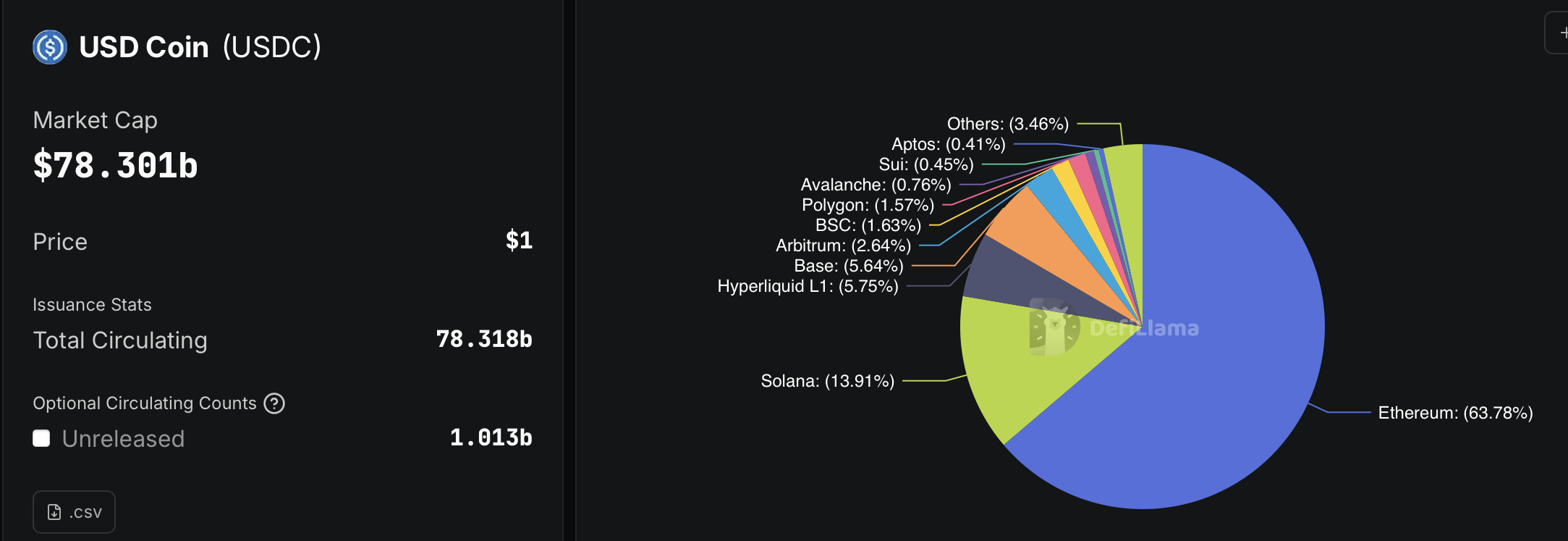
USDC market capitalization and blockchains. Source: DefiLlama

In January, Circle acquired Hashnote, the issuer of the tokenized money market fund US Yield Coin, bringing one of the largest yield-bearing real-world asset products into its stablecoin and infrastructure business.

Related: Paxos, Ripple, Circle and others secure US trust bank approvals

Stablecoin issuers make acquisitions in 2025

Stablecoin issuers have increasingly used acquisitions in 2025 to expand their businesses.

In November, Paxos acquired institutional crypto wallet provider Fordefi in a deal valued at more than $100 million, according to Fortune. Paxos, the issuer of Pax Dollar (USDP) and PayPal’s USD (PYUSD) stablecoin, said the acquisition strengthens its custody and transaction infrastructure for stablecoin issuance, asset tokenization and onchain payments.
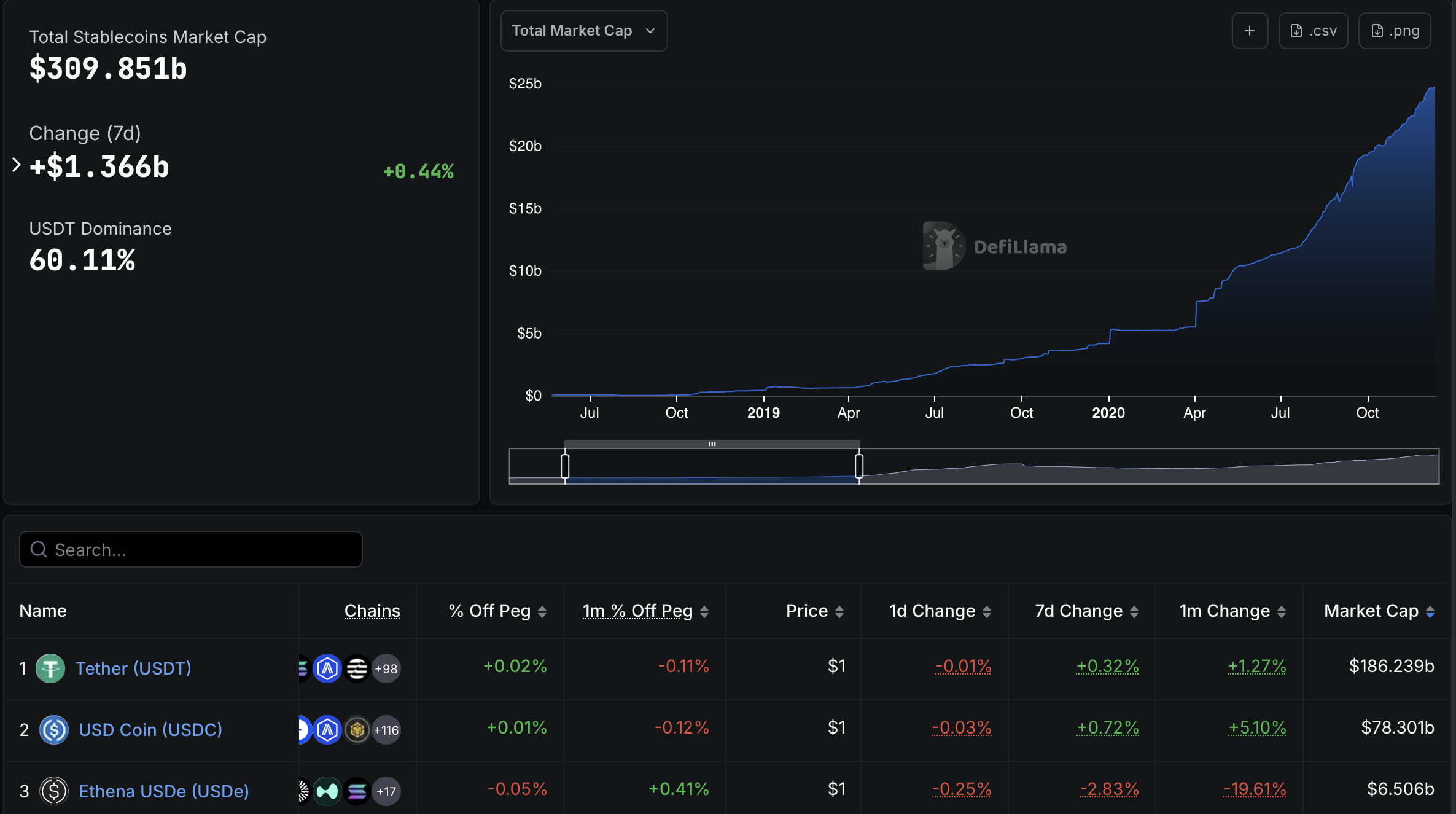
Stablecoin market cap. Source: DefiLlama

Tether, the dominant stablecoin issuer behind the USDt (USDT) token, has used its balance sheet to acquire minority stakes and strategic positions across traditional asset businesses.

In June, it acquired a roughly 32% stake in Canada-listed gold royalty company Elemental Altus Royalties for about $89 million. In November, Tether Investments acquired a minority stake in precious metals company Versamet Royalties, purchasing about 11.8 million common shares through a private agreement with an existing shareholder.

Tether has tried to push beyond finance into sports, submitting a binding all-cash offer on Dec. 12 to acquire Exor’s 65.4% controlling stake in Italy’s Juventus Football Club, a bid that the Agnelli family’s holding company later said its board unanimously rejected.

Magazine: Meet the onchain crypto detectives fighting crime better than the cops

Trend Kriptolar

İlgili Okumalar

The "Impossible Triad" Is Fundamentally a Pseudo-Problem

The article argues that blockchain's fundamental limitation is not the scalability trilemma (decentralization, scalability, security), which has been largely solved, but the lack of **privacy** and, until recently, clear **legitimacy**. Blockchain is described as a slow, expensive, globally shared computer whose core value is censorship resistance and verifiability. While ideal for native digital assets like money (e.g., stablecoins), its default transparency acts as a **tax**, exposing all transactions and enabling MEV extraction, which deters serious institutional capital. Simultaneously, its permissionless nature created regulatory ambiguity. The piece contends that **privacy** is the missing critical feature. It rejects the false choice between total transparency and complete anonymity. Modern cryptography (like zero-knowledge proofs) enables **compliant privacy**: users can prove facts (solvency, KYC status, compliance) without revealing the underlying sensitive data (specific holdings, identities). This preserves auditability for regulators and eliminates the leak of financial information. With recent regulatory progress (e.g., the GENIUS Act) addressing legitimacy, adding default, provably compliant privacy becomes a pure upgrade. It transforms blockchain from a costly, public ledger into a confidential settlement layer, finally bridging the gap to mainstream institutional and individual adoption of on-chain finance.

链捕手2 saat önce

The "Impossible Triad" Is Fundamentally a Pseudo-Problem

链捕手2 saat önce

Optical Chips: Collective Capacity Expansion

The global optical chip industry is experiencing a massive wave of expansion driven by surging AI data center demand. Major players across the US, Japan, Europe, and China are aggressively investing to ramp up production capacity. In the US, Coherent is expanding its 6-inch Indium Phosphide (InP) semiconductor fab in Texas, supported by CHIPS Act funding and a $2 billion strategic investment from NVIDIA. Lumentum is building a new factory for InP optical devices, and Nokia is scaling its advanced photonic chip packaging and testing capabilities. NVIDIA's investments aim to secure future supply of critical lasers and optical interconnect products for AI infrastructure. Japan's JX Advanced Metals, a leading InP substrate supplier, plans a multi-billion yen investment to increase its capacity 7-10 times, strengthening its grip on the crucial upstream materials market. In Europe, IQE and Tower Semiconductor settled a patent dispute and signed a multi-year InP epitaxial wafer supply agreement, highlighting that next-generation silicon photonics platforms will integrate high-performance InP components. STMicroelectronics and Sivers Semiconductors are also expanding silicon photonics production and partnerships. China is rapidly building out its domestic supply chain. Dongshan Precision's subsidiary, Source Photonics, announced a $12 billion project to expand optical chip and module production. Companies like Sanan Optoelectronics and Yunnan Germanium are scaling up InP chip manufacturing and substrate production, moving towards vertical integration from materials to modules. While debate continues around the exact future architecture—whether CPO (Co-Packaged Optics), NPO, or pluggables will dominate—analysts like Morgan Stanley argue the underlying driver is unchangeable: the explosive growth in bandwidth demand. This will inevitably increase the volume of optical engines, lasers, and related content per GPU, regardless of the final technical path. The competition for "more light" in the AI era has intensified into a global, full-chain capacity race.

marsbit5 saat önce

Optical Chips: Collective Capacity Expansion

marsbit5 saat önce

Stablecoins Finally Find Real Yield: An In-Depth Look at On-Chain Reinsurance Re | A Conversation with Re Founder Karan Saroya

Stablecoin Real Yield Found: A Deep Dive into On-Chain Reinsurance with Re's Karan Saroya As stablecoin supply exceeds $170 billion, the search for sustainable, non-speculative yield intensifies. Re, an on-chain reinsurance platform, provides an answer: connecting stablecoin capital to the trillion-dollar traditional reinsurance market. Re operates as a regulated reinsurer, accepting stablecoin deposits as collateral to back US insurance companies. These insurers pay premiums, generating yield that flows back to on-chain depositors. Currently supporting 35 insurers and underwriting $500 million, Re projects scaling to over $1 billion soon. Key insights from a Bankless podcast with founder Karan Saroya and investor Avichal of Electric Capital: 1. **Uncorrelated, Real-World Yield:** Re offers stablecoin holders access to reinsurance returns (targeting 12-14%+), an asset class entirely separate from crypto or equity markets. 2. **Operational Efficiency via Smart Contracts:** Re replaces traditional, labor-intensive capital fundraising with smart contracts, allowing a ~12-person team to compete with industry giants. 3. **Regulatory Leverage:** For every $1 of collateral, regulations allow backing $5-7 in written premiums. This leverage amplifies returns from the underlying risk-free rate. 4. **DeFi Integration:** Depositors receive receipt tokens, which can be used in protocols like Morpho for "looping," potentially pushing yields to 18-20%+. 5. **The "DeFi Mullet" Model:** A compliant front-end (regulated reinsurer) paired with a decentralized back-end (smart contracts, DeFi capital markets). 6. **RE Governance Token:** Modeled on Lloyd's of London, the token governs the central capital pool's allocation, counterparty acceptance, and parameters. 7. **Real Economic Impact:** Capital funds real-world productivity (factories, clinics, businesses) via insurance, moving beyond crypto's internal loops. The discussion highlights a pivotal moment: DeFi's supply-side infrastructure is now met by real demand for productive yield, potentially kickstarting a flywheel where vast on-chain stablecoin capital seeks these real-world returns.

链捕手6 saat önce

Stablecoins Finally Find Real Yield: An In-Depth Look at On-Chain Reinsurance Re | A Conversation with Re Founder Karan Saroya

链捕手6 saat önce

1996 or 1999? Walsh's First Test is 'How to View AI'

"1996 or 1999? Wall's First Big Test Is 'How to View AI'" Federal Reserve Chairman Wall's initial challenge is not whether to raise or cut rates, but a more fundamental judgment: what kind of boom is the current AI boom? This will determine the Fed's policy path and define his legacy. Economics is split between two opposing views, according to reporter Nick Timiraos. One sees imminent productivity gains that will increase supply and cool inflation, allowing the Fed to hold steady. The other argues that while productivity benefits are distant, demand shocks are here now, and waiting for data confirmation risks missing the intervention window, forcing sharper rate hikes later. Wall has signaled a leaning toward the first view, echoing 1996-era Alan Greenspan, who embraced strong, productivity-driven growth without fear of inflation. However, Wall faces a different macro environment than Greenspan did, with tariff pressures, expanding fiscal deficits, and diminishing globalization benefits, which could force more significant inflation pressures even if AI benefits materialize. Wall's logic, expressed before taking office, is that AI-driven productivity gains won't show in official data for years. If the Fed waits for confirmation, it might mistakenly tighten policy and choke off the very growth that could suppress inflation. This argues for using forward-looking narratives over lagging data. Chicago Fed President Austan Goolsbee presents a key counter-argument. He distinguishes between expected and unexpected productivity booms. A widely anticipated boom, like the current AI wave, can cause people to spend future wealth gains in advance, overheating the economy before productivity actually rises, thus requiring preemptive rate hikes. He cites rising costs for AI data centers as evidence of such overheating. Fed Governor Christopher Waller offers a rebuttal to Goolsbee, noting the "expected spending" mechanism only works if people can borrow against future income, which many households cannot do due to borrowing constraints. Wall also faces a paradox related to his desire to reduce the Fed's use of "forward guidance" (pre-announcing policy moves). This practice was established in 1999 when Greenspan began signaling hikes to avoid market shocks. If the economy follows a less optimistic path, Wall may be forced to choose between using the guidance he wants to abolish or risking market volatility by staying silent. The ultimate question defining Wall's first major test remains: Is this 1996 or 1999?

marsbit7 saat önce

1996 or 1999? Walsh's First Test is 'How to View AI'

marsbit7 saat önce

İşlemler

Spot
Futures

Popüler Makaleler

STORY Nedir

Hikaye Protokolünü Anlamak: Fikri Mülkiyet Yönetiminde Yeni Bir Çağı Öncü Olmak Hikaye Protokolüne Giriş Hızla gelişen blockchain teknolojisi dünyasında, Hikaye Protokolü, fikri mülkiyet (IP) yönetimi alanını dönüştürmeyi amaçlayan yenilikçi bir çözüm olarak karşımıza çıkıyor. Yaratıcıları güçlendirmek için tasarlanan Hikaye Protokolü, şeffaflığı, yaratıcılığı ve hukuki güçlendirmeyi teşvik eden bir dijital ekosistem yaratmaya hazırlanıyor. Protokol, yaratıcılara sadece eserlerini koruma fırsatı sunmakla kalmayıp aynı zamanda bunları etkili bir şekilde monetize etmeleri için merkeziyetsiz bir çerçeve sunarak web3 prensiplerine dayanarak çalışmaktadır. İçeriğin kolayca yeniden üretilebilir ve paylaşılabilir olduğu bir çağda, Hikaye Protokolü, yaratıcıların haklarına saygı gösteren ve işbirliği kültürünü destekleyen bir mekanizma oluşturmaya çalışmaktadır. Hikaye Protokolü Nedir? Hikaye Protokolü'nün temelinde, fikri mülkiyetin nasıl oluşturulduğunu, yönetildiğini ve lisanslandığını devrim niteliğinde değiştirmeyi amaçlayan gelişmiş bir blockchain tabanlı IP yönetim aracı bulunmaktadır. Projenin amacı, blockchain teknolojisinin merkeziyetsiz doğasından yararlanarak geleneksel yöntemleri kesintiye uğratmaktır. Bu, yaratıcıların kitleleriyle daha doğrudan etkileşimde bulunmalarını sağlayarak, fikri mülkiyet varlıklarının global ve ölçeklenebilir bir kütüphanesini sunmaktadır. Yaratıcılar, platformu kullanarak eserlerini kolayca kaydedebilir, içeriklerinin nasıl kullanılacağını belirleyen özelleştirilebilir kurallar oluşturabilirler. Bu süreç, sadece hukuki haklarını korumakla kalmaz, aynı zamanda eserlerinin sürekli ve şeffaf bir şekilde monetize edilmesini de teşvik eder. Sonuç olarak, Hikaye Protokolü, yazarlardan sanatçılara, müzisyenlerden programcılara kadar geniş bir yelpazede yaratıcılara hitap eder ve kapsayıcı ve erişilebilir bir ortam yaratır. Hikaye Protokolünün Yaratanı Kimdir? Hikaye Protokolü'nün vizyonu, SY Lee olarak bilinen Seung Yoon Lee ve Jason Zhao tarafından hayata geçirilmiştir. SY Lee, gazetecilik ve girişimcilik geçmişi ile birlikte zengin bir deneyim getirerek CEO ve ortak kurucu olarak görev yapmaktadır. Daha önceki girişimleri olan Byline ve Kakao'ya satılan Radish Fiction, onu dijital içerik platformlarında öncü bir figür haline getirmiştir. Ortak kurucu Jason Zhao, SY Lee'nin vizyonunu güçlü teknik uzmanlığı ile tamamlamaktadır. Stanford Üniversitesi'nden Bilgisayar Bilimleri mezunu ve DeepMind'ın eski çalışanı olan Jason, gelişmiş teknolojiler konusundaki deneyimi ile Hikaye Protokolü'nün dijital ekosistemdeki yeteneklerine katkıda bulunmaktadır. Hikaye Protokolünün Yatırımcıları Kimlerdir? Hikaye Protokolü, dönüşümcü teknolojilere duyduğu gözlem ile tanınan çok sayıda itibarlı yatırımcıdan önemli finansal destek almıştır. Bu kritik destek, projenin IP pazarını yeniden şekillendirme potansiyeline duyulan güveni yansıtmaktadır. Önemli yatırımcılar arasında, hem tohum aşamasını hem de Seri B finansmanını yönlendiren A16z Crypto bulunmaktadır; bu durum, dijital ekonomilerin geleceğine olan bağlılığını bir kez daha göstermektedir. Projeye katkı sağlayan diğer önemli yatırımcılar arasında: Polychain Capital: Seri B turuna katılan blockchain yatırımları konusunda tanınmış bir lider. Hashed Endeavor Samsung Next Foresight Ventures Dao5 Insignia Venture Partners Alliance DAO Mirana Ventures Bu yatırım ağı sadece finansman sağlamakla kalmaz, aynı zamanda platforma güvenilirlik ve stratejik içgörü kazandırarak Hikaye Protokolü'nü kendi alanında bir lider olarak konumlandırır. Hikaye Protokolü Nasıl Çalışır? Hikaye Protokolü, yaratıcıların fikri mülkiyetlerini sorunsuz bir şekilde yönetmelerine olanak tanıyan kapsamlı bir çerçeve sunmaktadır. Platform, onu geleneksel IP yönetim sistemlerinden ayıran birkaç benzersiz ve yenilikçi özellik ile desteklenmektedir. Anahtar Özellikler: Programlanabilir IP: Bu özellik, yaratıcılara IP'lerinin nasıl kullanılabileceğini tanımlama fırsatı sunar; remixleme ve işbirliği için kılavuzlar dahil. Yaratıcılar, açık ve programlanabilir parametreler belirleyerek, eserlerinin kendi vizyonlarıyla uyumlu bir şekilde kullanılmasını sağlayabilirler. Merkeziyetsiz Ekosistem: Protokol, yaratıcıların geleneksel lisanslama düzenlemelerinde sıkça bulunan aracılara ihtiyaç duymadan bağımsız bir şekilde faaliyet göstermelerini sağlar. Bu merkeziyetsiz yaklaşım, yaratıcıları güçlendirmekle kalmaz, aynı zamanda IP yönetimi ile genellikle ilişkilendirilen sürtünmeyi azaltır. Şeffaf Lisanslama: Lisanslama sürecini basitleştirerek, Hikaye Protokolü, yaratıcıların eserlerinin nasıl kullanıldığını izlemelerini kolaylaştırır. Bu manuel şeffaflık, IP haklarının sıklıkla tartışıldığı dijital bir ortamda güveni tesis etmek ve işbirliğini teşvik etmek için önemlidir. Birlikte, bu özellikler, yeniliği, iş birliğini ve yaratıcılara saygıyı teşvik eden sağlam bir ortam oluştururken, dijital çağda fikri mülkiyet hukukunun karmaşıklıklarını basitleştirir. Hikaye Protokolünün Zaman Çizelgesi Hikaye Protokolü'nün gelişimsel kilometre taşlarını anlamak, stratejik büyüme ve geleceğe yönelik vizyonu hakkında ipuçları verebilir. Aşağıda, projenin tarihindeki önemli olayları vurgulayan bir zaman çizelgesi bulunmaktadır: 2021: Hikaye Protokolü'nün kavramı üzerine temeller atıldı ve hedefleri belirlendi. 2023: Proje, A16z Crypto tarafından yönlendirilen bir tohum finansman turunda başarılı bir şekilde 29.3 milyon dolar topladı ve blockchain yenilikleri için rekabetçi bir pazara resmi giriş yaptı. 2024: İlk finansmanının başarısının ardından, Hikaye Protokolü 2.25 milyar dolarlık değerleme ile 80 milyon dolarlık bir Seri B finansman turunu duyurdu, bu da onun pazardaki pozisyonunu daha da güçlendirdi. Bu zaman çizelgesi, sadece Hikaye Protokolü'nün hızlı büyümesini değil, aynı zamanda endüstrideki önemli oyunculardan çektiği artan ilgi ve yatırımı da göstermektedir. Hikaye Protokolünün Geleceği Dijital içerik manzarası devamlı olarak evrildikçe, Hikaye Protokolü, IP yönetiminde bir devrimin öncüsü konumundadır. Yarattığı blockchain teknolojisini, yaratıcılara güç kazandırma ve şeffaflık için kullanarak, sürdürülebilir bir fikri mülkiyet ekosistemi için ikna edici bir vizyon sunmaktadır. Yaratıcılık ve yeniliğin temel alındığı bir dünyada, Hikaye Protokolü, yaratıcıların varlıkları üzerindeki sahiplik ve kontrolü korumasına olanak tanımakta ve nihayetinde yaratıcılığın gelişebileceği bir ortam yaratmaktadır. Deneyimli yatırımcılardan gelen geniş destek, bu platformun, hızla değişen dijital ekonomide fikri mülkiyetin nasıl işlediğini yeniden tanımlama potansiyelini daha da vurgulamaktadır. Sonuç olarak, Hikaye Protokolü sadece bir proje değil; daha adil ve erişilebilir bir IP ortamına doğru bir harekettir. Dijital dünya genişledikçe, Hikaye Protokolü, yaratıcıların kültüre ve topluma yaptıkları katkılardan adil bir şekilde tanınmasını ve tazmin edilmesini sağlayarak öncülük etmeyi vaat etmektedir. Yolculuk yeni başladı ve bu tür bir girişimin sonuçları derindir—yalnızca yaratıcılar için değil, dijital içeriğin geleceği için de.

256 Toplam GörüntülenmeYayınlanma 2024.04.04Güncellenme 2024.12.03

STORY Nedir

IP Nasıl Satın Alınır

HTX.com’a hoş geldiniz! Story (IP) satın alma işlemlerini basit ve kullanışlı bir hâle getirdik. Adım adım açıkladığımız rehberimizi takip ederek kripto yolculuğunuza başlayın. 1. Adım: HTX Hesabınızı OluşturunHTX'te ücretsiz bir hesap açmak için e-posta adresinizi veya telefon numaranızı kullanın. Sorunsuzca kaydolun ve tüm özelliklerin kilidini açın. Hesabımı Aç2. Adım: Kripto Satın Al Bölümüne Gidin ve Ödeme Yönteminizi SeçinKredi/Banka Kartı: Visa veya Mastercard'ınızı kullanarak anında Story (IP) satın alın.Bakiye: Sorunsuz bir şekilde işlem yapmak için HTX hesap bakiyenizdeki fonları kullanın.Üçüncü Taraflar: Kullanımı kolaylaştırmak için Google Pay ve Apple Pay gibi popüler ödeme yöntemlerini ekledik.P2P: HTX'teki diğer kullanıcılarla doğrudan işlem yapın.Borsa Dışı (OTC): Yatırımcılar için kişiye özel hizmetler ve rekabetçi döviz kurları sunuyoruz.3. Adım: Story (IP) Varlıklarınızı SaklayınStory (IP) satın aldıktan sonra HTX hesabınızda saklayın. Alternatif olarak, blok zinciri transferi yoluyla başka bir yere gönderebilir veya diğer kripto para birimlerini takas etmek için kullanabilirsiniz.4. Adım: Story (IP) Varlıklarınızla İşlem YapınHTX'in spot piyasasında Story (IP) ile kolayca işlemler yapın.Hesabınıza erişin, işlem çiftinizi seçin, işlemlerinizi gerçekleştirin ve gerçek zamanlı olarak izleyin. Hem yeni başlayanlar hem de deneyimli yatırımcılar için kullanıcı dostu bir deneyim sunuyoruz.

345 Toplam GörüntülenmeYayınlanma 2025.03.26Güncellenme 2026.06.02

IP Nasıl Satın Alınır

Tartışmalar

HTX Topluluğuna hoş geldiniz. Burada, en son platform gelişmeleri hakkında bilgi sahibi olabilir ve profesyonel piyasa görüşlerine erişebilirsiniz. Kullanıcıların IP (IP) fiyatı hakkındaki görüşleri aşağıda sunulmaktadır.

活动图片