Circle Obtains a "Federal Infrastructure License" for Stablecoins: The Deep Meaning Behind the OCC's Final Approval of Circle National Trust

链捕手2026-07-12 tarihinde yayınlandı2026-07-12 tarihinde güncellendi

Özet

Circle has received final approval from the U.S. Office of the Comptroller of the Currency (OCC) to establish Circle National Trust, a federally regulated national trust bank. This marks the first time a stablecoin issuer has entered the core U.S. financial regulatory system as a federal trust bank. Initially, the entity will focus on providing digital asset custody services for Circle and its affiliates, with plans to potentially offer reserve management in the future. This approval provides significant federal regulatory credibility, moving USDC towards becoming a "digitally native dollar settlement infrastructure." It strengthens Circle's ability to build a vertically integrated stablecoin platform encompassing issuance, custody, and settlement. The move signals a shift in the stablecoin competitive landscape—from simply issuing tokens to controlling federally supervised infrastructure. It enhances the role of stablecoins like USDC in payment settlements, particularly for cross-border transactions, by offering greater regulatory certainty for institutional adoption. Competitors like Coinbase and Paxos are also pursuing similar trust bank charters, highlighting the race to control the future infrastructure for digital dollar transactions.

Author: Yishabei

July 10, 2026, Circle announced it received final approval from the Office of the Comptroller of the Currency (OCC) to establish Circle National Trust (First National Digital Currency Bank, N.A.). This news quickly garnered market attention, with Circle's stock rising over 10% in pre-market trading.
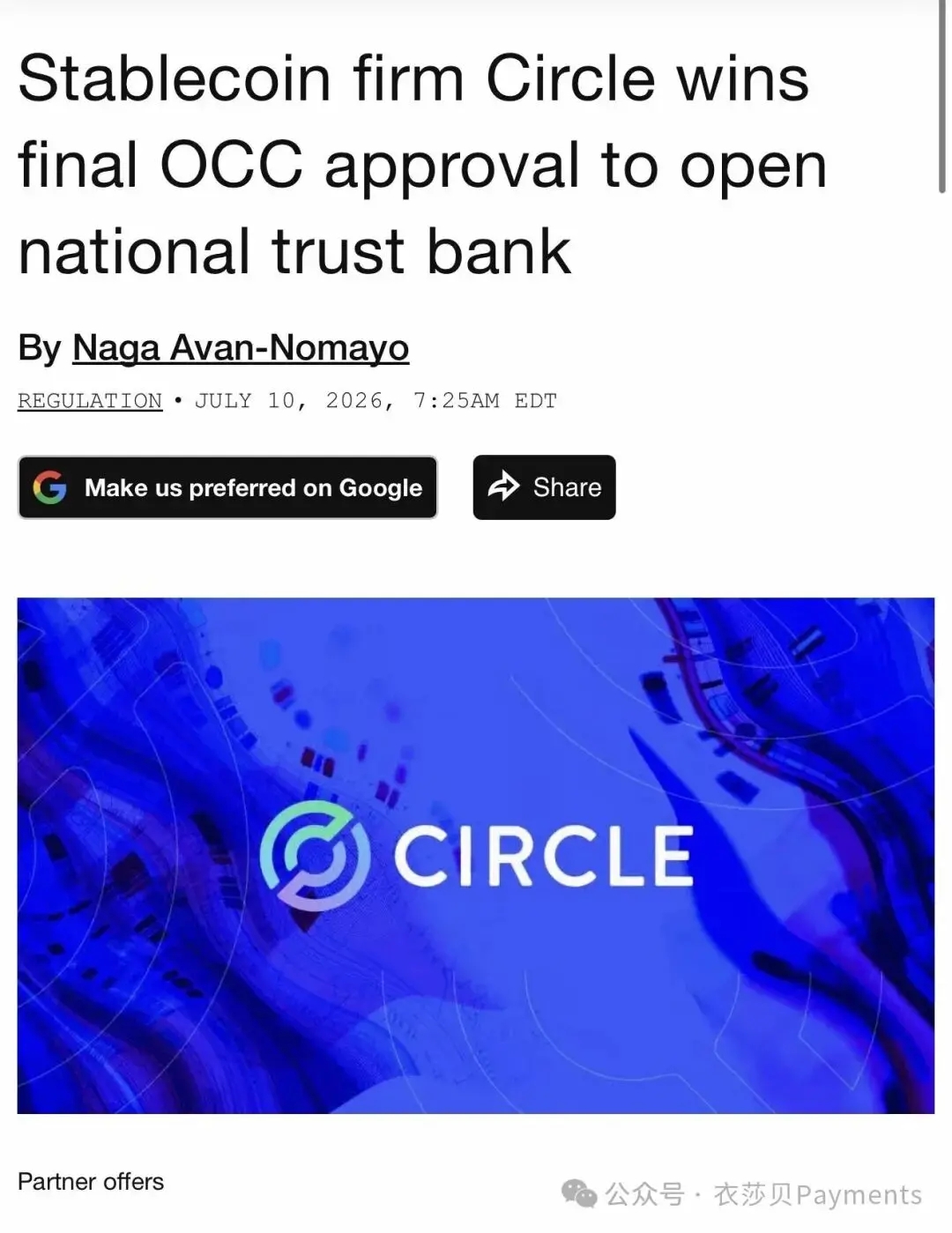
This is a landmark event that marks the first time a stablecoin issuer has formally entered the core US financial regulatory system as a federal trust bank.

It signifies that stablecoin competition is upgrading from "who issues more coins, who complies better" to "who can control the federally regulated infrastructure for issuance, reserves, custody, and settlement."

1. What exactly is this license?

Circle National Trust is a national trust bank, not a commercial bank.

It cannot accept public deposits, make loans, and does not have traditional bank FDIC deposit insurance. Essentially, it is a trust institution directly supervised at the federal level by the OCC, with its core function being to provide fiduciary services, including digital asset custody.

According to Circle's official statement:

  • Initial phase: Primarily providing digital asset custody services for Circle itself and related parties, with limited opening to institutional clients (banks, regulated derivatives institutions, etc.) as needed in the future.

  • Reserve management: Explicitly listed as a "future capability" (planned as a future capability), not currently operational.

This is an adjustment from the initial vision when Circle applied in 2025. At that time, the market speculated that reserve management would also be placed within the federally regulated entity simultaneously. However, in the final approval, the OCC adopted a more prudent, phased approach—allowing the custody business to land first, with reserve management to follow later.

This "easier first, harder later" disaggregation strategy demonstrates Circle's precise grasp of the regulatory pace and reduces the complexity and uncertainty of a single approval.

2. Why is this license of immense value?

1. Gaining Federal Regulatory Credit Endorsement

Previously, USDC primarily relied on state money transmitter licenses and New York's BitLicense. With the establishment of Circle National Trust, its core custody business is directly under federal OCC supervision.

This is highly significant for institutional adoption of USDC. When banks, brokerages, payment companies, and asset management institutions evaluate using USDC, they often prioritize not technology, but regulatory certainty and clarity of the responsible entity. A federal regulatory entity provides a level of trust endorsement far superior to state-level licenses.

USDC is evolving from a "stablecoin issued by a crypto company" to "federally regulated US dollar settlement infrastructure."

2. Paves a Federal Pathway for Future Reserve Management

Although reserve management has not yet migrated to Circle National Trust, the license structure is prepared for it. Once conditions are ripe (further regulatory clarity, mature internal systems and risk controls), Circle can relatively smoothly incorporate USDC reserve management into the federal entity.

This means the entire chain of issuance—custody—reserve management for USDC has the opportunity to operate under higher regulatory standards in the future, further enhancing its credibility as "digital dollar" infrastructure.

3. Building Vertical Integration Capabilities for Stablecoins

Circle's long-term roadmap is becoming increasingly clear:

Issue USDC → Manage reserves → Custody assets → On-chain settlement → Cross-border payment network → Provide stablecoin infrastructure services to traditional financial institutions.

It did not choose to become a traditional commercial bank that takes deposits and creates credit. Instead, it chose the lighter, more stablecoin-business-focused trust bank model. This model aligns with the core characteristics of stablecoins ("full reserve, payment nature") while maximizing the institutional benefits brought by federal regulation.

3. What does this mean for the payment industry?

For payment institutions like Visa, Mastercard, and Stripe, Circle National Trust will not directly compete for acquiring business in the short term.

The change occurs at the underlying settlement layer:

  • Merchants still receive payments via PSPs;

  • PSPs can obtain USDC through Circle or partner banks;

  • USDC is used for cross-border settlement, fund aggregation, merchant payouts, and other scenarios;

  • Circle National Trust provides federally regulated custody (potentially including reserve management in the future);

  • Traditional banks and payment institutions continue to handle fiat accounts, compliance access, local payment methods, and customer relationships.

This essentially strengthens the stablecoin settlement rail, rather than replacing the existing payment system. It grants stablecoins stronger regulatory compliance and institutional acceptance in cross-border payments, fund aggregation, real-time settlement, and other scenarios.

From a macro perspective, this is also a significant step in the evolution of stablecoins from "peripheral innovative tools" to "core financial infrastructure." In the future, a new competitive landscape and value distribution system will form around stablecoin issuance, custody, reserve management, and settlement networks.

4. The Competitive Landscape is Being Reshaped

After Circle obtained this license, other players are also accelerating their layouts:

  • Coinbase, Paxos, and other stablecoin issuers are also applying for similar trust bank licenses;

  • Stripe/Bridge, Ripple, and other payment and cross-border infrastructure players are also advancing related regulatory qualifications.

The competition is for who can control the issuance, custody, reserves, and settlement authority of the next generation of digital dollars.

Tether still primarily relies on state-level regulation, lagging significantly in federal-level license arrangements.

With this move, Circle has significantly widened its lead over major competitors in terms of regulatory moats.

5. Stablecoin Competition Enters a New Phase

The approval of Circle National Trust is an important institutional response by the US regulatory system to the "payment nature" and "infrastructure nature" of stablecoins.

It proves that for stablecoins to truly become global digital economy infrastructure, they must enter the highest-level regulatory framework and exist in a manner consistent with their business essence (trust bank, not commercial bank).

For Circle, this is a milestone victory from a decade of regulatory efforts and the starting point for greater ambitions in the future.

For the entire industry, the dimensions of stablecoin competition have fundamentally upgraded—from coin-issuance capability to infrastructure control capability.

Whoever can truly embed stablecoins into the federally regulated banking system is more likely to occupy key nodes in the next-generation US dollar settlement network.


İlgili Sorular

QWhat is Circle National Trust, and what is its primary function as approved by the OCC?

ACircle National Trust is a national trust bank (First National Digital Currency Bank, N.A.) approved by the U.S. Office of the Comptroller of the Currency (OCC). It is not a commercial bank, meaning it cannot accept public deposits, make loans, or have FDIC insurance. Its core function is to act as a federally regulated trust institution, providing fiduciary services, specifically starting with digital asset custody for Circle and its affiliates, with plans to potentially extend these services to institutional clients later.

QWhat is the strategic significance of Circle National Trust for Circle and its stablecoin USDC?

AThe approval grants Circle a critical federal regulatory charter, marking USDC's evolution from a stablecoin issued by a crypto company to a dollar settlement infrastructure under federal supervision. It provides a higher level of regulatory certainty and trust for institutional adoption. Furthermore, it creates a direct federal pathway for potentially moving USDC's reserve management into this regulated entity in the future, allowing for a fully federally supervised 'issuance-custody-reserve' pipeline.

QHow does the article differentiate between a national trust bank and a commercial bank in this context?

AThe article emphasizes that Circle National Trust is a national trust bank, not a commercial bank. Unlike a commercial bank, it cannot accept public deposits, offer loans, or provide FDIC insurance. Its role is specialized and focused on fiduciary and custody services. This model aligns better with the full-reserve, payments-focused nature of stablecoins, allowing Circle to leverage federal oversight without taking on the broader risks and responsibilities of a traditional commercial bank.

QAccording to the article, what impact will Circle National Trust have on the traditional payments industry (e.g., Visa, Mastercard)?

AThe article states that Circle National Trust will not directly compete with traditional payment networks for acquiring or processing transactions in the short term. Instead, its impact is at the underlying settlement layer. It strengthens the 'stablecoin settlement rail' for use cases like cross-border payments, treasury management, and real-time settlement. Payment Service Providers (PSPs) and traditional banks can utilize USDC (backed by this federal entity) for more efficient settlements while continuing to handle fiat accounts, compliance, local payment methods, and customer relationships.

QHow does Circle's OCC approval change the competitive landscape for stablecoin issuers like Tether and Paxos?

AThe approval gives Circle a significant regulatory advantage by establishing a direct federal oversight framework, creating a 'regulatory moat.' It signals that competition is shifting from merely issuing tokens to building and controlling federally regulated infrastructure for issuance, custody, and reserves. While competitors like Paxos and Coinbase are reportedly pursuing similar trust charters, Tether currently operates primarily under state-level regulations and is seen as lagging in this new federal infrastructure race, putting Circle in a leading position.

İlgili Okumalar

Tencent Heavily Invests in an IPO

"Tencent-Backed DPU Unicorn Leopard Cloud Intelligence Files for IPO on Shenzhen's ChiNext Board" Leopard Cloud Intelligence, a Shenzhen-based developer of Data Processing Unit (DPU) chips, has officially applied for an IPO on the ChiNext Board, aiming to become China's first publicly listed DPU company. Founded in August 2020 by Dr. Xiaoyang Xiao, a Stanford PhD graduate and serial entrepreneur who previously co-founded chip company RMI (acquired by Broadcom), the company focuses on the high-growth DPU sector. Its development accelerated following NVIDIA's formal introduction of the DPU concept in late 2020. The company has developed China's first high-performance, general-purpose programmable DPU SoC chip, boasting 400Gbps network bandwidth and claiming significant performance improvements and power savings over traditional solutions. Financially, Leopard Cloud's revenue grew exponentially from RMB 170,000 in 2023 to RMB 370 million in 2025, yet it remains unprofitable with substantial net losses. Its IPO application utilizes ChiNext's recently introduced fourth set of listing standards, which emphasize R&D and market valuation over short-term profitability. Tencent is the company's most significant backer and largest shareholder, holding a 19.78% stake after participating in multiple funding rounds. Other prominent investors include Sequoia Capital China, Shenzhen Capital Group, Five Dimensions Capital, and various government-guided funds from Shenzhen and Hangzhou. Pre-IPO, the company was valued at over RMB 14 billion. This listing is seen as a milestone for Shenzhen's semiconductor industry, complementing the recent successful IPO review of Yuexin Semiconductor (a Guangzhou-based wafer manufacturer) and signaling a wave of high-end hardware technology companies from the Greater Bay Area going public on the ChiNext Board.

marsbit22 dk önce

Tencent Heavily Invests in an IPO

marsbit22 dk önce

Circle Secures a 'Federal Infrastructure License' for Stablecoins: The Deep Implications of Circle National Trust Receiving Final Approval from the OCC

Circle announced on July 10, 2026, that it has received final approval from the U.S. Office of the Comptroller of the Currency (OCC) to establish Circle National Trust, a federally chartered national trust bank. This landmark event marks the first time a stablecoin issuer has formally entered the U.S. federal regulatory system as a trust bank, signifying a major shift in competition from simply issuing tokens to controlling regulated infrastructure for issuance, custody, reserve management, and settlement. Initially, Circle National Trust will focus on providing digital asset custody services for Circle and its affiliates, with plans to potentially extend services to institutional clients later. While reserve management for USDC is planned as a future capability, the approval of the trust charter creates a federal pathway for it. This grants Circle significant federal regulatory credibility, a crucial factor for institutional adoption of USDC. The move positions USDC to evolve from a crypto-company stablecoin toward a federally supervised dollar settlement infrastructure. The approval underscores a strategic focus on building vertical integration for stablecoins—encompassing issuance, custody, and settlement—within a specialized trust bank model rather than a traditional commercial bank. This model aligns with the full-reserve, payment-oriented nature of stablecoins while leveraging federal oversight. For the broader payments industry, this development strengthens the stablecoin settlement rail for use cases like cross-border payments and real-time settlement, complementing rather than replacing existing systems like Visa or Mastercard. The move reshapes the competitive landscape, as other players like Coinbase and Paxos also seek similar trust charters. Circle has now established a significant regulatory moat. Overall, this approval represents a pivotal step for stablecoins, transitioning them from innovative tools to core financial infrastructure governed by the highest levels of U.S. banking regulation.

marsbit56 dk önce

Circle Secures a 'Federal Infrastructure License' for Stablecoins: The Deep Implications of Circle National Trust Receiving Final Approval from the OCC

marsbit56 dk önce

İşlemler

Spot
活动图片