Circle and Bybit deepen USDC partnership as stablecoin nears $80B

cointelegraph2025-12-08 tarihinde yayınlandı2025-12-08 tarihinde güncellendi

Özet

Circle, the issuer of the USDC stablecoin, has entered a strategic partnership with cryptocurrency exchange Bybit to expand the liquidity and utility of USDC across its global ecosystem. The collaboration aims to enhance USDC integration in spot and derivatives trading, payment channels, and cross-chain support, while strengthening regulatory compliance, particularly in the EEA under MiCA. This move comes as USDC’s market capitalization has surged 77% since the start of 2025, reaching nearly $80 billion. Bybit emphasized that the partnership reflects its commitment to transparency and user choice, rather than exclusivity, as the stablecoin market continues to grow.

Circle, the publicly-listed issuer of one of the largest US dollar stablecoins globally, has entered into a strategic partnership with cryptocurrency exchange Bybit.

Bybit has entered a strategic partnership with an affiliate of Circle to expand liquidity and usability of its USDC (USDC) stablecoin, according to a joint announcement on Monday.

“The partnership aims to expand USDC access across Bybit’s global ecosystem, strengthen liquidity of the world’s largest regulated stablecoin, and reinforce Bybit’s position as a regulatory-compliant platform committed to transparency and trust,” the companies said.

The partnership comes as USDC is gaining momentum, with its market capitalization surging to historic records and nearing $80 billion.

Bybit to deepen USDC integration across spot, derivatives and payment channels

“Bybit’s partnership with Circle allows us to deepen USDC integration across spot, derivatives, and payment channels within a transparent and compliant framework,” a spokesperson for Bybit told Cointelegraph.

The crypto exchange is working closely with Circle to enhance liquidity provisioning, strengthen fiat on-ramps and off-ramps, as well as expand crosschain support, the representative said, adding:

“This collaboration is just the beginning — especially in the EEA region, where Circle has a strong regulatory presence under MiCA. We see meaningful opportunities to expand USDC’s utility and deliver even more reliable settlement options for global users.”

Bybit’s spokesperson mentioned that the exchange started to integrate USDC several years ago, starting with spot and perpetual trading pairs and expanding it to savings products, institutional settlement, conversion tools and fiat payment channels.

Related: Ethena’s synthetic USDe contracts sharply as dollar-backed stablecoins expand

“Today, USDC is already embedded across our ecosystem, and this new strategic partnership strengthens the underlying infrastructure with better liquidity, faster settlement and broader use cases,” Bybit said.

USDC market cap nearing $80 billion

The Bybit–Circle partnership caps a year of strong growth for USDC, with the stablecoin nearly doubling its market cap since the beginning of 2025.

Since Jan. 1, 2025, USDC market capitalization has surged by 77% from around $44 billion to $78 billion as of Dec. 7, according to data from CoinGecko.

The growth aligns with Circle increasingly pushing partnerships in traditional finance, including collaborations with the global exchange organization Deutsche Börse, payment giant Mastercard and more.
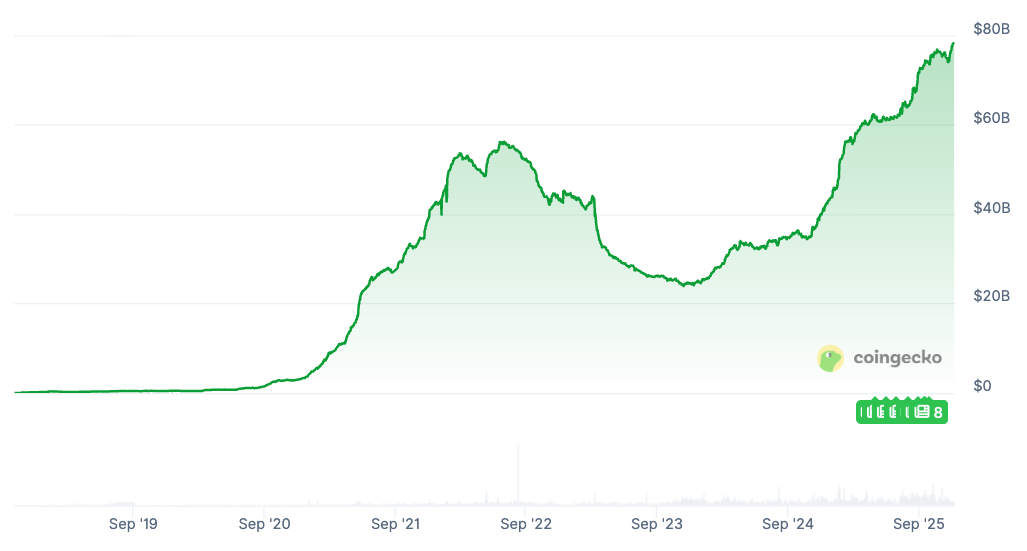
USDC market capitalization chart since launch. Source: CoinGecko

By comparison, Tether, the world’s largest stablecoin by market capitalization, has seen its market cap rise about 36% since the start of the year, climbing from roughly $137 billion to $186 billion.

“Bybit supports multiple stablecoins and remains committed to giving users choice. Our collaboration with Circle is not about exclusivity,” a spokesperson for Bybit said, adding: “It reflects our focus on transparency and regulatory clarity as the industry matures.”

Magazine: Animoca’s bet on altcoin upside, analyst eyes $100K Bitcoin: Hodler’s Digest, Nov. 23 – 29


İlgili Sorular

QWhat is the main focus of the strategic partnership between Circle and Bybit?

AThe partnership aims to expand USDC access across Bybit's global ecosystem, strengthen liquidity of the regulated stablecoin, and reinforce Bybit's position as a regulatory-compliant platform.

QHow has USDC's market capitalization changed since the beginning of 2025?

AUSDC's market capitalization has surged by 77% from around $44 billion on January 1, 2025, to $78 billion as of December 7.

QIn which specific areas of Bybit's platform will USDC integration be deepened?

AUSDC integration will be deepened across spot trading, derivatives, payment channels, savings products, institutional settlement, conversion tools, and fiat payment channels.

QHow does Bybit's spokesperson characterize the partnership with Circle regarding exclusivity?

AThe spokesperson stated that the collaboration is not about exclusivity, as Bybit supports multiple stablecoins, but reflects their focus on transparency and regulatory clarity.

QWhat regulatory framework in the EEA region makes Circle's presence particularly significant for this partnership?

ACircle has a strong regulatory presence under the Markets in Crypto-Assets (MiCA) regulation in the European Economic Area (EEA).

İlgili Okumalar

Is AI Creating a New Class of 'Information Poor'?

AI is generating a new kind of "information poverty." The core issue isn't that AI denies answers to the poor; it's that it provides abundant, cheap, and plausible-sounding answers to everyone. This availability shifts the true scarcity from obtaining answers to possessing the **judgment to evaluate them** and the access to turn them into real-world opportunities. New information poverty thus describes those who have AI tools and outputs, but lack the complementary skills, authorization, and contextual experience to critically assess and act on them. Research reveals a multi-layered divide: access to AI is stratified by income and platform design (e.g., premium vs. free, embedded tools). In workplaces, usage heavily favors higher-paid, more experienced, or formally trained employees, with AI often automating entry-level tasks that were traditional stepping stones. Crucially, the heaviest users are often mid-career professionals whose existing expertise allows them to effectively judge and leverage AI outputs, while novices risk over-relying on them without building judgment. While controlled experiments show AI can significantly boost low-skilled workers' performance, real-world adoption and benefit are constrained by unequal social and organizational structures. Historically, general-purpose technologies first reward those with existing complementary capital. AI, by affecting judgment-based work, may accelerate and deepen this initial inequality gap, even if it narrows over decades. The danger lies in the illusion of competence it creates, potentially stunting the very critical thinking needed in an era where judgment is paramount.

marsbit18 dk önce

Is AI Creating a New Class of 'Information Poor'?

marsbit18 dk önce

Jensen Huang 'Saves' South Korean Stock Market: Locks In SK Hynix Memory, Chip Shortage to Continue

On June 5th, South Korea's stock market experienced a sharp decline, with major chipmakers like Samsung and SK Hynix dropping nearly 10%. Amidst the turmoil, NVIDIA CEO Jensen Huang's visit to Seoul played a dramatic role in boosting market sentiment. Following a dinner meeting with SK Group Chairman Chey Tae-won and SK Hynix CEO Kwak Noh-Jung, Huang confirmed that NVIDIA's new Vera CPU will utilize SK Hynix DRAM. The companies announced a multi-year technical partnership to co-develop next-generation memory for NVIDIA's AI infrastructure, covering products from data centers to personal AI and robotics. This collaboration extends beyond memory supply. SK Hynix is integrating NVIDIA's AI and Omniverse platform into its own semiconductor design and manufacturing processes, including computational lithography and creating digital twins of its fabrication plants for autonomous operation. While strengthening ties with SK Hynix, NVIDIA is diversifying its supply chain for the upcoming HBM4 memory, with Samsung, SK Hynix, and Micron all certified as suppliers for its Vera Rubin platform. Despite this, Huang warned that the global chip shortage, driven by relentless demand from AI factory construction, is expected to persist for several years across the entire supply chain. His visit underscores NVIDIA's systematic effort to deepen integration with South Korea's broader tech industry.

marsbit1 saat önce

Jensen Huang 'Saves' South Korean Stock Market: Locks In SK Hynix Memory, Chip Shortage to Continue

marsbit1 saat önce

Nasdaq Plunges 4.2% in a Single Day: Does "Black Friday" Burst the U.S. Stock Market Bubble?

The Nasdaq plunged 4.18% on June 5, 2026, its worst single-day drop in over a year, as a much stronger-than-expected US jobs report triggered fears of economic overheating and delayed Federal Reserve interest rate cuts. The selloff, centered on high-valuation tech and AI stocks like Nvidia and Broadcom, spread across major indices. The article examines whether this signals a market top. The strong May non-farm payrolls data, nearly double expectations, pushed bond yields higher, directly hurting rate-sensitive tech stocks. This exposed vulnerabilities in the crowded AI trade, where valuations had soared on narratives of infinite growth, despite emerging signs of slowing order momentum and corporate AI monetization challenges. Prior to the drop, market indicators flashed warning signs: historically high valuations (e.g., Shiller CAPE ratio near 39.5), extreme bullish sentiment, and high levels of leverage. Technical charts showed key support levels being breached. Wall Street is divided on the outlook. Bears, citing risks of "stagflation" and AI bubble comparisons to the dot-com era, warn of a potential significant correction. Bulls view the drop as a healthy correction within a bull market, underpinned by a strong economy and expected corporate earnings growth of around 7% in 2026. The immediate future hinges on upcoming key events: the May CPI inflation data and the mid-June FOMC meeting. Their outcomes will critically shape market expectations for the Fed's rate path. The article concludes that conditions for a major market top are aligning, marking a fragile transition from narrative-driven gains to a phase demanding validation from macroeconomic data and corporate fundamentals. Caution is advised.

marsbit1 saat önce

Nasdaq Plunges 4.2% in a Single Day: Does "Black Friday" Burst the U.S. Stock Market Bubble?

marsbit1 saat önce

Nasdaq Plunges 4.2% in a Single Day, Did 'Black Friday' Pop the U.S. Stock Bubble?

The Nasdaq Composite plummeted 4.18% on June 5, its biggest single-day drop since April 2025, triggering widespread debate over whether the U.S. stock market has peaked. The sell-off was sparked by a stronger-than-expected U.S. non-farm payrolls report, which fueled fears of economic overheating and pushed back market expectations for Federal Reserve rate cuts, leading to a sharp rise in Treasury yields. The AI sector, the primary driver of the recent bull market, suffered severe losses, with the Philadelphia Semiconductor Index crashing over 10%. Stocks like Nvidia, Broadcom, and Micron led the decline. Concerns are mounting about the sustainability of AI capital expenditures and high valuations, with signs of order cuts for next-generation chips emerging. Analyses point to several warning signs: historically high market valuations (e.g., elevated Shiller CAPE ratio, Buffett Indicator), extreme bullish sentiment indicators, and significant insider selling. The sell-off also caused a key technical breakdown, with the S&P 500 breaking below its short-term moving average and testing its 200-day moving average. Wall Street is divided on the outlook. Bears warn this could be the start of a bubble deflation or a "stagflation" scenario, while bulls view it as a healthy, overdue correction within a bull market driven by solid corporate earnings growth. A more moderate view suggests the easy liquidity-driven rally is over, and markets are entering a phase of fundamental stock-picking with potential for consolidation. The immediate future hinges on key upcoming events: the May CPI report and the mid-June FOMC meeting. Their outcomes will be critical in determining whether this is a temporary pullback or the beginning of a more significant trend reversal. The consensus is that the era of one-directional market gains may be ending, requiring increased investor caution.

Odaily星球日报1 saat önce

Nasdaq Plunges 4.2% in a Single Day, Did 'Black Friday' Pop the U.S. Stock Bubble?

Odaily星球日报1 saat önce

The First Case on AI Agents: What Was Adjudicated?

"The First 'Agent' Ruling: What Was Decided?" On April 30, the Guangzhou Internet Court issued a ruling—China's first behavior preservation order in the intelligent agent (AI agent) field. The defendant, an open-source AI agent software, was ordered to stop downloads, cease actions that bypassed a platform's technical protection measures, and delete related tutorials and data. The core issue: the software used the operating system's "accessibility service" permissions to automate user interactions within other apps without those platforms' authorization. This mirrors a recent US case where Amazon sued Perplexity for similar reasons—bypassing Amazon's API to directly scrape and interact with its pages—and won a preliminary injunction. Both rulings establish a crucial legal boundary for the AI agent era: agents cannot operate unchecked. The article argues the fundamental legal principle emerging is one of **dual authorization**. An AI agent requires both **user consent** AND **platform consent** to operate legitimately within that platform's ecosystem. Bypassing platform rules through system-level permissions, even with user permission, undermines platform responsibilities for content moderation, data security, and user privacy, creating liability issues. The piece uses the evolution of "Doubao Phone" (an AI-integrated smartphone) as a case study. Its initial, aggressive version that bypassed platform controls faced roadblocks. Its upcoming 2.0 version is reportedly pivoting to negotiate API access and authorization deals with major platforms (like Alibaba's ecosystem), seen as a strategic adaptation to the new regulatory reality. A global trend is identified: the era of unregulated, "wild west" growth for AI agents is ending, replaced by a **compliance race**. This raises barriers to entry, as securing platform authorizations becomes a new cost. Open-source status is also not a legal shield if the code facilitates bypassing technical protections. In conclusion, these first rulings target not the largest, but the most **aggressive and representative** cases. By setting precedent with them, regulators are efficiently steering the entire industry towards a new, more regulated operating paradigm defined by dual authorization and platform cooperation.

marsbit1 saat önce

The First Case on AI Agents: What Was Adjudicated?

marsbit1 saat önce

İşlemler

Spot
Futures

Popüler Makaleler

$USDC Nedir

Klasik USDC: Kapsamlı Bir Genel Bakış Klasik USDC'ye Giriş Kripto para piyasasının hızla değişen manzarasında, stabilcoinler kritik bileşenler olarak ortaya çıktı; özellikle dijital varlıkları karakterize eden dalgalanmalara karşı stabilite sağlamada. Bu projelerden biri Klasik USDC’dir; bu dijital para birimi girişimi, stabil ve güvenilir bir değişim aracı sunmayı amaçlamaktadır. ABD doları ile 1:1 oranında bir bağ kurarak, Klasik USDC kullanıcılarına, web3 ve kripto para ekosistemlerinde çeşitli uygulamalar için donatılmış güvenilir bir dijital varlık sunmayı hedeflemektedir. Klasik USDC Nedir? Klasik USDC, temel olarak fiyat dalgalanmasını en aza indirmek üzere tasarlanmış bir kripto para türü olan stabilcoin'dir. Özellikle, Klasik USDC ABD dolarının değerini yakından temsil etmeyi amaçlayarak, kullanıcıların bu dijital para birimini işlemler, tasarruflar ve diğer finansal faaliyetler için kullanabilmelerini sağlamakta; böylece birçok kripto paranın karşılaştığı aniden meydana gelen fiyat dalgalanmalarından dolayı duyacakları korkuyu ortadan kaldırmaktadır. Klasik USDC'nin ana hedefi, ABD dolarının güvenilir ve güvenilir bir dijital eşdeğerini sağlamak; böylece geniş bir yelpazede web3 uygulamalarına, merkeziyetsiz finans (DeFi) platformlarına ve diğer kripto ile ilgili finansal sistemlere sorunsuz bir entegrasyon sağlamaktır. Stabil bir dijital para sunarak, Klasik USDC günlük ticareti kolaylaştırmayı, blok zinciri teknolojisini daha kullanıcı dostu hale getirmeyi ve kripto paraların ana akım kullanıma kabulünü teşvik etmeyi amaçlamaktadır. Klasik USDC'nin Yaratıcısı Klasik USDC'nin yaratıcısının veya geliştirme ekibinin kimliği büyük ölçüde bilinmemektedir ve şeffaflık eksikliği, projenin kökenleri hakkında bir belirsizlik yaratmıştır. Birçok kripto para girişimi kurucularını ve geliştirme ekiplerini öne çıkartırken, Klasik USDC, yaratıcısıyla ilgili kesin bilgi sunmamaktadır; bu durum, potansiyel kullanıcıların veya yatırımcıların projenin güvenilirliğini ve dayanıklılığını değerlendirirken zorluklar yaşamasına neden olmaktadır. Klasik USDC Yatırımcıları Yaratıcılarıyla ilgili belirsizliğin yanı sıra, Klasik USDC’nin yatırımcıları konusunda da spesifiklikten yoksundur. Bir projenin finansal desteği, sıklıkla ona güvenilirlik kazandırabilir ve operasyonlarını stabilize edebilir; ancak Klasik USDC'yi destekleyen belgeye dayalı yatırım fonlarının veya kuruluşlarının yokluğu, fonlama yapısına dair sorular doğurmaktadır. Bu belirsizlik, paydaşların projeye olan güvenini potansiyel olarak baltalayabilir. Klasik USDC Nasıl Çalışır? Klasik USDC'nin operasyonel mekanikleri, bir stabilcoin'in temelini oluşturan rezerv sistemi üzerine yoğunlaşmaktadır. Klasik USDC, dolaşımdaki dijital para biriminin değerine doğrudan karşılık gelen bir varlık rezervi tutmayı taahhüt etmektedir. Özellikle, her bir Klasik USDC token’i için, nakit veya nakit benzeri varlıklar şeklinde, karşılık gelen bir miktar destekleyici varlık rezervde tutulmaktadır. Bu strateji, kullanıcıların token’larını ABD doları karşılığında ne zaman olursa olsun geri alabilecekleri güvenini sunarak Klasik USDC'nin değerini koruyabilmesi için tasarlanmıştır. Bu rezerv yapısı, Klasik USDC’nin stabilitesini ve güvenilirliğini artırmayı amaçlamakta ve onu kripto para piyasasında güvenli bir alternatif haline getirmektedir. Klasik USDC'nin değerinin sürekli olarak ABD doları ile ilişkili olmasını sağlayarak, proje, geniş pazar dinamiklerinden endişe duyan kullanıcılar arasında güven inşa etmeyi hedeflemektedir. Klasik USDC'nin Zaman Çizelgesi Klasik USDC'nin tarihi, kripto para ekosistemindeki yolculuğunu ve evrimini yansıtan birkaç önemli kilometre taşları ile işaretlenmiştir: 2021: Klasik USDC'nin başlangıcı, stabilite için tasarlanmış yeni bir dijital para seçeneği sunmasıyla kaydedilmiştir. Bu yıl, token’in etkinliğine dair ilk kayıtlar ortaya çıkmış ve başlangıç fiyat seviyeleri belirlenmiştir. 2024: Klasik USDC, kripto pazarının genel olarak çeşitli trendlerle ve kullanıcı duyarlılığıyla mücadele etmesiyle dikkat çeken fiyat dalgalanmaları yaşamaya başlamıştır. Gelecek potansiyeline dair tahminler ortaya çıkmakta, pazar gözlemcileri ve analistlerin büyüme fırsatlarına duyduğu güçlü ilgiyi işaret etmektedir. Gelecek Tahminleri Uzmanlar, Klasik USDC'nin önümüzdeki yıllarda daha yüksek kabul ve stabilite seviyelerine ulaşabileceğini, potansiyel olarak 2025 ve 2026 civarında daha fazla gelişme beklenebileceğini speküle etmektedir. Ancak, bu tahminlere temkinli bir iyimserlikle yaklaşılmalıdır; çünkü kripto para piyasası doğası gereği öngörülemezdir ve çeşitli dış faktörler Klasik USDC'nin seyri üzerinde etkili olabilir. Klasik USDC Hakkında Önemli Noktalar Stabilite: Klasik USDC'nin temel tezi, ABD dolarının değeri ile paralel bir dijital para sunmak etrafında döner; böylece sık sık dalgalanan bir pazarda stabilite sağlar. Rezerv Sistemi: Projenin değerini desteklemek için bir varlık rezervi tutma taahhüdü, güvenilirliğini ve operasyonel sağlamlığını vurgulamaktadır. Web3 ve Kripto Entegrasyonu: Klasik USDC, çeşitli uygulamalar içinde kolay entegrasyonu sağlamak üzere tasarlanmış ve kullanıcı deneyimini artırmanın yanı sıra günlük işlemlerde kripto paraların kabulünü genişletmeyi hedeflemektedir. Gelecek Büyüme Potansiyeli: Hala gelişmekte olan Klasik USDC, stabilcoinlerin web3 ve kripto bağlamında kullanımının artmasıyla potansiyel büyüme yolları sunmaktadır. Sonuç Klasik USDC, kripto para alanında dikkate değer bir stabilcoin girişimi olarak kendini göstermekte; kullanıcılarına ABD dolarının stabilitesini temsil eden güvenilir bir dijital para sunmayı hedeflemektedir. Yaratıcıları ve finansal destekle ilgili belirsizliklere rağmen, Klasik USDC'nin arkasındaki ilkeler – rezerv destekli güvenceler etrafında şekillenen – onu dijital ekonomi içinde bireyler ve işletmeler için güvenilir bir seçenek olarak konumlandırma çabasındadır. Geleceğe yönelik bir bakışla, piyasa analistleri Klasik USDC'nin kripto para manzarasındaki değişen dinamiklere nasıl yanıt verdiğini gözlemlemek konusunda heveslidir; bu durum, onu stabilcoinler alanında önemli bir oyuncu haline getirebilir.

50 Toplam GörüntülenmeYayınlanma 2024.05.01Güncellenme 2024.12.03

$USDC Nedir

USDC Nasıl Satın Alınır

HTX.com’a hoş geldiniz! USD Coin (USDC) satın alma işlemlerini basit ve kullanışlı bir hâle getirdik. Adım adım açıkladığımız rehberimizi takip ederek kripto yolculuğunuza başlayın. 1. Adım: HTX Hesabınızı OluşturunHTX'te ücretsiz bir hesap açmak için e-posta adresinizi veya telefon numaranızı kullanın. Sorunsuzca kaydolun ve tüm özelliklerin kilidini açın. Hesabımı Aç2. Adım: Kripto Satın Al Bölümüne Gidin ve Ödeme Yönteminizi SeçinKredi/Banka Kartı: Visa veya Mastercard'ınızı kullanarak anında USD Coin (USDC) satın alın.Bakiye: Sorunsuz bir şekilde işlem yapmak için HTX hesap bakiyenizdeki fonları kullanın.Üçüncü Taraflar: Kullanımı kolaylaştırmak için Google Pay ve Apple Pay gibi popüler ödeme yöntemlerini ekledik.P2P: HTX'teki diğer kullanıcılarla doğrudan işlem yapın.Borsa Dışı (OTC): Yatırımcılar için kişiye özel hizmetler ve rekabetçi döviz kurları sunuyoruz.3. Adım: USD Coin (USDC) Varlıklarınızı SaklayınUSD Coin (USDC) satın aldıktan sonra HTX hesabınızda saklayın. Alternatif olarak, blok zinciri transferi yoluyla başka bir yere gönderebilir veya diğer kripto para birimlerini takas etmek için kullanabilirsiniz.4. Adım: USD Coin (USDC) Varlıklarınızla İşlem YapınHTX'in spot piyasasında USD Coin (USDC) ile kolayca işlemler yapın.Hesabınıza erişin, işlem çiftinizi seçin, işlemlerinizi gerçekleştirin ve gerçek zamanlı olarak izleyin. Hem yeni başlayanlar hem de deneyimli yatırımcılar için kullanıcı dostu bir deneyim sunuyoruz.

367 Toplam GörüntülenmeYayınlanma 2024.12.11Güncellenme 2026.06.02

USDC Nasıl Satın Alınır

Tartışmalar

HTX Topluluğuna hoş geldiniz. Burada, en son platform gelişmeleri hakkında bilgi sahibi olabilir ve profesyonel piyasa görüşlerine erişebilirsiniz. Kullanıcıların USDC (USDC) fiyatı hakkındaki görüşleri aşağıda sunulmaktadır.

活动图片