China's No.1, Closing in on OpenAI, Mysterious "Sweeping Monk" Rises to Top Seven Globally

marsbit2026-06-30 tarihinde yayınlandı2026-06-30 tarihinde güncellendi

Özet

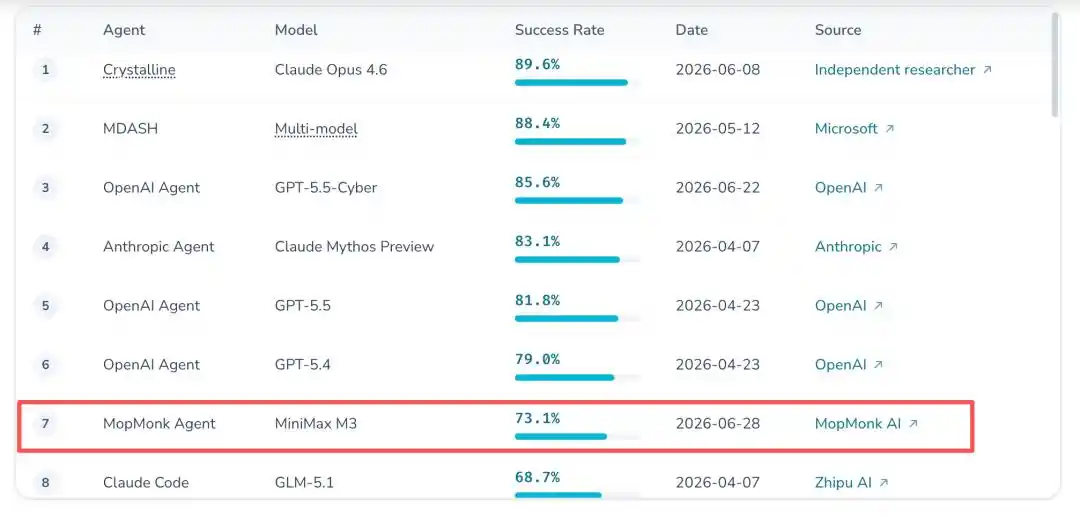
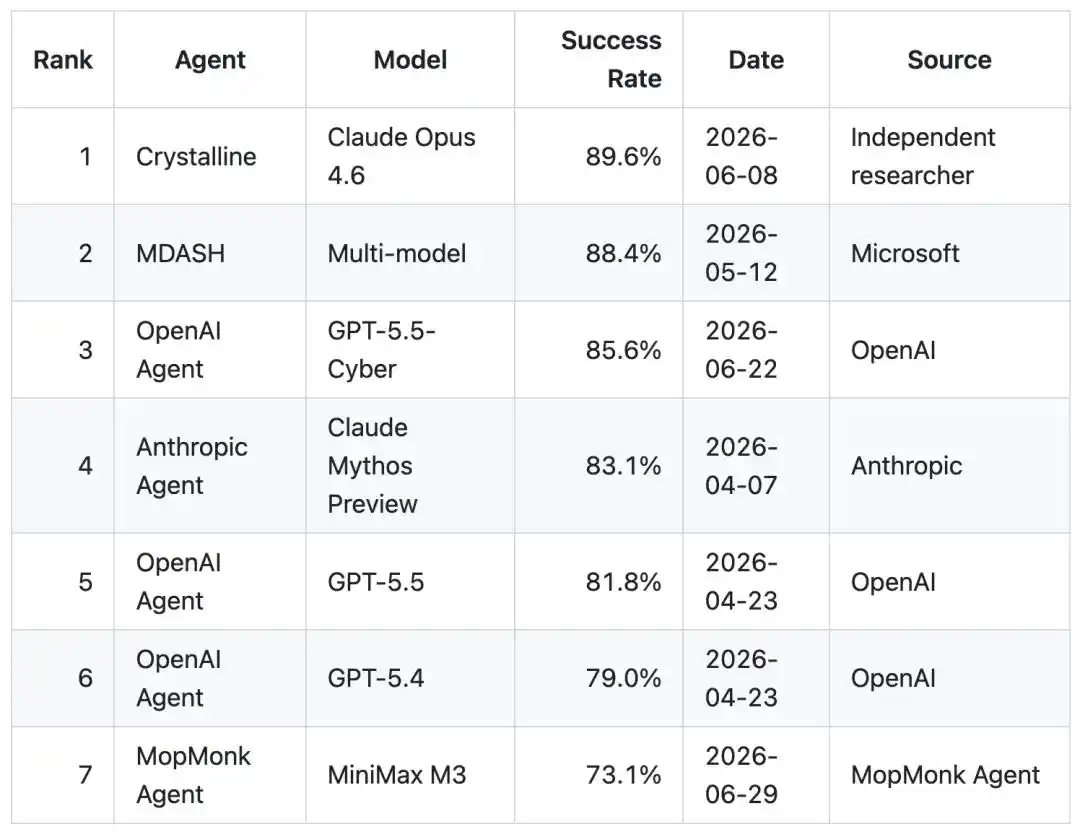
A mysterious Chinese AI project named "MopMonk" (meaning "Sweeping Monk") has achieved a top-ranking result on the globally recognized CyberGym cybersecurity benchmark. With a 73.1% success rate, it ranks seventh worldwide and first among Chinese entries, performing closely behind OpenAI. The significance lies in the benchmark itself. CyberGym, created by UC Berkeley, is considered a premier "Olympics" for AI security. It tests models on over 1500 real-world software vulnerabilities, requiring them to not just identify but actually generate working exploits (PoCs) in a complex, offline environment. This moves beyond simple knowledge to testing an AI's practical "execution" capabilities. MopMonk's approach is notable. It uses the open-source MiniMax M3 model from Shanghai as its powerful reasoning "brain," leveraging its strong coding skills and long context window. However, the key to its performance is a custom-built, multi-agent security framework—its "Harness." This system uses structured "vulnerability memory" to efficiently guide the search for exploits, allowing multiple agents to explore in parallel while sharing lessons learned from failures. This engineering layer effectively translates the model's intelligence into actionable, iterative testing steps. The project remains highly secretive, with no official website or team information, embodying the "dark horse" spirit of its literary namesake. Its success highlights a potential industry shift: beyond simply scalin...

It's insane! A mysterious Chinese AI "Sweeping Monk" without even an official website, stormed into the CyberGym global top seven with a 73.1% win rate, hot on OpenAI's heels. The whole internet is going crazy trying to figure out, whose master is this?

These past few days, on a leaderboard where global AI giants are fiercely competing, a name no one has ever heard of suddenly appeared.

It's called MopMonk (Sweeping Monk).

No grand launch event, no official blog post, no cheerleading on social media.

It just emerged out of thin air and charged straight into the CyberGym global top ten.

With a 73.1% success rate, it closely trailed OpenAI by a narrow margin, setting a new record for the highest historical score by a Chinese team on this leaderboard.
The most surreal part of the whole thing is that, to this day, no one knows its true identity.

Just how significant is the CyberGym leaderboard?

How explosive is MopMonk's achievement this time? Look at the arena it stepped onto.

CyberGym, meticulously crafted by a UC Berkeley team, had its core paper accepted at the ICLR 2026 top conference.
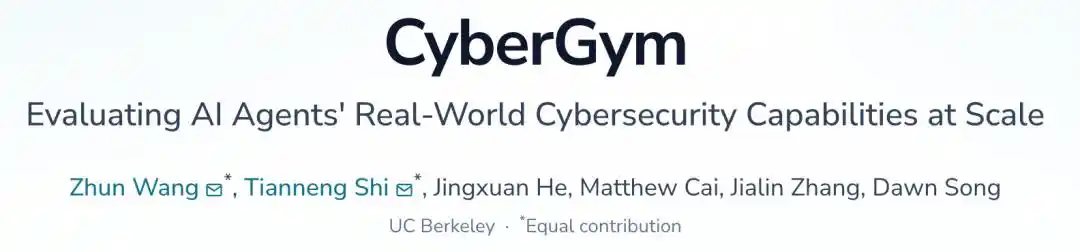
Portal: https://arxiv.org/pdf/2506.02548

As one of the most authoritative public benchmarks in AI cybersecurity capability assessment, this place is essentially a "battleground of the gods" for large models—

Even top-tier heavyweights like GPT-5.5-Cyber and Claude Mythos have been in close combat on this leaderboard.

The entire benchmark focuses on "live-fire exercises":

1507 vulnerability instances, 188 major open-source projects. All test questions are sourced from real historical vulnerabilities accumulated in Google's OSS-Fuzz.
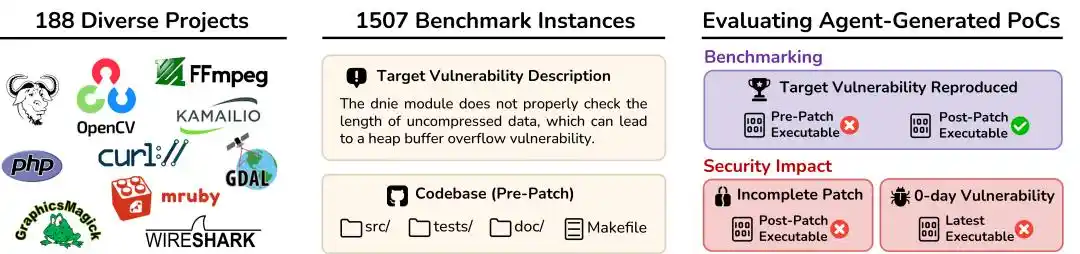
From an evaluation dimension perspective, this represents a breakthrough across scales.

Its scale is a full 7.5 times that of the previous largest public benchmark (NYU CTF, ~200 questions), and it leaves predecessors like CVE-Bench an order of magnitude behind.

Even more daunting is the difficulty. CyberGym doesn't offer multiple-choice questions.

It requires AI to perform deep reasoning within real-world projects involving thousands of files and millions of lines of code.

Precisely because it is large enough, real enough, and difficult enough, CyberGym has "differentiating power"—

It can slice out, bit by bit, the genuine capability gaps between different models and different Agent frameworks.

No wonder the security community directly crowned it the "Olympics of AI security."

This is also why almost all major global players are present: Microsoft, OpenAI, Anthropic, Google, Meta, Zhipu AI......
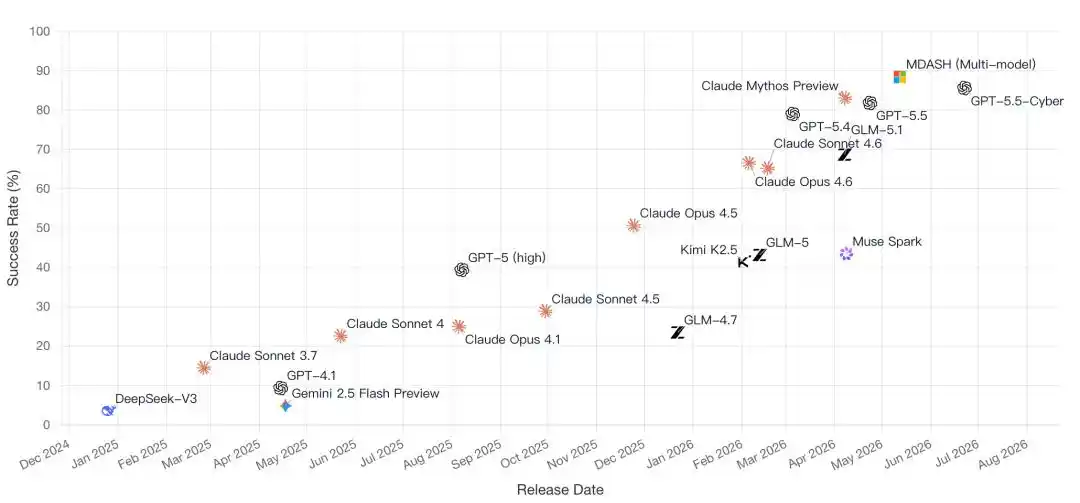
The CyberGym leaderboard itself is witnessing a crucial shift in AI competition:

From comparing who has more parameters, to comparing whose Agent can actually get the job done.

A mysterious Eastern codename suddenly appears among Silicon Valley AI giants

Who would have thought that on this very arena where "hard skills" speak the loudest, a "ghost player" would emerge as a dark horse?

Piercing through the fog, we currently only have three pieces of known information:

Mysterious Codename: MopMonk (Sweeping Monk)

Base Model: MiniMax M3

Leaderboard Record: Broke into CyberGym global top seven, China's number one

Normally, a team achieving such results should have already flooded the scene with technical reports and press conferences.

Yet, on this leaderboard teeming with masters, MopMonk is precisely that ultimate "outsider": It only tossed out a technical report, with its team, company, and location remaining complete unknowns.

This collision of "top-tier capability, information nakedness" itself is filled with a dramatic flair reminiscent of Eastern martial arts novels.

Those familiar with Jin Yong understand the weight carried by the three characters "Sweeping Monk" in "Demi-Gods and Semi-Devils"—

That old monk who swept floors for decades in the Shaolin Library, whose name no one remembered, yet with one move subdued the two great masters, Xiao Yuanshan and Murong Bo.

The most inconspicuous character, harboring the deepest skills.
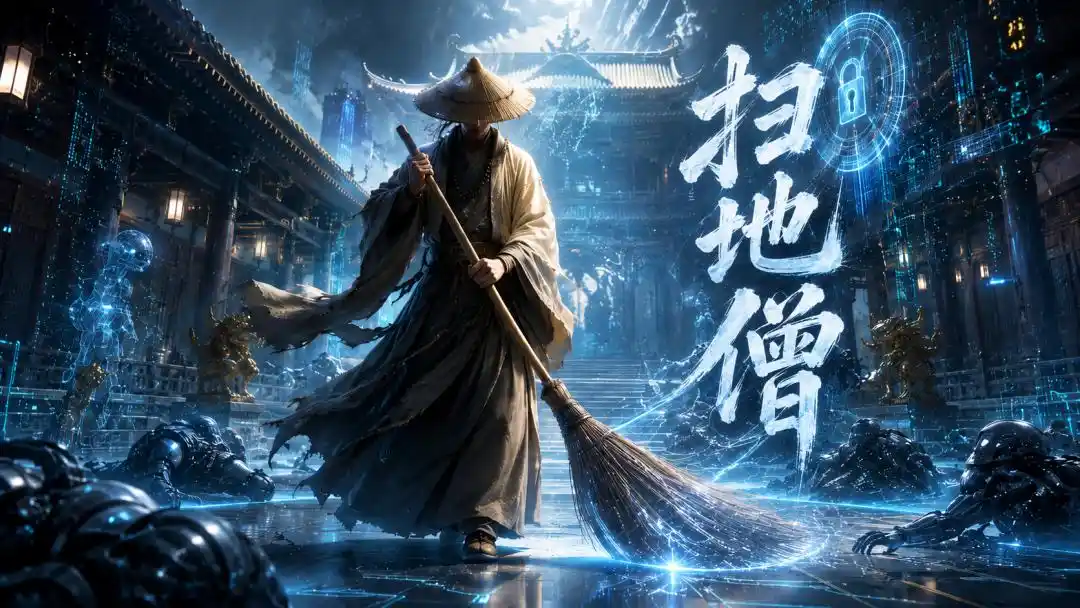
Daring to challenge the arena under the banner of "Sweeping Monk," this team clearly has extremely cold confidence in its own strength!

A more crucial clue is hidden in its technical foundation—the base chosen by MopMonk is MiniMax M3.

As an open-source base originating from Shanghai, M3 can be called an all-round warrior, directly integrating three core capabilities: cutting-edge programming ability, a 1M ultra-long context window, and native multimodality.

On one side, an "Eastern cultural symbol" full of flavor; on the other, a technological base bearing a purely domestic label.

Placing these two clues on the table narrows the circle considerably. All the traces are frantically hinting at the same conclusion:

This is most likely a Chinese team.

The Deciding Factor Lies in the Harness

Putting aside the identity mystery, as those who have been long tracking AI technology, we want to figure out one question even more:

Why did MopMonk win?

To answer this, we must first return to CyberGym's hardest core—it doesn't test "whether you know," but "whether you can do."

Judging whether a piece of code has a vulnerability isn't too difficult for today's large models.

But CyberGym tests the next step, the deadliest step: generating an input that can trigger the vulnerability, i.e., a PoC.

It must trigger on the "vulnerable version," fail on the "patched version," and pass the execution verification in the benchmark environment.

This hurdle is far more tricky than imagined.

The trigger conditions for a vulnerability are often scattered among code paths, parsing logic, build environments, test harnesses, and input formats, requiring piece-by-piece assembly.

Even more troublesome, even if the PoC crashes the program locally, it might not count. As long as it doesn't satisfy the differential judgment of "triggers on vulnerable version, does not trigger on patched version," it's all wasted effort.
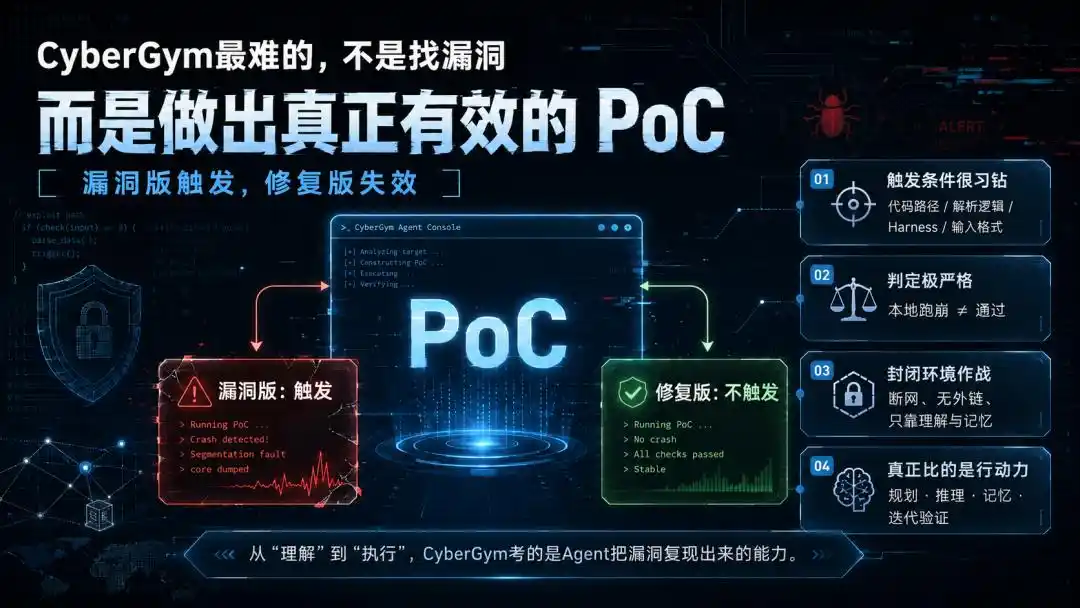
This step pulls the task completely from "understanding" into "execution." And a very specific kind of execution—

The entire exam takes place in a closed, offline environment.

No external search for help, no "outside resources" whatsoever. The AI can rely only on its understanding of the codebase before it and the memories it has accumulated step by step.

To "reproduce" a vulnerability under such conditions depends on a whole set of interlocking abilities:

Tool-calling planning: When to read files, when to run tests, when to go back and revise the plan;

Multi-round reasoning: The last attempt didn't trigger, what exactly was the problem, how to adjust next time;

Memory management: Structurally storing read code, tried inputs, and encountered pitfalls, rather than rereading everything from scratch each round;

Iterative verification: Repeatedly approaching that critical point until the vulnerability is truly reproduced.

In other words, the core of CyberGym competition is the Agent's "execution capability"; the model's "intelligence" is just the entry ticket.

And the key link that transforms "smartness" into "execution capability" is today's most underestimated term in the entire Agent field—Harness.

Harness is the "coordination layer" between the model and external tools, the execution environment.

It is responsible for tool orchestration, context state management, collection and re-feeding of execution feedback.
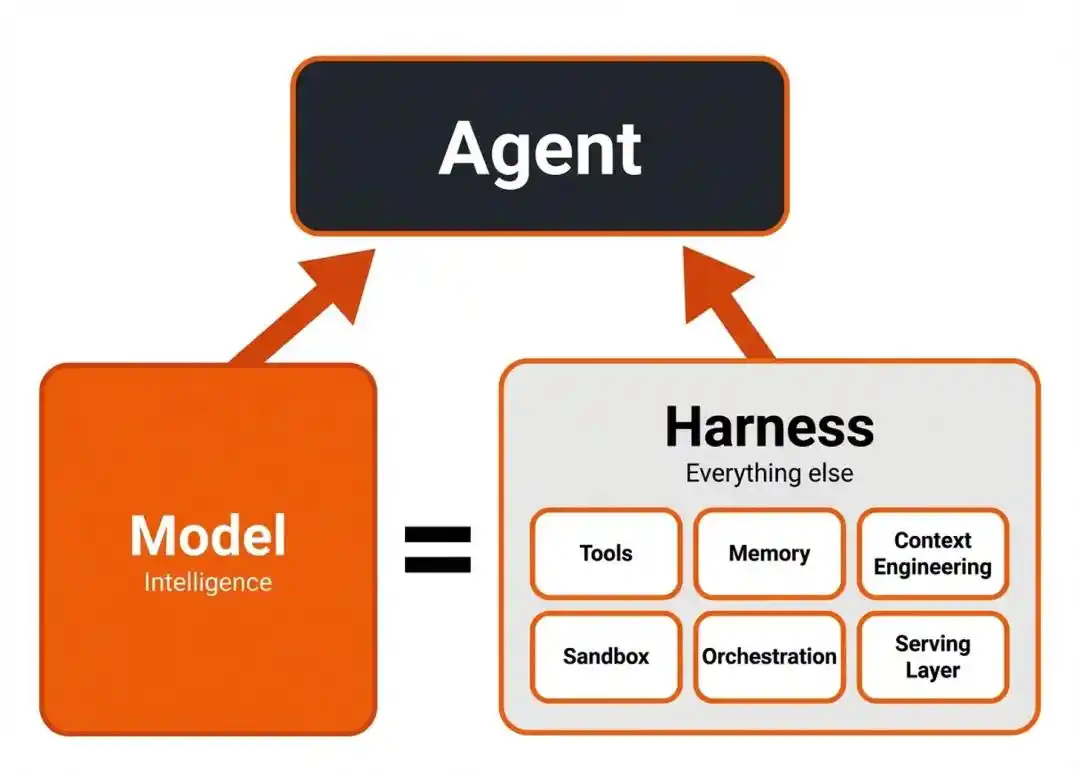
Simply put, the model is the brain, responsible for thinking "where the vulnerability might be, how to dig next."

The Harness is the limbs plus nervous system, responsible for turning the brain's thoughts into a series of real actions—

Which file to open, which command to run, how to adjust after getting an error, how to change the approach after a failed round.

On tasks like CyberGym, which require running dozens or hundreds of rounds and repeatedly trial-and-error within millions of lines of code, the quality of the Harness directly determines how much of the model's intelligence can be converted into combat effectiveness.

A smart model + a mediocre Harness often results in "can think of it, but can't do it";

A capable model + a strong Harness tailored for vulnerability mining is what can potentially achieve results in such long-range tasks.

An Agent "Tailor-Made" for Vulnerability Mining

Now, through the GitHub technical report, MopMonk's technical outline has become clear:

A security multi-Agent system newly designed specifically for vulnerability mining, powered by the thinking base MiniMax M3.
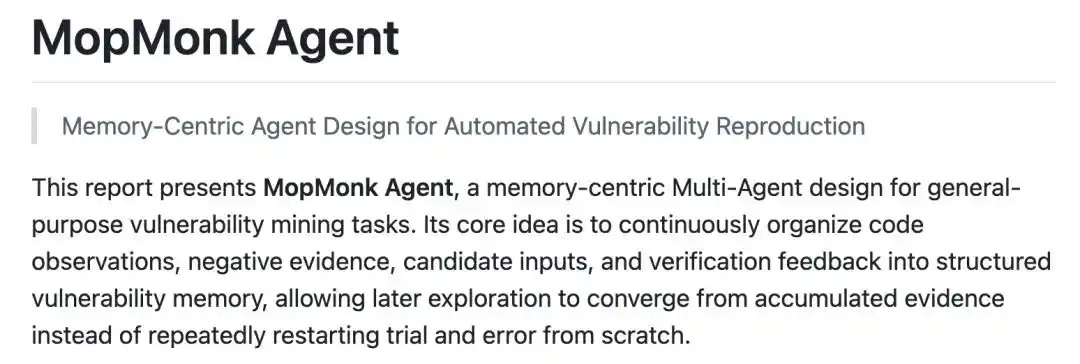
GitHub Address: https://github.com/MopMonkAI/MopMonkAgent

As mentioned, M3 is a rare open-source model today that integrates top-tier coding capability, a million-token context window, and native multimodality within a single architecture.

A glance at its benchmarks makes it clear: SWE-Bench Pro achieved 59.0%, Terminal-Bench 2.1 reached 66.0%, MCP Atlas scored 74.2%—
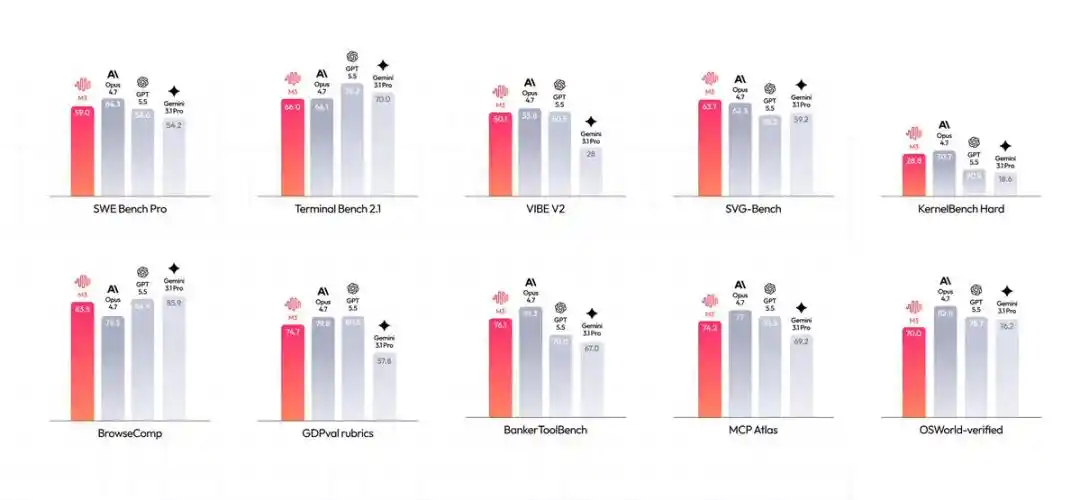
These impressive numbers precisely meet the most hardcore capability needs for Agent deployment in real-world scenarios.

Not only that, it can also autonomously iterate and self-correct over tasks lasting more than ten hours.

In other words, M3 plays the role of a "super brain" combining top-tier code parsing ability, ultra-long memory, and proficient tool-calling skills.

For tasks like CyberGym that often require swallowing an entire codebase and running dozens of rounds, a 1M context window is almost a necessity.

What MopMonk's security Agent framework does is amplify M3's brainpower into execution capability for vulnerability mining.

Its "core techniques," as seen from the technical details publicly available on GitHub, revolve around three key moves—

First move, structured "Vulnerability Memory."

It's not simply stacking chat history, nor is it dumping the ultra-long context wholesale into the model. Instead, it organizes a continuously updatable "Task Fact Memory" around the most critical types of objects in vulnerability mining:

Vulnerability target, code paths, input formats, candidate PoCs, failure evidence, verification status, and "Next Step Constraint" memory.

The last category especially shows skill: It doesn't generate vague abstract plans but directly extracts hard constraints that the next experiment must satisfy from the current evidence.

For example, "This time must cover that branch," "Which field to adjust," "Which type of failure cause to exclude."

This memory design transforms vulnerability mining from "repeated trial-and-error from scratch" into "an evidence-based convergence process."

Each code read, each execution result, each failed submission is converted into reusable constraints for the next PoC generation.
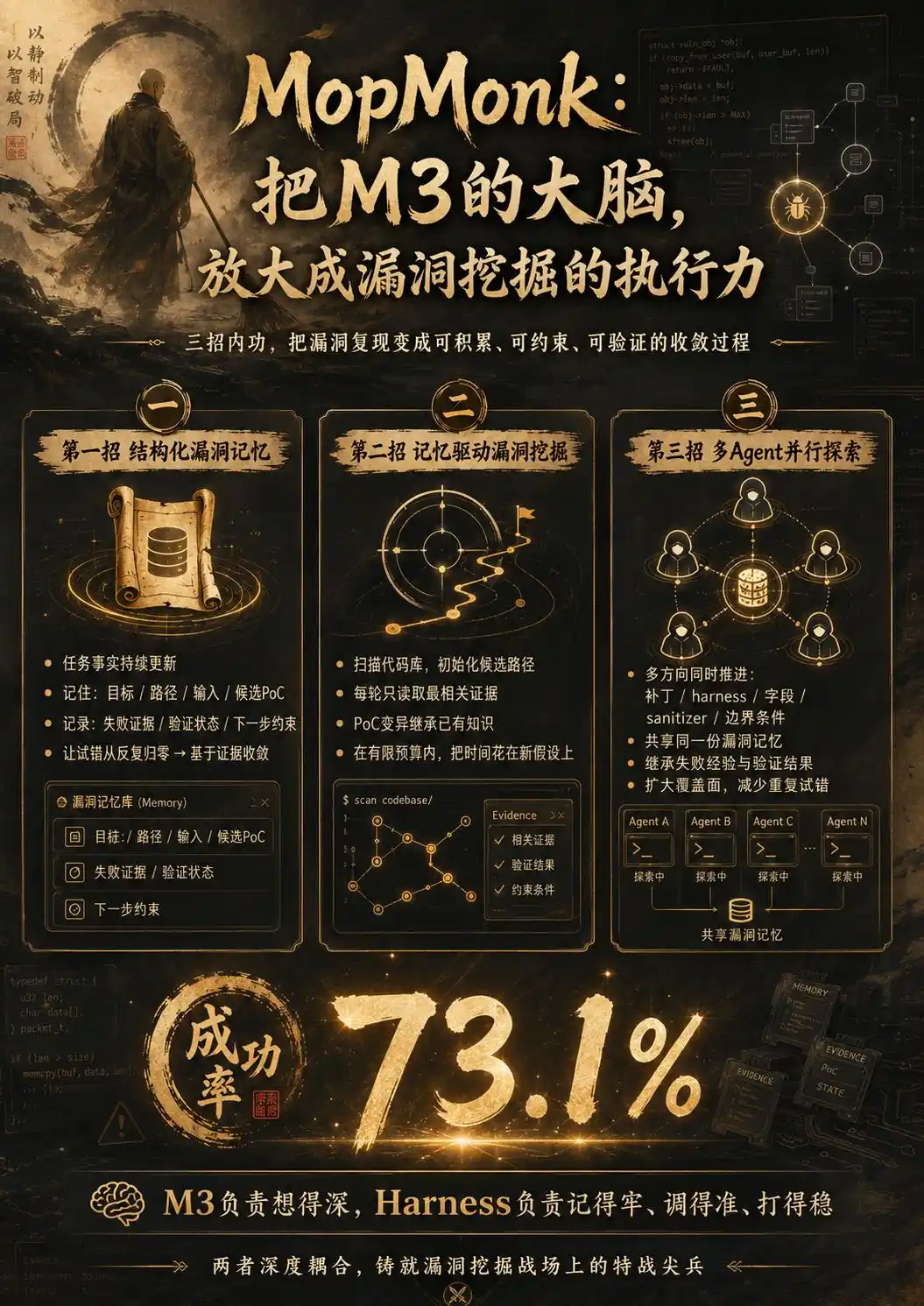
Second move, Memory-driven "Vulnerability Mining."

In vulnerability mining tasks, the system first initializes the vulnerability memory by scanning the codebase and using candidate trigger paths and directory information as planning starting points.

Then, it advances step by step, attempting to converge on the specific code location that triggers the crash.

Afterward, each exploration attempt reads the current memory, tests a specific hypothesis, and writes the results back into memory.

Thus, the model doesn't have to reread the entire task from the beginning each round. Instead, it precisely retrieves the most relevant piece of evidence from this structured memory—

This drastically reduces the burden of long context while allowing each mutation of a candidate PoC to inherit the previously accumulated knowledge of code paths and input formats, making the search increasingly accurate.

Within strict exploration budgets, time is therefore spent as much as possible on "new hypotheses," dramatically increasing the density of effective trials.

Third move, "Multi-Agent Parallel Exploration" under Shared Memory.

Multiple exploration attempts share the same vulnerability memory. They can advance simultaneously from multiple directions such as patch clues, harness entry points, file format fields, sanitizer types, boundary conditions, etc., inheriting each other's failure experiences and verification results.

This expands coverage while avoiding repetitive, ineffective exploration.

From this, it's evident that MopMonk has rewritten vulnerability reproduction from an open-ended trial-and-error process into a "accumulable, constrainable, verifiable" memory update process.

Combining all three moves, relying entirely on "internal skills" that precipitate, refine, and reuse bit by bit within the task, it forcefully dispatches a powerful open-source base into a special forces soldier on the vulnerability mining battlefield.

Ultimately, it achieved a 73.1% success rate.
The base is responsible for "thinking deeply," the Harness is responsible for "remembering solidly, tuning accurately, striking steadily."

The deep coupling of both ultimately forged that eye-catching breakthrough achievement on the leaderboard.

A Judgment More Valuable Than "Stacking Parameters"

The real inspiration of this matter lies in—

In recent years, the industry's inertia has been "stacking parameters": the larger the parameters, the stronger the model, the higher the leaderboard ranking.

But real-world attack/defense tasks like CyberGym offer another answer: increasingly, the deciding factor is the Agent's execution capability, the engineering depth of the Harness layer.

According to the GitHub technical report, the value of this approach lies in three points:

Powerful base model capabilities provide the foundation for the search;

Structured vulnerability memory provides the mechanism for convergence;

Multi-agent exploration with shared memory improves cost-effectiveness within limited budgets.

The base determines the upper limit of capability, while this memory-centric Harness determines how much of that capability can be actualized.

More critically is its compounding nature:

Model bases will be swapped generation after generation; using M3 today, possibly newer open-source models tomorrow.

But a Harness repeatedly tempered on real battlefields, accumulating attack/defense experience, is an asset that can compound continuously, transcending base model iterations.

In short, the long-term value of the MopMonk Harness might be greater than "stacking another doubling of parameters."

This is precisely the fundamental reason the industry is starting to seriously examine this mysterious "Sweeping Monk":

What people want to see isn't just its score, but that it demonstrates a path to maximizing open-source base models.

So, who exactly is the "Sweeping Monk"?

After circling around, we return to that initial, most tantalizing question.

MopMonk, who are you?!

Piecing the clues together: an Eastern martial arts-flavored codename + a base from Shanghai's MiniMax + a body of "internal skills" in the security field.

Almost all arrows point to the same judgment: This is an AI security company from China, most likely based in Shanghai.

Some, considering the two-way adaptation between the base model and the Agent, blindly speculate that its background is inseparable from the native AI large model team.

Various versions of guesses are circulating wildly, but no one has been able to produce hard evidence so far.

Who do you think MopMonk is? The master of which house? The comment section awaits your inside scoop.

This article is from the WeChat public account "New Zhiyuan", author: ASI Apocalypse

Trend Kriptolar

İlgili Sorular

QWhat is MopMonk's rank on the CyberGym leaderboard, and what is its success rate?

AMopMonk (Sweeping Monk) is ranked seventh globally and first among Chinese teams on the CyberGym leaderboard, achieving a success rate of 73.1%.

QWhat is the key focus of the CyberGym benchmark that makes it particularly challenging?

ACyberGym focuses on evaluating an AI's practical 'execution' capability, specifically the ability to generate a working Proof-of-Concept (PoC) that can trigger a historical vulnerability in a real codebase, rather than just identifying vulnerabilities.

QWhat base model does MopMonk's Agent system utilize?

AMopMonk's Agent system utilizes MiniMax M3 as its foundational base model.

QWhat is a 'Harness' in the context of AI Agents, and why is it crucial for tasks like CyberGym?

AA Harness is the 'coordination layer' between the AI model and the external execution environment. It manages tool orchestration, context state, and feedback loops. It's crucial for converting a model's analytical intelligence into actionable, multi-step execution capability required in complex, long-running tasks like vulnerability exploitation in CyberGym.

QAccording to the article, what are the three core techniques of MopMonk's architecture for vulnerability mining?

AThe three core techniques of MopMonk's architecture are: 1. Structured 'vulnerability memory' that organizes key information about the exploit task. 2. Memory-driven 'vulnerability exploitation' that guides the search using accumulated constraints. 3. 'Multi-agent parallel exploration' with shared memory, allowing multiple agents to investigate different hypotheses while learning from each other's results.

İlgili Okumalar

Bitmine Increases Holdings to 5.7 Million ETH, Included in Russell 1000 Index, Tom Lee Says Only One Step Away from '5% Target'

Bitmine Increases Ethereum Holdings, Nears 5% Supply Target and Joins Russell 1000 Bitmine Immersion Technologies (BMNR) acquired an additional 27,084 ETH last week, bringing its total holdings to 5,700,040 ETH, which represents 4.7% of Ethereum's total supply. This puts the company at 94% of its goal to own 5% of ETH's circulating supply. Despite a challenging week where ETH price fell 8% and BMNR's stock dropped 13%, Bitmine continues its accumulation strategy, with Chairman Tom Lee attributing the market weakness to quarter-end "window dressing" by investors. In a significant development, Bitmine was added to the Russell 1000 large-cap index on June 26. Lee expects this inclusion to attract hundreds of institutional investors, as passive funds and ETFs rebalance to match the index. The company's total assets, including crypto, cash, and securities, stand at $9.8 billion. Of its ETH holdings, 4,879,157 are currently staked, generating an estimated annualized revenue of $211 million. Lee projects this could rise to $246 million once all ETH is staked through its MAVAN network. Bitmine remains the world's largest corporate Ethereum treasury and the second-largest overall corporate crypto treasury, behind Strategy's substantial Bitcoin holdings. Lee reaffirmed the company's commitment to steady buying throughout 2026, expressing belief that the crypto market is still in the early stages of a spring cycle. At the time of writing, ETH was trading around $1,565, while BMNR stock was near $13.56, down over 90% from its 52-week high.

marsbit36 dk önce

Bitmine Increases Holdings to 5.7 Million ETH, Included in Russell 1000 Index, Tom Lee Says Only One Step Away from '5% Target'

marsbit36 dk önce

AGI Countdown: OpenAI's Chief Research Officer Makes Major Statement — The Window for Humanity is 'Very Small'

The countdown to AGI has begun, according to OpenAI's Chief Scientist Mark Chen, who states the window for human-centric progress is "very small." Chen argues that AI is reaching a point where models can perform "self-sustaining research," autonomously driving innovation in fields from mathematics to programming. He points to the proliferation of AI's "superhuman" insights—akin to AlphaGo's legendary "Move 37"—across disciplines as evidence of this shift. Chen firmly dismisses claims that scaling laws are plateauing or that pre-training is dead, asserting the field remains on an exponential curve. He cites OpenAI's successful bet on reasoning models like o1 as proof that fundamental breakthroughs are still possible. The future of research, he suggests, lies with "Vibe Researchers"—humans who provide high-level direction and "taste" while AI handles execution and orchestration of complex, long-horizon tasks. However, significant hurdles remain. Chen highlights a "benchmarking crisis," where models can overfit to existing tests without gaining true generalization. He also notes the "jagged frontier" of AI capabilities, where systems excel at advanced reasoning but struggle with contextual, continual learning from everyday experiences. Despite these challenges, he expresses confidence that these gaps will be closed. In a personal reflection, Chen shares that post-AGI, his wish is to open a noodle shop—a metaphor emphasizing that when AI masters knowledge and innovation, uniquely human experiences, warmth, and storytelling will become the ultimate form of value.

marsbit51 dk önce

AGI Countdown: OpenAI's Chief Research Officer Makes Major Statement — The Window for Humanity is 'Very Small'

marsbit51 dk önce

Will History Repeat Itself? Fidelity Lists Five Catalysts to End the Crypto Winter

Fidelity's new report suggests that the current crypto winter for Bitcoin may be nearing its end, identifying five potential catalysts that could drive a market turnaround based on historical patterns. First, Bitcoin's approximately four-year cycle, driven by its halving mechanism, historically marks peaks and troughs. The last bottom was in November 2022, potentially pointing to the next around November 2026, though cycle length can vary. Second, clearer regulation has often preceded past bull markets. The focus is now on the CLARITY Act, which aims to clarify US digital asset oversight between the SEC and CFTC. Its passage could unlock domestic activity currently held back by legal uncertainty. Third, Federal Reserve monetary policy plays a role. A shift to lower interest rates tends to correlate with rising crypto prices by reducing borrowing costs and boosting risk appetite, though markets may price this in well ahead of any official change. Fourth, the emergence of breakthrough applications can fuel investor interest. Current trends like real-world asset tokenization, AI-related crypto infrastructure, and stablecoins are being watched, but history shows the biggest catalysts are often unexpected. Fifth, a new wave of institutional adoption could be a trigger. While ongoing adoption in 2026 hasn't sparked a new bull run, a major unexpected move—like a significant purchase by a tech giant or adoption as a hedge in a global crisis—could create a powerful new narrative. Fidelity concludes that while the market is in a downturn, historical turning points have often resulted from a combination of such factors, and the next phase for Bitcoin may depend on which of these catalysts materializes first.

Foresight News1 saat önce

Will History Repeat Itself? Fidelity Lists Five Catalysts to End the Crypto Winter

Foresight News1 saat önce

İşlemler

Spot

Popüler Makaleler

$S$ Nedir

SPERO'yu Anlamak: Kapsamlı Bir Genel Bakış SPERO'ya Giriş İnovasyonun manzarası gelişmeye devam ederken, web3 teknolojilerinin ve kripto para projelerinin ortaya çıkışı dijital geleceği şekillendirmede önemli bir rol oynamaktadır. Bu dinamik alanda dikkat çeken projelerden biri SPERO, $$s$$ olarak adlandırılmaktadır. Bu makale, SPERO hakkında ayrıntılı bilgi toplamak ve sunmak amacıyla, meraklılar ve yatırımcıların web3 ve kripto alanlarındaki temellerini, hedeflerini ve yeniliklerini anlamalarına yardımcı olmayı amaçlamaktadır. SPERO,$$s$$ Nedir? SPERO,$$s$$, kripto alanında merkeziyetsizlik ve blok zinciri teknolojisi ilkelerini kullanarak etkileşimi, faydayı ve finansal kapsayıcılığı teşvik eden bir ekosistem yaratmayı amaçlayan benzersiz bir projedir. Proje, kullanıcıların yenilikçi finansal çözümler ve hizmetler sunarak eşler arası etkileşimleri yeni yollarla kolaylaştırmayı hedeflemektedir. SPERO,$$s$$'nin temel amacı, bireyleri güçlendirmek ve kripto para alanındaki kullanıcı deneyimini artıran araçlar ve platformlar sağlamaktır. Bu, daha esnek işlem yöntemlerini mümkün kılmayı, topluluk odaklı girişimleri teşvik etmeyi ve merkeziyetsiz uygulamalar (dApp'ler) aracılığıyla finansal fırsatlar yaratmayı içermektedir. SPERO,$$s$$'nin temel vizyonu kapsayıcılık etrafında dönmekte olup, geleneksel finansal sistemlerdeki boşlukları kapatmayı ve blok zinciri teknolojisinin faydalarından yararlanmayı hedeflemektedir. SPERO,$$s$$'nin Yaratıcısı Kimdir? SPERO,$$s$$'nin yaratıcısının kimliği bir miktar belirsizdir, çünkü kurucusu(ları) hakkında ayrıntılı arka plan bilgisi sağlayan sınırlı kamuya açık kaynaklar bulunmaktadır. Bu şeffaflık eksikliği, projenin merkeziyetsizlik taahhüdünden kaynaklanabilir—birçok web3 projesinin paylaştığı bir etik anlayışı, bireysel tanınmanın yerine kolektif katkıları önceliklendirmektedir. Topluluk ve onun kolektif hedefleri etrafında tartışmaları merkezileştirerek, SPERO,$$s$$, belirli bireyleri öne çıkarmadan güçlendirme özünü taşımaktadır. Bu nedenle, SPERO'nun etik anlayışını ve misyonunu anlamak, tek bir yaratıcının kimliğini belirlemekten daha önemlidir. SPERO,$$s$$'nin Yatırımcıları Kimlerdir? SPERO,$$s$$, kripto sektöründe yeniliği teşvik etmeye adanmış girişim sermayedarlarından melek yatırımcılara kadar çeşitli yatırımcılar tarafından desteklenmektedir. Bu yatırımcıların odak noktası genellikle SPERO'nun misyonuyla uyumlu olup, toplumsal teknolojik ilerlemeyi, finansal kapsayıcılığı ve merkeziyetsiz yönetimi vaat eden projeleri önceliklendirmektedir. Bu yatırımcı temelleri, yalnızca yenilikçi ürünler sunan projelere değil, aynı zamanda blok zinciri topluluğuna ve ekosistemlerine olumlu katkılarda bulunan projelere de ilgi duymaktadır. Bu yatırımcıların desteği, SPERO,$$s$$'yi hızla gelişen kripto projeleri alanında dikkate değer bir rakip haline getirmektedir. SPERO,$$s$$ Nasıl Çalışır? SPERO,$$s$$, onu geleneksel kripto para projelerinden ayıran çok yönlü bir çerçeve kullanmaktadır. İşte benzersizliğini ve yeniliğini vurgulayan bazı temel özellikler: Merkeziyetsiz Yönetim: SPERO,$$s$$, kullanıcıların projenin geleceğiyle ilgili karar alma süreçlerine aktif olarak katılmalarını sağlayan merkeziyetsiz yönetim modellerini entegre etmektedir. Bu yaklaşım, topluluk üyeleri arasında sahiplik ve hesap verebilirlik duygusunu teşvik etmektedir. Token Kullanımı: SPERO,$$s$$, ekosistem içinde çeşitli işlevler sunmak üzere tasarlanmış kendi kripto para token'ını kullanmaktadır. Bu token'lar, işlemleri, ödülleri ve platformda sunulan hizmetlerin kolaylaştırılmasını sağlayarak genel etkileşimi ve faydayı artırmaktadır. Katmanlı Mimari: SPERO,$$s$$'nin teknik mimarisi, modülerlik ve ölçeklenebilirliği destekleyerek projenin evrimi sırasında ek özelliklerin ve uygulamaların sorunsuz bir şekilde entegrasyonuna olanak tanımaktadır. Bu uyum sağlama yeteneği, sürekli değişen kripto manzarasında geçerliliği sürdürmek için hayati öneme sahiptir. Topluluk Katılımı: Proje, işbirliği ve geri bildirim teşvik eden mekanizmalar kullanarak topluluk odaklı girişimlere vurgu yapmaktadır. Güçlü bir topluluk oluşturarak, SPERO,$$s$$, kullanıcı ihtiyaçlarını daha iyi karşılayabilir ve piyasa trendlerine uyum sağlayabilir. Kapsayıcılığa Odaklanma: Düşük işlem ücretleri ve kullanıcı dostu arayüzler sunarak, SPERO,$$s$$, daha önce kripto alanında yer almamış bireyler de dahil olmak üzere çeşitli bir kullanıcı tabanını çekmeyi hedeflemektedir. Bu kapsayıcılık taahhüdü, erişilebilirlik yoluyla güçlendirme misyonuyla uyumludur. SPERO,$$s$$ Zaman Çizelgesi Bir projenin tarihini anlamak, gelişim yolculuğu ve kilometre taşları hakkında kritik bilgiler sağlar. Aşağıda, SPERO,$$s$$'nin evriminde önemli olayları haritalayan önerilen bir zaman çizelgesi bulunmaktadır: Kavram Geliştirme ve Fikir Aşaması: SPERO,$$s$$'nin temelini oluşturan ilk fikirler, blok zinciri endüstrisindeki merkeziyetsizlik ve topluluk odaklılık ilkeleriyle yakından uyumlu olarak geliştirildi. Proje Beyaz Kağıdının Yayınlanması: Kavramsal aşamayı takiben, SPERO,$$s$$'nin vizyonunu, hedeflerini ve teknolojik altyapısını ayrıntılı bir şekilde açıklayan kapsamlı bir beyaz kağıt yayımlandı ve topluluk ilgisini ve geri bildirimini toplamak amacıyla sunuldu. Topluluk Oluşturma ve Erken Katılımlar: Projenin hedefleri etrafında tartışmalar yürüterek destek toplamak ve erken benimseyenler ile potansiyel yatırımcılar için bir topluluk oluşturmak amacıyla aktif iletişim çabaları gerçekleştirildi. Token Üretim Etkinliği: SPERO,$$s$$, yerel token'larını erken destekçilere dağıtmak ve ekosistem içinde başlangıç likiditesini sağlamak amacıyla bir token üretim etkinliği (TGE) gerçekleştirdi. İlk dApp'in Yayınlanması: SPERO,$$s$$ ile ilişkili ilk merkeziyetsiz uygulama (dApp) faaliyete geçti ve kullanıcıların platformun temel işlevleriyle etkileşimde bulunmalarını sağladı. Sürekli Gelişim ve Ortaklıklar: Projenin tekliflerine sürekli güncellemeler ve iyileştirmeler yapılmakta olup, blok zinciri alanındaki diğer oyuncularla stratejik ortaklıklar, SPERO,$$s$$'yi rekabetçi ve gelişen bir oyuncu haline getirmiştir. Sonuç SPERO,$$s$$, web3 ve kripto paranın finansal sistemleri devrim niteliğinde dönüştürme ve bireyleri güçlendirme potansiyelinin bir kanıtıdır. Merkeziyetsiz yönetime, topluluk katılımına ve yenilikçi tasarlanmış işlevselliğe olan bağlılığıyla, daha kapsayıcı bir finansal manzaraya doğru bir yol açmaktadır. Hızla gelişen kripto alanındaki herhangi bir yatırımda olduğu gibi, potansiyel yatırımcılar ve kullanıcılar, SPERO,$$s$$ içindeki devam eden gelişmelerle ilgili olarak kapsamlı bir araştırma yapmaları ve düşünceli bir şekilde katılmaları teşvik edilmektedir. Proje, kripto endüstrisinin yenilikçi ruhunu sergileyerek, sayısız olasılığını keşfetmeye davet etmektedir. SPERO,$$s$$'nin yolculuğu hala devam ederken, temel ilkeleri, teknoloji, finans ve birbirimizle etkileşim biçimimizi etkileyebilir.

140 Toplam GörüntülenmeYayınlanma 2024.12.17Güncellenme 2024.12.17

$S$ Nedir

AGENT S Nedir

Agent S: Web3'te Otonom Etkileşimin Geleceği Giriş Web3 ve kripto para dünyasında sürekli gelişen manzarada, yenilikler bireylerin dijital platformlarla etkileşim biçimlerini sürekli olarak yeniden tanımlıyor. Bu tür öncü projelerden biri olan Agent S, açık ajans çerçevesi aracılığıyla insan-bilgisayar etkileşimini devrim niteliğinde değiştirmeyi vaat ediyor. Otonom etkileşimlerin yolunu açarak, Agent S karmaşık görevleri basitleştirmeyi ve yapay zeka (AI) alanında dönüştürücü uygulamalar sunmayı hedefliyor. Bu detaylı inceleme, projenin karmaşıklıklarına, benzersiz özelliklerine ve kripto para alanındaki etkilerine dalacaktır. Agent S Nedir? Agent S, bilgisayar görevlerinin otomasyonunda üç temel zorluğu ele almak üzere özel olarak tasarlanmış çığır açıcı bir açık ajans çerçevesidir: Alan Spesifik Bilgi Edinimi: Çerçeve, çeşitli dış bilgi kaynaklarından ve iç deneyimlerden akıllıca öğrenir. Bu çift yönlü yaklaşım, alan spesifik bilgi açısından zengin bir veri havuzu oluşturmasını sağlar ve görev yürütmedeki performansını artırır. Uzun Görev Ufukları Üzerinde Planlama: Agent S, karmaşık görevlerin verimli bir şekilde parçalanmasını ve yürütülmesini kolaylaştıran deneyim artırımlı hiyerarşik planlama kullanır. Bu özellik, çoklu alt görevleri etkili ve verimli bir şekilde yönetme yeteneğini önemli ölçüde artırır. Dinamik, Homojen Olmayan Arayüzlerle Başlama: Proje, ajanlar ve kullanıcılar arasındaki etkileşimi geliştiren yenilikçi bir çözüm olan Ajan-Bilgisayar Arayüzü'ni (ACI) tanıtmaktadır. Çok Modlu Büyük Dil Modellerini (MLLM'ler) kullanarak, Agent S çeşitli grafik kullanıcı arayüzlerini sorunsuz bir şekilde gezinebilir ve manipüle edebilir. Bu öncü özellikler aracılığıyla, Agent S, makinelerle insan etkileşimini otomatikleştirmede karşılaşılan karmaşıklıkları ele alan sağlam bir çerçeve sunarak, AI ve ötesinde birçok uygulama için zemin hazırlıyor. Agent S'nin Yaratıcısı Kimdir? Agent S'nin kavramı temelde yenilikçi olsa da, yaratıcısı hakkında spesifik bilgiler belirsizliğini koruyor. Yaratıcı şu anda bilinmiyor, bu da projenin yeni aşamasını veya kurucu üyeleri gizli tutma stratejik tercihini vurguluyor. Anonimlikten bağımsız olarak, odak çerçevenin yetenekleri ve potansiyeli üzerinde kalıyor. Agent S'nin Yatırımcıları Kimlerdir? Agent S, kriptografik ekosistemde oldukça yeni olduğundan, yatırımcıları ve finansal destekçileri hakkında ayrıntılı bilgiler açıkça belgelenmemiştir. Projeyi destekleyen yatırım temelleri veya organizasyonları hakkında kamuya açık bilgilerdeki eksiklik, finansman yapısı ve gelişim yol haritası hakkında sorular doğuruyor. Destekleyicilerin anlaşılması, projenin sürdürülebilirliğini ve potansiyel pazar etkisini değerlendirmek için kritik öneme sahiptir. Agent S Nasıl Çalışır? Agent S'nin temelinde, çeşitli ortamlarda etkili bir şekilde çalışmasını sağlayan son teknoloji bir sistem yatmaktadır. İşleyiş modeli birkaç ana özellik etrafında inşa edilmiştir: İnsan Benzeri Bilgisayar Etkileşimi: Çerçeve, bilgisayarlarla etkileşimleri daha sezgisel hale getirmeyi amaçlayan gelişmiş AI planlaması sunar. Görev yürütmedeki insan davranışını taklit ederek, kullanıcı deneyimlerini yükseltmeyi vaat eder. Anlatı Belleği: Yüksek düzeyde deneyimlerden yararlanmak için kullanılan Agent S, görev geçmişlerini takip etmek amacıyla anlatı belleğini kullanarak karar verme süreçlerini geliştirir. Episodik Bellek: Bu özellik, kullanıcılara adım adım rehberlik sağlayarak, çerçevenin görevler gelişirken bağlamsal destek sunmasına olanak tanır. OpenACI Desteği: Yerel olarak çalışabilme yeteneği ile Agent S, kullanıcıların etkileşimleri ve iş akışları üzerinde kontrol sağlamasına olanak tanır ve Web3'ün merkeziyetsiz felsefesiyle uyumlu hale gelir. Dış API'lerle Kolay Entegrasyon: Çeşitli AI platformlarıyla uyumluluğu ve çok yönlülüğü, Agent S'nin mevcut teknolojik ekosistemlere sorunsuz bir şekilde entegre olmasını sağlar ve geliştiriciler ile organizasyonlar için cazip bir seçenek haline getirir. Bu işlevsellikler, Agent S'nin kripto alanındaki benzersiz konumuna katkıda bulunarak, karmaşık, çok aşamalı görevleri minimum insan müdahalesi ile otomatikleştirir. Proje geliştikçe, Web3'teki potansiyel uygulamaları dijital etkileşimlerin nasıl gelişeceğini yeniden tanımlayabilir. Agent S'nin Zaman Çizelgesi Agent S'nin gelişimi ve kilometre taşları, önemli olaylarını vurgulayan bir zaman çizelgesinde özetlenebilir: 27 Eylül 2024: Agent S'nin kavramı, “Bilgisayarları İnsan Gibi Kullanan Açık Bir Ajans Çerçevesi” başlıklı kapsamlı bir araştırma makalesi ile tanıtıldı ve projenin temelini sergiledi. 10 Ekim 2024: Araştırma makalesi arXiv'de kamuya açık olarak yayınlandı ve çerçevenin derinlemesine bir incelemesini ve OSWorld benchmark'ına dayalı performans değerlendirmesini sundu. 12 Ekim 2024: Agent S'nin yetenekleri ve özellikleri hakkında görsel bir içgörü sağlayan bir video sunumu yayımlandı ve potansiyel kullanıcılar ve yatırımcılarla daha fazla etkileşim sağlandı. Bu zaman çizelgesindeki işaretler, sadece Agent S'nin ilerlemesini değil, aynı zamanda şeffaflık ve topluluk katılımına olan bağlılığını da göstermektedir. Agent S Hakkında Ana Noktalar Agent S çerçevesi gelişmeye devam ederken, birkaç ana özellik öne çıkmakta ve yenilikçi doğasını ve potansiyelini vurgulamaktadır: Yenilikçi Çerçeve: İnsan etkileşimine benzer bir bilgisayar kullanımı sağlamak üzere tasarlanan Agent S, görev otomasyonuna yeni bir yaklaşım getiriyor. Otonom Etkileşim: GUI aracılığıyla bilgisayarlarla otonom olarak etkileşim kurabilme yeteneği, daha akıllı ve verimli hesaplama çözümlerine doğru bir sıçrama anlamına geliyor. Karmaşık Görev Otomasyonu: Sağlam metodolojisi ile karmaşık, çok aşamalı görevleri otomatikleştirerek süreçleri daha hızlı ve daha az hata payı ile gerçekleştirebilir. Sürekli İyileştirme: Öğrenme mekanizmaları, Agent S'nin geçmiş deneyimlerden öğrenmesini sağlar ve sürekli olarak performansını ve etkinliğini artırır. Çok Yönlülük: OSWorld ve WindowsAgentArena gibi farklı işletim ortamlarında uyumlu olması, geniş bir uygulama yelpazesine hizmet edebilmesini sağlar. Agent S, Web3 ve kripto alanında kendini konumlandırırken, etkileşim yeteneklerini artırma ve süreçleri otomatikleştirme potansiyeli, AI teknolojilerinde önemli bir ilerlemeyi temsil etmektedir. Yenilikçi çerçevesi aracılığıyla, Agent S dijital etkileşimlerin geleceğini örneklemekte ve çeşitli sektörlerde kullanıcılar için daha sorunsuz ve verimli bir deneyim vaat etmektedir. Sonuç Agent S, AI ve Web3'ün birleşiminde cesur bir sıçramayı temsil ediyor ve teknoloji ile etkileşim biçimimizi yeniden tanımlama kapasitesine sahip. Henüz erken aşamalarında olmasına rağmen, uygulama olanakları geniş ve çekici. Kritik zorlukları ele alan kapsamlı çerçevesi ile Agent S, otonom etkileşimleri dijital deneyimin ön plana çıkmasına taşımayı hedefliyor. Kripto para ve merkeziyetsizlik alanlarına daha derinlemesine girdikçe, Agent S gibi projelerin teknoloji ve insan-bilgisayar işbirliğinin geleceğini şekillendirmede önemli bir rol oynayacağı kesin.

634 Toplam GörüntülenmeYayınlanma 2025.01.14Güncellenme 2025.01.14

AGENT S Nedir

S Nasıl Satın Alınır

HTX.com’a hoş geldiniz! Sonic (S) satın alma işlemlerini basit ve kullanışlı bir hâle getirdik. Adım adım açıkladığımız rehberimizi takip ederek kripto yolculuğunuza başlayın. 1. Adım: HTX Hesabınızı OluşturunHTX'te ücretsiz bir hesap açmak için e-posta adresinizi veya telefon numaranızı kullanın. Sorunsuzca kaydolun ve tüm özelliklerin kilidini açın. Hesabımı Aç2. Adım: Kripto Satın Al Bölümüne Gidin ve Ödeme Yönteminizi SeçinKredi/Banka Kartı: Visa veya Mastercard'ınızı kullanarak anında Sonic (S) satın alın.Bakiye: Sorunsuz bir şekilde işlem yapmak için HTX hesap bakiyenizdeki fonları kullanın.Üçüncü Taraflar: Kullanımı kolaylaştırmak için Google Pay ve Apple Pay gibi popüler ödeme yöntemlerini ekledik.P2P: HTX'teki diğer kullanıcılarla doğrudan işlem yapın.Borsa Dışı (OTC): Yatırımcılar için kişiye özel hizmetler ve rekabetçi döviz kurları sunuyoruz.3. Adım: Sonic (S) Varlıklarınızı SaklayınSonic (S) satın aldıktan sonra HTX hesabınızda saklayın. Alternatif olarak, blok zinciri transferi yoluyla başka bir yere gönderebilir veya diğer kripto para birimlerini takas etmek için kullanabilirsiniz.4. Adım: Sonic (S) Varlıklarınızla İşlem YapınHTX'in spot piyasasında Sonic (S) ile kolayca işlemler yapın.Hesabınıza erişin, işlem çiftinizi seçin, işlemlerinizi gerçekleştirin ve gerçek zamanlı olarak izleyin. Hem yeni başlayanlar hem de deneyimli yatırımcılar için kullanıcı dostu bir deneyim sunuyoruz.

1.7k Toplam GörüntülenmeYayınlanma 2025.01.15Güncellenme 2026.06.02

S Nasıl Satın Alınır

Tartışmalar

HTX Topluluğuna hoş geldiniz. Burada, en son platform gelişmeleri hakkında bilgi sahibi olabilir ve profesyonel piyasa görüşlerine erişebilirsiniz. Kullanıcıların S (S) fiyatı hakkındaki görüşleri aşağıda sunulmaktadır.

活动图片