China Turns To Interest Rates To Kick-Start Digital Yuan Adoption

bitcoinist2025-12-30 tarihinde yayınlandı2025-12-30 tarihinde güncellendi

Özet

China will allow commercial banks to pay interest on digital yuan (e-CNY) wallet balances starting January 1, 2026, shifting the digital currency from a cash-like instrument to a deposit-like asset. The People’s Bank of China (PBOC) introduced the new framework, which brings e-CNY under deposit insurance protection and requires non-bank payment providers to hold full reserves. By November 2025, e-CNY recorded 3.48 billion transactions totaling ¥16.7 trillion ($2.37 trillion). The move may influence where consumers and businesses store funds, as interest-bearing e-CNY becomes more attractive. Banks may face higher operational costs but could benefit from reduced nonbank platform deposits. The policy also strengthens cross-border testing and regulatory oversight.

According to reports, China will let commercial banks pay interest on balances held in digital yuan wallets starting January first, 2026.

The People’s Bank of China has laid out a new framework that moves the e-CNY from a cash-like tool to something closer to a bank deposit. Lu Lei of the PBOC is named in official notices about the change.

Banks To Pay Interest On e-CNY

Based on reports, holders of merchant or personal digital wallets will earn interest calculated by the banks that run those wallets.

The move requires banks to treat digital yuan holdings more like deposits, and it brings those balances under China’s deposit insurance protections. Reports say non-bank payment firms that operate wallets must keep 100% reserves for the e-CNY they manage.

Adoption Numbers And Rules

According to official figures cited in media coverage, by November 2025 there were about 3.48 billion e-CNY transactions with a combined value near ¥16.7 trillion — roughly $2.37 trillion.

The new policy links interest payments to existing deposit rate arrangements, which means interest rates on e-CNY will be set in line with how banks price other deposit accounts.

Observers have pointed out that the change could shift where consumers keep money, since insured, interest-bearing e-CNY becomes more attractive for storing funds.
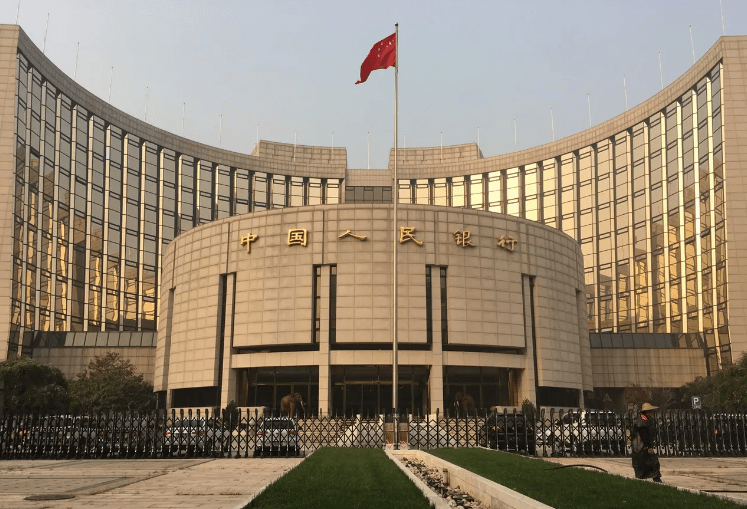
The People's Bank of China. Image: Fintech Futures

Reports have disclosed that digital yuan wallets will be subject to rules similar to those for regular bank accounts. Deposit insurance will apply, and reserve and reporting requirements will be tightened for third-party payment providers.

The PBOC framework also sets clearer rules for cross-border testing that was already under way with partners such as Singapore, Thailand, Hong Kong, the UAE and Saudi Arabia.

Banking And Policy Impact

Banks will need to adapt systems for interest calculation and for clearing e-CNY transactions at scale, which could increase operational costs in the short term. That said, some costs may be offset if more money flows into e-CNY wallets and fewer funds stay in nonbank payment platforms.

Total crypto market cap currently at $2.95 trillion. Chart: TradingView

Monetary authorities will watch how these flows interact with the broader money supply and lending operations, because shifts in where deposits sit can affect credit channels.

For everyday users, the most direct change is that holding e-CNY could earn interest and enjoy the same insurance protection as deposits. For businesses, payment settlement may become cheaper or faster depending on how banks price services.

Reports suggest regulators aim to keep the system safe by demanding full reserves from third-party operators and clearer oversight by banks.

Based on reports and official statements, the change takes effect on January 1, 2026, and it marks a major step in China’s long running e-CNY program. Regulators, banks and users will all be watching how interest rules are applied and whether the shift leads to wider use of the digital currency.

Featured image from Unsplash, chart from TradingView

İlgili Sorular

QWhen will commercial banks start paying interest on digital yuan wallet balances in China?

AJanuary 1, 2026.

QWhat is the People's Bank of China (PBOC) transforming the e-CNY into with this new framework?

AIt is moving the e-CNY from a cash-like tool to something closer to a bank deposit.

QHow will the interest on e-CNY wallets be calculated and set?

AInterest will be calculated by the banks that run the wallets and will be set in line with how banks price other deposit accounts.

QWhat protection will digital yuan wallet balances receive under the new policy?

AThey will be brought under China’s deposit insurance protections.

QWhat are the operational implications for banks due to this new policy?

ABanks will need to adapt systems for interest calculation and clearing e-CNY transactions at scale, which could increase operational costs in the short term.

İlgili Okumalar

Google and Amazon Simultaneously Invest Heavily in a Competitor: The Most Absurd Business Logic of the AI Era Is Becoming Reality

In a span of four days, Amazon announced an additional $25 billion investment, and Google pledged up to $40 billion—both direct competitors pouring over $65 billion into the same AI startup, Anthropic. Rather than a typical venture capital move, this signals the latest escalation in the cloud wars. The core of the deal is not equity but compute pre-orders: Anthropic must spend the majority of these funds on AWS and Google Cloud services and chips, effectively locking in massive future compute consumption. This reflects a shift in cloud market dynamics—enterprises now choose cloud providers based on which hosts the best AI models, not just price or stability. With OpenAI deeply tied to Microsoft, Anthropic’s Claude has become the only viable strategic asset for Google and Amazon to remain competitive. Anthropic’s annualized revenue has surged to $30 billion, and it is expanding into verticals like biotech, positioning itself as a cross-industry AI infrastructure layer. However, this funding comes with constraints: Anthropic’s independence is challenged as it balances two rival investors, its safety-first narrative faces pressure from regulatory scrutiny, and its path to IPO introduces new financial pressures. Globally, this accelerates a "tri-polar" closed-loop structure in AI infrastructure, with Microsoft-OpenAI, Google-Anthropic, and Amazon-Anthropic forming exclusive model-cloud alliances. In contrast, China’s landscape differs—investments like Alibaba and Tencent backing open-source model firm DeepSeek reflect a more decoupled approach, though closed-source models from major cloud providers still dominate. The $65 billion bet is ultimately about securing a seat at the table in an AI-defined future—where missing the model layer means losing the cloud war.

marsbit17 dk önce

Google and Amazon Simultaneously Invest Heavily in a Competitor: The Most Absurd Business Logic of the AI Era Is Becoming Reality

marsbit17 dk önce

Computing Power Constrained, Why Did DeepSeek-V4 Open Source?

DeepSeek-V4 has been released as a preview open-source model, featuring 1 million tokens of context length as a baseline capability—previously a premium feature locked behind enterprise paywalls by major overseas AI firms. The official announcement, however, openly acknowledges computational constraints, particularly limited service throughput for the high-end DeepSeek-V4-Pro version due to restricted high-end computing power. Rather than competing on pure scale, DeepSeek adopts a pragmatic approach that balances algorithmic innovation with hardware realities in China’s AI ecosystem. The V4-Pro model uses a highly sparse architecture with 1.6T total parameters but only activates 49B during inference. It performs strongly in agentic coding, knowledge-intensive tasks, and STEM reasoning, competing closely with top-tier closed models like Gemini Pro 3.1 and Claude Opus 4.6 in certain scenarios. A key strategic product is the Flash edition, with 284B total parameters but only 13B activated—making it cost-effective and accessible for mid- and low-tier hardware, including domestic AI chips from Huawei (Ascend), Cambricon, and Hygon. This design supports broader adoption across developers and SMEs while stimulating China's domestic semiconductor ecosystem. Despite facing talent outflow and intense competition in user traffic—with rivals like Doubao and Qianwen leading in monthly active users—DeepSeek has maintained technical momentum. The release also comes amid reports of a new funding round targeting a valuation exceeding $10 billion, potentially setting a new record in China’s LLM sector. Ultimately, DeepSeek-V4 represents a shift toward open yet realistic infrastructure development in the constrained compute landscape of Chinese AI, emphasizing engineering efficiency and domestic hardware compatibility over pure model scale.

marsbit54 dk önce

Computing Power Constrained, Why Did DeepSeek-V4 Open Source?

marsbit54 dk önce

İşlemler

Spot
Futures
活动图片