China Mobile Launches Token-Included Phone Plan

marsbit2026-05-19 tarihinde yayınlandı2026-05-19 tarihinde güncellendi

Özet

China's three major telecom operators—China Telecom, China Mobile, and China Unicom—have simultaneously launched nationwide "Token packages" for consumers. Starting from as low as 9.9 RMB per month for 10 million tokens, these plans allow direct payment via phone bills, positioning AI usage tokens as a new type of basic telecom commodity akin to traditional data or call packages. Each operator has adopted slightly different strategies: China Telecom offers tiered personal and enterprise plans bundled with bandwidth and security services; China Mobile integrates tokens with cloud computing packages and partners with Tencent; while China Unicom provides free trial tokens and team plans. Despite minor price variations, their core approach is unified: selling computational tokens directly to their massive combined user base of over 1.7 billion subscribers. The significance lies not in groundbreaking pricing but in the unparalleled distribution channel. By embedding token sales into existing billing systems, operators are demystifying AI access, transforming tokens from a niche developer resource into a mainstream utility. This collective move by state-backed carriers signals a strategic industry shift from "traffic management" to "computing power management," potentially reshaping the AI API market landscape and making token purchases as simple as topping up phone credit.

Breaking News! China Telecom, China Mobile, and China Unicom All Enter the Fray

From May 16th to 17th, the three major telecom operators successively launched nationwide Token plans within two days.

Starting as low as 9.9 yuan/month for 10 million Tokens.

Direct payment via phone bill is supported.

AI has evolved from a tech circle concern into a line item on your phone bill.

What does this mean—Tokens are becoming the new generation of "data packages."
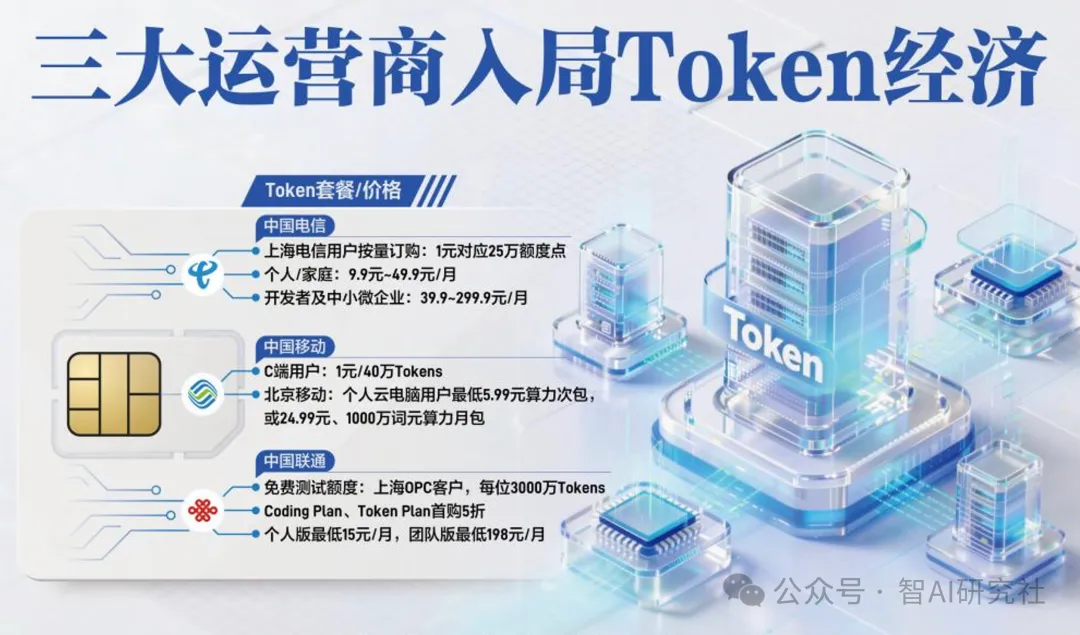
Different Selling Methods, Strikingly Similar Direction

First, look at China Telecom's offering.

Individual plan: Minimum 9.9 yuan/month, includes 10 million Tokens.

Higher tiers include 29.9 yuan and 49.9 yuan, corresponding to 40 million and 80 million Tokens respectively.

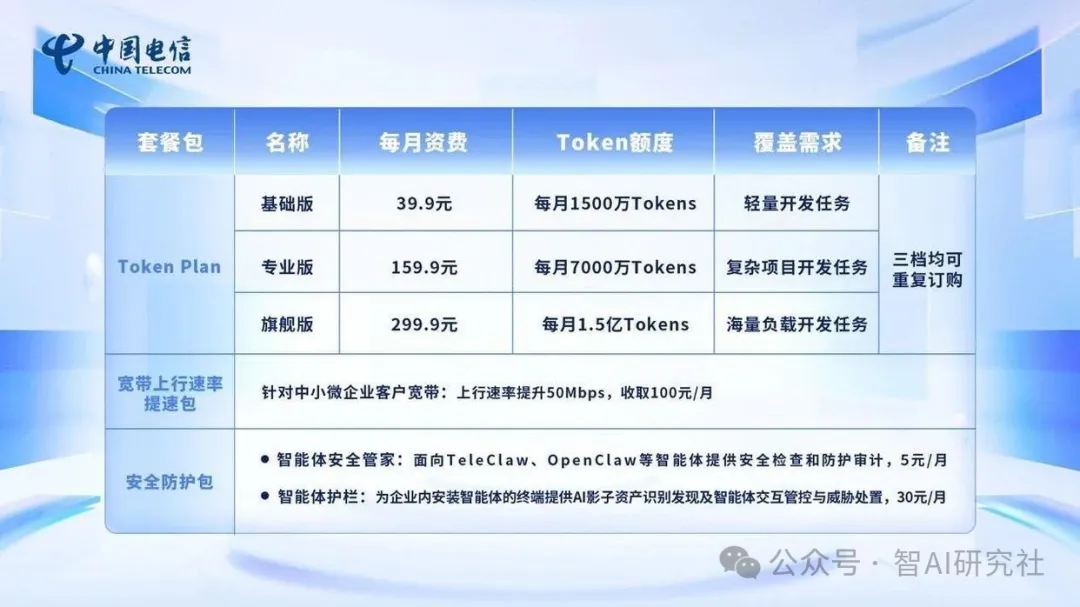
For developers and enterprises: Basic version at 39.9 yuan for 15 million Tokens, Professional version at 159.9 yuan, and Flagship version at 299.9 yuan.

China Telecom's selling point is a bundled package of "Tokens + Connectivity + Security," offering broadband uplink speed boost and security protection along with Tokens.
Next, China Mobile.

Shanghai Mobile, in collaboration with Tencent, launched an AI-native workbench, with 1 yuan buying 400k Tokens. Beijing Mobile was even earlier—minimum 5.99 yuan for a computing resource sub-package, and 24.99 yuan for 10 million Tokens.

The most notable move is that China Mobile integrated Tokens into its cloud computer service.

Users without a cloud computer can directly purchase a bundled cloud computer plan with built-in OpenClaw, ready to use upon startup.

China Unicom's approach is also different.

Shanghai Unicom is giving them away—OPC customers can receive a 30 million Token testing quota for free.

Personal version: 15 yuan/month for 6 million Tokens. Team version: 198 yuan/month, also including a one-month free trial of AI cloud desktop.

The prices of the three operators are similar, with each having its own strategic focus.

But the core logic is exactly the same—selling Tokens like phone credit packages.
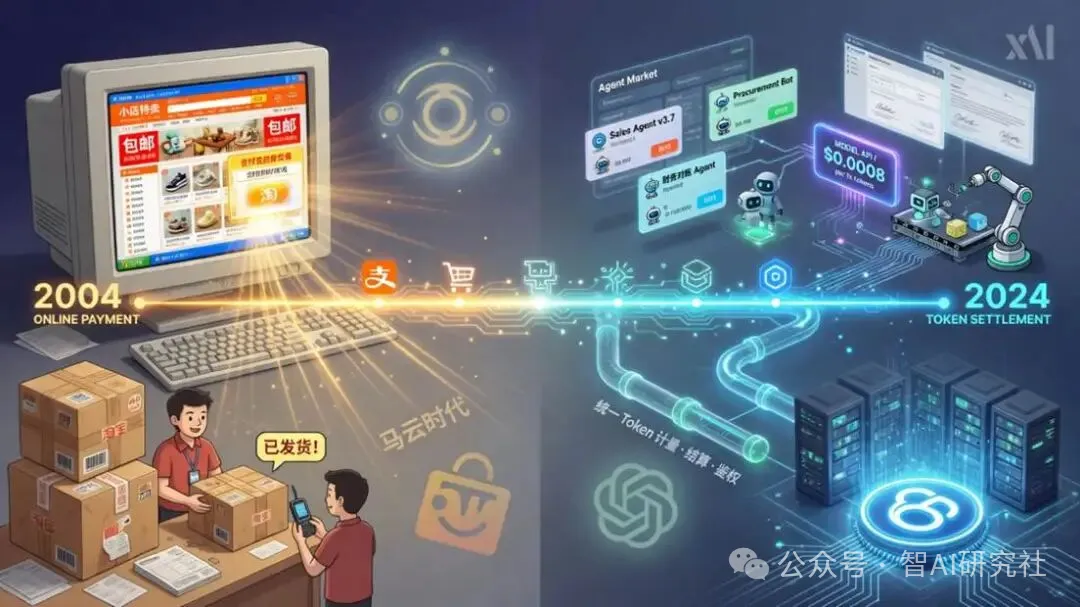
What's More Worth Noting Than the 9.9 Yuan Price

The 9.9 yuan Token plan itself is not cheaper than offerings from major tech giants.

Some market commentators note that compared to API pricing from major model providers, the operators do not have a clear price advantage.

But the key point here is not the price; it's the distribution channel.

Major tech companies sell Tokens to developers and power users—there's a ceiling there.

Telecom operators sell Tokens to everyone who has a mobile phone.

China Mobile has nearly 1 billion subscribers, China Telecom has nearly 400 million, and China Unicom also has over 300 million.

This user pool is on a completely different scale.

And most importantly, this represents the collective entry of state-owned enterprises.
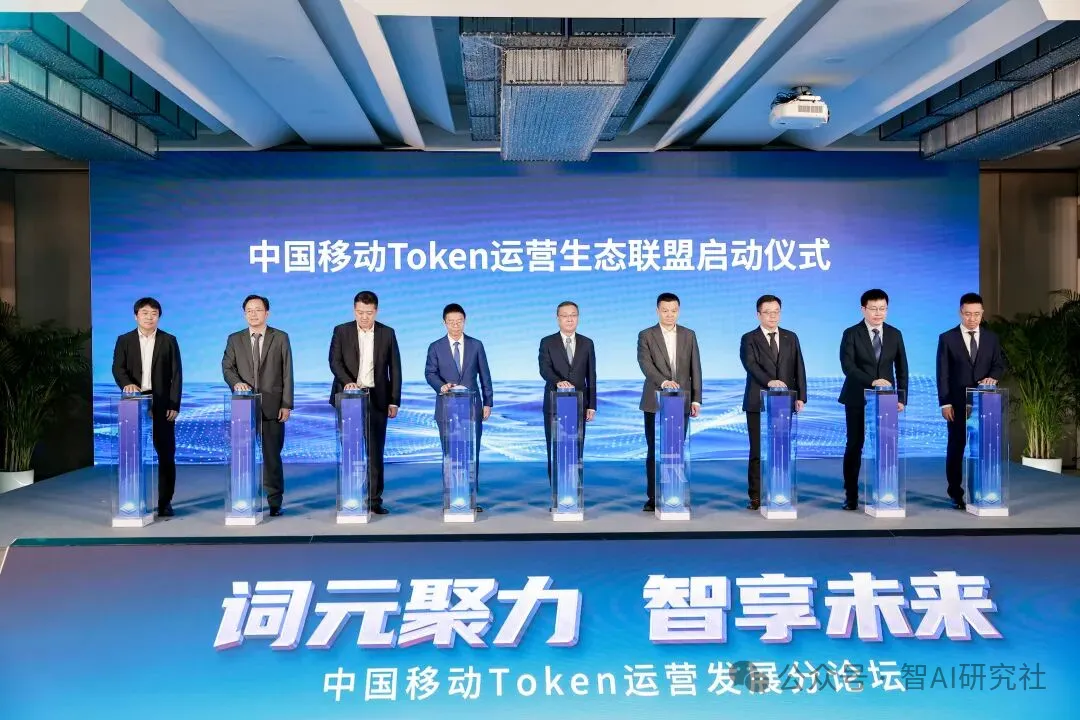
The shift in the telecom industry from traffic management to computing power management is not the decision of a single company.

It is a synchronous pivot by the three major operators.

The data from the National Data Administration is also on the table—the daily Token consumption volume in China surged from 100 billion in early 2024 to over 140 trillion by March 2026.

An increase of over a thousand times in two years.

Tokens are no longer a niche unit in the AI circle; they are becoming a basic telecom commodity alongside data and call credit.

Some telecommunications industry experts judge that if all three operators follow through,

the distribution market for large model APIs might partially shift from cloud providers to the operator system.

In the future, you won't need to understand what an API or a model is to buy Tokens.

You could just go to a service center and say, "Top up 100 yuan worth of Tokens for me," and another line would appear on your phone bill.


İlgili Sorular

QWhat is the core new product that China's three major telecom operators (China Telecom, China Mobile, and China Unicom) have recently launched?

AThey have collectively launched national "Token packages" or "Token plans." These are data-like packages where users pay a monthly fee to receive a certain amount of AI model processing tokens.

QWhat is the lowest monthly price point mentioned for these Token packages, and how many tokens does it offer?

AThe lowest monthly price mentioned is 9.9 yuan per month, which offers 10 million tokens. The article cites this as China Telecom's entry-level personal plan.

QWhy is the launch of these Token packages by telecom operators considered significant beyond just pricing?

AThe significance lies in the channel and scale. Unlike AI companies selling primarily to developers, operators can sell Token packages to their entire mobile user base—totaling hundreds of millions of customers—making AI consumption as easy and common as paying a phone bill.

QHow is China Mobile specifically integrating its Token offering?

AChina Mobile is integrating Tokens into its cloud computer service. For users without a cloud computer, they can purchase a fused package that includes a cloud computer pre-installed with 'OpenClaw' AI tools, ready to use upon startup.

QWhat broader industry shift does the article suggest this move by the telecom operators represents?

AIt represents a strategic shift for the telecom industry from 'traffic operation' (focusing on data/bandwidth) to 'computing power operation' (focusing on AI processing tokens and services). This is a coordinated move by the state-backed operators, signaling Tokens are becoming a fundamental telecom commodity.

İlgili Okumalar

Warsh's First Day in Office, Markets Deliver a 'Wake-up Call': Rate Hike Expected This Year

On his first day in office, newly inaugurated Federal Reserve Chairman Warsh received a stark market warning, with expectations now fully pricing in a 25-basis-point interest rate hike this year. The shift was triggered by hawkish remarks from Fed Governor Waller, who stated that inflation is now the key policy "driver" and that the odds of a hike or cut are evenly split. This sent short-term Treasury yields higher. Waller signaled a significant pivot in his stance, citing disappointing inflation and labor data. He suggested removing "easing bias" language from Fed statements and did not rule out future rate increases if inflation fails to recede, though he noted immediate action isn't warranted without signs of unanchored inflation expectations. Chairman Warsh faces immediate pressure at his first FOMC meeting in June. With the preferred inflation gauge at a three-year high, analysts warn that failing to hike could be interpreted as an implicit easing of policy. The geopolitical situation in the Middle East is adding to existing price pressures. The market's expectation for a hike contrasts sharply with earlier forecasts for multiple cuts. While long-term Treasury yields have been contained by lower energy prices recently, analysts note they remain under structural upward pressure. Warsh's swearing-in at the White House highlights political scrutiny over Fed independence. However, the market has made it clear that inflation is the most urgent challenge, leaving the new chairman little time to settle in.

marsbit2 saat önce

Warsh's First Day in Office, Markets Deliver a 'Wake-up Call': Rate Hike Expected This Year

marsbit2 saat önce

Has Microsoft Lost Its Way in the AI Race, and Can Copilot Bring It Back on Track?

Microsoft, once seen as an early AI frontrunner due to its investment in OpenAI, is navigating a strategic shift amid increased competition. Its initial reliance on OpenAI’s GPT models has been complicated by OpenAI’s growing ambitions as a direct competitor, rapid advancements from rivals like Claude and Gemini, and the disruptive rise of AI agents, which challenge its traditional SaaS business model. These factors contributed to stock declines and slower-than-expected adoption of its flagship Copilot products. In response, CEO Satya Nadella has taken a hands-on role in product development, signaling the urgency of change. Microsoft is pivoting from a model-centric strategy to a "model-agnostic" enterprise platform approach. It aims to become the foundational layer connecting various AI models—from OpenAI, Anthropic, or its own new "Superintelligence" team—with enterprise workflows, data, security, and cloud services. Recent organizational changes merged consumer and enterprise Copilot teams to accelerate innovation, exemplified by new products like Copilot Tasks and Copilot Cowork. However, this transformation comes at a high cost. Microsoft faces massive capital expenditures, potentially reaching ~$190 billion by 2026, to support AI infrastructure. While its platform strategy shows early signs of traction with growing Azure AI revenue, it must balance startup-like agility with the reliability expected by enterprise clients. The core challenge is no longer being the sole AI winner but defending its position as the essential enterprise software entry point amidst rapid technological commoditization and the shift towards always-on AI agents.

marsbit3 saat önce

Has Microsoft Lost Its Way in the AI Race, and Can Copilot Bring It Back on Track?

marsbit3 saat önce

Why Haven't Forex Stablecoins Taken Off?

Why FX Stablecoins Never Took Off: A Path Forward via Synthetic FX Despite the explosive growth of stablecoin-powered digital banking, which has seen ~$6B in VC investment and a 24x surge in crypto card spending in under a year, a major limitation persists: these banks are essentially dollar-only accounts. This leaves 95-99% of global accounts, which are denominated in non-USD currencies, underserved. Attempts to create native foreign currency (FX) stablecoins (like EURC) have largely failed, with total FX stablecoin TVL at ~$600M compared to $400B for USD stablecoins—a 700x gap. These FX tokens face critical challenges: fragile pegs due to low liquidity, limited exchange/FinTech acceptance, poor on/off-ramps, complex regional compliance, and a chicken-and-egg adoption problem. The article argues that the solution lies not in competing with entrenched USD stablecoin networks (USDT/USDC), but in adopting a synthetic FX model inspired by traditional finance. Specifically, it advocates for Mark-to-Market Non-Deliverable Forwards (NDFs)—cash-settled FX derivatives that allow users to maintain underlying USD stablecoin holdings while having their account balance and P&L denominated in a foreign currency. This approach offers key advantages: strong oracle-based pegs, retention of deep USD stablecoin liquidity and yield, superior on/off-ramps, scalability to any currency with a reliable feed, and capital efficiency. It mirrors how modern institutional FX markets operate. Primary use cases for on-chain NDFs include: 1. **Digital Banks/Wallets:** Enabling multi-currency accounts for international users without leaving the USD stablecoin ecosystem, boosting deposits and retention. 2. **FX Carry Trade Vaults:** Offering access to sovereign interest rate differentials (e.g., earning yield on BRL) in a more stable and scalable format than crypto-native products like Ethena. 3. **Global Enterprise Payments:** Allowing merchants to receive payments in local currency equivalents while settling in USD stablecoins, similar to services offered by Stripe for fiat. The conclusion is that synthetic FX, not native FX stablecoins, is the viable path to integrating foreign exchange into the growing stablecoin digital banking landscape, potentially unlocking the next phase of institutional DeFi and multi-trillion-dollar global adoption.

链捕手3 saat önce

Why Haven't Forex Stablecoins Taken Off?

链捕手3 saat önce

İşlemler

Spot
Futures
活动图片




