ChatGPT Issues Sudden Ban, Cutting Off Global AI Writers Overnight

marsbit2026-07-31 tarihinde yayınlandı2026-07-31 tarihinde güncellendi

Özet

The Golden Age of AI writing is showing signs of collapse. While AI models grow more powerful, the quality of their generated text is perceived to be declining. Research notes a divergence: models excel in structured domains like coding and math due to clear feedback signals, but their language expression and reasoning plateau or even regress, as there's no reliable automated metric to score "good writing." Simultaneously, platforms are imposing new restrictions. ChatGPT has reportedly begun refusing prompts that explicitly instruct it to mimic the style of specific famous authors like Stephen King or J.K. Rowling, though requests based on abstract narrative features remain possible. This shift undermines user expectations. AI writing tools are becoming less reliable for end-to-end content creation, as model capabilities may not consistently improve and prompt efficacy can change overnight due to platform policy updates. Consequently, AI is receding to a more auxiliary role—a tool for research, structuring, and editing—while human judgment, experience, and creative intent regain paramount importance.

The golden age of AI writing is collapsing!

Entering it, each generation of models grows stronger, yet the articles become increasingly worse.

It knows when to list several suggestions, where to insert subheadings, and never forgets to add a concluding sentence at the end.

But after reading the entire piece, not a single sentence remains in your mind.

The Stronger the Model, the Less Human the Writing Sounds

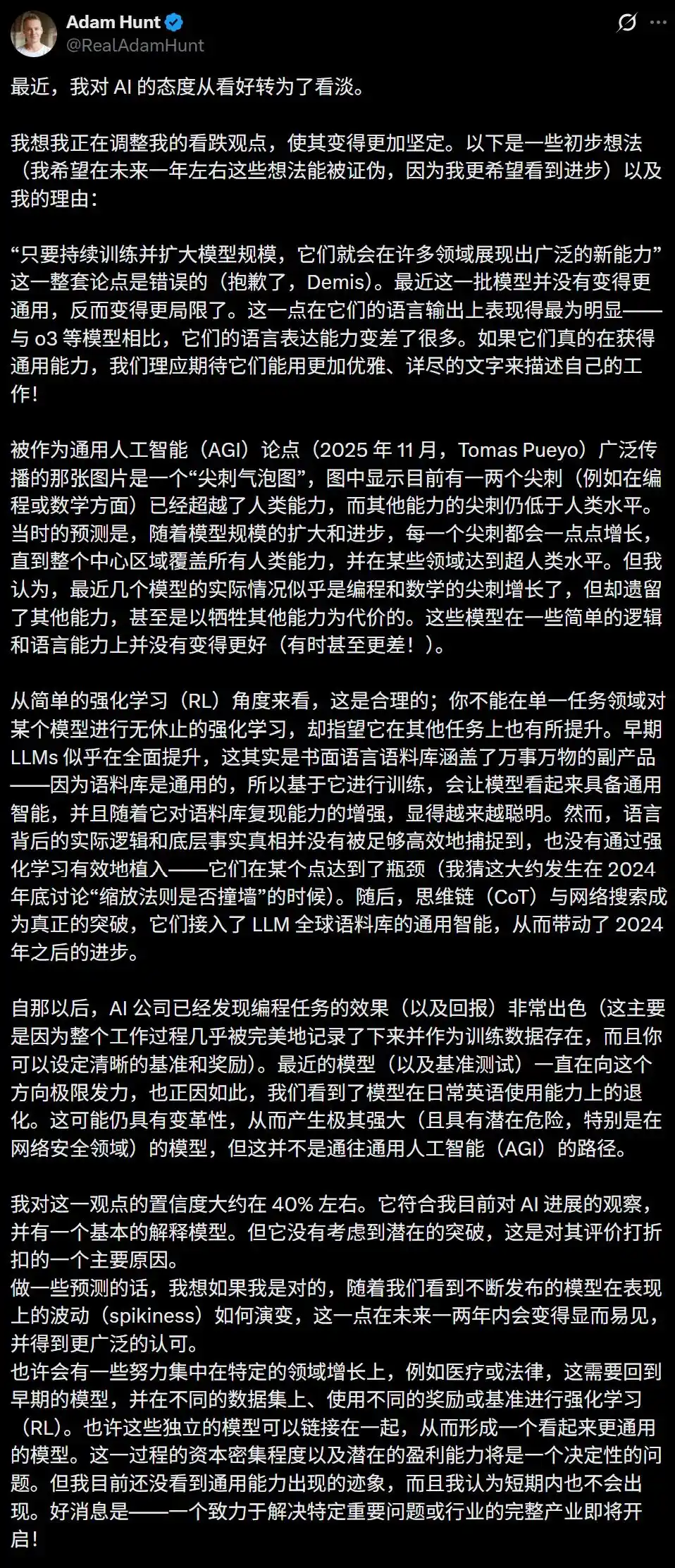
Recently, Cambridge University postdoctoral researcher Adam Hunt also noticed this phenomenon. His research focuses on evolutionary psychiatry and human evolution.

Hunt was previously optimistic about AI. However, on July 28, he frankly admitted in a long post: he is growing increasingly pessimistic now.
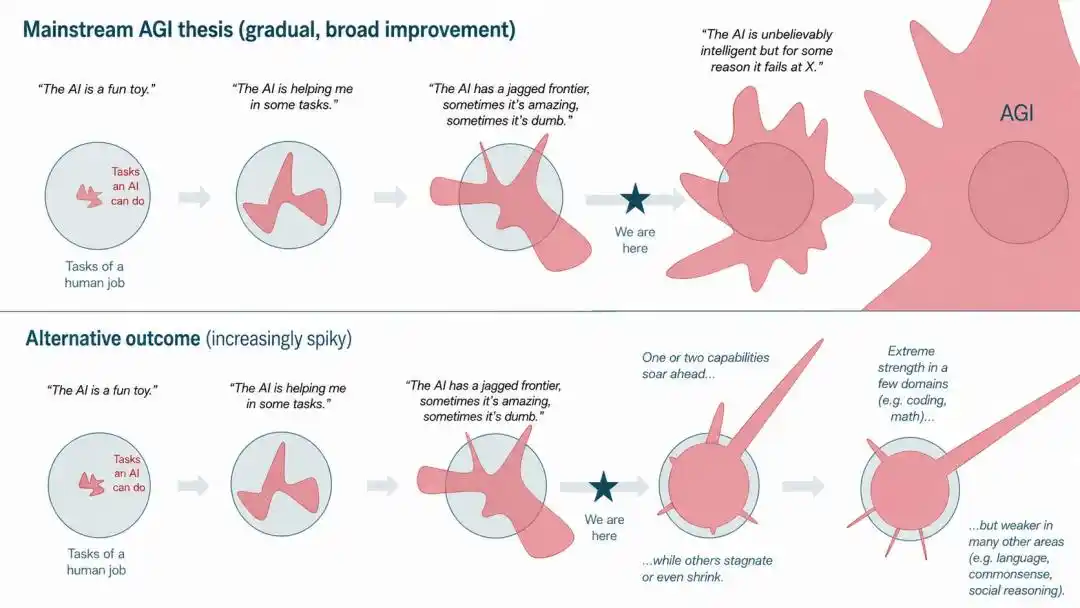
There was a popular metaphor before, depicting model capability as a circle with a sharp spike.

First, code and mathematics surpass humans, then as scale increases, every direction gradually grows, ultimately achieving AGI.

But in reality, the spike for code and mathematics is indeed growing longer, while language expression and simple reasoning have not improved synchronously.
From a reinforcement learning perspective, this outcome is almost inevitable.

Earlier generations of LLMs appeared to become "comprehensively smarter" because the training corpus itself covered all domains, from poetry to theses, encompassing the entire internet.

However, that was a byproduct of the corpus, not the model's genuine "comprehension."

Chain-of-thought and web search were subsequently introduced, giving models a temporary boost. But ultimately, this path hit a wall.

Following that, AI companies eager for a turnaround turned their focus to code.

The reason is simple: there is a constant stream of training data available.

GitHub commits, reviews, and PRs are all readily available. Moreover, similar to mathematics, code provides clear feedback signals: either it runs or it doesn't.

What about writing articles? How do you automatically score "how well a piece of prose is written"? Without a reward, RL won't optimize in that direction.

Thus, all training efforts shifted to code, while language expression had to rely on the foundation laid during the pre-training phase.

This foundational knowledge can only diminish over time. To accommodate improvements in other areas, it might even degrade.

This is precisely where Goodhart's law tends to manifest.

When a metric becomes the training target, it no longer accurately reflects true capability. Labs optimize models using benchmark tests, then prove their improvement with similar tests.

Benchmark accuracy scores will continue to rise. Yet, the actual user experience may stagnate or even decline.

This Time, Imitation Is Also Restricted

While capabilities are degrading, another development is occurring simultaneously.

A Reddit user complained in a post that they had been using ChatGPT to write a book for several months, subscribing to the advanced model. They took a break in between.

When they returned, the prompt that had always worked suddenly returned a refusal.

The prompt itself wasn't complex: specify an author, request to increase dialogue, enrich details, and avoid fragmented sentences.

In the past, simply writing the author's name allowed the model to generate content approximating their style, without needing additional explanations on sentence length, rhythm, or perspective.

Now, this type of prompt no longer works.

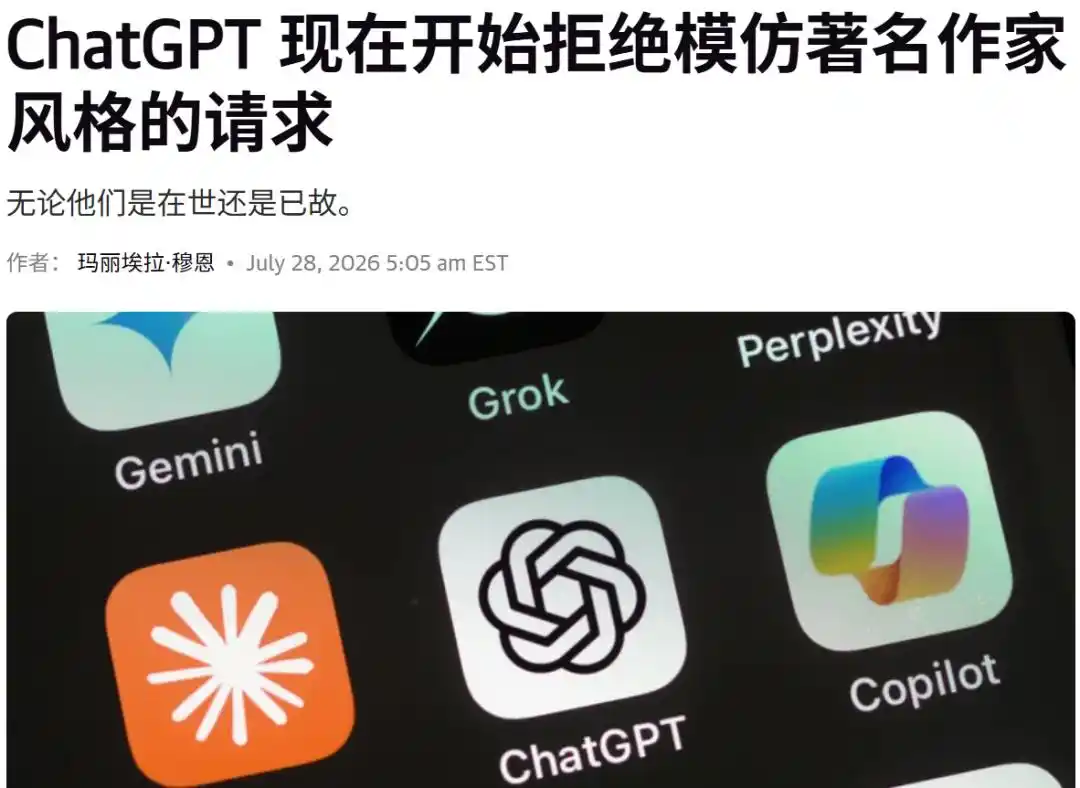
Ars Technica tested with Stephen King, J.K. Rowling, Amy Tan, Dickens, Hemingway, and Engadget tested with Agatha Christie. ChatGPT refused to imitate all of them.

If you don't name names and only request abstract features like "suspense intensity," "narrative pacing," or "dialogue density," it can still output. But the flavor is no longer the same.
The Golden Age of AI Writing Has Collapsed

Today, this controversy has shaken users' fundamental expectations regarding AI writing.

Models may not necessarily write better, and prompts are no longer guaranteed to remain effective long-term.

When platforms change their rules, entire writing pipelines built around specific models can collapse overnight.

However, AI writing won't disappear; it has merely retreated to its proper place: as a tool.

It can research information, structure content, and revise sentences, but it cannot replace the author in deciding what to write and why to write it.

In other words, human experience, judgment, and desire to express are becoming increasingly valuable.

Reference: https://arstechnica.com/ai/2026/07/chatgpt-stops-cloning-famous-writers-voices-but-may-capture-a-similar-feeling/

This article is from WeChat public account "New Zhiyuan," author: ASI Apocalypse

Trend Kriptolar

İlgili Sorular

QAccording to the article, what is the main reason for the decline in the quality of AI-generated writing?

AThe article attributes the decline to reinforcement learning (RL) optimization focusing on domains with clear, automated feedback like code, while creative writing lacks such objective metrics, causing language expression capabilities to stagnate or degrade as models prioritize other benchmarks.

QWhat specific change did ChatGPT make regarding prompts that imitate famous writers?

AChatGPT now refuses to generate content in the style of specific, named famous authors like Stephen King or J.K. Rowling when prompted directly. Prompts using only abstract stylistic features are still allowed, but the output is less authentic.

QWhat is Goodhart's law, as mentioned in the article, and how does it relate to AI model training?

AGoodhart's law states that when a measure becomes a target, it ceases to be a good measure. The article relates this to AI companies optimizing models for specific benchmark tests, which improves scores on those tests but doesn't necessarily translate to better real-world performance, potentially leading to a decline in user experience.

QWhat does the article suggest is the future role of AI in writing?

AThe article suggests AI writing will recede from attempting to replace authors and settle into its proper role as a tool. It will be used for tasks like researching, structuring content, and editing sentences, but the human author's experience, judgment, and desire to express remain central and increasingly valuable.

QWhat analogy does researcher Adam Hunt use to describe the unrealistic expectation of AI model development?

AHe references a popular analogy depicting model capability as a spiky circle, where proficiency in areas like code and math grows into a sharp peak, expecting all other abilities like language to grow uniformly toward AGI. The article argues that in reality, the 'spike' for code has grown while language and simple reasoning have not kept pace.

İlgili Okumalar

Saeed Al-Marri: How Tokenization Unlocks New Opportunities for Shipping Funds

Said Al-Marri: How Tokenization Opens New Opportunities for Shipping Funds For centuries, commercial shipping has been a capital-intensive asset class limited to institutional funds and shipping dynasties. Said bin Saleh Al-Marri, CEO of Ethra Invest and Ethra Ship, aims to break down these barriers by combining Real World Asset (RWA) tokenization with conservative private equity principles. This bridges decentralized finance (DeFi) with the physical realities of global trade. Tokenization allows fractional ownership of ships on a blockchain, giving smaller investors access to previously inaccessible markets. However, Al-Marri warns it is not a regulatory loophole or a cure for asset illiquidity. The core physical risks are isolated in Special Purpose Vehicles (SPVs) for qualified investors. While tokenization enhances transparency and ownership record-keeping, Al-Marri stresses that a liquid secondary market depends on transparent asset valuation and must not interfere with ship operations managed by professionals. Regarding legal enforcement, smart contracts cannot physically seize a ship. Legal recourse still relies on traditional maritime courts, ship mortgages, and flag state laws, with blockchain records needing to mirror legal ownership in the SPV perfectly. Beyond ownership, the industry faces administrative hurdles like paper-based bills of lading. Al-Marri argues the bottleneck is legal and operational standardization, not technology. He advocates for a hybrid model combining digital trade documents and programmable settlements with support from regulated financial institutions, rather than a full crypto replacement for tools like Letters of Credit. A major challenge is decarbonizing the global fleet by 2050. Transitioning to green fuels requires massive upfront investment. Al-Marri emphasizes a conservative, holistic approach to underwriting these projects, evaluating technology, fuel availability, safety, and resale value. Investments must be justified under conservative forecasts, not just optimistic ones. By combining pragmatic risk management with digital infrastructure, leaders like Al-Marri show that the evolution of maritime finance is about mobilizing capital to build a modernized and sustainable global fleet, not just putting ships on a blockchain.

cryptonews.ru8 dk önce

Saeed Al-Marri: How Tokenization Unlocks New Opportunities for Shipping Funds

cryptonews.ru8 dk önce

Six Years Later, UNI Finally Welcomes Its Own "Buyback Bull"

After years of debate, Uniswap's UNI token has finally entered a 'buyback bull' phase following the long-awaited activation of its fee-switch mechanism. The UNIfication proposal, executed in December 2025, redirected a portion of protocol fees from select pools and Unichain sequencer revenue into a treasury (TokenJar) dedicated to buying back and permanently burning UNI. Initial market reaction was muted due to modest early burn rates. A significant shift occurred in July 2026 with the launch of Robinhood Chain. Uniswap's immediate deployment there skyrocketed trading volume, making it a top fee-generator. Subsequently, governance votes extended the fee mechanism to v4 pools and Robinhood Chain, causing protocol revenue to nearly triple. Daily funds directed to UNI burns rose sharply, with Robinhood Chain contributing over half. This transitioned UNI's narrative from a governance token to a cash-flow asset backed by a perpetual automatic buyer. UNI's price, which had languished around $2.30 in early June, nearly doubled to approach $4.60 by late July. Analysts credit this to the tangible cash flow from fees rather than mere speculation. Unlike many newer projects where buybacks are offset by large investor unlocks, UNI's six-year history has resulted in a widely distributed and relatively clean supply, allowing the buyback pressure to effectively impact the secondary market. The key test will be whether trading activity, particularly on Robinhood Chain, sustains after its initial gas subsidies expire.

marsbit13 dk önce

Six Years Later, UNI Finally Welcomes Its Own "Buyback Bull"

marsbit13 dk önce

Only 153 Venture Capital Firms Invested in July: Is the Crypto VC Industry Experiencing a 'Mass Extinction'?

In July 2026, only 153 unique venture capital firms participated in disclosed crypto funding rounds, marking the lowest monthly count since November 2020. This figure represents an 87% decline from the peak of 1,177 firms in 2022. Overall, the first seven months of 2026 saw crypto projects raise approximately $11.78 billion across 481 rounds. This crypto VC contraction contrasts sharply with the broader venture capital landscape, where global VC investment reached a record $560.4 billion in H1 2026, heavily fueled by major AI company financings. This shift in capital allocation has drawn funds away from the crypto sector. Within crypto, funding is highly concentrated. Trading platforms, prediction markets, and payment sectors absorbed 53% of the total capital. While early-stage deals remain frequent, the largest sums flow to a few late-stage rounds and mergers & acquisitions, which surged to $7.23 billion in Q2 2026. The market is consolidating around top funds like a16z crypto and Dragonfly, which successfully raised new multi-billion dollar funds, while many smaller firms have retreated. Analysts describe this as a "great extinction" for crypto VCs, where capital is becoming more selective, favoring proven business models and assets over early-stage speculation. This raises the bar for project quality, funding efficiency, and viable exit paths.

marsbit34 dk önce

Only 153 Venture Capital Firms Invested in July: Is the Crypto VC Industry Experiencing a 'Mass Extinction'?

marsbit34 dk önce

İşlemler

Spot

Popüler Makaleler

BAN Nasıl Satın Alınır

HTX.com’a hoş geldiniz! Comedian (BAN) satın alma işlemlerini basit ve kullanışlı bir hâle getirdik. Adım adım açıkladığımız rehberimizi takip ederek kripto yolculuğunuza başlayın. 1. Adım: HTX Hesabınızı OluşturunHTX'te ücretsiz bir hesap açmak için e-posta adresinizi veya telefon numaranızı kullanın. Sorunsuzca kaydolun ve tüm özelliklerin kilidini açın. Hesabımı Aç2. Adım: Kripto Satın Al Bölümüne Gidin ve Ödeme Yönteminizi SeçinKredi/Banka Kartı: Visa veya Mastercard'ınızı kullanarak anında Comedian (BAN) satın alın.Bakiye: Sorunsuz bir şekilde işlem yapmak için HTX hesap bakiyenizdeki fonları kullanın.Üçüncü Taraflar: Kullanımı kolaylaştırmak için Google Pay ve Apple Pay gibi popüler ödeme yöntemlerini ekledik.P2P: HTX'teki diğer kullanıcılarla doğrudan işlem yapın.Borsa Dışı (OTC): Yatırımcılar için kişiye özel hizmetler ve rekabetçi döviz kurları sunuyoruz.3. Adım: Comedian (BAN) Varlıklarınızı SaklayınComedian (BAN) satın aldıktan sonra HTX hesabınızda saklayın. Alternatif olarak, blok zinciri transferi yoluyla başka bir yere gönderebilir veya diğer kripto para birimlerini takas etmek için kullanabilirsiniz.4. Adım: Comedian (BAN) Varlıklarınızla İşlem YapınHTX'in spot piyasasında Comedian (BAN) ile kolayca işlemler yapın.Hesabınıza erişin, işlem çiftinizi seçin, işlemlerinizi gerçekleştirin ve gerçek zamanlı olarak izleyin. Hem yeni başlayanlar hem de deneyimli yatırımcılar için kullanıcı dostu bir deneyim sunuyoruz.

534 Toplam GörüntülenmeYayınlanma 2024.12.11Güncellenme 2026.06.02

BAN Nasıl Satın Alınır

Tartışmalar

HTX Topluluğuna hoş geldiniz. Burada, en son platform gelişmeleri hakkında bilgi sahibi olabilir ve profesyonel piyasa görüşlerine erişebilirsiniz. Kullanıcıların BAN (BAN) fiyatı hakkındaki görüşleri aşağıda sunulmaktadır.

活动图片