It's been almost four years since ChatGPT launched.
Over these four years, how many sentences have you chatted with it, how many images have you uploaded, how many projects have you started? You probably can't even count them yourself.
But there's one pain point you must remember: trying to find that conversation from three months ago is basically a matter of luck.
The search box on the sidebar is practically useless. With many conversations, searching for old ones is nearly impossible.
In the OpenAI developer community, complaints about this old search have been long-standing:
Finally able to find that message, why did it take so long; that old search bar has never worked well; with many conversations, searching old ones becomes impossible; digging up old conversations is a nightmare...


These aren't just a few scattered complaints.
ChatGPT can generate anything, but the drafts you've written, code discussions you've had, images you've generated, and resources you've hoarded—as conversations pile up, 'finding records' becomes more like searching for a needle in a haystack. Scrolling the sidebar until your hand aches might not even help you find that crucial discussion from three weeks ago.
But this time, things have changed.
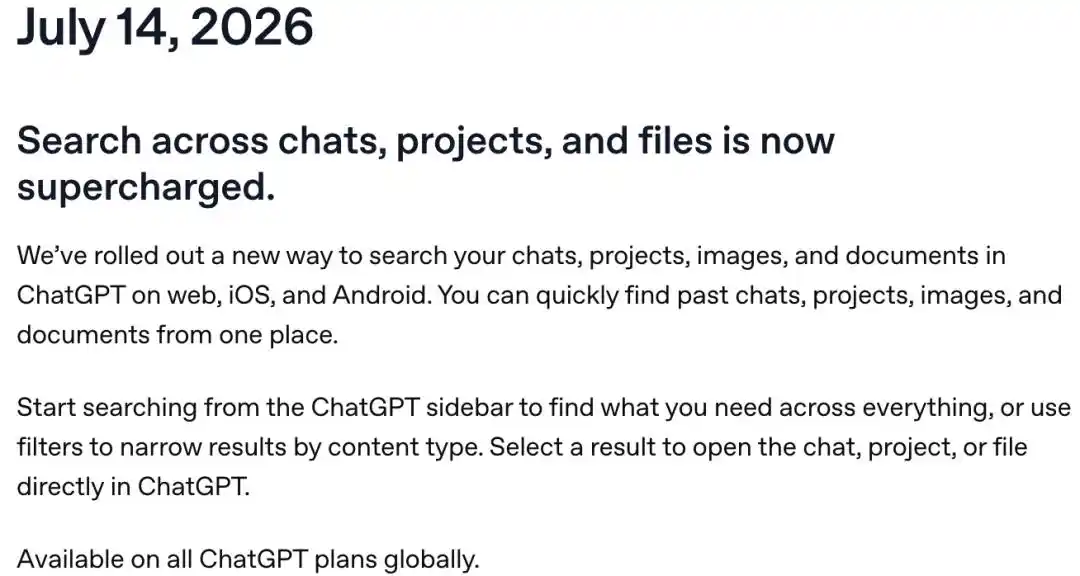
On July 14th, OpenAI rolled out a new unified search for ChatGPT, cramming everything in your ChatGPT into one unified entry: chat history, projects, uploaded documents, generated images—all searchable.
Synchronized across Web, iOS, and Android, available globally across all plans from Free to Enterprise.
If you actually go back and search through those years of 'inventory,' you'll realize: ChatGPT can 'search itself' for the first time.
And this is far from simply adding a search box: it makes your data more valuable.
For everyone, the most valuable asset in the AI era isn't the model, but the massive amount of data generated from your interactions with AI that you've accumulated.
One Entry
Searches Your Entire ChatGPT
This update isn't about making ChatGPT search the internet—that's a feature it's had for a while.
This searches the things you've accumulated in your own ChatGPT account.
The entry is right on the sidebar.

The search scope covers four categories: chats, images, documents, projects, and supports filtering by content type.
When you find something, click to go directly to the target content—no need to scroll back screen by screen.
This is completely different from the previous ChatGPT Search for the web. One helps you find information in the world, the other helps you find information in the things you've accumulated yourself.
However, there's a boundary here: cross-content search only covers content 'uploaded into ChatGPT, or generated within Projects and Work.'
Connected apps like Google Drive hanging outside are not searchable for now, and the official timeline for expanding this isn't provided.
Therefore, what ChatGPT can dig up is still only the portion you've personally handed over to it.
But even this portion is already substantial.
From Chatbot
To Your Personal Knowledge Base
How important can a search box be?
It really can't be underestimated. It's the missing puzzle piece that ChatGPT has needed for nearly four years.
For the past four years, ChatGPT has essentially been a 'conversation tool.' Everything you've chatted about is locked in isolated dialogues.
Its value is highest at the moment of the chat; after a week, it's basically sunk to the bottom of the ocean: you distinctly remember discussing a certain plan, but just can't retrieve it.
Behind this update lies a bigger change: ChatGPT is evolving from a 'chatbot' into a 'personal knowledge base.'
To put it more bluntly, it's starting to develop its own 'file system.'
Notion and Obsidian manage your own notes, Google Search manages all internet information.
And ChatGPT aims to take over an area that has never been specifically managed before: the things you and AI have co-produced over these years.
These are your assets in the AI era.
Models will be replaced generation after generation, but the conversations, projects, and materials you've accumulated with AI—no one can take them away or replicate them.
And now, all this data can be easily found and used at will within ChatGPT.
Your Data
Gets Heavier the More You Search
Search makes your pile of data more useful. It also makes the index in OpenAI's hands more complete, more valuable, but also more sensitive.
The more you can retrieve that conversation from three years ago, the clearer this record itself becomes. But there's a problem here: its boundaries are hard to fully control.
First, look at a default setting most people don't notice.
In consumer plans (Free, Plus, Pro), your conversations are by default used to train models, unless you manually go into Data Controls and turn it off. And most people have never clicked that switch.
Now consider another thing.
On January 5th of this year, in the copyright lawsuit against OpenAI by The New York Times and other media, a U.S. federal court upheld a ruling: compelling OpenAI to hand over 20 million de-identified ChatGPT conversation logs to the plaintiffs.
These 20 million represent only 0.5% of the logs it has retained, the latter being on the order of 'tens of billions.'
OpenAI cited user privacy in its defense; the court didn't accept it, with one key reason being: these conversations were 'voluntarily submitted' by users to OpenAI.
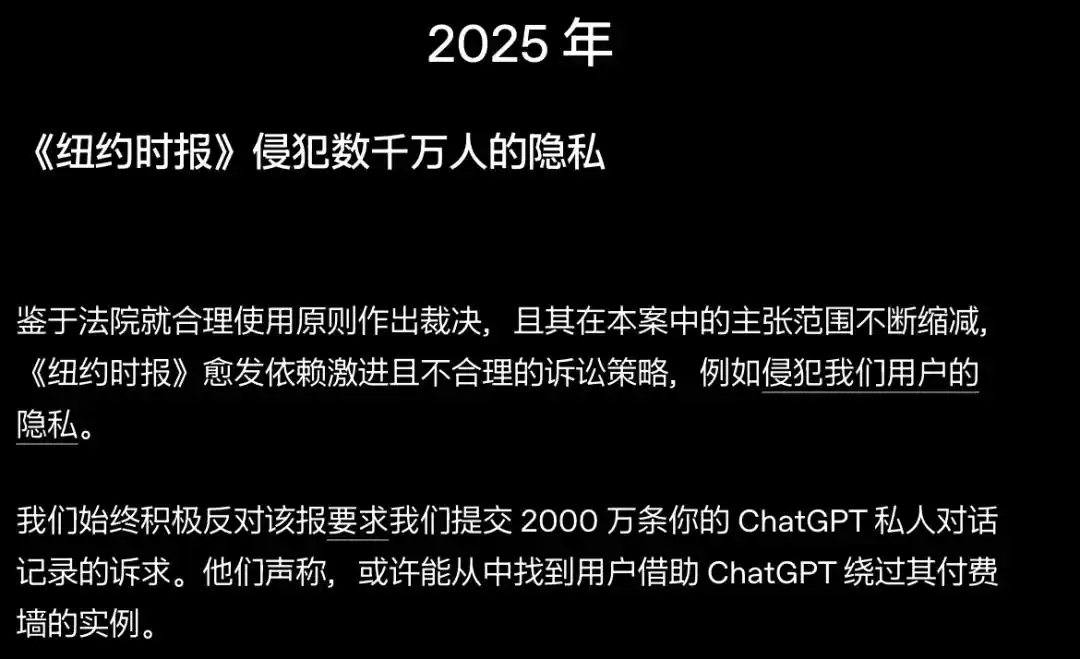
OpenAI website response page: publicly opposing The New York Times' request for 20 million user conversation records. (Source: OpenAI website)
More subtly, according to TechCrunch reports, the plaintiffs previously accused OpenAI of consistently claiming it 'could not search' these logs.
And now, OpenAI turns around and gives every user a 'search anything' feature.
The search upgrade itself didn't change any privacy policies, and the official announcement didn't mention new data uses. But it has made the things you've accumulated over these years carry more weight.
Every sentence you've said to it is both an asset and, in certain circumstances, could be opened up and presented in court.
Why Does ChatGPT Suddenly Need a Search Box?
Because it stopped being just a chatbot a long time ago.
Looking at OpenAI's moves over the past year or two:
File upload, Projects, Memory, then ChatGPT Work capable of running hours-long tasks, Sites for directly generating websites and light apps, the new desktop client merging Chat/Work/Codex, and the successive launches of the three-tier GPT-5.6 models.
The direction is crystal clear: OpenAI wants to turn ChatGPT into where you work.
And many of these moves happened just in the last half-month of July.
When you dump project materials, writing records, code discussions, generated images—all into it, the pile of stuff inside will only grow. The more it grows, the more fatal 'not finding' becomes.
Thus, search became the final piece of the puzzle in this loop.
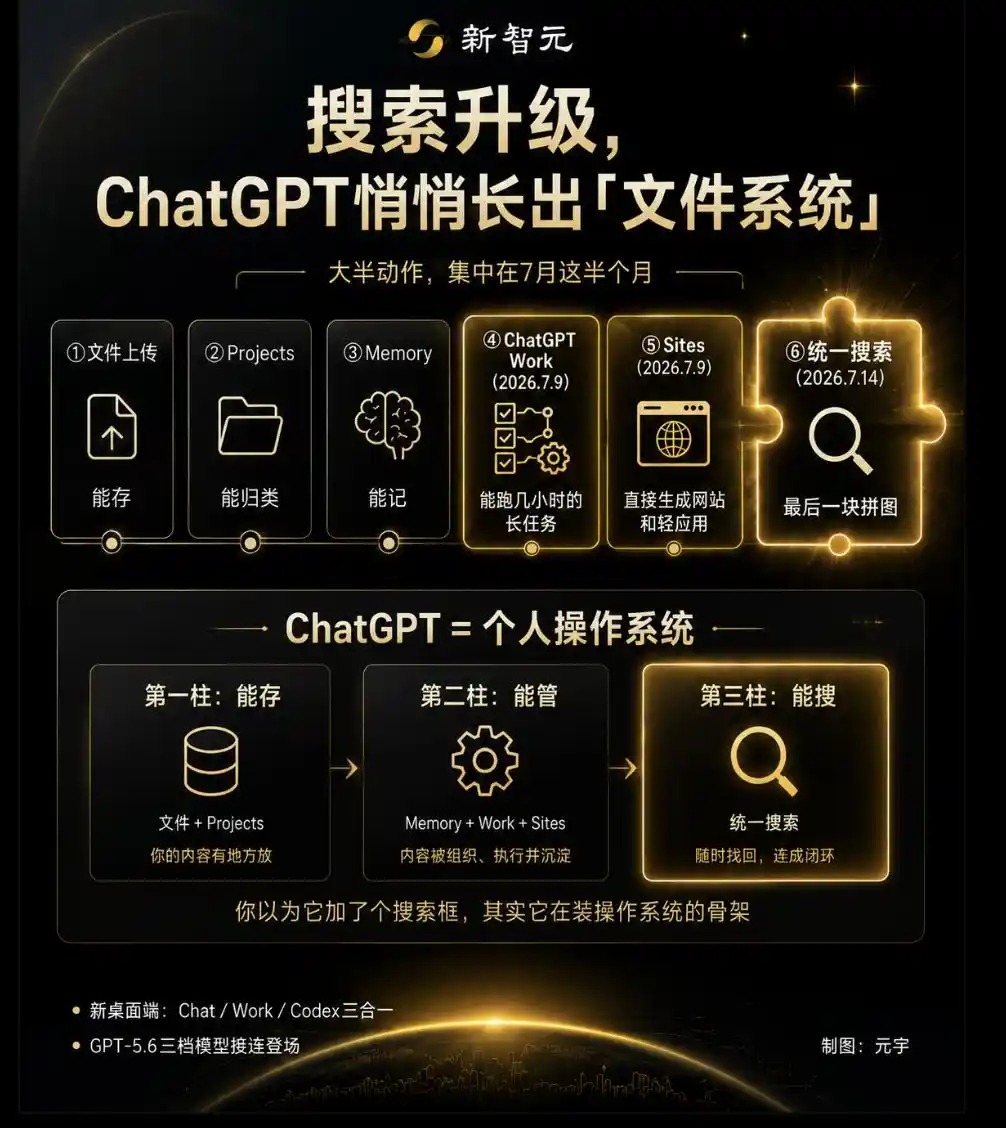
In a nutshell: ChatGPT is beginning to have its own 'file system.'
You might think it just added a search box, but actually, it's installing the skeleton an operating system should have: the ability to store, manage, and search.
Not OpenAI's Innovation
But the Industry's Overdue Debt
And patching this up is, in a way, making up for a lesson the whole industry needs.
How bad the old search was is common knowledge in the circle.

As soon as the update came out, someone in the comments directly called out: hope Anthropic copies this quickly, Claude's current search is 'terribly bad.'
Interestingly, in 2026, the three giants are almost simultaneously doing the same thing, just with different approaches.
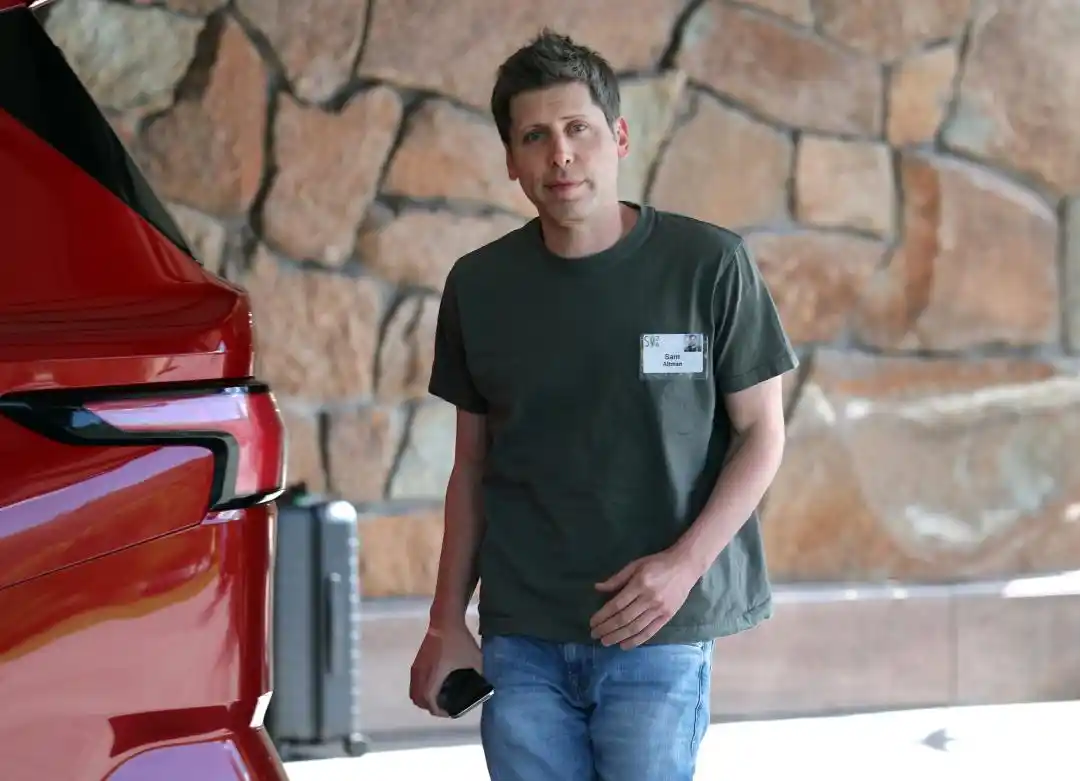
July 7th, Sam Altman appeared at the Sun Valley Summit. One week later, OpenAI densely released Work, Sites, and unified search within half a month. (Source: Kevin Dietsch via Getty Images)
ChatGPT takes the personal assistant route, gathering things you and it produced together into one entry;
Gemini relies on the Google ecosystem, integrating email, cloud drive, calendar;
Claude bets on long-term memory and Skills, gradually accumulating context for you.
Different paths, but the same destination: organizing your data, making it retrievable, and ready on demand.
If the first half of the large model competition was about answering like a human, the second half is quietly shifting the focus elsewhere: who can grasp, and moreover, revitalize your data.
Over the past two years, AI companies have desperately competed on models, yet almost no one seriously considered how to revitalize the pile of data users have accumulated.
This is precisely the key to the second half: whoever can revitalize user data can truly capture users.
Ultimately, for a product launched almost four years ago, it's only today that lets you 'search back through what you said.' What's late isn't this search box, but a re-awareness of the entire industry:
The batch of data you've accumulated together with AI is the most valuable.
References:
https://x.com/testingcatalog/status/2077132529270743286
https://x.com/btibor91/status/2077079848678555932
https://help.openai.com/en/articles/6825453-chatgpt-release-notes
https://openai.com/zh-Hans-CN/new-york-times/
This article is from the WeChat public account "New Zhiyuan", author: ASI Apocalypse, editor: Yuanyu