ChatGPT Can Manage Your Money for You. Would You Trust It with Your Bank Account?

marsbit2026-05-16 tarihinde yayınlandı2026-05-16 tarihinde güncellendi

Özet

OpenAI has launched a personal finance tool for ChatGPT, currently in preview for US-based ChatGPT Pro users. This feature allows users to connect their bank and investment accounts (via Plaid, supporting over 12,000 institutions) directly to ChatGPT. It analyzes transactions, generates visual dashboards, and offers conversational financial advice—such as budgeting or planning for major purchases—based on the user's actual data. This move follows OpenAI's acquisitions of fintech startups Roi and Hiro Finance, signaling a strategic push into vertical "super assistant" applications, similar to its earlier health-focused feature. However, the launch has sparked significant privacy concerns. Critics question the safety of granting such sensitive financial access to an AI, especially amid ongoing lawsuits alleging OpenAI shared user chat data with third parties like Meta and Google. OpenAI emphasizes that ChatGPT only reads data (no transaction capabilities), deletes it within 30 days if disconnected, and offers opt-out options for model training. Yet, trust remains a major hurdle. The trend reflects a broader industry shift: AI companies like Anthropic and Perplexity are also targeting high-value, data-rich domains like finance and health. While technically promising, the tool operates in a regulatory gray area—it provides personalized guidance but disclaims formal financial advice or liability. Ultimately, OpenAI's challenge is convincing users to trust an AI with their most p...

On May 15, OpenAI launched a new feature that left many feeling "both excited and uneasy" — a ChatGPT personal finance tool. Simply put, you can now directly connect your bank accounts and investment accounts to ChatGPT.

This feature is currently available for preview only to ChatGPT Pro users (monthly fee $200) in the United States. OpenAI uses the financial data service Plaid to facilitate account connections, supporting over 12,000 financial institutions, including JPMorgan Chase, Fidelity, Charles Schwab, Robinhood, American Express, and Capital One.

It sounds great. But the comments section almost exploded — would you really dare to give your bank account to an AI?!

01

What Does Your "AI Personal CFO" Look Like?

First, let's see what this tool can actually do.

Users go to the "Finances" option in the ChatGPT sidebar, click start, or directly type "@Finances, connect my accounts" in the dialog box. ChatGPT will then guide you through connecting your bank accounts via Plaid. The entire authorization process is essentially the same as linking your bank card in apps like Venmo or Robinhood — Plaid's tokenized authentication mechanism means ChatGPT itself does not have access to your bank passwords.
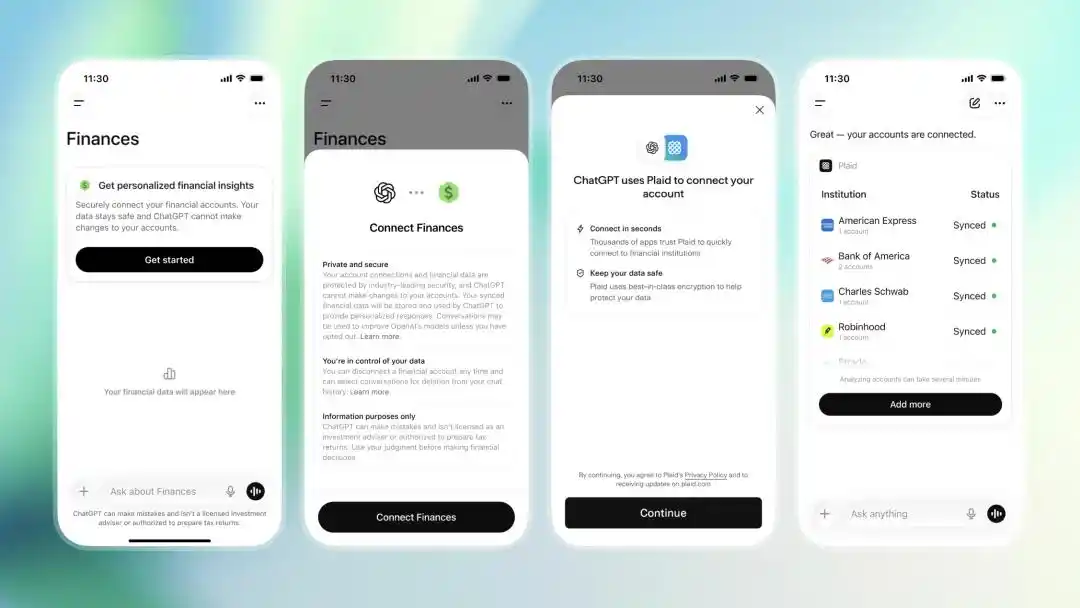
You need to connect your bank account via Plaid first | Image source: OpenAI

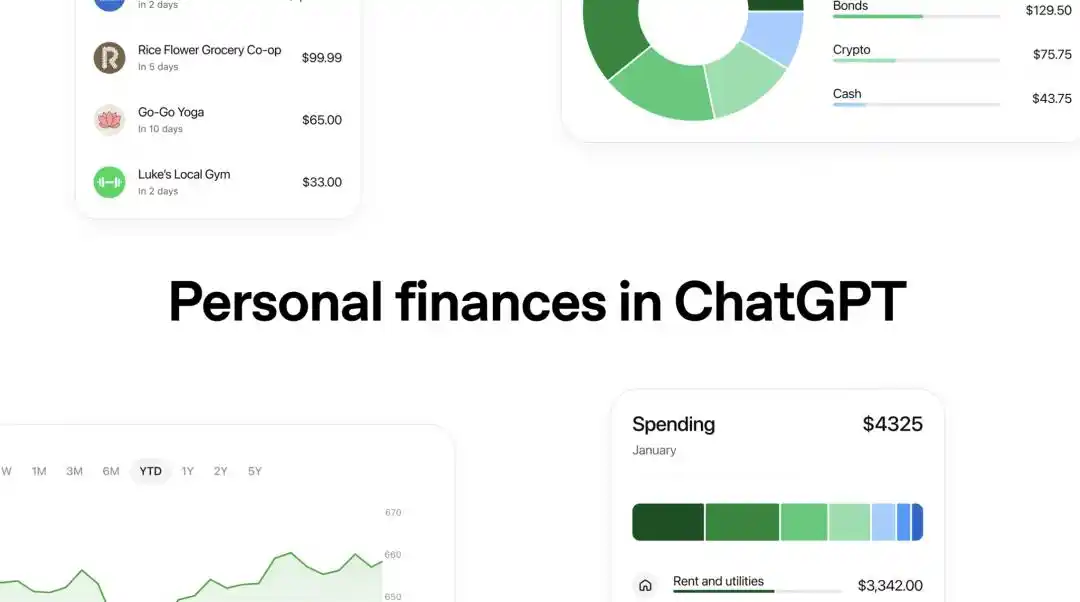
Once connected, ChatGPT will take a few minutes to sync and categorize your financial data, then generate a visual financial dashboard. This dashboard covers comprehensive information: checking and savings account balances, transaction history, spending breakdown by category, monthly recurring subscription services, upcoming bills, payroll deposit records, investment portfolio performance, as well as liabilities like credit card debt and mortgages.

But the dashboard is just the starting point. The really interesting part is "conversational finance management." Unlike traditional budgeting tools like Mint or YNAB, ChatGPT doesn't require you to look at charts, browse categories, or manually set budgets. You simply ask questions in natural language, and it provides answers based on your actual data.
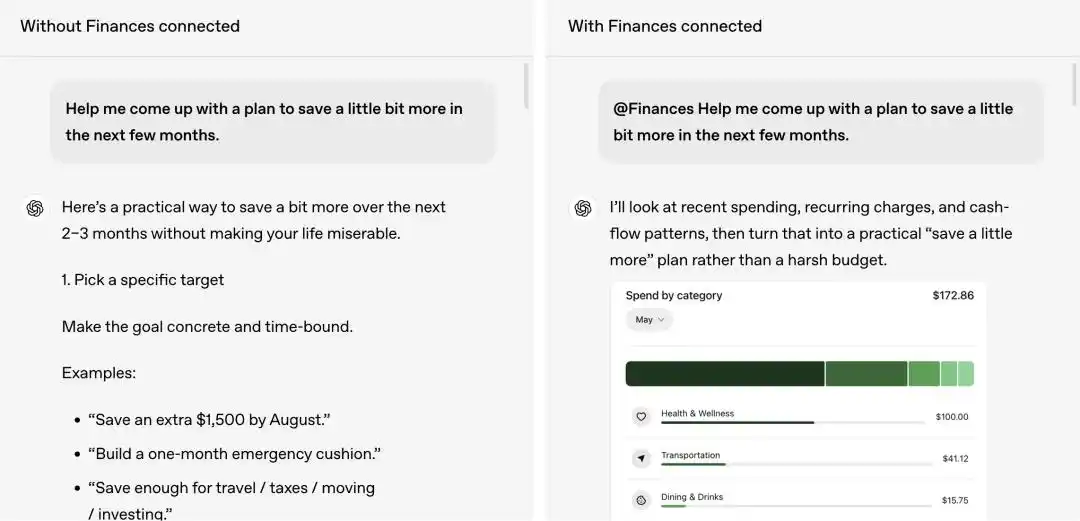
Comparison of financial questions before (left) and after (right) using personal financial data. Clearly, the latter is more planned and targeted | Image source: OpenAI

OpenAI provided several example scenarios: you can ask, "Am I spending more lately than before? What's changed?" ChatGPT will analyze your transaction history for spending trends.

You can say, "Help me make a plan to buy a house locally within five years," and it will calculate based on your income, savings rate, and current liabilities; you can even tell it, "I still owe my parents some money" or "I plan to buy a car early next year." ChatGPT will store this information in its "financial memory," and subsequent conversations will consider this context.

This is completely different from ChatGPT's previous experience in answering financial questions. Before, if you asked it "How should I save money to buy a house?" you'd get a bunch of generic textbook financial advice. Now that it can see your bank account balance, monthly spending structure, investment returns, and debt ratio, the suggestions are no longer generic nonsense like "we recommend saving 20% of your salary each month."

OpenAI also hinted at the next step: soon supporting Intuit data integration, allowing users to have ChatGPT analyze the specific tax impact of selling a particular stock or assess their approval probability for a certain credit card application.

OpenAI wants to evolve ChatGPT from "helping you look up a concept" to "helping you make decisions."

02

Two Acquisitions, Three Strategic Moves

OpenAI didn't undertake this on a whim.

Its groundwork has actually been underway for over half a year. In October 2025, OpenAI acquired the personal finance app Roi, and its founder Sujith Vishwajith subsequently joined OpenAI.

In April 2026, OpenAI acquired another personal finance startup, Hiro Finance, with founder Ethan Bloch and the entire team joining. Hiro's positioning was "AI personal CFO" and had helped users manage over $1 billion in assets. Bloch previously founded the automated savings app Digit, which was acquired for over $200 million in 2021.

Two acquisitions, two fintech veterans, half a year — OpenAI is clearly building a "financial task force" in a planned manner.

The driving data behind this is also staggering. OpenAI revealed that over 200 million people ask financial-related questions on ChatGPT every month — from budget management to how to cut expenses. These users were already using a "general-purpose chatbot" for financial tasks, except previously ChatGPT's responses lacked personalized data support.
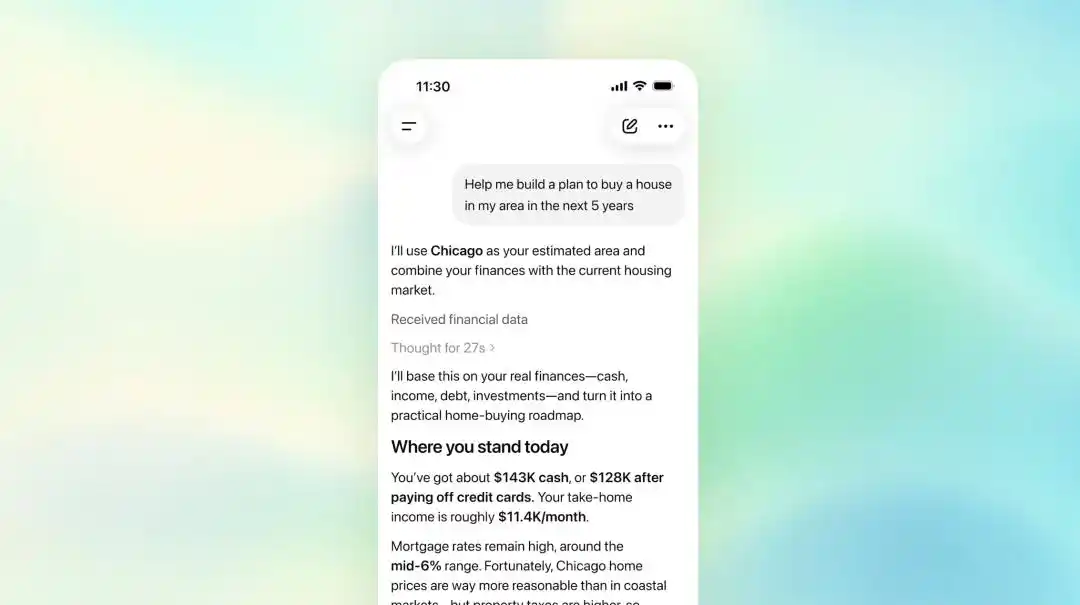
Users can directly conduct financial analysis within ChatGPT | Image source: OpenAI

Now, with Plaid's account connections and the stronger reasoning capabilities of the GPT-5.5 model, ChatGPT's goal is clear: to evolve from a "chat-about-anything" general assistant into a "super assistant" that truly understands your financial situation.

OpenAI has actually already tested this path before.

In January of this year, it launched ChatGPT Health, allowing users to connect medical records and health apps like Apple Health and MyFitnessPal. Official data shows over 230 million people ask health questions on ChatGPT weekly. From health to finance, OpenAI is shaping ChatGPT into an entry point covering all "high-value decision-making" scenarios in life.

03

Privacy Storm Arrives Faster Than the Product

But the problem is, managing money isn't like writing copy. What you're handing over isn't a prompt, but your entire financial profile.

Following the release of this feature, reactions on social media were overwhelmingly skeptical. Someone commented on Twitter: "What sane person would willingly give that level of access to OpenAI?" Others immediately brought up past issues: "You guys were just hit with a class-action lawsuit for secretly sharing ChatGPT conversation data with Google and Facebook."

This isn't baseless. Just one day before the finance feature launch, a new class-action lawsuit was filed in a California federal court, alleging that OpenAI embedded Meta Pixel and Google Analytics tracking codes in the ChatGPT webpage, transmitting chat topics, user IDs, email addresses, and other information to Meta and Google for ad targeting without user knowledge. The complaint points out that many users discuss extremely private topics like finance, health, and law on ChatGPT.
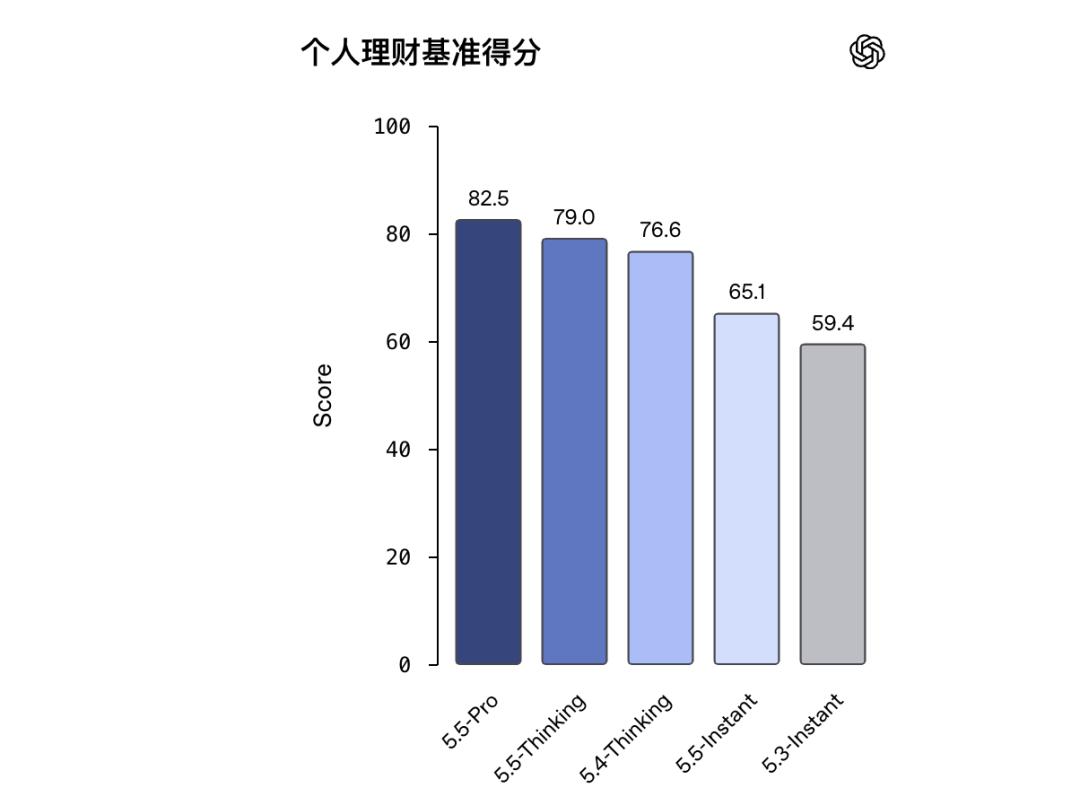
OpenAI officially stated that GPT-5.5 Pro performs better for private financial analysis | Image source: OpenAI

Getting sued for allegedly secretly sharing user chat data, then launching a new product that asks users to connect their bank accounts — this timing coincidence is almost a PR disaster-level coincidence.

OpenAI clearly recognizes the trust issue. It repeatedly emphasized in its announcement that ChatGPT cannot perform any actions on user accounts, nor can it see full account numbers; it can only read balances, transaction history, investment portfolios, and liability information. Upon disconnection, data will be deleted within 30 days. Users can also view and delete the financial "memories" ChatGPT retains.

But one detail is noteworthy — there is an optional switch in the system called "Improve the model for everyone." If users turn it on, their financial conversation data will be used to train the AI model. Although this switch is off by default, its very existence sends a signal:

Your financial data, within OpenAI's system, can theoretically become training material.

04

AI Companies Collectively Rush Towards "High-Value Data"

Viewing ChatGPT's financial tool within a broader context reveals a collective shift in the AI industry.

The era of general-purpose chatbots is ending; the war for "vertical super assistants" has begun.

OpenAI launched health in January and finance in May; Anthropic released ten professional AI Agents for the financial industry in early May, directly targeting banking, insurance, and asset management, with data sources including Moody's, S&P Capital IQ, and Morningstar — news that caused FactSet's stock to drop 8% that day. Perplexity also launched "Computer for Professional Finance" around the same time, targeting professional investment research teams, supporting connections to data sources like PitchBook and Daloopa, and offering 35 preset financial workflows.

Interestingly, Perplexity's financial product recently also started supporting user connections to brokerage accounts via Plaid — using the same infrastructure as ChatGPT. This means Plaid is becoming the underlying pipeline for the "AI finance management" era, much like Stripe for online payments.

But the strategic differences between companies are also evident. OpenAI is taking a consumer (C) route, aiming to bring every ordinary person's bank account into ChatGPT. Anthropic and Perplexity are taking a business (B) route, aiming to let financial professionals use AI to replace some functions of Bloomberg Terminal.

However, whether B or C, the core logic is the same: whoever gains access to users' most private, highest-value data occupies the entry point in the next phase of AI.

Health data, financial data, legal data — these fields are being collectively targeted by AI companies not because AI suddenly became good at finance, but because these scenarios naturally require personalization, inherently involve high-frequency interaction, and naturally have a willingness to pay.

05

The Ultimate Test for the "Super Assistant"

Returning to ChatGPT's launch. From a product logic perspective, it's actually quite well done: using Plaid connections ensures a baseline of security, read-only permissions rather than operational permissions reduce risk, and the 30-day data deletion provides an exit mechanism. OpenAI also stated it will soon support Intuit connections, allowing users to analyze the tax impact of stock sales or assess credit card approval probabilities.

But there is a chasm between a well-made product and user trust.

Sam Altman wants to turn ChatGPT into a "personal super assistant," covering every aspect of life from writing to search, from health to finance, from programming to shopping. This vision is undeniably grand. But the grander the vision, the higher the demand for trust. And OpenAI's track record on privacy issues doesn't inspire complete confidence.

A comment on Slashdot was quite direct: "Hand over your bank account to a hallucinating chatbot? Since when can AI's financial advice be written into the disclaimer?"

This is harsh but touches the core issue. There's a fundamental difference between AI financial tools and traditional financial advisors — human financial advisors are subject to financial regulation, have licenses, and bear legal responsibility; ChatGPT's terms of service clearly state it does not provide investment advice and bears no financial consequences.

When a tool looks like a financial advisor, talks like a financial advisor, and even understands your spending data better than most advisors — yet legally, it is nothing of the sort — this itself is a gray area that needs serious discussion.

OpenAI says it will first gather feedback from Pro users before deciding whether to open it up to Plus users. This is a smart strategy — using the most adventurous hardcore users to "beta test." But if the trust issue isn't resolved, the larger user base might never see it.

Technically, ChatGPT is ready to manage your money.

But are you ready? This might be an unavoidable choice for everyone in the AI era.

Geek's Question

Would you be willing to connect your bank account to an AI chatbot? Why or why not?

This article is from the WeChat public account "GeekPark" (ID: geekpark), author: Huà Lín Wǔ Wáng


Trend Kriptolar

İlgili Sorular

QWhat is the new ChatGPT feature announced by OpenAI, and what does it allow users to do?

AOpenAI announced a personal finance tool for ChatGPT, currently in preview for U.S. ChatGPT Pro users. It allows users to connect their bank and investment accounts (through the financial data service Plaid) directly to ChatGPT, enabling it to analyze personal financial data and provide tailored advice.

QWhat are some of the key privacy concerns raised about this new ChatGPT feature?

AMajor privacy concerns include users handing over sensitive financial data to OpenAI, especially following recent lawsuits alleging OpenAI shared user chat data with companies like Meta and Google. There is also concern about the 'Improve the model for everyone' optional setting, which could allow financial conversation data to be used for AI training.

QHow does OpenAI's approach with its finance tool differ from that of companies like Anthropic and Perplexity in the financial AI space?

AOpenAI is targeting the consumer (C端) market, aiming to connect individual bank accounts to ChatGPT for personal finance management. In contrast, Anthropic and Perplexity are focused on the business/professional (B端) market, providing AI tools for financial professionals with data from sources like Moody's and PitchBook, aiming to replace parts of platforms like Bloomberg Terminal.

QWhat previous acquisitions did OpenAI make to build its finance capabilities?

ATo build its finance capabilities, OpenAI acquired the personal finance app Roi in October 2025 and the personal finance startup Hiro Finance in April 2026. These acquisitions brought in founders and teams with fintech expertise to form a 'financial commando unit' within OpenAI.

QAccording to the article, what is a fundamental legal distinction between an AI like ChatGPT and a human financial advisor?

AA fundamental legal distinction is that human financial advisors are regulated, licensed, and bear legal liability for their advice. In contrast, ChatGPT's terms of service clearly state that it does not provide investment advice and bears no responsibility for financial outcomes, creating a significant regulatory grey area.

İlgili Okumalar

STAR 50 Soars 10.73%, Why Did A-Shares Stage a "V-Shaped Reversal"?

After a prolonged decline, the Chinese A-share market staged a strong rally on July 21. The STAR 50 index surged 10.73%, its largest single-day gain in nearly a year, leading a broad-based "V-shaped" reversal. The Shanghai Composite Index rose 1.79%, the Shenzhen Component Index gained 4.81%, and the ChiNext Index jumped 7.05%. Total market turnover reached 2.97 trillion yuan, an increase of 256.1 billion yuan from the previous session, with over 3,100 stocks advancing. The semiconductor sector spearheaded the rebound, with related ETFs posting significant gains. Analysts attribute the surge to three converging factors. First, coordinated capital inflows from "national team" institutions, insurance funds, listed company buybacks, and fund house self-purchases have bolstered market liquidity and confidence. Second, supportive policy signals, including commitments from regulators to ensure stable market operations, provided a favorable backdrop. Third, a stabilization and recovery in overseas markets, notably South Korea, created a positive external environment. Institutions suggest the most severe panic selling phase for the tech sector has likely passed, following a significant digestion of crowded positions and leveraged funds. While short-term volatility may persist, the medium to long-term outlook remains underpinned by enduring trends like AI computing demand expansion and semiconductor localization. The market's focus now shifts to the sustainability of supportive fund flows, earnings reports, and upcoming catalysts from the global AI industry chain.

marsbit28 dk önce

STAR 50 Soars 10.73%, Why Did A-Shares Stage a "V-Shaped Reversal"?

marsbit28 dk önce

U.S. Tech Momentum Stocks Post Largest Single-Day Gain Ever, But Is the Plunge Over?

US tech momentum stocks staged a sharp rebound on Tuesday (July 21st). Morgan Stanley's TMT Momentum Factor surged over 12%, marking its largest single-day gain on record, exceeding even peaks from the 2000 dot-com bubble. Key momentum indices from Goldman Sachs also posted their strongest daily performances in years. The rally was led by semiconductors, with the Philadelphia Semiconductor Index jumping 4.6%. This rebound followed three consecutive down days and a cumulative 33% plunge in momentum stocks, one of the steepest drawdowns since the dot-com era. Analysts attribute the surge largely to a short squeeze. Heavy selling had pushed high-beta momentum stocks into deeply oversold territory, forcing many short sellers, particularly in Asia, to cover their positions, creating a self-reinforcing buying spiral. However, the rebound's internals appear weak. Trading volume was notably low, and advancing stocks still lagged decliners on the S&P 500, indicating a narrow, concentrated rally rather than broad market participation. Diverging views emerge on the outlook. BTIG warns the bounce has hit key resistance and recommends selling into strength, citing extreme volatility and historical parallels to past market tops. Conversely, Goldman Sachs and UBS believe the momentum unwind is nearing its end, suggesting it may be time to gradually add exposure, as positioning has been significantly reduced. They caution, however, that high volatility warrants a measured approach, potentially using defined-risk strategies. The upcoming earnings season, particularly reports from major tech firms like Alphabet, is seen as a critical test for the rally's sustainability. Simultaneously, bond markets flashed a warning, with yields rising partly due to spiking oil prices. Analysts note that if long-term Treasury yields break decisively higher, it could pose a significant headwind for equities, especially growth stocks.

marsbit35 dk önce

U.S. Tech Momentum Stocks Post Largest Single-Day Gain Ever, But Is the Plunge Over?

marsbit35 dk önce

U.S. Tech Momentum Stocks Record Largest Single-Day Gain Ever, but Has the Rout Ended?

U.S. tech momentum stocks staged a dramatic rebound on Tuesday, July 21st. Key momentum indices like the Morgan Stanley TMT Momentum Factor and Goldman Sachs' High Beta Momentum Long Index posted historic or near-historic single-day gains, fueled largely by semiconductor stocks. This sharp rally followed a severe three-day sell-off that saw momentum stocks plunge 33%, marking one of the steepest pullbacks since the dot-com bubble. Analysts attribute the bounce primarily to a short squeeze, as forced covering from over-leveraged traders, particularly in Asia, created a buying spiral. However, the rally's health is questioned due to weak market breadth—overall trading volume was low, and decliners outnumbered advancers in the S&P 500 despite the index's gain—suggesting a narrow, concentrated surge rather than broad recovery. Opinions on the sustainability diverge. BTIG strategists warn the rebound has hit key resistance levels, citing extreme volatility and historic stock dispersion as signs of an ongoing broader correction, and recommend selling into strength. Conversely, Goldman Sachs and UBS view the aggressive momentum unwinding as nearing its end, noting reduced positioning and a lack of new fundamental catalysts. They suggest the sell-off presents a selective opportunity to add exposure, albeit cautiously and gradually using defined-risk strategies. The immediate trajectory hinges on the ongoing earnings season, with market focus on Alphabet's capital expenditure guidance for AI investment clarity. Meanwhile, bond markets present a risk, with rising Treasury yields—potentially heading toward 5.5%—and widening credit spreads for mega-cap tech companies posing a threat to equity valuations. The combination of technical factors, earnings results, and macro conditions leaves the durability of the rebound in doubt.

链捕手37 dk önce

U.S. Tech Momentum Stocks Record Largest Single-Day Gain Ever, but Has the Rout Ended?

链捕手37 dk önce

Long-Divided Must Unite, Long-United Must Divide: When L1 Becomes Its Own Rollup, What Is Ethereum's Endgame?

"The Inevitable Cycle: When L1 Becomes Its Own Rollup – What is Ethereum's Endgame?" For years, the Ethereum community grappled with concerns that L2s were fragmenting the ecosystem and eroding L1's value. While L2s provided cheaper execution, they also splintered liquidity and the unified user experience of a single chain. This has prompted a fundamental reassessment of the relationship between L1 and L2. Ethereum's roadmap is evolving. The "Scale" initiative merges L1 and L2 expansion into a holistic framework. L1 itself is advancing with higher gas limits, statelessness, and zkEVM verification, no longer content to be just a low-throughput settlement layer. Consequently, the primary value proposition of L2s is shifting from merely providing cheap blockspace to offering L1 cannot easily provide: application-specific optimizations, privacy features, and flexible governance models. L2s are becoming a spectrum of execution environments with varying degrees of security inheritance from Ethereum. A critical challenge in this multi-chain future is interoperability. The vision is to make Ethereum "feel like one chain again." This relies on advancements in native account abstraction (like EIP-7702) and intent-based architectures (Open Intents Framework), where users declare desired outcomes, and solvers handle the complex cross-chain execution. Furthermore, shortening Ethereum's finality time from minutes to seconds is crucial, as it underpins trust between chains for bridges, stablecoins, and cross-chain applications. Perhaps the most provocative idea is that Ethereum L1 itself could become a form of "its own Rollup." As zkEVM and proof systems mature, high-performance nodes could execute transactions and generate validity proofs. Regular validators would then verify these proofs instead of re-executing all transactions. This blurs the traditional L1/L2 hierarchy, making "Rollup" more of a general execution-verification architecture. Native Rollup aims to integrate L2 validation more directly into the Ethereum protocol, allowing L2s to inherit L1's security more fully and move away from reliance on security councils. In the end, L2s are not destined to replace L1 or be made obsolete by it. The likely future is a unified system where diverse execution environments—each optimized for specific use cases like DeFi, gaming, or privacy—coexist. They will share a common foundation of security, liquidity, and verifiable state, seamlessly connected to restore a cohesive user experience. The next phase for Ethereum is not just about scaling through separation, but about intelligently reintegrating what was separated back into a coherent whole.

链捕手54 dk önce

Long-Divided Must Unite, Long-United Must Divide: When L1 Becomes Its Own Rollup, What Is Ethereum's Endgame?

链捕手54 dk önce

İşlemler

Spot

Popüler Makaleler

$BANK Nedir

Bank AI: Bankacılıkta Devrimsel Bir Adım Giriş Teknolojideki hızlı ilerlemelerin damgasını vurduğu bir çağda, Bank AI, yapay zeka (AI) ve bankacılık hizmetleri kesişiminde yer almaktadır. Bu yenilikçi proje, finansal manzarayı yeniden tanımlamayı, operasyonel verimliliği, güvenlik önlemlerini ve müşteri deneyimlerini AI'nin gücüyle geliştirmeyi hedefliyor. Bank AI yolculuğuna çıkarken, projenin içeriğine, operasyonel dinamiklerine, tarihsel bağlamına ve önemli kilometre taşlarına dalacağız. Bank AI Nedir? Bank AI, yapay zekanın çeşitli bankacılık operasyonlarına entegrasyonunu hedefleyen dönüştürücü bir girişimi temsil etmektedir. Bu proje, süreçleri otomatikleştirmek, risk yönetimi protokollerini geliştirmek ve kişiselleştirilmiş hizmetler aracılığıyla müşteri etkileşimini artırmak için AI'nin yeteneklerinden yararlanmaktadır. Bank AI'nin temel hedefleri şunlardır: Bankacılık Fonksiyonlarının Otomasyonu: AI teknolojilerini kullanarak, Bank AI rutin görevleri otomatikleştirmeyi, insan kaynakları üzerindeki yükü azaltmayı ve verimliliği artırmayı amaçlamaktadır. Geliştirilmiş Risk Yönetimi: Proje, dolandırıcılık ve diğer tehditlere karşı güvenlik önlemlerini güçlendirerek riski tahmin edip tanımlamak için AI algoritmalarını kullanmaktadır. Bankacılık Hizmetlerinin Kişiselleştirilmesi: Bank AI, müşteri verilerini ve davranışlarını analiz ederek, özel finansal ürünler ve hizmetler sunmaya odaklanmaktadır. Müşteri Deneyimini İyileştirme: Chatbotlar ve sanal asistanlar gibi AI destekli çözümlerin uygulanması, kullanıcıların daha insana yakın etkileşimler yaşamasını sağlamayı hedeflemekte, bankalarla etkileşim biçimlerini devrim niteliğinde değiştirmektedir. Bu hedeflerle, Bank AI, bankacılığı daha verimli, güvenli ve kullanıcı odaklı hale getiren önemli bir oyuncu olarak kendini konumlandırmaktadır. Bank AI'nin Yaratıcısı Kimdir? Bank AI'nin yaratıcısı hakkında detaylar bilinmemektedir. Bu nedenle, mevcut bilgilerde belirli bir kişi veya organizasyon tanımlanmamıştır. Projenin başlangıcı etrafındaki anonimlik soruları gündeme getirse de, bunun iddialı vizyonu ve hedefleri üzerinde bir olumsuz etkisi yoktur. Bank AI'nin Yatırımcıları Kimlerdir? Proje yaratıcılarında olduğu gibi, Bank AI'nin yatırımcıları veya destekleyen organizasyonları hakkında da özel bilgiler açıklanmamıştır. Bu bilgiler olmadan, projenin ilerlemesini destekleyen finansal destek ve kurumsal destek hakkında bir çerçeve çizmek zordur. Yine de, böyle yenilikçi bir alanda gelişimi sürdürmek için sağlam bir yatırım temelinin önemi büyüktür. Bank AI Nasıl Çalışır? Bank AI, geleneksel bankacılık çerçevelerinden ayıran benzersiz faktörlere odaklanarak birden fazla yenilikçi alanda faaliyet göstermektedir. İşte temel operasyonel özellikler: Otomasyon: Makine öğrenimi algoritmalarını uygulayarak, Bank AI bankalar içindeki çeşitli manuel süreçleri otomatikleştirir. Bu, operasyonel maliyetleri azaltır ve insan çalışanların daha stratejik faaliyetlere yönelmelerini sağlar. Gelişmiş Risk Yönetimi: Risk yönetimi uygulamalarına AI entegrasyonu, bankaların dolandırıcılık gibi potansiyel tehditleri doğru bir şekilde tahmin etme araçlarıyla donatılmasını sağlar, böylece müşteri bilgileri ve varlıkları güvence altına alınır. Özelleştirilmiş Finansal Tavsiyeler: Müşteri etkileşimlerinden sürekli olarak öğrenerek, AI sistemleri kullanıcı ihtiyaçlarının daha iyi anlaşılmasını sağlar ve finansal kararlar hakkında özelleştirilmiş tavsiyeler sunar. Geliştirilmiş Müşteri Etkileşimleri: AI destekli chatbotlar ve sanal asistanlar kullanarak, Bank AI daha etkileşimli bir müşteri deneyimi sunar, kullanıcıların sorularını hızlı bir şekilde çözmelerine imkan tanır, bekleme sürelerini azaltır ve memnuniyet seviyelerini artırır. Bu operasyonel özellikler, Bank AI'yi bankacılık sektöründe bir öncü olarak konumlandırmakta ve hizmet sunumu ile operasyonel mükemmeliyet için yeni standartlar belirlemektedir. Bank AI Zaman Çizelgesi Bank AI'nin gidişatını anlamak için tarihsel bağlamına bir göz atmak gerekmektedir. Aşağıda önemli kilometre taşlarını ve gelişmeleri vurgulayan bir zaman çizelgesi bulunmaktadır: 2010'ların Başları: AI entegrasyonunun bankacılık hizmetlerine olan ilgisi arttı, bankacılık kurumları potansiyel faydalarını tanımaya başladılar. 2018: Bankaların temel müşteri hizmetleri ve geliştirilmiş güvenlik yönetimi için risk yönetim sistemlerinde chatbotlar gibi AI araçları kullanmaya başlamasıyla AI teknolojilerinin uygulanmasında belirgin bir artış yaşandı. 2023: AI'nin karmaşıklığı artmaya devam etti ve belge işleme ile gerçek zamanlı yatırım analizi gibi daha karmaşık görevler için üretken AI devreye alındı. Bu yıl, AI teknolojisi sayesinde bankaların sahip olduğu yeteneklerde önemli bir sıçrama yaşandı. 2024-Güncel Durum: Bu yıl itibarıyla, Bank AI yükselişte, devam eden araştırmalar ve geliştirmeler bankacılık operasyonlarındaki yetenekleri daha da artırmaya hazırlanıyor. AI uygulamalarının sürekli araştırılması, heyecan verici gelişmelere işaret etmektedir. Bank AI Hakkında Anahtar Noktalar Bankacılıkta AI Entegrasyonu: Bank AI, bankacılık süreçlerini kolaylaştırmak ve kullanıcı deneyimlerini geliştirmek için yapay zekanın benimsenmesine odaklanmaktadır. Otomasyon ve Risk Yönetimi Vurgusu: Proje, rutin görevlerin yükünü azaltmayı amaçlarken, tahmine dayalı analizlerle güvenlik çerçevelerini geliştirmeye büyük önem vermektedir. Kişiselleştirilmiş Bankacılık Çözümleri: Müşteri verilerinden yararlanarak, Bank AI bireysel kullanıcı ihtiyaçlarına yönelik özelleştirilmiş bankacılık hizmetleri sunar. Gelişime Bağlılık: Bank AI, teknolojinin sürekli evrimi ile uyumlu olmasını sağlamak ve güncel kalmak için sürekli araştırma ve geliştirme çabalarına bağlı kalmaktadır. Sonuç Özetle, Bank AI bankacılık endüstrisinde önemli bir adımı temsil etmekte, yapay zekayı kullanarak operasyonel paradigmaları yeniden şekillendirmekte, güvenliği artırmakta ve müşteri memnuniyetini teşvik etmektedir. Yaratıcı ve yatırımcılar hakkındaki bilgi eksikliklerine rağmen, Bank AI'nin net hedefleri ve işlevsel mekanizmaları, devam eden evrimi için güçlü bir temel sunmaktadır. AI teknolojisi gelişmeye ve bankacılık sektörüyle birleşmeye devam ettikçe, Bank AI finansal hizmetlerin geleceğini önemli ölçüde etkilemeye hazır durumda, bankacılıkla olan anlayışımızı ve etkileşim biçimlerimizi geliştirmektedir.

188 Toplam GörüntülenmeYayınlanma 2024.04.06Güncellenme 2024.12.03

$BANK Nedir

BANK Nasıl Satın Alınır

HTX.com’a hoş geldiniz! Lorenzo Protocol (BANK) satın alma işlemlerini basit ve kullanışlı bir hâle getirdik. Adım adım açıkladığımız rehberimizi takip ederek kripto yolculuğunuza başlayın. 1. Adım: HTX Hesabınızı OluşturunHTX'te ücretsiz bir hesap açmak için e-posta adresinizi veya telefon numaranızı kullanın. Sorunsuzca kaydolun ve tüm özelliklerin kilidini açın. Hesabımı Aç2. Adım: Kripto Satın Al Bölümüne Gidin ve Ödeme Yönteminizi SeçinKredi/Banka Kartı: Visa veya Mastercard'ınızı kullanarak anında Lorenzo Protocol (BANK) satın alın.Bakiye: Sorunsuz bir şekilde işlem yapmak için HTX hesap bakiyenizdeki fonları kullanın.Üçüncü Taraflar: Kullanımı kolaylaştırmak için Google Pay ve Apple Pay gibi popüler ödeme yöntemlerini ekledik.P2P: HTX'teki diğer kullanıcılarla doğrudan işlem yapın.Borsa Dışı (OTC): Yatırımcılar için kişiye özel hizmetler ve rekabetçi döviz kurları sunuyoruz.3. Adım: Lorenzo Protocol (BANK) Varlıklarınızı SaklayınLorenzo Protocol (BANK) satın aldıktan sonra HTX hesabınızda saklayın. Alternatif olarak, blok zinciri transferi yoluyla başka bir yere gönderebilir veya diğer kripto para birimlerini takas etmek için kullanabilirsiniz.4. Adım: Lorenzo Protocol (BANK) Varlıklarınızla İşlem YapınHTX'in spot piyasasında Lorenzo Protocol (BANK) ile kolayca işlemler yapın.Hesabınıza erişin, işlem çiftinizi seçin, işlemlerinizi gerçekleştirin ve gerçek zamanlı olarak izleyin. Hem yeni başlayanlar hem de deneyimli yatırımcılar için kullanıcı dostu bir deneyim sunuyoruz.

775 Toplam GörüntülenmeYayınlanma 2025.05.09Güncellenme 2026.06.02

BANK Nasıl Satın Alınır

Tartışmalar

HTX Topluluğuna hoş geldiniz. Burada, en son platform gelişmeleri hakkında bilgi sahibi olabilir ve profesyonel piyasa görüşlerine erişebilirsiniz. Kullanıcıların BANK (BANK) fiyatı hakkındaki görüşleri aşağıda sunulmaktadır.

活动图片