Chasing Beta, Letting Go of Alpha: The Harsh Conclusion from a Century of U.S. Stock Market Data

比推2026-01-07 tarihinde yayınlandı2026-01-07 tarihinde güncellendi

Özet

Based on an analysis of 100 years of U.S. stock market data, this article argues that investors should prioritize market returns (Beta) over the pursuit of outperforming the market (Alpha). The author illustrates that even a skilled investor generating significant Alpha can underperform a simple index fund if their investment period coincides with a weak market cycle. For example, an investor with a +5% annual Alpha from 1960-1980 would have achieved lower real returns than a poor investor with a -5% Alpha who invested during the strong 1980-2000 bull market. Historical data shows that even with a 3% annual advantage, an active investor still had a 25% probability of underperforming the index over 20-year periods. The core conclusion is that market performance (Beta) is a far more critical determinant of ultimate returns than investment skill (Alpha). Since investors cannot control market cycles, the article suggests this is actually liberating. It allows individuals to redirect their energy away from the futile pressure to "beat the market" and toward factors they can control: optimizing their career, savings rate, health, and family. The potential financial and personal gains from excelling in these areas are argued to be vastly more significant than the marginal benefits of seeking Alpha. The advice for 2026 is to "chase Beta, not Alpha."

Author: Nick Maggiulli, Finance Blogger & Author of "Just Keep Buying"

Compiled by: Felix, PANews

Original Title: A Century of U.S. Stock Market Revelations: Why We Should Chase Beta and Forget Alpha


The investment world widely believes that alpha, or the ability to outperform the market, is the goal investors should pursue. This is entirely logical. All else being equal, more alpha is always better.

However, having alpha does not always mean better investment returns. Because your alpha always depends on the market's performance. If the market performs poorly, alpha may not necessarily bring you profits.

For example, imagine two investors: Alex and Pat. Alex is very skilled at investing, outperforming the market by 5% every year. Pat, on the other hand, is a poor investor, underperforming the market by 5% each year. If Alex and Pat invest during the same period, Alex's annual return will always be 10% higher than Pat's.

But what if Pat and Alex start investing at different times? Is it possible that despite Alex's superior skills, Pat ends up with higher returns than Alex?

The answer is yes. In fact, if Alex invests in U.S. stocks from 1960 to 1980, and Pat invests from 1980 to 2000, then after 20 years, Pat's investment returns will exceed Alex's. The chart below illustrates this:
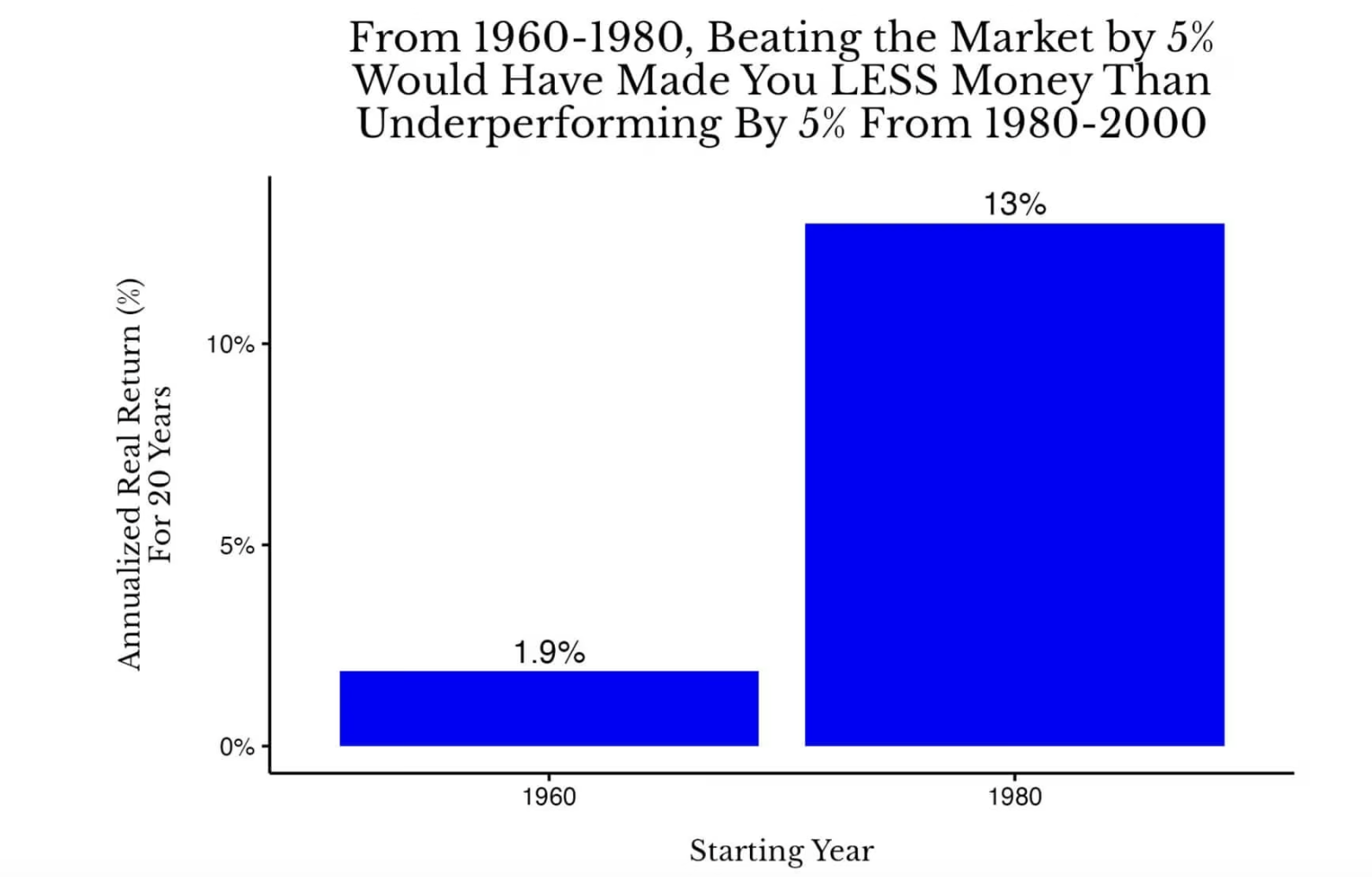
Comparison of 20-year annualized real total returns of U.S. stocks from 1960-1980 vs. 1980-2000

In this scenario, Alex's annual return from 1960 to 1980 is 6.9% (1.9% + 5%), while Pat's annual return from 1980 to 2000 is 8% (13% – 5%). Although Pat is a less skilled investor than Alex, in terms of inflation-adjusted total returns, Pat performs better.

But what if Alex's competitor is a true investor? Now assume Alex's competitor is Pat, the person who lags the market by 5% each year. But in reality, Alex's true competitor should be an index investor who earns returns equal to the market each year.

In this scenario, even if Alex outperforms the market by 10% annually from 1960-1980, he would still lag behind an index investor from 1980-2000.

Although this is an extreme example (an outlier), you might be surprised how frequently having alpha leads to underperformance relative to historical periods. As shown in the chart below:
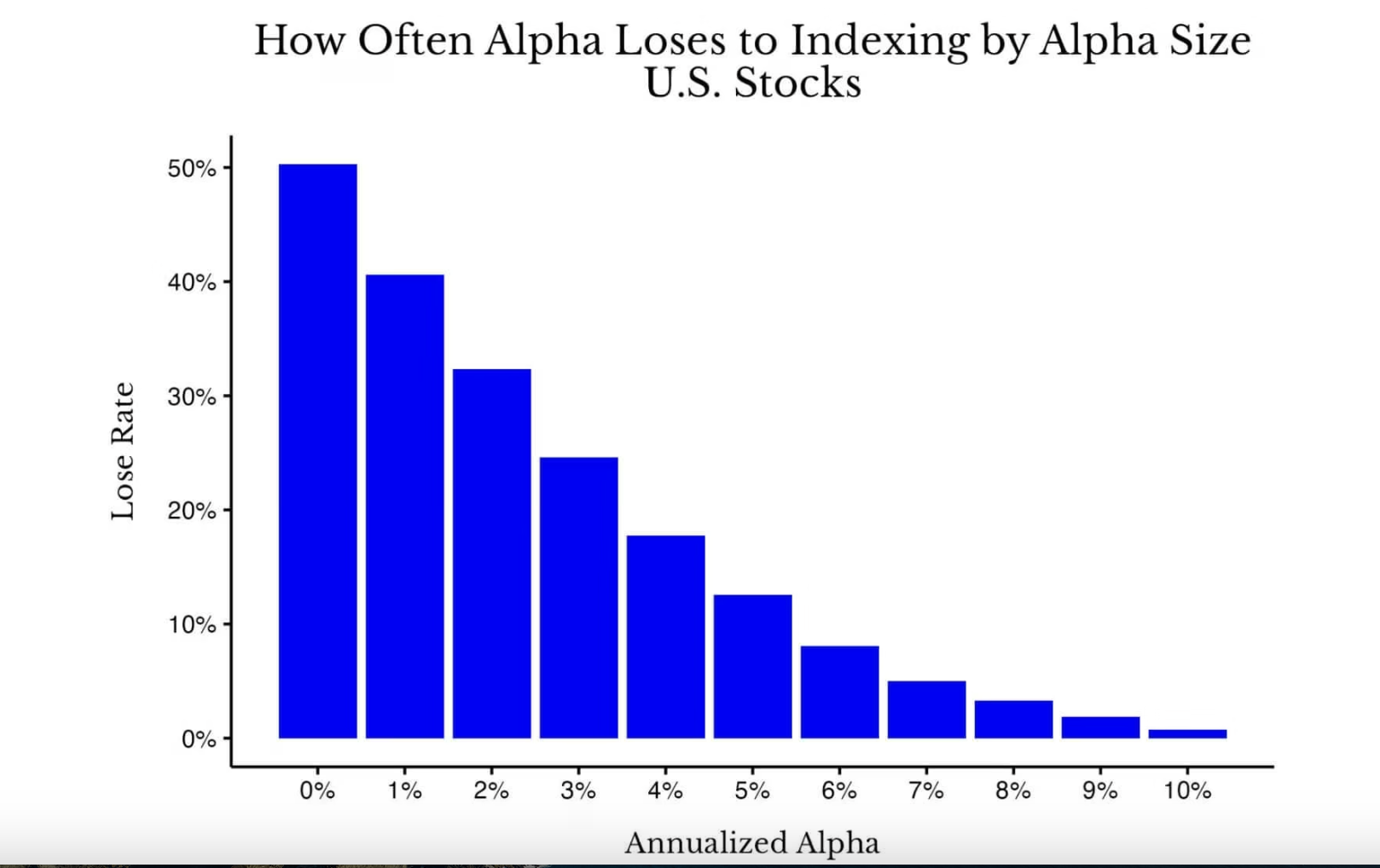
Probability of underperforming the index vs. alpha size across all 20-year periods in the U.S. stock market from 1871 to 2005

As you can see, when you have no alpha (0%), the probability of outperforming the market is essentially a coin flip (about 50%). However, as alpha increases, the compounding effect of returns does reduce the frequency of underperforming the index, but not as much as one might think. For example, even with an annual alpha of 3% over a 20-year period, there is still a 25% probability of underperforming an index fund during other periods in U.S. market history.

Of course, some might argue that relative performance is what matters, but I don't share that view. Ask yourself: would you rather have average market returns during normal times, or just "lose less money" (i.e., achieve positive alpha) during a great depression? I would certainly choose the index returns.

After all, most of the time, index returns deliver fairly good results. As shown below, the annualized real returns of U.S. stocks fluctuated by decade but were mostly positive (Note: Data for the 2020s only shows returns up to 2025):
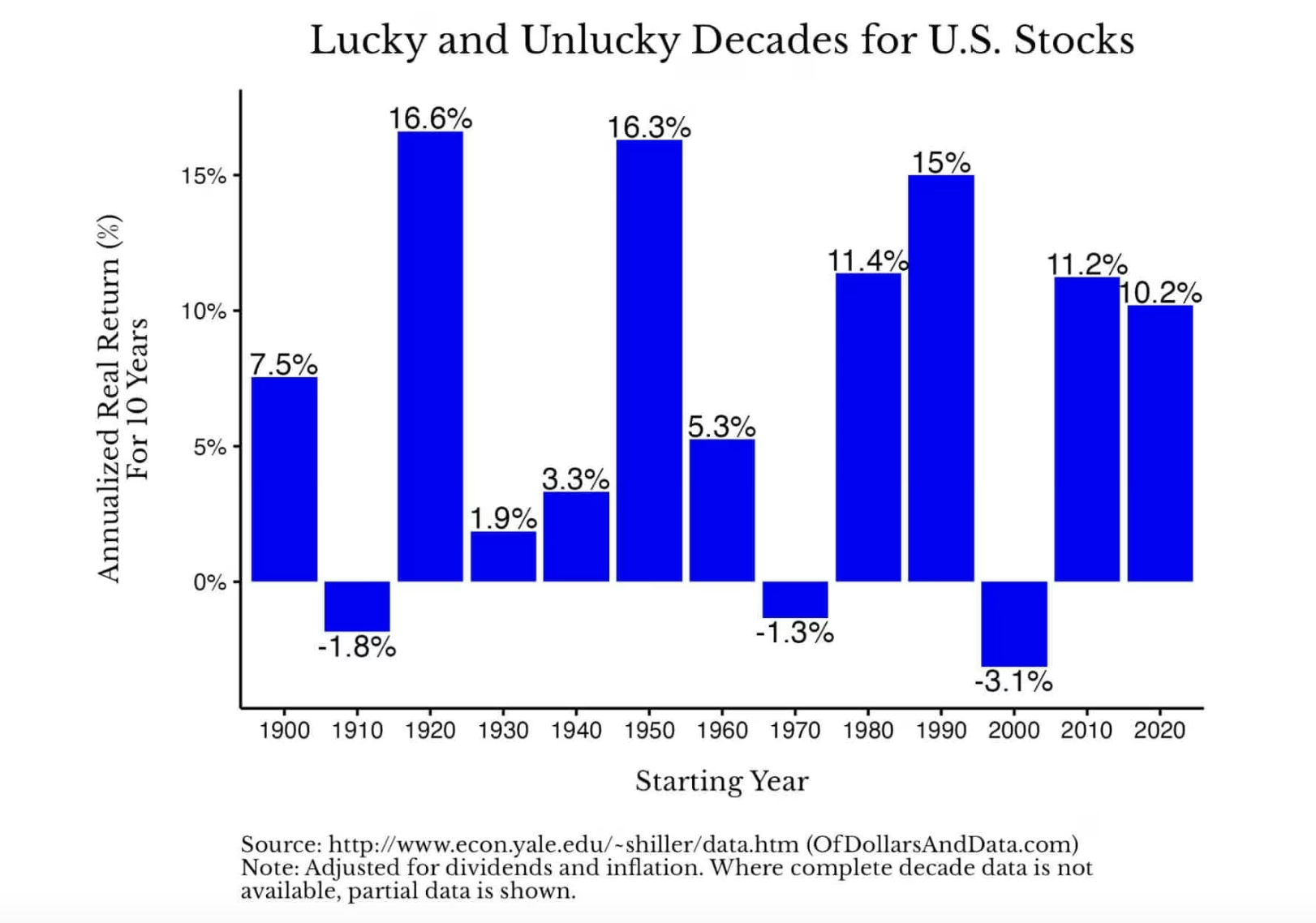
All of this shows that while investment skill is important, market performance is often more critical. In other words, pray for Beta, not Alpha.

Technically, β (Beta) measures the volatility of an asset's returns relative to the market. If a stock has a Beta of 2, it is expected to rise 2% when the market rises 1% (and vice versa). But for simplicity, market return is often referred to as Beta (i.e., a beta coefficient of 1).

The good news is that if the market doesn't provide enough "Beta" in one period, it may make up for it in the next cycle. You can see this in the chart below, which shows the 20-year rolling annualized real returns of U.S. stocks from 1871 to 2025:
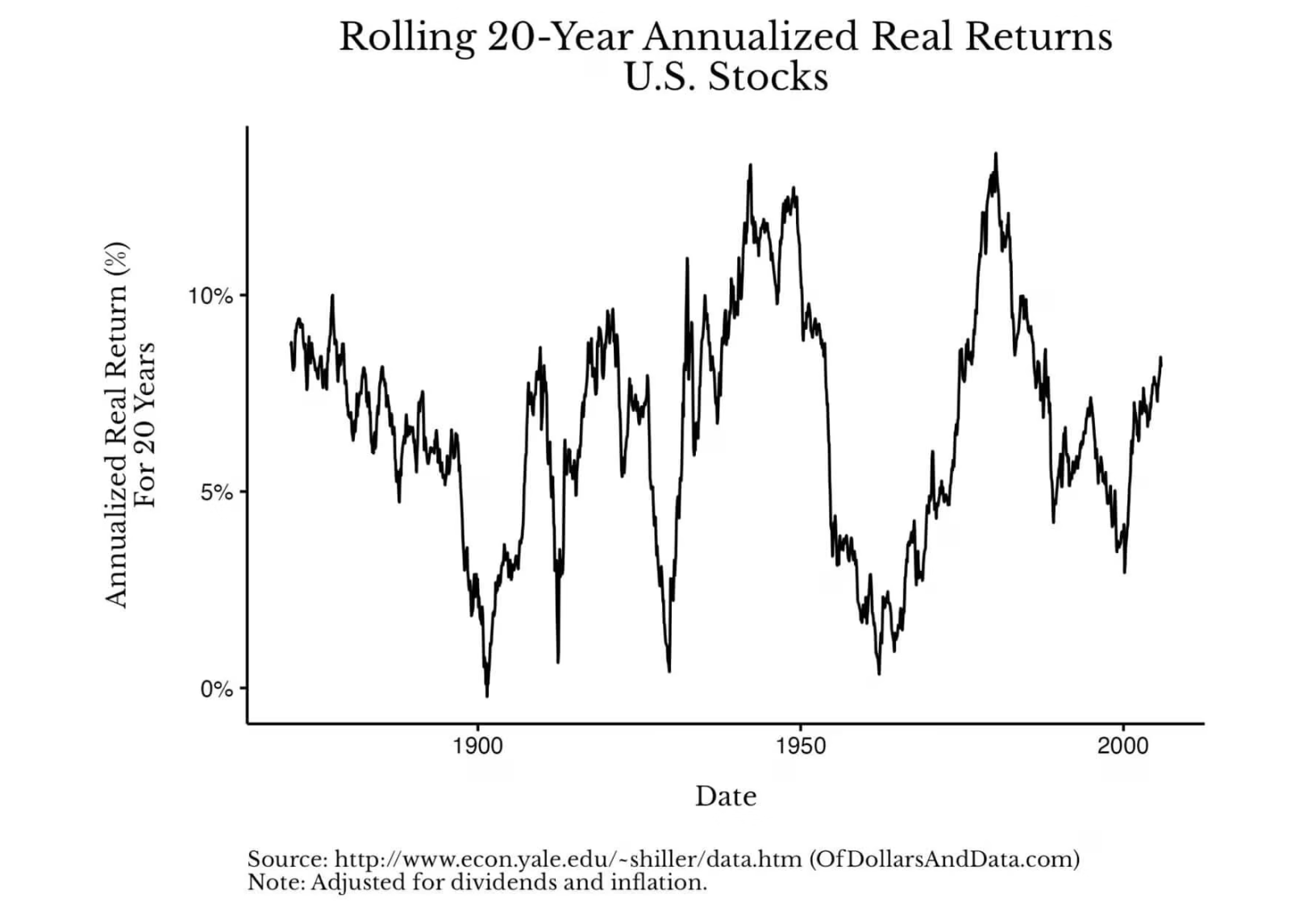
This chart visually shows how returns can rebound strongly after downturns. Taking U.S. stock history as an example, if you invested in U.S. stocks in 1900, your annualized real return over the next 20 years would be close to 0%. But if you invested in 1910, your annualized real return over the next 20 years would be about 7%. Similarly, if invested at the end of 1929, the annualized return was about 1%; whereas if invested in the summer of 1932, the annualized return was as high as 10%.

This huge difference in returns again confirms the importance of overall market performance (Beta) relative to investment skill (Alpha). You might ask, "I can't control where the market goes, so why does this matter?"

It matters because it is a relief. It frees you from the pressure of "having to beat the market" and allows you to focus on what you can truly control. Instead of feeling anxious that the market is beyond your command, see it as one less thing to worry about. See it as a variable you don't need to optimize because you simply cannot optimize it.

So what should you optimize instead? Optimize your career, savings rate, health, family, and so on. Over the long span of life, the value created in these areas is far more meaningful than苦苦追求 a few percentage points of excess returns in your investment portfolio.

Do the simple math: a 5% raise or a strategic career transition can increase your lifetime income by six figures or more. Similarly, maintaining good health is efficient risk management, significantly hedging against future medical expenses. And spending time with family sets a positive example for their future. The benefits of these decisions far exceed the gains most investors can expect from trying to outperform the market.

In 2026, focus your energy on the right things. Chase Beta, not Alpha.


Twitter:https://twitter.com/BitpushNewsCN

Bitpush TG Discussion Group:https://t.me/BitPushCommunity

Bitpush TG Subscription: https://t.me/bitpush

Original link:https://www.bitpush.news/articles/7600652

İlgili Sorular

QWhat is the main argument presented in the article regarding investment returns?

AThe article argues that market performance (Beta) is more important than investment skill (Alpha) for long-term returns. Even skilled investors with positive Alpha can underperform if they invest during a poor market period, while less skilled investors can outperform if they invest during a strong market period.

QAccording to the historical data, what is the probability of underperforming the index even with a 3% annual Alpha over 20 years?

AEven with a 3% annual Alpha over 20 years, there is still a 25% probability of underperforming the index fund, based on U.S. market data from 1871 to 2005.

QWhy does the author suggest that investors should focus on Beta rather than Alpha?

AThe author suggests focusing on Beta because market returns are largely uncontrollable, and investors should instead optimize factors they can control, such as their career, savings rate, health, and family, which can provide greater long-term value than seeking marginal investment outperformance.

QHow does the article illustrate the impact of market timing using the examples of Alex and Pat?

AAlex, who outperforms the market by 5% annually from 1960-1980, achieves a 6.9% real annual return. Pat, who underperforms the market by 5% annually from 1980-2000, achieves an 8% real annual return. This shows Pat's superior results due to better market timing, despite poorer investment skill.

QWhat does the 20-year rolling annualized real returns chart of U.S. stocks from 1871 to 2025 demonstrate?

AThe chart demonstrates that market returns tend to rebound strongly after periods of low returns, highlighting the importance of market cycles (Beta) over individual investment skill (Alpha). For example, returns were near 0% from 1900-1920 but rose to 7% from 1910-1930.

İlgili Okumalar

WeChat Agent Issues a 'Heroic Summons,' Half of the Internet Responds

WeChat AI Agent is on the horizon. The WeChat Open Platform has issued a guide for developers, offering them ways to integrate into the WeChat AI ecosystem. This will enable mini-programs to be discovered and invoked by the AI. Meituan has already announced its integration, allowing users to access services like food delivery through WeChat AI. Other platforms like Ctrip and Tongcheng have followed suit. Furthermore, WeChat is collaborating with major smartphone manufacturers to enable their native AI assistants to perform actions within WeChat, such as initiating calls or sending messages, through a controlled protocol called Agent-to-Agent (A2A). Reports indicate the WeChat AI Agent will be accessible by swiping right on the main interface. It aims to understand user intent within the rich context of chats, groups, and past interactions, then automatically call upon relevant mini-programs to complete tasks like ordering coffee or booking restaurants. This positions it as a potential "super app" with direct access to WeChat's vast ecosystem of services, social connections, and payment systems. Technically, this is a complex endeavor. It requires advanced natural language understanding, a "world model" to predict interactions within mini-programs (UI-Oceanus), multi-model orchestration for cost efficiency, and careful coordination with millions of third-party service providers. Tencent's development follows a "Co-Design" approach, where product teams and the Hunyuan model team collaborate closely, allowing capabilities honed in other AI products (like Yuanbao for chat, ima for search, WorkBuddy for office tasks) to be transferred to the WeChat Agent. Tencent is strategically opting for the A2A protocol over GUI-based automation (which it has blocked in the past), maintaining control over its ecosystem. To manage the immense scale and cost of serving 1.4 billion monthly active users, Tencent is deepening its ties with DeepSeek, known for its cost-effective training, to secure a low-cost inference backbone. The ultimate goal is to solve practical, everyday problems for users within the WeChat ecosystem, moving beyond technical benchmarks to deliver real utility, which Tencent sees as the key to winning in the long-term AI game.

marsbit3 dk önce

WeChat Agent Issues a 'Heroic Summons,' Half of the Internet Responds

marsbit3 dk önce

Humanity Loses $31 Million in Attack, Token Price Plummets 90% Due to a Single Private Key

On June 9th, the digital identity project Humanity Protocol suffered a major security breach resulting in over $31 million in losses. According to on-chain analyst Specter, hundreds of wallets holding the project's H token were drained. The attack was confirmed by founder Terence Kwok to be caused by the compromise of a foundation member's private key. As a precaution, users are advised to avoid interacting with Humanity's cross-chain bridge or liquidity pools. The incident caused the H token price to crash over 90%, from around $0.70 to a low of $0.052, wiping its market cap from $2 billion to approximately $35.7 million. The attacker allegedly minted 100 million new H tokens and is selling them for BNB. This breach adds to existing controversies surrounding Humanity Protocol. Founded in 2024, it aimed to verify human users via palm-print biometrics and zero-knowledge proofs. However, a leaked conversation in 2025 revealed that only about 1 million of its 9 million claimed Human IDs had completed biometric verification, suggesting 88% might be bots. Furthermore, the project has faced allegations of being a repackaged product from a Chinese access control vendor, raising privacy and authenticity concerns. Founder Terence Kwok's previous venture, Tink Labs, a hotel smartphone startup that raised $170 million, failed and entered bankruptcy in 2020 after burning through its funding. The current attack highlights the persistent critical issue of private key management in crypto. Unlike smart contract exploits, a private key compromise bypasses all on-chain security mechanisms. With no user compensation plan announced yet, this $31 million breach may be a final blow to the project's credibility, already weakened by previous controversies and a heavily depreciated token.

marsbit38 dk önce

Humanity Loses $31 Million in Attack, Token Price Plummets 90% Due to a Single Private Key

marsbit38 dk önce

MicroStrategy Will Not Die in This Downturn: Reflexivity, STRC Anchoring Back to Par, and the Self-Rescue Logic of "Sell Stock, Not Bitcoin"

This article analyzes the recent sharp decline in Bitcoin and MicroStrategy (MSTR), framing it as a targeted "reflexivity" attack. The trigger was MSTR using its cash reserves to buy back convertible notes, raising market concerns about a liquidity crisis. The playbook follows George Soros's principle: market expectations can shape reality. Fears that MSTR might be forced to sell BTC caused panic selling, lowering BTC's price and worsening MSTR's financial ratios, thus reinforcing the negative narrative. The author argues that MSTR's Structured Convertible (STRC), while falling in price, is a floating-rate security that will eventually return to par value (100). The price drop reflects the market demanding a higher yield due to perceived risk, but as a floating-rate instrument, its coupon can adjust, naturally pulling the price back to par over time. This is crucial for MSTR's continued ability to raise funds. The core thesis is that MSTR's best move to counter the attack is to **issue new equity (sell shares)**, not sell its Bitcoin holdings. While selling BTC would solve the immediate cash crunch, it would destroy the company's core investment thesis and premium. It would dilute the BTC per share, likely erase the market premium over its net asset value (mNAV > 1), and worsen its debt-to-asset ratio. Issuing shares while mNAV is high (e.g., 1.25x) allows MSTR to raise cash for reserves without harming shareholder value or the "perpetual accumulation" narrative. It improves the debt ratio and reassures STRC holders, breaking the negative reflexivity cycle. In conclusion, while MSTR could survive this episode even by selling BTC, doing so would fundamentally alter its investment proposition and weaken it for future cycles. The optimal, value-preserving strategy is to sell equity to rebuild reserves and maintain the long-term growth flywheel.

marsbit39 dk önce

MicroStrategy Will Not Die in This Downturn: Reflexivity, STRC Anchoring Back to Par, and the Self-Rescue Logic of "Sell Stock, Not Bitcoin"

marsbit39 dk önce

Humanity Loses $31 Million, a Private Key Causes Token Price to Plunge 90%

On June 9th, the digital identity project Humanity Protocol suffered a major security breach resulting in over $31 million stolen from hundreds of wallets holding its H token. The attack was caused by the compromise of a private key belonging to a foundation member, leading the team to advise users against interacting with its bridge or liquidity pools. Following the incident, the price of the H token plummeted by over 90%, from around $0.70 to a low of $0.052, wiping out a significant portion of its market capitalization. The attacker allegedly minted 100 million new H tokens and began selling them for BNB. Humanity Protocol, founded in 2024, aimed to verify human users through palm-print biometrics and zero-knowledge proofs on Polygon CDK. Despite raising $50 million across two funding rounds and achieving a unicorn valuation, the project faced prior controversies. Shortly after its June 2025 token launch, reports emerged that only about 1 million of its 9 million registered IDs had completed biometric verification, suggesting 88% might be bots. Furthermore, allegations surfaced that the project might be a rebranded "shell" of a Chinese access control company, raising concerns about data privacy and authenticity. The project's founder, Terence Kwok, has a controversial business history. His previous venture, Tink Labs, burned through $170 million in funding before collapsing in 2020. The breach highlights the persistent critical risk of private key management in crypto. With no user compensation plan detailed in the initial response, the incident deals a severe blow to trust in a project already struggling with credibility issues.

Foresight News1 saat önce

Humanity Loses $31 Million, a Private Key Causes Token Price to Plunge 90%

Foresight News1 saat önce

İşlemler

Spot
Futures
活动图片