Chaos Labs Exits, Who Will Take Over Aave's Risk?

marsbit2026-04-07 tarihinde yayınlandı2026-04-07 tarihinde güncellendi

Özet

Chaos Labs, the core risk management provider for Aave V2 and V3 markets, has announced its decision to terminate its partnership with Aave. Despite Aave Labs increasing the budget to $5 million to retain them, Chaos Labs chose to leave due to fundamental disagreements on how risk should be managed. Key reasons for the departure include: the loss of core Aave contributors increasing operational risk, the expanded scope and complexity introduced by Aave V4 (which requires rebuilding risk infrastructure from scratch), and the fact that Chaos Labs operated at a financial loss even with increased budgets. They estimate that proper risk management for both V3 and V4 should cost at least $8 million annually (≈5.6% of protocol revenue), closer to traditional banking standards, rather than the previous 2%. Chaos Labs emphasized that Aave’s reputation and institutional adoption rely heavily on its risk management track record. They also highlighted unquantified costs like legal liability and operational security risks. The exit occurs as Aave plans its V4 upgrade and expands into institutional markets. Chaos Labs warns that migrating to V4 while maintaining V3 will double, not halve, the workload, and that accumulated operational experience cannot be easily transferred. The decision reflects a principled stance: Chaos Labs only attaches its name to work that meets its high-risk standards, even at significant financial sacrifice.

Editor's Note: Chaos Labs has announced its decision to proactively end its risk management collaboration with Aave and is seeking early termination of this authorized relationship. As the core team that has provided risk pricing and management for all of Aave's V2 and V3 markets over the past three years, its departure comes at a critical juncture as Aave is advancing its V4 architectural restructuring and institutional expansion.

In the statement, Chaos Labs emphasized that this decision was not due to short-term budget disagreements but rather a fundamental divergence in the perception of "how risk should be managed." With the loss of core contributors, increasing system complexity, and the architectural rewrite brought by V4, the responsibilities and costs of risk management have significantly expanded, but resource allocation and priority setting have not been adjusted accordingly.

The article further points out that as DeFi gradually attracts institutional funds, the risk record itself has become the most critical "admission asset." When a protocol needs to simultaneously handle more complex system structures and higher compliance standards, risk is no longer just a technical issue but a foundational capability that determines its sustainable operation.

As DeFi enters its next phase, where should risk management be positioned, and is the industry willing to bear the corresponding costs?

Below is the original text:

Since November 2022, Chaos Labs has priced every loan initiated on Aave and managed the risks for all Aave V2 and V3 markets across various networks, during which no materially impactful bad debts occurred.

During this period, Aave's Total Value Locked (TVL) grew from $5.2 billion to over $26 billion, with cumulative deposits exceeding $2.5 trillion and over $2 billion in completed liquidations.
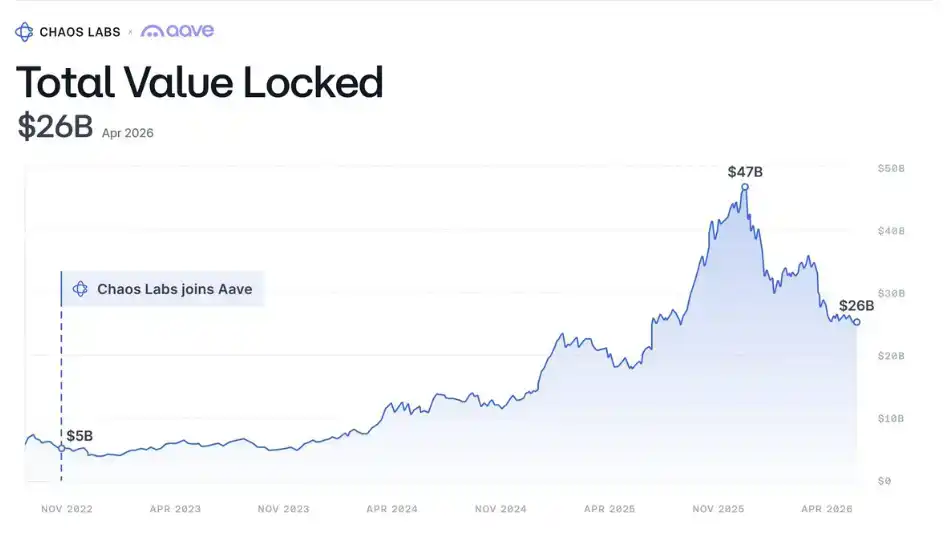
Today, we have decided to proactively end this authorized relationship and seek early termination of the collaboration.

This decision was not made hastily. We have always collaborated in good faith with DAO contributors, and Aave Labs has remained professional, even increasing the budget to $5 million to retain us. However, we chose to leave because this collaboration no longer aligns with our fundamental understanding of "how risk should be managed."

Although there are differences in future paths, I still believe Aave Labs is acting in what it perceives as the best interest of Aave.

Why We Chose to Leave

Over the past three years, we have stood with Aave through multiple market crises—moments that tested nearly every parameter we set and every machine learning model we built.

When we joined, the DAO's annualized net expenditure was negative $35 million; a few months ago, it peaked at $150 million. As one of the core contributors, we take pride in this journey.

People do not easily walk away from such an experience. Therefore, for the sake of transparency and as a reference for the DAO's future, we explain our reasons here.

Funding can solve many problems, but not all. The deeper issue lies in the structural divergence between the two parties on the fundamental question of "how to manage risk." As discussions about the future path continued, this divergence became increasingly clear.

Ultimately, the issue boils down to three points:

The departure of core Aave contributors has significantly increased the workload and operational risks;

The launch of V4 has expanded the scope of risk management functions, increasing operational and legal responsibilities, and its architecture was not designed by us, nor is it a design approach we would adopt;

Over the past three years, we have consistently operated Aave's risk management at a loss. Even with a $1 million budget increase, overall operations would still be in negative profit.

This leaves only two choices, neither of which we can accept:

Doing our best with insufficient resources but failing to meet the risk management standards expected of the "world's largest DeFi application";

Continuing to subsidize Aave's risk operations with our own funds, sustaining losses.

Even if the economic issues were resolved, the divergence in risk priorities and management approaches remains, and this cannot be solved simply by increasing the budget.

However, none of this changes our perspective on this work.

For Chaos Labs, contributing to Aave has always been an honor and a heavy responsibility. Our reputation is built on our track record. Every collaboration must be done to the standard it deserves, or not at all.

People, Technology, and Operational Experience

Aave is an excellent brand. Its leading position does not stem from the flashiest features or the most aggressive growth strategies.

What has long given Aave its advantage is its "reliability." Brand and market sentiment are essentially lagging reflections of its performance, security, and risk management capabilities—especially in extreme market conditions that have destroyed other participants. It is on this foundation that the consensus of "Just Use Aave" has gradually formed.

Competitors have launched more aggressive mechanisms and growth strategies, but they have collapsed one after another due to risk management failures or security vulnerabilities. In a market composed of the world's most volatile assets, "survivability" is the product itself. Those who can manage risk better and longer will prevail.

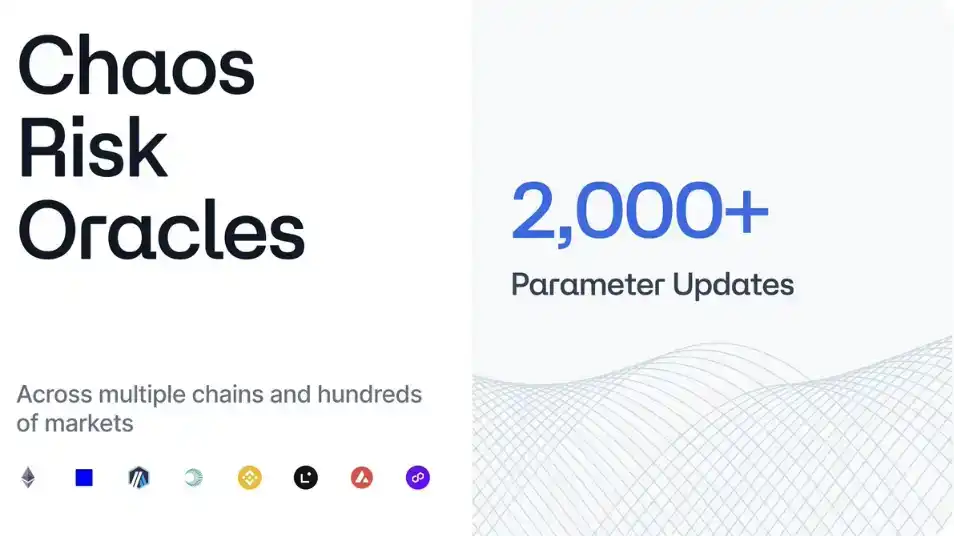
Aave's true innovation, however, lies in areas many protocols overlook: processes and infrastructure. The Risk Oracles we built and first launched on Aave enable the protocol to self-heal and update parameters in real-time based on dynamic and highly volatile market conditions. This infrastructure supports Aave's expansion to over 250 markets across 19 blockchains, handling hundreds of parameter updates monthly while maintaining rigorous operational standards, thus earning the trust it holds today.
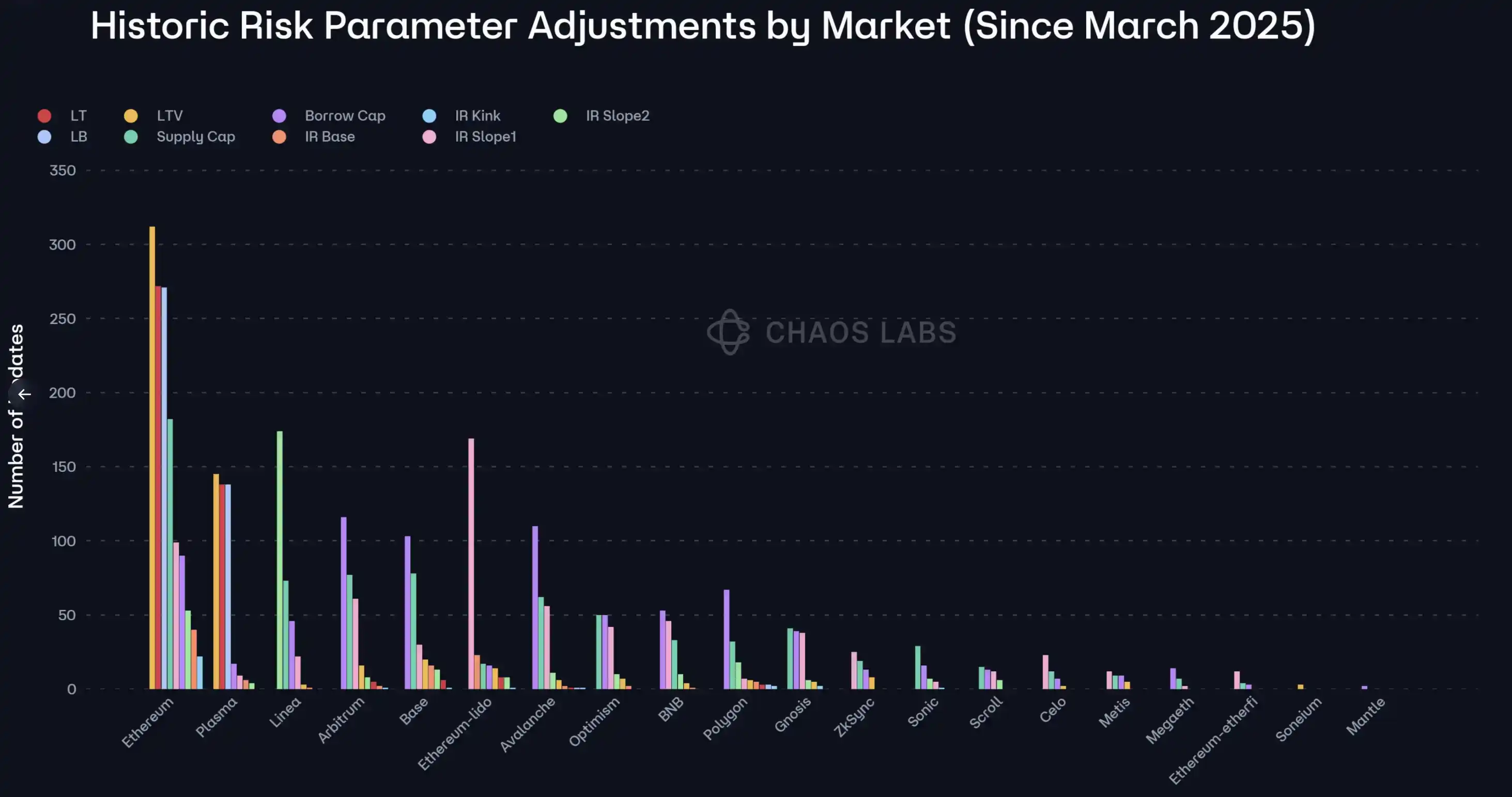
This rigor stems from a specific collaboration system and execution stack: ACI handles growth and governance (@Marczeller), TokenLogic handles treasury management and growth (@Token_Logic), BGD handles protocol engineering (@bgdlabs), and Chaos Labs handles risk management.

The brand is what the outside world sees; what truly makes it worth seeing are the people, technology, and operational experience behind it.

GTM and Institutional Expansion

Our contributions extend far beyond risk management.

Over the past few years, the crypto industry has rapidly institutionalized. The world's largest financial institutions have begun accessing DeFi, but no matter how real the on-chain yields are, they are outweighed by one prerequisite: if institutions fear client funds could be at risk, none of this matters. For any regulated entity, all discussions begin and end with risk. A few extra basis points of yield are never worth risking principal. Institutions seek risk-adjusted returns, and they will not allocate funds to a protocol they cannot "clearly explain" to their compliance teams.

Precisely because of this, Aave's risk record has become its most important GTM asset. And we, as the builders of this record, have thus been able to directly engage with these institutions. At the request of Aave Labs, we took on this role, meeting with partners globally, producing research and due diligence materials, and personally participating in Aave's institutional expansion. We also hope the DAO will continue to benefit from these accumulated efforts in the coming months.

Ship of Theseus

If every plank of a ship is replaced, is it still the same ship? The name remains, the flag remains, but the foundation is already different.

Aave is now in such a state. The core contributors who built and operated V3 have left, and the operational experience that supported Aave through market cycles over the past three years has been lost with them.

We are the last remaining technical contributor from this group.

V3 remains the largest application in DeFi, requiring 7×24×365 risk management. Although Aave Labs is optimistic about a rapid migration to V4, history shows that such migrations often take months or even years. Until V4 fully assumes V3's markets and liquidity, both systems must run in parallel. The workload does not halve; it doubles.

More critical is operational experience. Even assuming different teams have equal capability, the experience accumulated over three years of continuous operation cannot be directly handed over.

How long will it take to bridge this gap? The answer is clearly not "zero." And until the gap is closed, someone must bear this cost—a responsibility that falls almost entirely on us, while the budget is already insufficient for the expanded scope.

The continuity of the brand is not equivalent to the continuity of the system.

Why V4 Is Different

V4 is a completely new lending protocol with entirely new smart contract code, system architecture, and design paradigms. Aside from the name, it bears little resemblance to Aave V3.

Architectural changes directly impact risk: more cross-market, cross-module interdependencies,全新的信用结构, and adjusted liquidation logic. And the "second-order risks" of any new protocol only gradually apparent after real funds enter the system.

Responsibly taking over this system means rebuilding infrastructure, toolchains, and simulation systems from the ground up and redoing the entire operational process on a codebase that has not yet been market-tested. This scope is far greater than V3, and this is at the core of our decision.

Risk is downstream of architecture. When the architecture undergoes fundamental changes, risk management itself must be重构. Unlike standardized services like price oracles or reserve proofs, the Risk Oracle and its supporting systems must be customized for the specific protocol architecture. Once the architecture is rewritten, the risk infrastructure must be rebuilt.

The problem is: the scope has significantly expanded, but resources have not increased accordingly. Aave Labs may be able to accept such a trade-off, but we cannot.

The Real Cost of This

We are walking away from a historically well-functioning, $5 million collaboration. For a startup, this is by no means a decision made lightly, and thus deserves fuller context.

Remuneration is only part of it; more importantly, it's a signal: how many resources an organization dedicates to risk reflects its priority on risk.

Simultaneously, I also believe that few truly understand the actual costs, real expenditures, and risks borne by such systems. Therefore, I hope to clarify this here.

It must be clear: the DAO has every right to decide what it values and how much it is willing to pay for it. I have no objection to that. My duty is merely to judge whether these conditions are suitable for us—and this time, they are not.

Comparing Aave to a Bank

Aave often compares itself to a bank, and we use this standard for perspective. Banks typically allocate 6%–10% of their revenue to compliance and risk infrastructure. In 2025, Aave's revenue was $142 million, and our budget was $3 million, accounting for about 2%.

We estimate that the minimum risk budget for V3 + V4 should be $8 million to cover the broader risk scope, additional infrastructure, and the GTM work we have already undertaken, accounting for about 5.6% of revenue, still below the lower bound for banks.

And this comparison might even be "generous." The openness of blockchain makes it more complex and asymmetric in terms of market risk and cybersecurity risk. The protocol's open-source transparency means the attack surface is equally visible to everyone. Recent series of attacks have proven this is not a theoretical risk. We believe DeFi should invest more in risk than traditional finance, not less.

Of course, Aave's scale has almost no comparable counterpart in DeFi; banks are just a reference point to understand how much institutions that "take risk seriously" typically invest. Whether a protocol "has the ability" to invest in risk and whether it "chooses to invest" are two different things.

For Aave, capability is not the issue: the DAO holds approximately $140 million in reserves, and Aave Labs just passed a $50 million self-funding proposal. But even if resources were scarce, the cost of risk management would not change. Budgets cannot reshape the threat structure—cost is cost.

Costs That Don't Appear in the Budget

Manpower and infrastructure are only explicit costs; there are also隐性成本 that are harder to quantify but must be borne.

First, legal and institutional risk. Engaging in risk management in DeFi (whether as a risk manager or treasury manager) faces undefined liability boundaries. There is no mature regulatory framework, no "safe harbor," and no clear legal definition of what responsibility risk managers should bear when a protocol fails. When the system functions normally, this work is "invisible"; once problems arise, the responsibility does not disappear.

Second, network and operational security. Providing risk services for a protocol managing tens of billions of dollars in assets itself becomes a target for attacks. The costs of audits, monitoring, infrastructure, and internal control systems rise in tandem with user deposit规模.

These costs are not unique to us. Any team taking on this role at this scale would face the same exposure. The question is whether the collaboration structure reflects this reality.

If the upside is limited and the downside risk is unlimited, then choosing to continue is not "having faith"; it is poor risk management.

Our Principles

At Chaos, we always adhere to a simple principle: we only put our name to work we fully stand behind.

When things go well, this principle is easy to uphold; what truly matters is when it comes at a cost. Today, that cost is $5 million.

I once wrote in "The Market Crypto Never Built" what institutional-grade risk management should look like. This decision is the embodiment of that belief in reality. If we advocate for higher standards in the industry, we must first hold ourselves to those standards.

I hope V4 will succeed. If it turns out our concerns were overestimated, that would be good for the entire industry.

To the Aave community: Thank you for the trust during this time; it has been our honor.

İlgili Sorular

QWhy did Chaos Labs decide to end its risk management partnership with Aave?

AChaos Labs ended the partnership due to a fundamental disagreement with Aave on how risk should be managed, not because of short-term budget issues. The departure of core Aave contributors, increased operational risks, the expanded scope and legal responsibilities from V4's architecture (which they did not design), and operating at a financial loss for three years were key factors.

QWhat was Chaos Labs' role and contribution to Aave during their partnership?

AChaos Labs was responsible for pricing every loan and managing risk for all Aave V2 and V3 markets across multiple networks. They built risk infrastructure like Risk Oracles, handled parameter updates, and contributed to Aave's growth from $5.2B to over $26B TVL. They also supported Aave's institutional expansion by engaging with regulated entities and providing research and due diligence materials.

QHow does Chaos Labs view the importance of risk management in DeFi, especially for protocols like Aave?

AChaos Labs believes risk management is a foundational capability, not just a technical issue. In DeFi, where protocols handle volatile assets, survival and reliability are the product. A strong risk record is a critical GTM asset for attracting institutional funds, as institutions prioritize risk-adjusted returns and require clear risk explanations for compliance.

QWhat are the challenges and increased costs associated with managing risk for Aave V4 according to Chaos Labs?

AV4 is a completely new protocol with different architecture, credit structures, and liquidation logic, requiring rebuilding risk infrastructure, tools, and simulations from scratch. Managing both V3 and V4 in parallel would double the workload. Chaos Labs estimated a minimum risk budget of $8M (5.6% of revenue) for V3+V4, higher than the 2% they received, to cover expanded scope, infrastructure, and hidden costs like legal and operational security.

QWhat principle did Chaos Labs cite as the reason for their decision to leave, despite the financial impact?

AChaos Labs operates on the principle of only putting their name on work they fully stand behind. They believe that advocating for higher standards in DeFi risk management requires adhering to those standards themselves, even at a cost—in this case, foregoing a $5M partnership that no longer aligned with their risk management philosophy.

İlgili Okumalar

İşlemler

Spot
Futures

Popüler Makaleler

$S$ Nedir

SPERO'yu Anlamak: Kapsamlı Bir Genel Bakış SPERO'ya Giriş İnovasyonun manzarası gelişmeye devam ederken, web3 teknolojilerinin ve kripto para projelerinin ortaya çıkışı dijital geleceği şekillendirmede önemli bir rol oynamaktadır. Bu dinamik alanda dikkat çeken projelerden biri SPERO, $$s$$ olarak adlandırılmaktadır. Bu makale, SPERO hakkında ayrıntılı bilgi toplamak ve sunmak amacıyla, meraklılar ve yatırımcıların web3 ve kripto alanlarındaki temellerini, hedeflerini ve yeniliklerini anlamalarına yardımcı olmayı amaçlamaktadır. SPERO,$$s$$ Nedir? SPERO,$$s$$, kripto alanında merkeziyetsizlik ve blok zinciri teknolojisi ilkelerini kullanarak etkileşimi, faydayı ve finansal kapsayıcılığı teşvik eden bir ekosistem yaratmayı amaçlayan benzersiz bir projedir. Proje, kullanıcıların yenilikçi finansal çözümler ve hizmetler sunarak eşler arası etkileşimleri yeni yollarla kolaylaştırmayı hedeflemektedir. SPERO,$$s$$'nin temel amacı, bireyleri güçlendirmek ve kripto para alanındaki kullanıcı deneyimini artıran araçlar ve platformlar sağlamaktır. Bu, daha esnek işlem yöntemlerini mümkün kılmayı, topluluk odaklı girişimleri teşvik etmeyi ve merkeziyetsiz uygulamalar (dApp'ler) aracılığıyla finansal fırsatlar yaratmayı içermektedir. SPERO,$$s$$'nin temel vizyonu kapsayıcılık etrafında dönmekte olup, geleneksel finansal sistemlerdeki boşlukları kapatmayı ve blok zinciri teknolojisinin faydalarından yararlanmayı hedeflemektedir. SPERO,$$s$$'nin Yaratıcısı Kimdir? SPERO,$$s$$'nin yaratıcısının kimliği bir miktar belirsizdir, çünkü kurucusu(ları) hakkında ayrıntılı arka plan bilgisi sağlayan sınırlı kamuya açık kaynaklar bulunmaktadır. Bu şeffaflık eksikliği, projenin merkeziyetsizlik taahhüdünden kaynaklanabilir—birçok web3 projesinin paylaştığı bir etik anlayışı, bireysel tanınmanın yerine kolektif katkıları önceliklendirmektedir. Topluluk ve onun kolektif hedefleri etrafında tartışmaları merkezileştirerek, SPERO,$$s$$, belirli bireyleri öne çıkarmadan güçlendirme özünü taşımaktadır. Bu nedenle, SPERO'nun etik anlayışını ve misyonunu anlamak, tek bir yaratıcının kimliğini belirlemekten daha önemlidir. SPERO,$$s$$'nin Yatırımcıları Kimlerdir? SPERO,$$s$$, kripto sektöründe yeniliği teşvik etmeye adanmış girişim sermayedarlarından melek yatırımcılara kadar çeşitli yatırımcılar tarafından desteklenmektedir. Bu yatırımcıların odak noktası genellikle SPERO'nun misyonuyla uyumlu olup, toplumsal teknolojik ilerlemeyi, finansal kapsayıcılığı ve merkeziyetsiz yönetimi vaat eden projeleri önceliklendirmektedir. Bu yatırımcı temelleri, yalnızca yenilikçi ürünler sunan projelere değil, aynı zamanda blok zinciri topluluğuna ve ekosistemlerine olumlu katkılarda bulunan projelere de ilgi duymaktadır. Bu yatırımcıların desteği, SPERO,$$s$$'yi hızla gelişen kripto projeleri alanında dikkate değer bir rakip haline getirmektedir. SPERO,$$s$$ Nasıl Çalışır? SPERO,$$s$$, onu geleneksel kripto para projelerinden ayıran çok yönlü bir çerçeve kullanmaktadır. İşte benzersizliğini ve yeniliğini vurgulayan bazı temel özellikler: Merkeziyetsiz Yönetim: SPERO,$$s$$, kullanıcıların projenin geleceğiyle ilgili karar alma süreçlerine aktif olarak katılmalarını sağlayan merkeziyetsiz yönetim modellerini entegre etmektedir. Bu yaklaşım, topluluk üyeleri arasında sahiplik ve hesap verebilirlik duygusunu teşvik etmektedir. Token Kullanımı: SPERO,$$s$$, ekosistem içinde çeşitli işlevler sunmak üzere tasarlanmış kendi kripto para token'ını kullanmaktadır. Bu token'lar, işlemleri, ödülleri ve platformda sunulan hizmetlerin kolaylaştırılmasını sağlayarak genel etkileşimi ve faydayı artırmaktadır. Katmanlı Mimari: SPERO,$$s$$'nin teknik mimarisi, modülerlik ve ölçeklenebilirliği destekleyerek projenin evrimi sırasında ek özelliklerin ve uygulamaların sorunsuz bir şekilde entegrasyonuna olanak tanımaktadır. Bu uyum sağlama yeteneği, sürekli değişen kripto manzarasında geçerliliği sürdürmek için hayati öneme sahiptir. Topluluk Katılımı: Proje, işbirliği ve geri bildirim teşvik eden mekanizmalar kullanarak topluluk odaklı girişimlere vurgu yapmaktadır. Güçlü bir topluluk oluşturarak, SPERO,$$s$$, kullanıcı ihtiyaçlarını daha iyi karşılayabilir ve piyasa trendlerine uyum sağlayabilir. Kapsayıcılığa Odaklanma: Düşük işlem ücretleri ve kullanıcı dostu arayüzler sunarak, SPERO,$$s$$, daha önce kripto alanında yer almamış bireyler de dahil olmak üzere çeşitli bir kullanıcı tabanını çekmeyi hedeflemektedir. Bu kapsayıcılık taahhüdü, erişilebilirlik yoluyla güçlendirme misyonuyla uyumludur. SPERO,$$s$$ Zaman Çizelgesi Bir projenin tarihini anlamak, gelişim yolculuğu ve kilometre taşları hakkında kritik bilgiler sağlar. Aşağıda, SPERO,$$s$$'nin evriminde önemli olayları haritalayan önerilen bir zaman çizelgesi bulunmaktadır: Kavram Geliştirme ve Fikir Aşaması: SPERO,$$s$$'nin temelini oluşturan ilk fikirler, blok zinciri endüstrisindeki merkeziyetsizlik ve topluluk odaklılık ilkeleriyle yakından uyumlu olarak geliştirildi. Proje Beyaz Kağıdının Yayınlanması: Kavramsal aşamayı takiben, SPERO,$$s$$'nin vizyonunu, hedeflerini ve teknolojik altyapısını ayrıntılı bir şekilde açıklayan kapsamlı bir beyaz kağıt yayımlandı ve topluluk ilgisini ve geri bildirimini toplamak amacıyla sunuldu. Topluluk Oluşturma ve Erken Katılımlar: Projenin hedefleri etrafında tartışmalar yürüterek destek toplamak ve erken benimseyenler ile potansiyel yatırımcılar için bir topluluk oluşturmak amacıyla aktif iletişim çabaları gerçekleştirildi. Token Üretim Etkinliği: SPERO,$$s$$, yerel token'larını erken destekçilere dağıtmak ve ekosistem içinde başlangıç likiditesini sağlamak amacıyla bir token üretim etkinliği (TGE) gerçekleştirdi. İlk dApp'in Yayınlanması: SPERO,$$s$$ ile ilişkili ilk merkeziyetsiz uygulama (dApp) faaliyete geçti ve kullanıcıların platformun temel işlevleriyle etkileşimde bulunmalarını sağladı. Sürekli Gelişim ve Ortaklıklar: Projenin tekliflerine sürekli güncellemeler ve iyileştirmeler yapılmakta olup, blok zinciri alanındaki diğer oyuncularla stratejik ortaklıklar, SPERO,$$s$$'yi rekabetçi ve gelişen bir oyuncu haline getirmiştir. Sonuç SPERO,$$s$$, web3 ve kripto paranın finansal sistemleri devrim niteliğinde dönüştürme ve bireyleri güçlendirme potansiyelinin bir kanıtıdır. Merkeziyetsiz yönetime, topluluk katılımına ve yenilikçi tasarlanmış işlevselliğe olan bağlılığıyla, daha kapsayıcı bir finansal manzaraya doğru bir yol açmaktadır. Hızla gelişen kripto alanındaki herhangi bir yatırımda olduğu gibi, potansiyel yatırımcılar ve kullanıcılar, SPERO,$$s$$ içindeki devam eden gelişmelerle ilgili olarak kapsamlı bir araştırma yapmaları ve düşünceli bir şekilde katılmaları teşvik edilmektedir. Proje, kripto endüstrisinin yenilikçi ruhunu sergileyerek, sayısız olasılığını keşfetmeye davet etmektedir. SPERO,$$s$$'nin yolculuğu hala devam ederken, temel ilkeleri, teknoloji, finans ve birbirimizle etkileşim biçimimizi etkileyebilir.

89 Toplam GörüntülenmeYayınlanma 2024.12.17Güncellenme 2024.12.17

$S$ Nedir

AGENT S Nedir

Agent S: Web3'te Otonom Etkileşimin Geleceği Giriş Web3 ve kripto para dünyasında sürekli gelişen manzarada, yenilikler bireylerin dijital platformlarla etkileşim biçimlerini sürekli olarak yeniden tanımlıyor. Bu tür öncü projelerden biri olan Agent S, açık ajans çerçevesi aracılığıyla insan-bilgisayar etkileşimini devrim niteliğinde değiştirmeyi vaat ediyor. Otonom etkileşimlerin yolunu açarak, Agent S karmaşık görevleri basitleştirmeyi ve yapay zeka (AI) alanında dönüştürücü uygulamalar sunmayı hedefliyor. Bu detaylı inceleme, projenin karmaşıklıklarına, benzersiz özelliklerine ve kripto para alanındaki etkilerine dalacaktır. Agent S Nedir? Agent S, bilgisayar görevlerinin otomasyonunda üç temel zorluğu ele almak üzere özel olarak tasarlanmış çığır açıcı bir açık ajans çerçevesidir: Alan Spesifik Bilgi Edinimi: Çerçeve, çeşitli dış bilgi kaynaklarından ve iç deneyimlerden akıllıca öğrenir. Bu çift yönlü yaklaşım, alan spesifik bilgi açısından zengin bir veri havuzu oluşturmasını sağlar ve görev yürütmedeki performansını artırır. Uzun Görev Ufukları Üzerinde Planlama: Agent S, karmaşık görevlerin verimli bir şekilde parçalanmasını ve yürütülmesini kolaylaştıran deneyim artırımlı hiyerarşik planlama kullanır. Bu özellik, çoklu alt görevleri etkili ve verimli bir şekilde yönetme yeteneğini önemli ölçüde artırır. Dinamik, Homojen Olmayan Arayüzlerle Başlama: Proje, ajanlar ve kullanıcılar arasındaki etkileşimi geliştiren yenilikçi bir çözüm olan Ajan-Bilgisayar Arayüzü'ni (ACI) tanıtmaktadır. Çok Modlu Büyük Dil Modellerini (MLLM'ler) kullanarak, Agent S çeşitli grafik kullanıcı arayüzlerini sorunsuz bir şekilde gezinebilir ve manipüle edebilir. Bu öncü özellikler aracılığıyla, Agent S, makinelerle insan etkileşimini otomatikleştirmede karşılaşılan karmaşıklıkları ele alan sağlam bir çerçeve sunarak, AI ve ötesinde birçok uygulama için zemin hazırlıyor. Agent S'nin Yaratıcısı Kimdir? Agent S'nin kavramı temelde yenilikçi olsa da, yaratıcısı hakkında spesifik bilgiler belirsizliğini koruyor. Yaratıcı şu anda bilinmiyor, bu da projenin yeni aşamasını veya kurucu üyeleri gizli tutma stratejik tercihini vurguluyor. Anonimlikten bağımsız olarak, odak çerçevenin yetenekleri ve potansiyeli üzerinde kalıyor. Agent S'nin Yatırımcıları Kimlerdir? Agent S, kriptografik ekosistemde oldukça yeni olduğundan, yatırımcıları ve finansal destekçileri hakkında ayrıntılı bilgiler açıkça belgelenmemiştir. Projeyi destekleyen yatırım temelleri veya organizasyonları hakkında kamuya açık bilgilerdeki eksiklik, finansman yapısı ve gelişim yol haritası hakkında sorular doğuruyor. Destekleyicilerin anlaşılması, projenin sürdürülebilirliğini ve potansiyel pazar etkisini değerlendirmek için kritik öneme sahiptir. Agent S Nasıl Çalışır? Agent S'nin temelinde, çeşitli ortamlarda etkili bir şekilde çalışmasını sağlayan son teknoloji bir sistem yatmaktadır. İşleyiş modeli birkaç ana özellik etrafında inşa edilmiştir: İnsan Benzeri Bilgisayar Etkileşimi: Çerçeve, bilgisayarlarla etkileşimleri daha sezgisel hale getirmeyi amaçlayan gelişmiş AI planlaması sunar. Görev yürütmedeki insan davranışını taklit ederek, kullanıcı deneyimlerini yükseltmeyi vaat eder. Anlatı Belleği: Yüksek düzeyde deneyimlerden yararlanmak için kullanılan Agent S, görev geçmişlerini takip etmek amacıyla anlatı belleğini kullanarak karar verme süreçlerini geliştirir. Episodik Bellek: Bu özellik, kullanıcılara adım adım rehberlik sağlayarak, çerçevenin görevler gelişirken bağlamsal destek sunmasına olanak tanır. OpenACI Desteği: Yerel olarak çalışabilme yeteneği ile Agent S, kullanıcıların etkileşimleri ve iş akışları üzerinde kontrol sağlamasına olanak tanır ve Web3'ün merkeziyetsiz felsefesiyle uyumlu hale gelir. Dış API'lerle Kolay Entegrasyon: Çeşitli AI platformlarıyla uyumluluğu ve çok yönlülüğü, Agent S'nin mevcut teknolojik ekosistemlere sorunsuz bir şekilde entegre olmasını sağlar ve geliştiriciler ile organizasyonlar için cazip bir seçenek haline getirir. Bu işlevsellikler, Agent S'nin kripto alanındaki benzersiz konumuna katkıda bulunarak, karmaşık, çok aşamalı görevleri minimum insan müdahalesi ile otomatikleştirir. Proje geliştikçe, Web3'teki potansiyel uygulamaları dijital etkileşimlerin nasıl gelişeceğini yeniden tanımlayabilir. Agent S'nin Zaman Çizelgesi Agent S'nin gelişimi ve kilometre taşları, önemli olaylarını vurgulayan bir zaman çizelgesinde özetlenebilir: 27 Eylül 2024: Agent S'nin kavramı, “Bilgisayarları İnsan Gibi Kullanan Açık Bir Ajans Çerçevesi” başlıklı kapsamlı bir araştırma makalesi ile tanıtıldı ve projenin temelini sergiledi. 10 Ekim 2024: Araştırma makalesi arXiv'de kamuya açık olarak yayınlandı ve çerçevenin derinlemesine bir incelemesini ve OSWorld benchmark'ına dayalı performans değerlendirmesini sundu. 12 Ekim 2024: Agent S'nin yetenekleri ve özellikleri hakkında görsel bir içgörü sağlayan bir video sunumu yayımlandı ve potansiyel kullanıcılar ve yatırımcılarla daha fazla etkileşim sağlandı. Bu zaman çizelgesindeki işaretler, sadece Agent S'nin ilerlemesini değil, aynı zamanda şeffaflık ve topluluk katılımına olan bağlılığını da göstermektedir. Agent S Hakkında Ana Noktalar Agent S çerçevesi gelişmeye devam ederken, birkaç ana özellik öne çıkmakta ve yenilikçi doğasını ve potansiyelini vurgulamaktadır: Yenilikçi Çerçeve: İnsan etkileşimine benzer bir bilgisayar kullanımı sağlamak üzere tasarlanan Agent S, görev otomasyonuna yeni bir yaklaşım getiriyor. Otonom Etkileşim: GUI aracılığıyla bilgisayarlarla otonom olarak etkileşim kurabilme yeteneği, daha akıllı ve verimli hesaplama çözümlerine doğru bir sıçrama anlamına geliyor. Karmaşık Görev Otomasyonu: Sağlam metodolojisi ile karmaşık, çok aşamalı görevleri otomatikleştirerek süreçleri daha hızlı ve daha az hata payı ile gerçekleştirebilir. Sürekli İyileştirme: Öğrenme mekanizmaları, Agent S'nin geçmiş deneyimlerden öğrenmesini sağlar ve sürekli olarak performansını ve etkinliğini artırır. Çok Yönlülük: OSWorld ve WindowsAgentArena gibi farklı işletim ortamlarında uyumlu olması, geniş bir uygulama yelpazesine hizmet edebilmesini sağlar. Agent S, Web3 ve kripto alanında kendini konumlandırırken, etkileşim yeteneklerini artırma ve süreçleri otomatikleştirme potansiyeli, AI teknolojilerinde önemli bir ilerlemeyi temsil etmektedir. Yenilikçi çerçevesi aracılığıyla, Agent S dijital etkileşimlerin geleceğini örneklemekte ve çeşitli sektörlerde kullanıcılar için daha sorunsuz ve verimli bir deneyim vaat etmektedir. Sonuç Agent S, AI ve Web3'ün birleşiminde cesur bir sıçramayı temsil ediyor ve teknoloji ile etkileşim biçimimizi yeniden tanımlama kapasitesine sahip. Henüz erken aşamalarında olmasına rağmen, uygulama olanakları geniş ve çekici. Kritik zorlukları ele alan kapsamlı çerçevesi ile Agent S, otonom etkileşimleri dijital deneyimin ön plana çıkmasına taşımayı hedefliyor. Kripto para ve merkeziyetsizlik alanlarına daha derinlemesine girdikçe, Agent S gibi projelerin teknoloji ve insan-bilgisayar işbirliğinin geleceğini şekillendirmede önemli bir rol oynayacağı kesin.

420 Toplam GörüntülenmeYayınlanma 2025.01.14Güncellenme 2025.01.14

AGENT S Nedir

S Nasıl Satın Alınır

HTX.com’a hoş geldiniz! Sonic (S) satın alma işlemlerini basit ve kullanışlı bir hâle getirdik. Adım adım açıkladığımız rehberimizi takip ederek kripto yolculuğunuza başlayın. 1. Adım: HTX Hesabınızı OluşturunHTX'te ücretsiz bir hesap açmak için e-posta adresinizi veya telefon numaranızı kullanın. Sorunsuzca kaydolun ve tüm özelliklerin kilidini açın. Hesabımı Aç2. Adım: Kripto Satın Al Bölümüne Gidin ve Ödeme Yönteminizi SeçinKredi/Banka Kartı: Visa veya Mastercard'ınızı kullanarak anında Sonic (S) satın alın.Bakiye: Sorunsuz bir şekilde işlem yapmak için HTX hesap bakiyenizdeki fonları kullanın.Üçüncü Taraflar: Kullanımı kolaylaştırmak için Google Pay ve Apple Pay gibi popüler ödeme yöntemlerini ekledik.P2P: HTX'teki diğer kullanıcılarla doğrudan işlem yapın.Borsa Dışı (OTC): Yatırımcılar için kişiye özel hizmetler ve rekabetçi döviz kurları sunuyoruz.3. Adım: Sonic (S) Varlıklarınızı SaklayınSonic (S) satın aldıktan sonra HTX hesabınızda saklayın. Alternatif olarak, blok zinciri transferi yoluyla başka bir yere gönderebilir veya diğer kripto para birimlerini takas etmek için kullanabilirsiniz.4. Adım: Sonic (S) Varlıklarınızla İşlem YapınHTX'in spot piyasasında Sonic (S) ile kolayca işlemler yapın.Hesabınıza erişin, işlem çiftinizi seçin, işlemlerinizi gerçekleştirin ve gerçek zamanlı olarak izleyin. Hem yeni başlayanlar hem de deneyimli yatırımcılar için kullanıcı dostu bir deneyim sunuyoruz.

1.3k Toplam GörüntülenmeYayınlanma 2025.01.15Güncellenme 2025.03.21

S Nasıl Satın Alınır

Tartışmalar

HTX Topluluğuna hoş geldiniz. Burada, en son platform gelişmeleri hakkında bilgi sahibi olabilir ve profesyonel piyasa görüşlerine erişebilirsiniz. Kullanıcıların S (S) fiyatı hakkındaki görüşleri aşağıda sunulmaktadır.

活动图片