CFTC warns on prediction market insider trading as volumes hit $75B in Q1

ambcrypto2026-04-01 tarihinde yayınlandı2026-04-01 tarihinde güncellendi

Özet

The U.S. Commodity Futures Trading Commission (CFTC) has warned that insider trading laws apply to prediction markets, countering the belief that such activity operates in a regulatory gray area. A senior official stated the CFTC will aggressively pursue cases involving misuse of material non-public information, emphasizing that prediction market contracts fall under existing anti-fraud provisions. The regulator also highlighted exchanges' responsibilities to maintain surveillance systems and avoid listing easily manipulated contracts. This comes as prediction market trading volume surged to $75 billion in Q1 2026, up dramatically from $330 million in Q1 2024, driven by event-based trading on political, economic, and sports outcomes. The CFTC outlined enforcement priorities including insider trading, market manipulation, and retail fraud, while also introducing a new cooperation framework for self-reporting firms.

The U.S. derivatives regulator is sharpening its stance on prediction markets just as the sector sees explosive growth.

In remarks delivered on 31 March, a senior official at the Commodity Futures Trading Commission said insider trading laws do apply to prediction markets, pushing back against a growing narrative that such activity exists in a regulatory gray area.

The agency signaled that it will “aggressively detect, investigate, and prosecute” insider trading involving the misuse of material non-public information.

Insider trading rules extend to event contracts

The CFTC’s enforcement division emphasized that prediction market contracts fall under existing anti-fraud provisions of U.S. commodities law.

That includes trading based on misappropriated information obtained through a breach of duty, a framework commonly known as the “misappropriation theory.”

The remarks directly challenge a widely circulated belief across social media and parts of the crypto industry that insider trading is either permissible or inevitable in prediction markets.

Instead, the agency made clear that such conduct can constitute fraud under the Commodity Exchange Act, particularly when confidential information is used improperly.

Exchanges face growing compliance pressure

The warning was not limited to individual traders.

The CFTC also highlighted the role of exchanges, noting that platforms must maintain surveillance systems, enforce fair trading practices, and avoid listing contracts susceptible to manipulation.

The regulator highlighted risks in certain event-based contracts, including those tied to individual actions or outcomes, where access to non-public information could distort pricing.

Record growth brings regulatory focus

The renewed scrutiny comes as prediction markets scale rapidly.

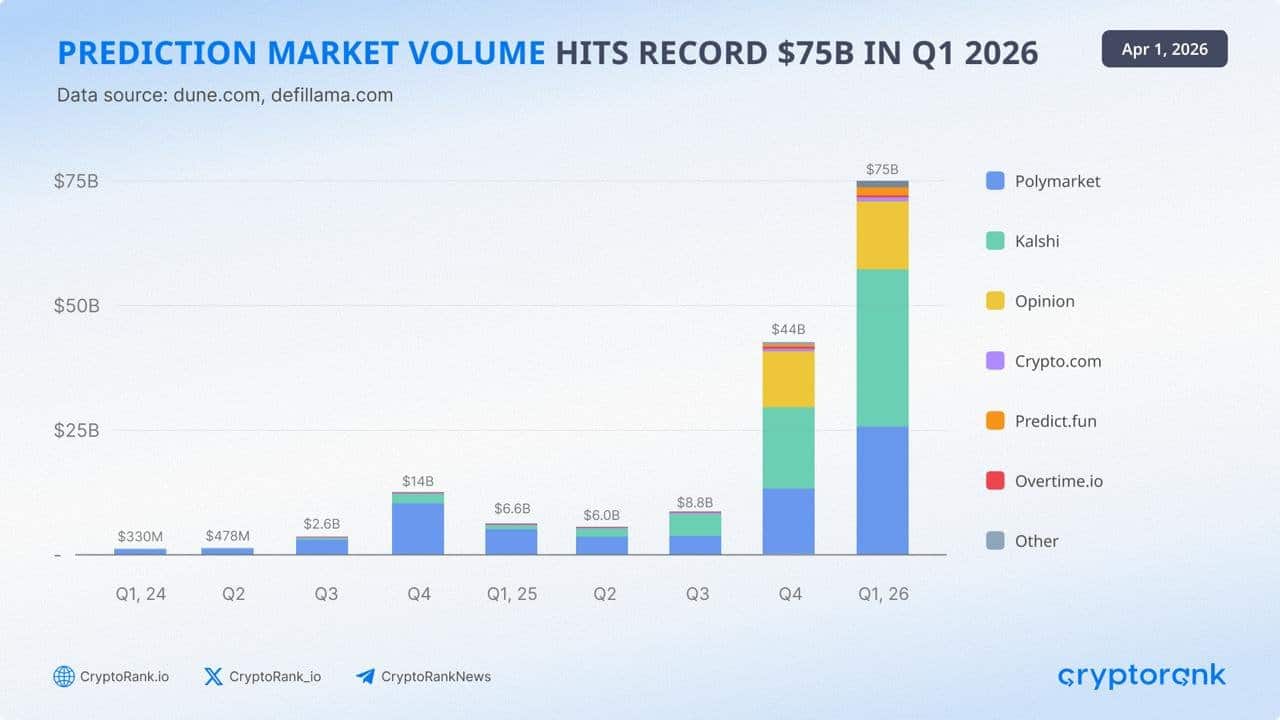
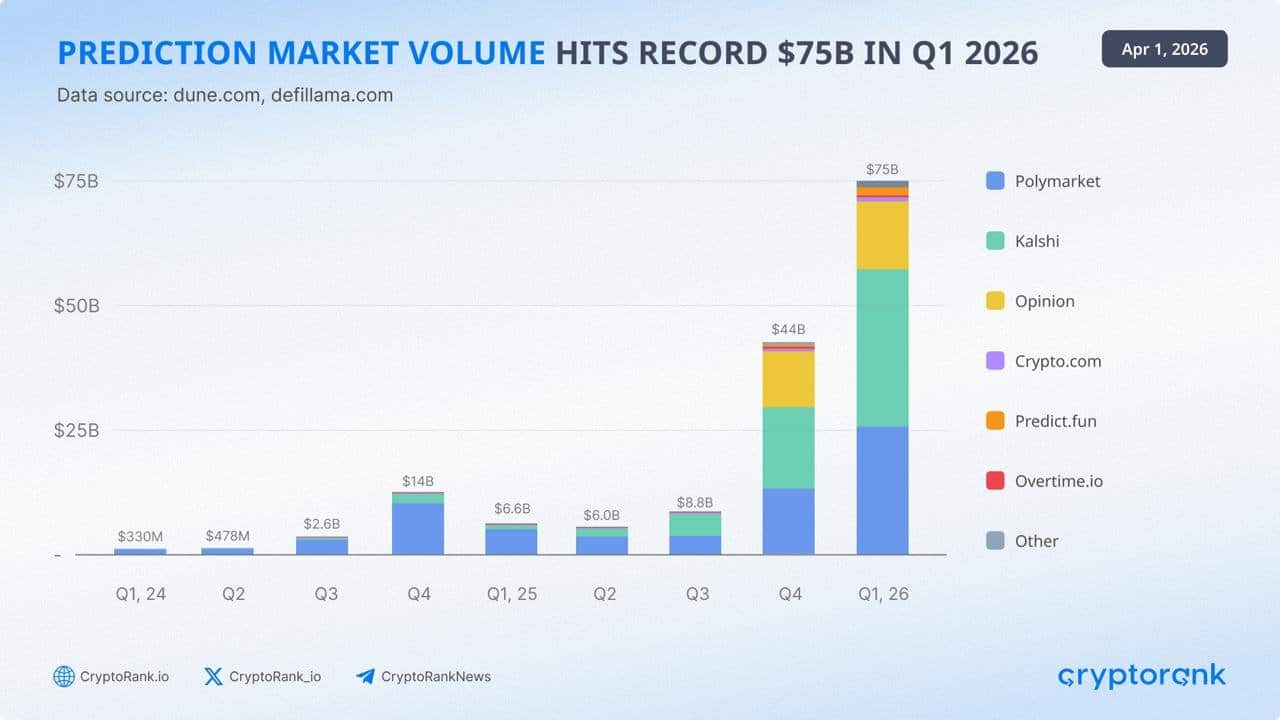
Data from CryptoRank and DeFiLlama shows total trading volume across platforms such as Polymarket and Kalshi reached $75 billion in Q1 2026, up sharply from just $330 million in Q1 2024.
Source: CryptoRank

The growth reflects increasing demand for event-based trading across political outcomes, macroeconomic indicators, and sports markets.

But with that expansion has come rising concern over market integrity, particularly around insider information and potential manipulation.

A shift in enforcement approach

The CFTC also outlined a broader shift in its enforcement approach.

While signaling an end to so-called “regulation by enforcement,” the agency identified five core priorities: insider trading, market manipulation, disruptive trading practices, retail fraud, and willful violations of AML and KYC rules.

At the same time, it plans to introduce a new cooperation framework that could offer declinations for firms that self-report, fully cooperate, and remediate misconduct.


Final Summary

  • Prediction markets have grown rapidly to $75 billion in quarterly volume, drawing increased regulatory scrutiny over insider-trading risks.
  • The CFTC has made clear that insider trading laws apply to these markets, signaling more active enforcement as the sector grows.


İlgili Sorular

QWhat is the CFTC's stance on insider trading in prediction markets according to the article?

AThe CFTC has made clear that insider trading laws apply to prediction markets, and it will 'aggressively detect, investigate, and prosecute' such activity, particularly the misuse of material non-public information.

QWhat was the total trading volume for prediction markets in Q1 2026, and how does it compare to Q1 2024?

AThe total trading volume across prediction market platforms reached $75 billion in Q1 2026, which is a sharp increase from just $330 million in Q1 2024.

QBesides individual traders, who else did the CFTC warn about compliance in its remarks?

AThe CFTC also warned exchanges, highlighting that platforms must maintain surveillance systems, enforce fair trading practices, and avoid listing contracts that are susceptible to manipulation.

QWhat legal framework did the CFTC's enforcement division say prediction market contracts fall under?

AThe CFTC's enforcement division emphasized that prediction market contracts fall under the existing anti-fraud provisions of U.S. commodities law.

QWhat are the five core enforcement priorities the CFTC identified?

AThe five core enforcement priorities identified by the CFTC are: insider trading, market manipulation, disruptive trading practices, retail fraud, and willful violations of AML and KYC rules.

İlgili Okumalar

In Jinjiang, Fujian, a Storage Super Unicorn Lies Quiet

In Fujian's Jinjiang, a city known for sportswear, lies a quiet semiconductor giant: Fujian Jinhua Integrated Circuit Co. (JHICC). Once a promising domestic DRAM manufacturer alongside Yangtze Memory and ChangXin Memory Technologies (CXMT), its journey was derailed in 2018 when the U.S. placed it on an Entity List and filed criminal charges for alleged trade secret theft. This halted production for years. A turning point came in February 2024 when a U.S. federal court found JHICC not guilty. However, it had lost crucial time. While CXMT soared to become a top-valued A-share company in 2024, JHICC, with an estimated valuation of 80 billion RMB, was just restarting. Its current output is primarily customized DDR4 chips, not the advanced DDR5/HBM demanded for AI, but it still benefits from the broader memory chip upcycle. JHICC's story is tied to Chen Zhengkun, a veteran engineer who left Micron to lead the venture. Founded in 2016 with state-backed funding, JHICC partnered with Taiwan's UMC to develop DRAM technology. Rapid progress was cut short by the U.S. actions, which Micron initiated, partly due to its heavy reliance on the Chinese market. Post-sanctions, Chen's team worked to rebuild the production line with reduced reliance on U.S. technology. According to its records, JHICC achieved small-scale production and revenue growth under immense pressure. It now focuses on the stable "niche" DRAM market (e.g., TVs, routers) with a monthly capacity of ~40,000 wafers, aiming for 60,000 by 2026. It holds over 1,000 patents but remains on the Entity List. For Jinjiang, investing in JHICC was a bold industrial leap. The local government provided unwavering financial and logistical support during the crisis, helping the company survive. JHICC has become the anchor for a growing local semiconductor cluster. Though its scale lags behind domestic peers, JHICC's persistence symbolizes a hard-won foothold in a global market long dominated by Samsung, SK Hynix, and Micron. Having missed one boom, it seeks a place in the new AI-driven memory supercycle.

marsbit6 dk önce

In Jinjiang, Fujian, a Storage Super Unicorn Lies Quiet

marsbit6 dk önce

Must-Watch Events Next Week|CLARITY Act Could Face Senate Vote; SpaceX, Circle to Report Earnings (8.3-8.9)

**Summary: Key Events and Developments to Watch (August 3-9)** The upcoming week is marked by significant financial disclosures, key legislative deadlines, and notable product updates. **Major Financial Events:** Several companies are scheduled to release their Q2 2026 earnings. American Bitcoin (ABTC) will report on August 3, followed by SpaceX and Hut 8 Mining Corp. on August 4, and Circle on August 5. Notably, a significant portion of SpaceX shares (up to 12% of total shares) will be unlocked on August 6 following their earnings release. **Key Legislative Deadline:** The U.S. Senate faces an August 7 deadline to secure 60 votes for the CLARITY Act, a bipartisan bill aiming to establish a federal regulatory framework for cryptocurrencies. The Senate may hold a full vote on the bill during the week. **Economic Data:** The U.S. July Non-Farm Payrolls report will be released on August 7, providing crucial labor market data. **Technology & Product Updates:** * **Shutdowns:** DeFi portfolio tracker Zapper and wallet app Ctrl Wallet will cease operations on August 3. * **Upgrades:** LayerZero will deprecate its v1 relayers on August 3. XRP Ledger's new version 3.3.0, featuring five new functions, is expected next week. * **AI:** Elon Musk announced that the advanced Grok 4.6 AI model is set for release around August 7. * **Bitcoin:** The BIP-110 forced signaling for a potential Bitcoin network change is scheduled to begin around August 8. **Other Notable Events:** Chinese robotics firm Unitree Tech has set its preliminary price inquiry for its IPO for August 5. South Korean exchange Upbit will delist AQT and AERGO tokens on August 3.

marsbit2 saat önce

Must-Watch Events Next Week|CLARITY Act Could Face Senate Vote; SpaceX, Circle to Report Earnings (8.3-8.9)

marsbit2 saat önce

İşlemler

Spot
活动图片




