The US Commodity Futures Trading Commission (CFTC) has issued updated guidance for tokenized collateral in derivatives markets, paving the way for a pilot program to test how cryptocurrencies can be used as collateral in derivatives markets.
Collateral in derivatives markets serves as a security deposit, acting as a guarantee to ensure that a trader can cover any potential losses.
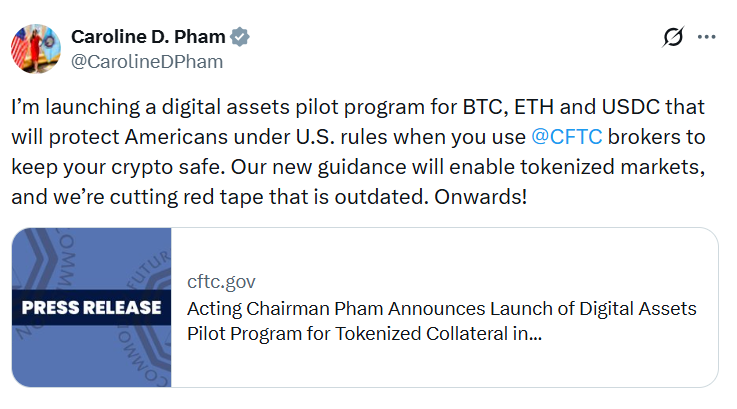
The digital asset pilot, announced by CFTC acting chairman Caroline Pham on Monday, will allow futures commission merchants (FCM) — a company that facilitates futures trades for clients — to accept Bitcoin (BTC), Ether (ETH) and Circle’s stablecoin USDC (USDC) for margin collateral.
The CFTC pilot is another step toward integrating crypto into regulated markets, and Circle CEO Heath Tarbert said it will also protect customers, reduce settlement frictions because tokenized collateral moves instantly onchain, and assist with risk reduction.
Pham said in a statement that the pilot program also “establishes clear guardrails to protect customer assets and provides enhanced CFTC monitoring and reporting.”
As part of the pilot, participating FCMs will be subject to strict reporting criteria, which require weekly reports on total customer holdings and any significant issues that may affect the use of crypto as collateral.
Updated CFTC guidance for tokenized assets
The CFTC’s Market Participants Division, Division of Market Oversight, and Division of Clearing and Risk also issued updated guidance on the use of tokenized assets as collateral in the trading of futures and swaps.
The guidance covers tokenized real-world assets, including US Treasury’s money market funds, and topics such as eligible tokenized assets, legal enforceability, segregation, and control arrangements.
Pham said in an X post on Monday that the “guidance provides regulatory clarity and opens the door for more digital assets to be added as collateral by exchanges and brokers, in addition to US Treasurys and money market funds.”
The Market Participants Division also issued a “no-action position” on specific requirements regarding the use of payment stablecoins as customer margin collateral and the holding of certain proprietary payment stablecoins in segregated customer accounts.
A CFTC Staff Advisory that restricted FCMs’ ability to accept crypto as customer collateral, Staff Advisory 20-34, was also withdrawn because it is “outdated and no longer relevant,” in part due to the GENIUS Act.
Crypto execs back CFTC move
Several crypto executives applauded the move by the CFTC.
Katherine Kirkpatrick Bos, the general counsel at blockchain company StarkWare, said the use of “tokenized collateral in the derivatives markets is MASSIVE.”
Related: US regulators dismiss SEC-CFTC merger rumors, move to dispel crypto ‘FUD’
“Atomic settlement, transparency, automation, capital efficiency, savings. Feels abrupt but who recalls the tokenization summit in 2/24, a glimmer of hope in the darkness,” she said.
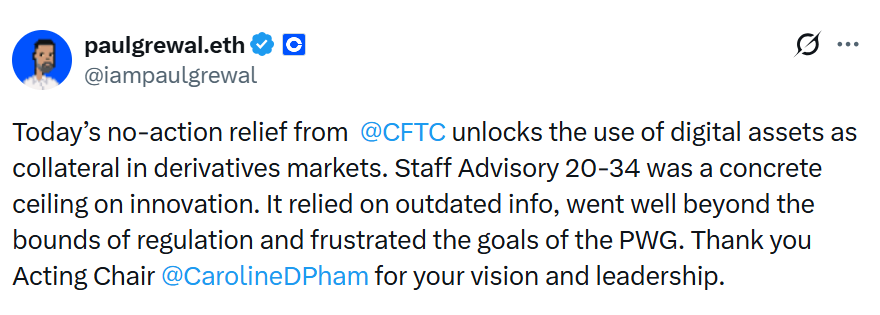
Coinbase chief legal officer Paul Grewal also supported the action, calling Staff Advisory 20-34 a “concrete ceiling on innovation.”
“It relied on outdated info, went well beyond the bounds of regulation and frustrated the goals of the PWG.”
Meanwhile, Salman Banaei, the general counsel at layer-1 blockchain, the Plume Network, said it was a “major move” by the CFTC, and another push toward wider adoption.
“This is a step toward the use of onchain infra to automate settlement for the biggest asset class in the world: OTC derivatives, swaps,” he added.
Magazine: XRP’s ‘now or never’ moment, Kalshi taps Solana: Hodler’s Digest, Nov. 30 – Dec. 6